The Huwei Salon: An Intellectual Hub
Kobe Chen / photos Chuang Kung-ju / tr. by Phil Newell
May 2015


Hidden away in a tiny lane in the busy commercial center of Huwei Township, Yunlin County, there is a free-standing house with an enclosed courtyard. The lush greenery there makes you feel like you’ve come into a pleasant woodsy clearing. A quaint house, which gives every indication of being very old, stands within. And there in the courtyard sits a young person, head buried in a photography book, completely absorbed.
This is the Huwei Salon, located in a paradisiacal setting personally crafted and decorated by owner Helen Wang, expressing her personal good taste and her fondness for her hometown. This is not only one of Yunlin’s few independent bookstores, it is a platform for exchanges and sharing among the culturati and intelligentsia. Opened for four years now, the salon has already gained quite a reputation in central Taiwan.
It is early evening, when people are just beginning to turn their lights on, and twilight bathes the town of Huwei in Yunlin County. As many shop owners are closing up for the night, the staff at the Huwei Salon are busy coming and going in preparation for tonight’s seminar.
Tonight’s featured speakers, a collective set of authors who go by the name of Wuming Xiaoshen (“minor gods”), are here to talk about their new book Gongmin Hen Mang (“Busy Citizens”). They will discuss how social media and big data were utilized in the recent Taipei mayoral election.
Seminars at the Huwei Salon often feature unfamiliar points of view, and therefore attract quite a number of interested citizens. As Helen Wang says, “The only way to avoid stagnating is to have new things constantly coming in and to get continual stimulation.” Even if things sometimes get a bit highbrow, Wang intends to stick to her ideals and will not compromise.

When you enter the Huwei Salon, you are surrounded by a classical, tranquil ambience. Each of the doors in the walls leads to a different realm of knowledge.
Clearly the Huwei Salon is not simply a bookstore, but serves as a cultural platform for the entire Yunlin area. The salon organizes at least one activity per week, inviting people from all kinds of fields. Moreover, the events are coordinated with a recommended book for each given month. For example, in April the book was The Southern Wind: The Story of Taixi Village (a village near a naphtha cracker that has a high rate of cancer), and there were several seminars discussing environmental issues. One was on fine particulate matter in the air, a problem which has recently gotten a great deal of attention, and another—for which the salon cooperated with local nongovernmental organizations—discussed the harmful impact of the petrochemical industry on the Yunlin area.
There was also a coordinated exhibit of documentary photographs from The Southern Wind. The walls were hung with powerful black-and-white images highlighting the conflicts and attachments that exist between man and the earth, and calling on people to devote more attention to the issue of air pollution in Taiwan.
Other activities organized by the salon have included inviting local master artisans—who are rarely available to the public—to teach people something about traditional skills and techniques, such as nail-free carpentry or pottery making. The salon also hosts book launches, screenings of independent documentary films, and live music performances. No wonder it has become the hub around which the intellectual life of Yunlin revolves.
In fact, Wang is no rookie at this kind of place. She founded a teahouse more than 20 years ago that attracted many cultural figures, including the well-known musicians Wu Bai and Chen Ming-chang, who were frequent guests. Similarly, today the Huwei Salon is often visited by indigenous singer Panai Kusui and Hakka singer Lin Sheng Xiang.

Turn on a small lamp casting a warm yellow light, sip a special-blend coffee, and let your thoughts float free on the sea of books.
Walking into the Huwei Salon is not like walking into an ordinary bookstore—it’s more like visiting the home of a book collector. Here you will not find any special rack with the bestsellers on it, nor will you find any of the boutique-style baubles and knickknacks that fall under the rubric “creative and cultural products.” When you open the main door, what first catch the eye are a number of elegant classical low tables, arranged along the two sides of the living room; on each of the tables there is a small table lamp. The overall mood is retro, returning to an era before the knowledge explosion, in which books were still treasured.
This house, built during the 1940s and once a clinic, has a roof of Japanese concrete tiles over a symmetrical Western-style concrete structure. This hybrid architecture is typical of the time when Huwei was a major sugar producer back in the Japanese colonial era. Here you seem to have your finger right on the pulse of history.
When you open the door that leads into the salon proper, there are three side rooms that hold books on the themes of, respectively, the environment, gender issues, and globalization/sociology, which form the three pillars of thought of the Huwei Salon.
Huwei Township went through its own baptism of globalization in the last century, transforming from a small agricultural community into a center of sugar production for export. This attracted a large number of outsiders to settle in the community. Later, as Taiwan’s industrial structure changed, Huwei became one of the towns in Taiwan most adversely affected by population outflow. Helen Wang has brought her skill set into play here in an effort to help the community reclaim a sense of pride and shed its sense of inferiority.

An old house has been reinvented with the spirit of an Enlightenment intellectual gathering place. Reinvigorated by culture, the Huwei Salon exudes a warm aura left by the passing of history.
Wang, who is 53 years old, graduated from the Department of Chinese at National Chengchi University. After that, she got involved in politics when she went to help an older schoolmate of hers run for office. It’s hard to imagine that this bookshop owner, who wears no makeup and goes around barefoot, actually served three consecutive terms as a county assembly member starting in 1986, held office as a national legislator in 2000–2002, and founded the Association for Women’s Political Participation.
She drew away from the world of politics in 2003 and set up a feminist radio station, “Sister Radio,” in her hometown of Huwei. The station began broadcasting on March 8, International Women’s Day. On the door were hung two large red lips, representing the courage to speak. In the conservative world of central and southern Taiwan, the station naturally caused quite a stir.
A few years ago, Wang discovered that the so-called “bookstores” in Huwei in fact sold virtually no books at all; they dealt mainly in stationery and school supplies. Adding to this the fact that many outsiders ridiculed Yunlin as a “cultural desert,” Wang got a little peeved, and from there she got idea to found an independent bookstore.
“Yunlin is by no means a cultural desert. We not only have traditional hand-puppet theater, which most people know about, we also have all kinds of local customs connected to the sugar industry and agriculture. The main problem is that local people cannot see how precious local culture is,” Wang argues. The history of Huwei Township goes back nearly 100 years, so it has a rich cultural heritage, but the people lack the self-confidence to go about preserving local customs.
Through activities and seminars, the Huwei Salon hopes to get local people to devote more attention to their own cultural roots, and from there to eradicate their low cultural self-esteem. Through things like book launches for local authors and series of lectures given in Taiwanese, the salon aims to reconstruct a cultural life that fits into and belongs to Huwei.
This year, the salon got together with the Van Body Theatre to hold several “body workshops.” Participants went through physical training to reacquaint themselves with their own bodies and the land beneath their feet. And Helen Wang has her sights set even farther. She hopes she will be able to have resident dance and theater companies, and that these will develop body consciousness among local people and from there cultivate Huwei’s own theater group.
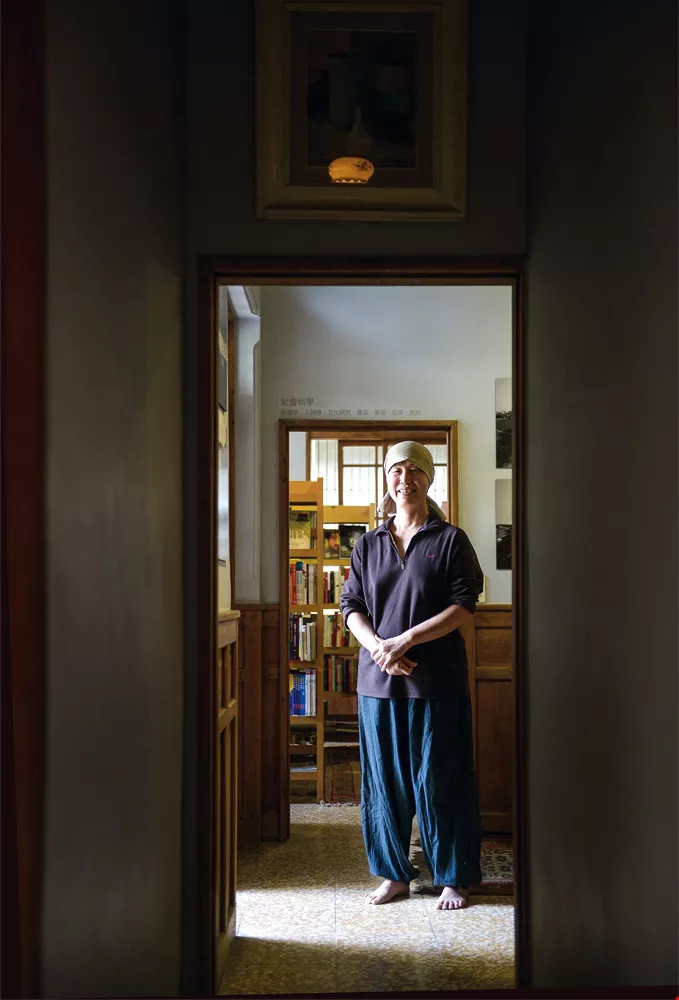
Returning to her hometown to buttress its cultural self-esteem, Helen Wang has seen her dreams gradually come to fruition as the Huwei Salon has grown over time.
It may appear that Wang has made a step backward from a life that was once more exciting, but that’s not how she sees it. Wang says that now that people can say, and dare to say, whatever they want to say, to enjoy freedom is the greatest happiness in life. “I want to change the world, to be a point of light. That doesn’t necessarily mean doing something grandiose, but at the very least I want to do well whatever it is I’m able to do,” she states.
Wang is no stranger to the media landscape, but she has never issued one press release for any salon event. She prefers to work quietly and with a low profile, using her network of friends to get her message out and attract people who care about the issues.
But sticking to your ideals generally involves paying some kind of a price. Behind the scenes of this quiet paradise, Wang has a big mortgage hanging over her head. Her friends do what they can to help out, taking only transportation costs when they appear at activities, because they think that this kind of place is worth supporting.
“Yunlin is where I grew up, and to change things this is where I’ll start. Perhaps there aren’t a lot of people here supporting what I’m doing right now, but if it is good and right that a thing be done, then someone has to step up and do it.” Wang says with a laugh that as long as the bookstore can support itself, she’ll be happy: “So long as it’s not a constant headache for me, that’s enough.”
There are many bookshops in many corners of Taiwan like the Huwei Salon, quietly going about their work of changing the world. In this fast-paced Internet era, they preserve a pure land where books are embraced and where people can read—and think—in peace. Providers of cultural nourishment, they are a way for their founders to do something to give back to the hometowns that produced them.

The weekly outdoor seminar is one of the “marquee events” at the Huwei Salon.

Turn on a small lamp casting a warm yellow light, sip a special-blend coffee, and let your thoughts float free on the sea of books.


@List.jpg?w=522&h=410&mode=crop&format=webp&quality=80)
@List.jpg?w=522&h=410&mode=crop&format=webp&quality=80)
