

Fenqihu, known by such nicknames as "southern Taiwan's Jiufen" or "Alishan's 'City of Sadness'" (after the Hou Hsiao-hsien film classic made in Jiufen) is a century-old mountain city that still carries the scars of time. Although tourist guides have been heard to use terms like "a poorly managed mess" to describe it (for lack of facilities, chaotic roads, excessive crowding), in the last few years it has not only been nothing like a "city of sadness," it has made a distinctive name for itself. Among the tens of scenic spots in the Alishan area, the number of visitors is second only to the forest recreation area, and it is the top destination for Taiwanese visitors.
This old settlement, built in the Jiaqing reign period (1796-1820) of the Qing Dynasty, flourished for a time, then fell into decline. But today it is standing up once again, just like mountains on whose slopes it rests.
Fenqihu, located at an elevation of 1405 meters above sea level, is in Zhonghe Village in Chiayi's Zhuqi Township. The Mandarin name means "Lake Struggle" but there is no lake at all, and the origins of the name are unrelated to any struggle. Because it is in a basin surrounded to the east, west, and north by mountains (Mt. Dadong, Mt. Guanglun, and Motian Peak, respectively), Fenqifu reminded early settlers of the three-sided baskets used in drying rice. The word for this kind of basket is bengi in Taiwanese, while basin is hu in Taiwanese, so the name Bengihu just meant "Three-Sided-Basket Basin." But when the spoken Taiwanese was rendered into written Mandarin Chinese, the characters selected, purely for phonetic reasons, turned out to mean "struggle" (fenqi) and "lake" (hu). That's why you'll see a lot of bloggers talk about their visits to "Lake Fenqi" and the inn is called the "Fancylake Hotel"!
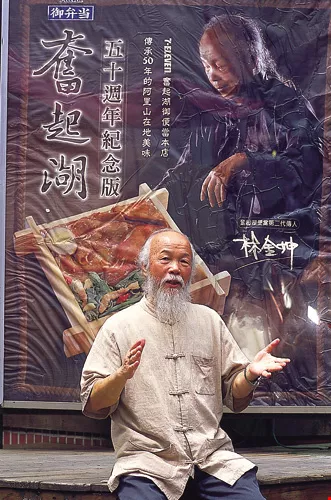
Lin Jinkun, founder of the "Fancylake" Hotel, is the "spokesperson" for Fenqihu ready-to-eat boxed meals; tourists are all anxious to have their pictures taken with this "living shop symbol."
The Biandang Kingdom
When Taiwanese hear the name Fenqihu, the first thing they think of is "railroad biandangs" (a biandang is a boxed, ready-to-eat full meal, with meat, vegetables, and rice). In fact, you could almost say that the story of what came to be called the "Biandang Kingdom" is the story of the rise and fall of Fenqihu.
Lin Jinkun is the second-generation heir of the family business of making railroad biandangs. His grandfather Lin Fen was an ordinary laborer, who moved to Fenqihu to work on extension of the railroad through there. He later opened a dry goods store that also sold rice snacks, alcohol, and cigarettes. Lin Yifang, Lin Jinkun's father, started off in business by running a roadside noodle stand.
Lin Jinkun says that early on the railroad biandangs sold to train passengers were handled by the Management Office for Mt. Jade (Yushan) in Chiayi City. They were crude and simple meals, made worse by the fact they were cold and tasteless after their journey from Chiayi to Fenqihu. Lin's father was good friends with the people at the management office, and the "Dengshan Shi Tang" restaurant that he ran happened to be right next to the Fenqihu train station. Thanks to his personal connections and geographical serendipity, in 1955 he was able to go into the business of providing railroad biandangs.
The Lins had their own special recipes for things like pork chops and salted eggs, and their meals steadily earned a good reputation. Eventually they were featured in a magazine article, which christened their domain "the Biandang Kingdom."
The 1960s were the golden age in Fenqihu, and for the Biandang Kingdom as well. In those days the Alishan Forest Railway ran 10 trains per day (five each way up and down the mountain) through Fenqihu, where they would linger to give hungry passengers enough time to get off and buy a biandang.
If you figure 500 riders per train, that meant 5000 visits to Fenqihu each day. In those days the Lin family accounted for about half of all the biandangs sold-in other words, more than 2000 per day!
All good things, alas, must come to an end. In 1982, when Provincial Highway #18 opened to traffic, Fenqihu's fortunes changed overnight, and sales of biandangs at the Dengshan Shi Tang fell to less than 10 per day.
"Often when a train arrived, there would be only three people on board-the conductor, his assistant, and the brakeman!" says Lin Jinkun, who has personally witnessed the rise and fall of the Alishan line. Fenqihu's biandang business thrived as a result of the railway, and died as a result of the highway. Ain't that just the way?
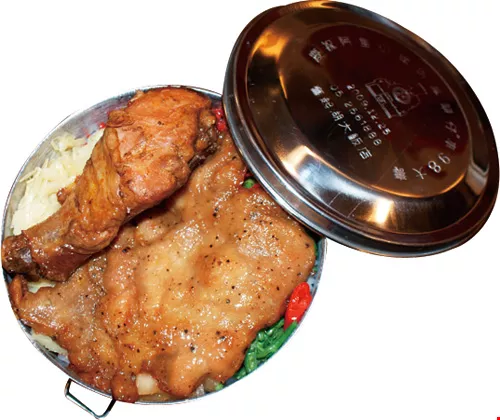
If you come to Fenqihu, you certainly wouldn't want to miss a local biandang meal. The traditional aluminum containers bring back a lot of memories for some people.
From eating to playing
With the food business declining, Fenqihu had little choice but to develop tourism. Indeed, as early as 1978, a development committee chaired by Lin Jinkun started looking for attractions to link into a tourism trail.
The Fenqihu Station is one of four wooden stations along the main Alishan rail line. The Forestry Bureau warehouse next to the station still houses old steam locomotives and many old pictures of the forest railway. It has always been a magnet for train buffs to wax nostalgic over the iron horses of yesteryear.
Kitty-corner from the station front, there still stands a stretch of "square bamboo" transplanted from Japan to Taiwan in 1924. Square bamboo trees originally came from the Mt. Emei area of Sichuan Province in mainland China. From there they moved east to Japan, and then were transplanted to Taiwan. Today you can only see them in Fenqihu or in Xitou Forest in Nantou.
Next to the station there is a stretch of Taiwan incense cedar a century old. This tree is considered-along with the red cypress, hinoki cypress, Taiwania, and China fir-to constitute the "five major conifers" of Taiwan. The trees have elegant, beautiful shapes, and the wood is very hard. They are comparable to highly reputed red cypress for making the palanquins of temple deities, sacred statues, and building beams and pillars.
More than 10 years passed, with Fenqihu just managing to hold on, but not doing well enough to keep young people from leaving town to seek their fortunes elsewhere. The economic low point was 1997. Fenqihu residents had decided to try and make another go of it with railroad biandangs for tourists, but just after they got started, the area was hard hit by the earthquake of September 21, 1999. Travelers were scared off from mountain journeys (most of the deaths and damage were in mountainous areas), and Fenqihu again fell into the mists of obscurity.
The turning point came in June 2002. President Enterprises, riding a "retro" fad in Taiwanese society, came to Fenqihu to propose selling "railroad biandangs" in their 7-Eleven convenience stores. Lin Jinkun, figuring there was nothing to lose in giving it a shot, gave them menus and recipes and came forward as spokesperson. To everyone's amazement, the biandangs were a huge hit.
A biandang war erupted between the main convenience store chains, from which both President and Fenqihu profited further, with the town able to sell 200,000 meals a day through President's more than 4000 stores. This was not only good for business at 7-Eleven, it put Fenqihu back in the public eye.
Today there are more than a dozen biandang makers in Fenqihu, and their life-sized advertising figures, lined up next to the "Fancylake Hotel," are the most distinctive and eye-catching trademark of the old street.
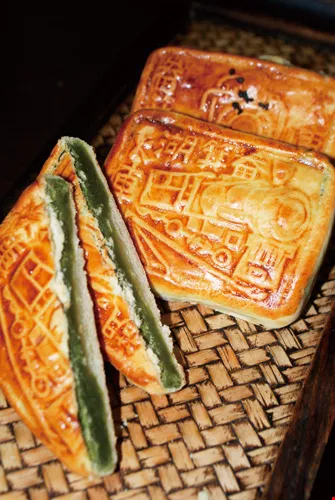
Traditional Chinese pastries made the same way that they were over 60 years ago have the most authentic old-fashioned flavor of anything in Fenqihu. On the other hand, pseudo-traditional "train pastries," one of the most popular items with tourists, were invented just in the last few years.
Light at the end of the tunnel
You won't find many mainland Chinese tourists in Fenqihu. Besides Taiwanese, who are the vast majority, most of the others come from Japan, Singapore, Malaysia, and Hong Kong. In cherry-blossom season, they can get more than 100,000 visitors in one day.
Although Fenqihu is the midpoint stop on the line between Beimen and Alishan, many more visitors come here by highway than by train. But, says Lin Jinkun, Fenqihu just wouldn't be the same without the Alishan railway: "Without the railroad there would be no Fenqihu; without Fenqihu where it is Alishan would never have been able to develop as it has." Fenqihu and the Alishan railway are symbiotic.
Visitors mostly come here in a nostalgic search for days gone by, and local merchants are testimony to the infectiousness of history and culture.
"I used to be the spokesperson, now I'm the guardian!" says Lin, 66 this year, who is proud to be Fenqihu born-and-bred. In an effort to revitalize disappearing old culture, the Lins still carry on the family tradition, unique in Taiwan, of using the old aluminum containers for their biandangs. When visitors are handed their aluminum-boxed meals, they can't help but exclaim: "Now that's a genuine traditional biandang!"
Meanwhile, along the Fenqihu Old Street, a mere 500 meters long, with a stone paved walkway, the places with the most historical and cultural color are mainly traditional Chinese bakeries. Baked goods have long been an essential part of many kinds of cultural ceremonies, including weddings, funerals, and the arrival or departure of guests.
Tianmeizhen, founded in 1943, was the first Chinese bakery in Fenqihu. Besides the dumplings that they started long ago making for lumberjacks going off to work in the morning, Tianmeizhen has created a new specialty for the current generation of Fenqihu: "train pastries."
Liu Jiarong, in his 30s, is the third-generation operator of Tianmeizhen. His great-grandfather was a lumberjack, but his grandfather, the first in the line to move to Fenqihu, opened a shop making bread and wedding pastries.
The "Fenqihu train pastries," with an image of the Alishan Forest Railway steam engine baked right on the surface, are a new product that Tianmeizhen came out with in 1997 as part of "Railroad Day" celebrations sponsored by the Forestry Bureau. These pastries, uniting the two historical threads of the rail line and the bakeries, look old but are a modern innovation. An instant hit, they have become a trademark of Tianmeizhen and Fenqihu as a whole.
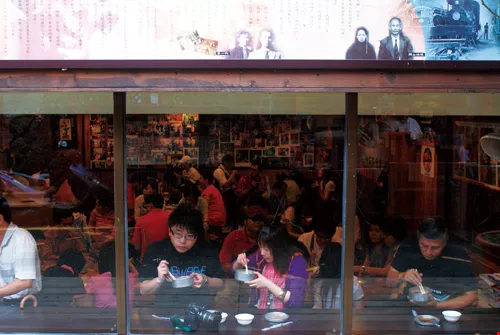
The Old Street, located just down from the Fenqihu Train Station, is a classic example of a century-old commercial center of a mountain town. It is packed with visitors on weekends and holidays.
Follow that train!
Early this year, Liu Jiarong's "train gift boxes" packaged like an old Alishan train were named by the Association of Taiwan Tour Souvenirs as one of the "Top 100" products with special local character. They have also been popular with consumers, who can't seem to leave town without taking one or more along. In peak season there are long lines of customers, waiting-line numbers in hand, to be called to pick up their fresh-from-the-oven gift boxes, while the employees sweat over their pastry-making "until their hands start to wilt!" says Liu.
Another bakery, founded in 1946, is the Derming Bakery, which has also taken the path of "innovative nostalgia."
Besides continuing to offer traditional Chinese baked goods that they have been selling for over 60 years now, third-generation family member Zhuang Fengjun has come up with a "bomb pastry" using an old-fashioned type of filled bread, seasoning it with a variety of "explosive" ingredients. Zhuang has also come up with mochi pastries in novel flavors like red bean and green tea, which have proven attractive especially to younger people.
The Jians, husband and wife, worked in the Derming Bakery in the early 1960s. Forty-seven years after getting married and leaving this place, this February they returned and even paid a special visit to their old boss's son, leaving behind a commemoration of their visit. Like the Jians, many people come to Fenqihu with nostalgic longings. Some find long-lost flavors in their aluminum biandang box, others find long-forgotten feelings reawakened by "train pastries." What about you? Why not come for a visit and see what sentiments Fenqihu can inspire in you?

@List.jpg?w=522&h=410&mode=crop&format=webp&quality=80)


@List.jpg?w=522&h=410&mode=crop&format=webp&quality=80)
@List.jpg?w=522&h=410&mode=crop&format=webp&quality=80)
