Tea for Two, and Two for Tea --Taiwan, China and the Cup that Cheers
Chang Chiung-fang / photos Jimmy Lin / tr. by Scott Williams
December 2006


Tea is more than just another agricultural product: it is at once a cash crop, a source of foreign exchange, a lifestyle, a folk custom, and a cultural practice passed down through the ages.
In recent years, as the scent of coffee has wafted across Taiwan, spread by US and Japanese coffee chains like Starbucks and Kohikan, some Taiwanese businesspeople have begun working to achieve a very different objective in mainland China--the spread of Taiwanese tea. Some are busy selling it in Guangdong and Fujian, while others are working to establish the reputation of "Taiwanese oolong" in hopes that it will catch on in the mainland.
Tea was first drunk in China.
The Chinese have been drinking tea for thousands of years. The practice began in the Western Zhou Dynasty, and reached its zenith during the Tang. But the history of tea isn't simply one of domestic consumption--in the mid-17th century, tea and silk were China's major exports. In 1669, Britain's East India Company began purchasing tea in the Fujianese city of Xiamen (the local language of which gives "tea" its English name), and the beverage soon became popular in the West. Chinese tea would dominate global markets for the next 200 years.
Taiwan's teas also have their origins in China. Chinese emigrants to Taiwan during the reign of Emperor Jiaqing (1796-1820) brought tea seedlings with them on their voyage. Over the years, a variety of factors, ranging from Taiwan's climate and soil conditions to selective breeding, have given rise to unique Taiwanese teas. Now, boosted by a well-developed tea-drinking culture, these teas are poised to "retake the mainland" as a top-shelf import.
Though Taiwanese tea has only been available in the mainland for the last decade or so, it has already given rise to a "tempest in a teapot."
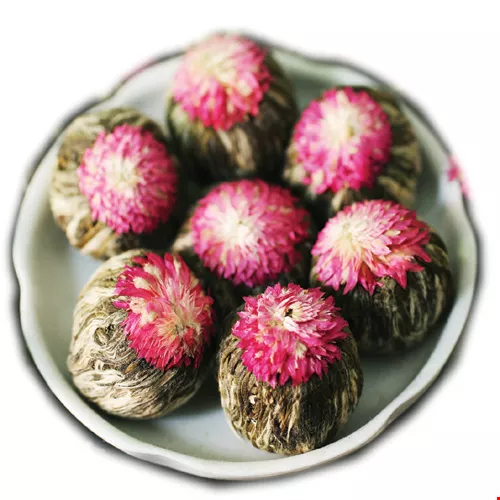
Peony tea
Though Guangdong Province is not considered one of China's ten major tea-producing regions, it is an important transit point and export center. In recent years, the Fangcun area of Guangdong's provincial capital, Guangzhou, has joined the Maliandao area of Beijing as a leading center for the sale of tea both domestically and abroad.
The 3-4,000 large and small tea brokers who gather at Fangcun's two tea markets, the Southern Tea Market and Guangzhou Tea City, do more than RMB2 billion worth of business every year.
Here, where the streets are steeped in the scent of tea, all the shop signs are in traditional characters and many of the merchants are clearly Taiwanese. In fact, Taiwanese tea merchants are responsible for much of the recent growth of Fangcun's tea markets.
Chen Guochang, head of the Fangcun Tea Dealers' Association, says that China began exporting jasmine tea in the 1970s because that was what the leaders in the north enjoyed. Although Fangcun didn't grow tea, it grew flowers and soon became home to 120-some jasmine tea processors.
The tribulations of the Cultural Revolution effectively brought tea drinking and tea growing to a halt in China. "When you don't have enough to eat and have to choose between a bag of rice and a bag of tea," posits Chen, "which do you take?" Of course you take the rice, he says, answering his own question.
"We're grateful for the efforts of Taiwan's tea merchants," Chen says sincerely. He explains that Taiwanese merchants have worked hard to keep the tea culture of Fangcun alive in the period of liberalization that has followed the Cultural Revolution. They not only brought Taiwanese tea to the area, but also all manner of tea-industry-related equipment and skills, including packaging machinery, vacuum pumps, traditional utensils (pots, cups, etc.), publications, and tea-producing techniques, spurring a revival in China's tea culture.
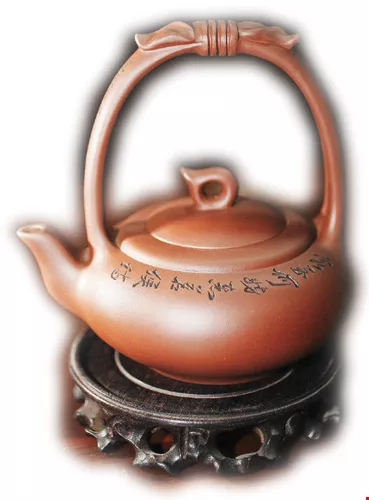
Taiwanese tea arrived in the mainland sometime around 1993, where its exceptional bouquet quickly caught the attention of tea drinkers there.
Zhou Zhaoxi, a native of Anxi in Fujian Province who currently sells Yunnanese pu-erh tea in Fangcun, says he thought Taiwanese tea "stunningly fine" when he first tasted it some ten years ago. "Both its mouthfeel and aroma were quite different from mainland brews," he says.
Taiwanese tea merchants' push into China and their success there was actually a consequence of the dire straits in which they had found themselves in Taiwan.
Up until the 1980s, Taiwan's tea growers produced primarily (75%) for export. But as the economy began to take flight labor became both expensive and scarce, causing tea growers' production costs to rise. As their products became less competitive in their traditional export markets--the UK, the US, and Canada--growers became more dependent on the domestic market, which began to account for 90% of their sales. Fortunately, it was at about this time that the mainland began to pull back the "bamboo curtain." Low- and mid-grade teas for which there was no market in Taiwan began to make their way into the mainland through various channels.
Chen Chih-jen, a tea dealer from Mingchien Township, Nantou County, has been selling tea in the mainland for ten years. He says when he first went to the mainland to help growers from his own township he used to carry his inventory on his person.
"In those days, no one had heard of Taiwanese oolong tea," he says. "They were only familiar with the name on the container--Kaoshanching." He says that back then, you could earn ten times your money on Taiwanese tea, so people could fly business class carrying 40 kilograms of tea and turn a profit.
Teas that had fallen out of favor in Taiwan, like ginseng oolong and mechanically picked tea from Sungpo Village in Nantou County, immediately became phenomenally popular. Vendors needed only to hang out a shingle saying "Taiwanese tea" to have customers vying to buy their merchandise. During this heyday, even tiny Mingchien Township was selling as much as 6,000 metric tons of tea a year in the mainland.
"In those days, we carried 'Taiwan-compatriot' identification when we sold tea," laughs Chen. He explains that to convince their customers that they and their tea were from Taiwan they not only had to carry the IDs but also to stuff Taiwanese newspapers in amongst the tea in the tea chests.
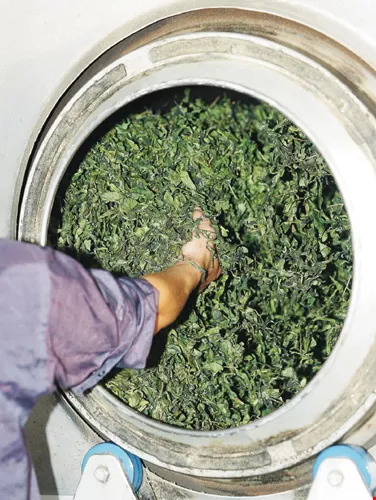
The just-picked flushes are first wilted in the sun, then fermented. The flushes are then fired to stop the fermentation process and preserve their semi-fermented flavor. Rolling breaks some of the cell walls in the leaves, making for a more flavorful beverage when the tea is brewed. It also produces distinctive shapes. Dried, sorted, and roasted, the now fully processed tea exudes a rich aroma.
These days, Taiwanese tea merchants in China deal from their own shops. And as their numbers have grown, they've begun to hang their shingles in Fangcun by the Pearl River.
The area is currently home to 30-40 Taiwanese tea merchants. Most sell Taiwanese teas, but some also deal in Taiwanese-style oolongs, as well as local and pu-erh teas.
The Tea Professor was Fangcun's first tea shop to deal solely in Taiwanese tea. Owner Hsu Lung-pao says that business was great a decade ago--he never had a moment's rest from when he opened his shop at 8 a.m. till he closed it at 11 p.m.
Chen Chih-jen originally distributed Taiwanese tea in the Shantou and Pearl River Delta areas. Noting which way the wind was blowing, he moved to Fangcun five years ago, opening Tang Ming Huang Tea Company to trade in Taiwanese tea.
"Taiwanese don't pick tea anymore," says Lin Yen-hsin, another Taiwanese dealer in Fangcun. Lin adds that her husband's family long ago stopped cultivating their two hectares of fields in Taipei County's Sanhsia Township. Unable to make a living growing tea in Taiwan, they began selling tea in China. Her husband also planted 50 hectares of tieguanyin and 20 hectares of Taicha No. 12 (a new hybrid Taiwanese oolong also known as Chinhsuen) in Fujian, operating at a scale dozens of times that of his old family farm in Sanhsia. Their Fujian plantation produces some 70,000 catties (35,000 kilograms) annually of what as known as "Taiwanese-style tea," that is, Taiwanese varieties grown in the mainland.
Initially, Lin shipped mainland tea and Taiwanese-style tea back to Taiwan for resale. But getting the tea through customs was troublesome and time-consuming, typically taking one to two months. When the tea eventually arrived in Taiwan, it was no longer fresh and its mouthfeel had suffered. Five years ago, she decided on a change of approach. After spending more than RMB200,000 on a transfer fee to rent a 30-square-meter storefront in Fangcun, she opened her own shop, Shangpin Tea, from which to sell her family's Taiwanese-style teas.
Chang Yi-hsiung, another Fangcun-based Taiwanese tea merchant who hails from Chiayi, has poured ten years into making a go of Shuizhongyue, a shop dealing exclusively in Taiwanese teas. Chang believes that if he works hard and is honest with his customers, he'll eventually win a piece of the huge mainland market. "Persistence pays off in the end," he says.
Chang's life is a simple one--he doesn't gamble or go out on the town at all. Instead, this man who seems to thrive on hardship devotes his every waking moment to tea.
Wu Hsin-tien of Kaohsiung also used to sell Taiwanese tea in Fangcun, but the intense competition in the town, as well as his own lack of expertise in Taiwanese tea, kept his business from really taking off. Three years ago, he switched to dealing in pu-erh, the flavor of which improves with age, eliminating the need to quickly dispose of inventory. At the time he made his decision, he had no idea that pu-erh was poised for a resurgence in popularity, and he inadvertently became the most profitable Taiwanese tea merchant in Fangcun. "Just one moment of carelessness, and I was wealthy," says Wu, who finds the situation just as amusing as everyone else does.
The market for pu-erh really is a little bit out of control. For example, round-cake Fuyuanchang tea produced in the late 19th century sells for RMB100,000 per cake and Dazi Luyin pu-erh from the 1950s goes for RMB210,000 per seven-cake "bucket." No wonder people say that the blacker the pu-erh, the blacker the heart of the person dealing in it.
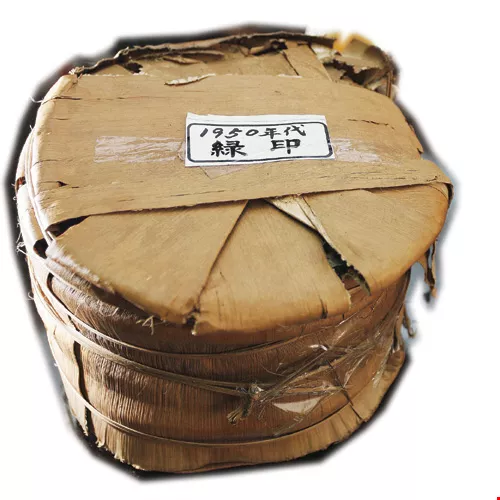
Qizibing
In recent times, cigarettes, alcohol and tea have been the three staples of Chinese gift-giving. But with rapid economic growth in the mainland, the market for Taiwanese tea has actually declined. Profit margins have also been thinned by the growing numbers of tea dealers pouring into Fangcun from elsewhere in China.
"Prices for Taicha No. 13 [a hybrid oolong also known as 'Tsui-yu'] have plummeted from RMB400 per catty in the early days to just RMB40 today," says Hsu with a resigned shake of his head. "And revenues have plunged from RMB6-700,000 per month to only RMB1-200,000. Mainland teas have the support of the government, which promotes them vigorously. Taiwanese teas here have to rely on themselves."
"It's getting tougher and tougher to do business," says Chen. In the old days, mainland tea wasn't vacuum packed, which made it hard to keep. But the importation of Taiwanese packaging technology now allows mainland teas to keep better. The improved freshness, together with the implementation of stringent quality controls and the growing number of varieties available, has eliminated Taiwanese tea's competitive advantage.
The Taiwanese merchants know the score. Their current predicament is a result of their own use of price competition, as well as of their gradual loss of their technical and varietal edge.
Take the old ginseng oolong tea, for example. "Ginseng oolong failed," says Chen, "because we cooked our own goose." Chen says he has a friend who used to sell ginseng oolong in Shantou before being hired by mainland entrepreneurs to make ginseng oolong for them at a salary of RMB30,000 per month. There's really only one trick in the ginseng oolong production process, and the mainlanders learned the crucial step within three months. No longer useful to them, Chen's friend lost his job and was left with his tea-dealing business, itself in dire straits as a result of vicious competition.
Chen says the mainland's improvements in its processing, management, and marketing skills aren't the only reason Taiwanese tea has been losing market share. "Another reason is that Taiwanese growers are themselves growing tea in the mainland now," explains Chen.
Hsu thinks that the production of Taiwanese-style tea by Taiwanese growers in the mainland has struck a real blow to the market for "pure" Taiwanese tea. "Consumers don't know the difference between 'Taiwanese tea' and 'Taiwanese-style tea," he explains. "So now they think that there's been a serious across-the-board decline in the quality of Taiwanese tea."

Amidst all these difficulties, Shuizhongyue continues to shine.
"The mainland market is big and still growing," says Shuizhongyue's Chang Yi-hsiung, an old hand in the Fangcun market. Even though his revenues are no longer doubling or tripling every year the way they were before the pu-erh fad took off, he says they're still growing by about 20% a year.
Taiwanese merchants have also been complaining about falling profit margins. "In the old days, Taiwanese tea was a luxury import," explains Chen, who has taken the change in stride. "During the Lunar New Year's high season, when it was a popular gift item, there wasn't enough supply to meet demand, and dealers who weren't happy with their customers could tell them to get lost. Now that Taiwanese tea is an everyday beverage, the prices have naturally returned to reasonable levels."
Others attribute the decline of Taiwanese tea in the mainland to the growing popularity of Anxi tieguanyin and the craze for Yunnanese pu-erh, which they say have squeezed Taiwanese tea's market share.
But Chang isn't much worried about pu-erh's effect on the market. "Right now, pu-erh is being traded like a company on the stock market," says Chang. "People see its price rising and they're hoarding it. But Taiwanese tea is different. Because its flavor keeps for only a short time, it has to be consumed fresh--it can't be hoarded. That means that once you sell it, the customer's going to use it pretty quickly. So vendors of Taiwanese tea are unlikely to go broke because they've misjudged the market."
"Consumers like new things," says Hsu, "so tea fads are cyclical." He notes that Taiwanese ginseng oolong, Anxi's tieguanyin, and Yunnan's pu-erh have all had their day in the sun, and argues that the sun will shine again on Taiwanese tea. In the meantime, Hsu has begun investing in more diversified operations, including a pumpkin-seed processing plant in the north and an aquaculture facility that raises marbled gobies on Hainan Island. "If I can sell tea, I'll sell it. If I can't I'll pack it in," says Hsu, who has already prepared himself for the worst.
The vendors at the forefront of Taiwanese tea's mainland invasion have begun to tire. The Taiwanese who are currently making preparations to go are well aware that the mainland market is tough. But what choice do they have? Nobody stays in a loss-making business. Labor costs in Taiwan make it too expensive for growers here to work their lands. Leaving Taiwan is their only option.
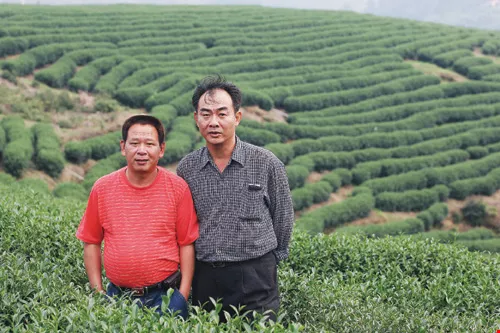
Tea making is a tough job. Living in the mountains is lonely to begin with, and tea makers must also constantly make the rounds managing their workers. The photo shows Tai Pin's manager Liu Yi-yu (left) and general manager Tsai Shang-tao (right).
Mid-October is harvest time for winter teas. At this time of year, dawns are always shrouded in mist in the Yongfu tea district in Fujian Province's Zhangping City. When they burn off at about 9 a.m., the more than 300 women who pick tea on the mountainside are ready to get to work. A bell rings and they begin bringing in the first of this year's winter tea.
Tea may be called the "forget-your-troubles herb," but the life of a tea grower can be filled with worry. For one thing, they're always at the mercy of the weather. As some have said about tea, "Pick it three days early and you've got a treasure; three days late and it's just a weed."
It rained yesterday in Yongfu after a month without a drop. Today, Tai Pin Tea's workers are celebrating amongst themselves. "New leaves sprout quickly after a rain," explains Tai Pin chairman Hsieh Tung-ching. "We'll be able to harvest an extra hundred catties."
Tai Pin has been growing "soft-stemmed" Taiwanese qingxin oolong here for 11 years. Tea growing is already grueling work, but Tai Pin's three Taiwanese partners--Hsieh (company chairman), Tsai Shang-tao (company president), and Liu Yi-yu (company manager)--must also deal with the pain of being far from home and separated from their wives and children. Here in the remote, backward Fujian mountains, tea is their constant companion.
"The labor costs are a tenth of Taiwan's," says Liu, his voice resonating with the frustration Taiwanese growers feel at having had no option but to leave Taiwan. "How could we have survived if we hadn't come here?"
Hsieh spent a year evaluating locations in preparation for growing tea in an unfamiliar land, scouting the terrain in a rental car. Luck and his knowledge of tea eventually led him to Yongfu, an area perfectly suited to growing Taiwanese oolongs. Ensconced in the mountains about three hours by car from Xiamen, Yongfu is known for its alpine vegetables. Daytime to nighttime temperatures vary by more than 10°C, and the weather begins to turn frosty in November.
Hsieh says he really was fortunate because the soil and climatic differences could have wrought major changes in his teas. It has happened before. Take persimmons, for example. Taiwanese growers cultivate a variety that produces seedless fruit. But when grown in Yongfu, that same variety produces less valuable seeded fruit. Hsieh thanks heaven that the land here produces a high-quality Taiwanese oolong.
Tai Pin produces several hundred thousand catties of Taiwanese-style oolong per year, making it the largest producer of oolong on either side of the Taiwan Strait.
Tai Pin also grows the tieguanyin native to the region in Mianzhichang, Hua'an County, which is more than two hours by car from Yongfu. Hsieh admits that the tieguanyin grown in the mountains around Mucha in Taiwan is no match for that grown in the tea's native Anxi. The Taiwanese growers in the mainland can't match it either--they run high-volume operations that produce a tea that is much "cruder" than the refined teas raised by local growers on their generally small plantations. "We're still feeling our way," says Liu.
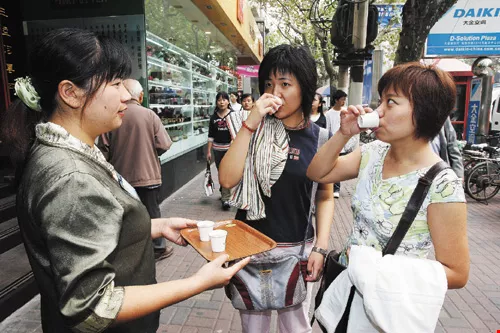
Put life on hold for a moment and enjoy a cup of tea! TenFu's 576 teashops are distributed throughout China. The photo shows the friendly staff at TenFu's teashop on Huihai Middle Road, Shanghai, offering tea to passersby.
As the saying goes, "Better to arrive opportunely than early." Tai Pin wasn't the first Taiwanese grower to set up operations in Fujian, but it has so far been the most successful, and one of the few to be really profitable.
Lan Fang-jen, a long-time tea researcher and chief of promotions for the agricultural association in Nantou County's Mingchien Township, says the quality of fertilizers and of labor used by mainland tea growers falls short of that in Taiwan. Processing equipment and leaf-preservation techniques are also not yet generally up to Taiwanese standards. This lack of support infrastructure ultimately caused most of the first wave of Taiwanese growers, who set up plantations in the mainland a decade or more years ago, to throw in the towel.
Li Ching-lin is a case in point. When intense competition in Taiwan ate away all his profits ten years ago, he leased out his two or three hectares of tea fields in Mingchien Township's Sungpo Village and traveled with his wife to Shantou in Guangdong Province. After a stint there growing ginseng oolong, he spent a couple years in a job with giant Taiwan-owned TenFu Tea Group. Li only returned to Taiwan to begin working his land again in 2006.
"I really would have liked to make some money in the mainland," says Li, offering several reasons for why he pulled out after so many years there. "It's just so big. You need a lot of money to get into the game, and I didn't have the stakes. Besides, you can't trust anybody."
Tea growing in the mainland is a high-stakes game. Tai Pin chairman Hsieh Tung-ching, always low key, notes that most of the Taiwanese who have come to the mainland to grow tea have failed. Like Li, Hsieh attributes their failure to a lack of backing. Once you've invested your money, it takes at least six or seven years to begin to see a return. You have to be able to hold out that long to succeed.
Tea isn't a typical investment in other ways, too. It takes the right kind of climate, land and people to succeed. If perchance the weather doesn't cooperate, there's really nothing you can do.
Li Pin-kun is another case in point. He planted 130 hectares of Taiwanese oolong in Enshi, Hubei Province. Then the area was hit by a freak snowfall that killed all his plants. Li has since relocated to Yongfu, where he has a much smaller 30-hectare plantation.
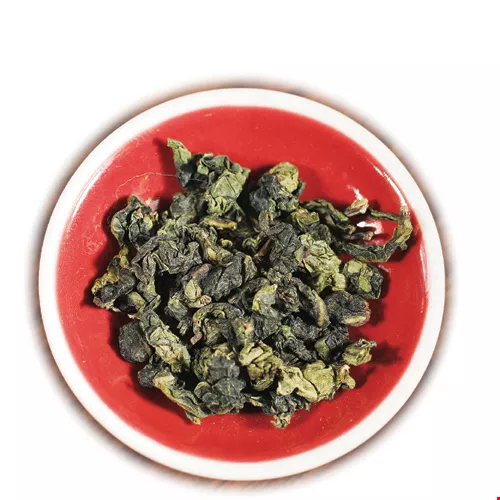
Tieguanyin
Lu Chang-ta, a tea dealer who has established his Yu Shan teashops in Xiamen, Fujian Province and Kunshan, Jiangsu Province, has been selling tea in China for more than a decade and is a vendor of Tai Pin's teas. A tall, dark-haired man in his early 30s when he first arrived, he is now middle-aged and balding.
It's hard work making a living in a distant land. But like many other Taiwanese tea dealers who've chosen to work in the mainland, Lu felt that trying his luck there was preferable to the dead end in which he had found himself in Taiwan. "If you bet your life, you've got a chance," he says. "But if you just wait for death, you're a goner for sure."
"You can't sit around waiting for something to fall into your lap," he explains, echoing the sentiments of other Taiwanese tea dealers.
Sadly, these Taiwanese merchants, whether growers or dealers, are training their future competition while fighting tooth and nail with one another.
"I too was once an apprentice," admits Tai Pin's Liu. The Taiwanese-owned tea plantations can't help but function as training grounds for their future rivals. This is the very model of development Taiwan itself used. "Taiwan can't escape its past in China," observes Liu.
But there's no getting around the fact that the relocation of Taiwanese tea growers to the mainland has been a blow to Taiwan's own tea industry.
Lee Rie-ho, chairman of the TenFu Group and reigning king of the mainland and Taiwanese tea industries, believes that this situation was inevitable. "When Taiwan liberalized apple imports, the Lishan farmers protested en masse," he recalls. "And now? The quality of Taiwanese apples is as high as that of any of the imports."
Lee argues that you have to take the long view--that the only way to improve Taiwan's markets is through competition.
"Even though Taiwanese varieties and Taiwanese talent are going abroad, you can't transplant the character of Taiwanese tea," says the Mingchien Farmers' Association's Lan Fang-jen. He explains that Taiwan's best tea-growing areas are located near the Tropic of Cancer, at around 1,500 meters elevation in the mountains of Nantou and Chiayi Counties. The area's island climate, its plentiful sunlight and its high day-night temperature differential (temperatures typically are around 28°C during the day and 13°C at night), make the oolong harvested in October sweet and fragrant. In fact, there's none better. The tea, acknowledged to be the best produced in either Taiwan or the mainland, attracts crowds of tourists who buy in volume.

Three years ago, Wu Shin-tien stopped selling Taiwanese teas and began dealing in pu-erh. "I'm smiling even in my dreams," jokes Wu, whose decision perfectly coincided with the onset of a fad for pu-erh teas.
No one doubts the quality of Taiwanese tea, but producers continue to have trouble pooling their energies to build its reputation and win market share in China.
Last year, the Taiwanese growers in the Yongfu area named Hsieh Tung-ching the head of their newly formed Zhangping City Taiwan Business Association. Their goal is to use the organization to fight for their rights.
Fangcun's Taiwanese tea vendors, meanwhile, are grateful to the TenFu Group for its success in making Taiwanese tea's reputation more widely known in the mainland. But Taiwanese teas currently hold less than 3% of the huge mainland market. There is still a great deal to be done to increase their visibility and market share.
People flow in and out of Tai Pin's office and tearoom in Yongfu, chatting over mouthfuls of the just harvested winter tea. A Mr. Li is here from Taiwan to check out the locale. A Mr. Wang just planted his own tea last year, and has nothing to harvest yet. Visitors gather here to hone their skills as they prepare to take the plunge into the brutal Taiwan oolong-Anxi tieguanyin fray. Taiwanese merchants are seeking to position themselves to harvest profits regardless of which ultimately wins.
"This is a once-in-a-lifetime opportunity," says Tai Pin's Hsieh. "None of us want to miss out." Hsieh, who sees Taiwanese tea's moment in the sun passing, violates his own credo about remaining low-key and urges his fellow-countrymen to take a chance.
Their mouths savoring Taiwanese tea, their eyes on Taiwanese news, and their ears filled with the sounds of the Southern Min language that differs little from that spoken in Taiwan, they feel almost at home and yet worlds away. Here in the tea-infused tea country of Fujian, things can be a little bewildering.

The just-picked flushes are first wilted in the sun, then fermented. The flushes are then fired to stop the fermentation process and preserve their semi-fermented flavor. Rolling breaks some of the cell walls in the leaves, making for a more flavorful beverage when the tea is brewed. It also produces distinctive shapes. Dried, sorted, and roasted, the now fully processed tea exudes a rich aroma.
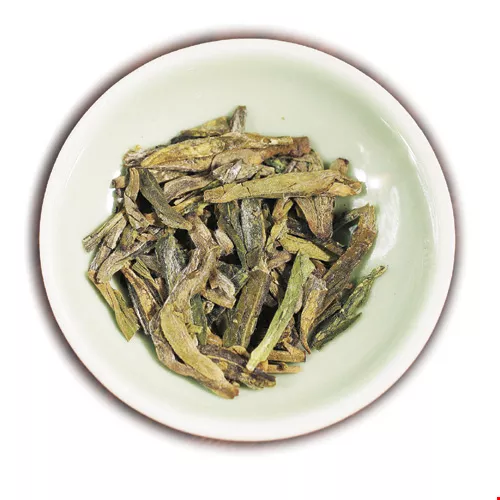
Longjing
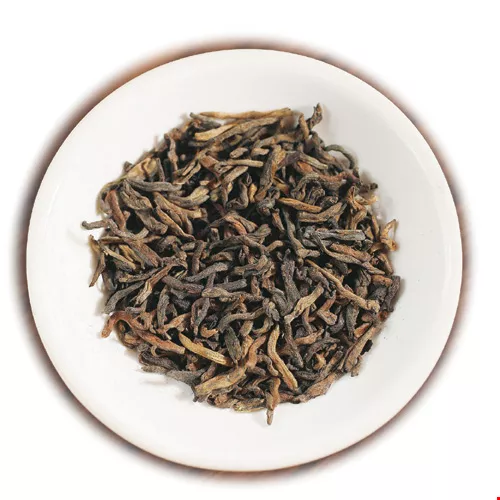
Pu-erh
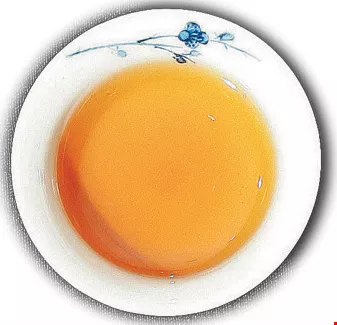
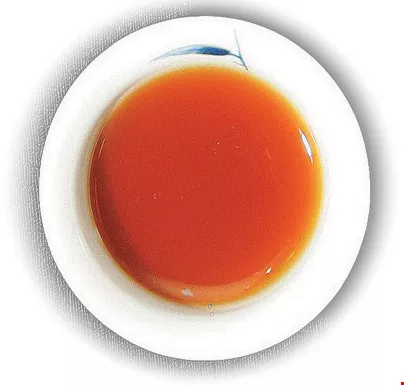

The just-picked flushes are first wilted in the sun, then fermented. The flushes are then fired to stop the fermentation process and preserve their semi-fermented flavor. Rolling breaks some of the cell walls in the leaves, making for a more flavorful beverage when the tea is brewed. It also produces distinctive shapes. Dried, sorted, and roasted, the now fully processed tea exudes a rich aroma.
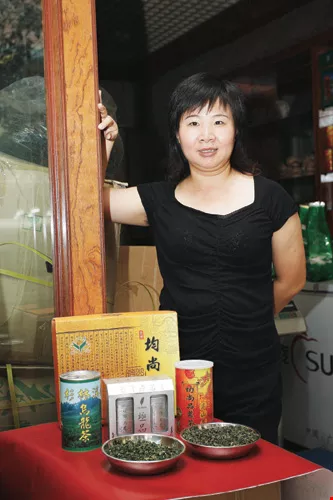
Lin Yen-hsin's Fangcun shop deals in Taiwanese-style teas grown in Fujian by her husband.
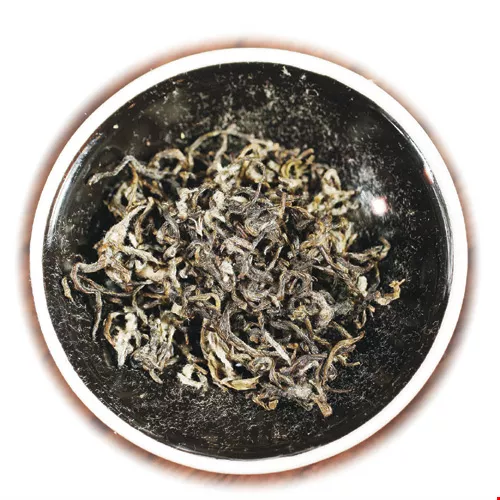
Biluochun

Zhumingxiang

The just-picked flushes are first wilted in the sun, then fermented. The flushes are then fired to stop the fermentation process and preserve their semi-fermented flavor. Rolling breaks some of the cell walls in the leaves, making for a more flavorful beverage when the tea is brewed. It also produces distinctive shapes. Dried, sorted, and roasted, the now fully processed tea exudes a rich aroma.

The just-picked flushes are first wilted in the sun, then fermented. The flushes are then fired to stop the fermentation process and preserve their semi-fermented flavor. Rolling breaks some of the cell walls in the leaves, making for a more flavorful beverage when the tea is brewed. It also produces distinctive shapes. Dried, sorted, and roasted, the now fully processed tea exudes a rich aroma.
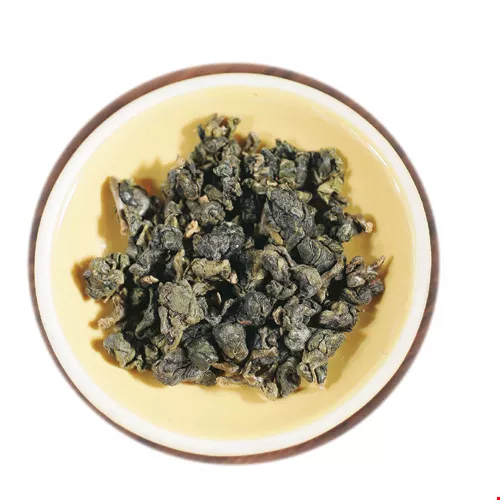
Taiwanese tungting oolong

The just-picked flushes are first wilted in the sun, then fermented. The flushes are then fired to stop the fermentation process and preserve their semi-fermented flavor. Rolling breaks some of the cell walls in the leaves, making for a more flavorful beverage when the tea is brewed. It also produces distinctive shapes. Dried, sorted, and roasted, the now fully processed tea exudes a rich aroma.
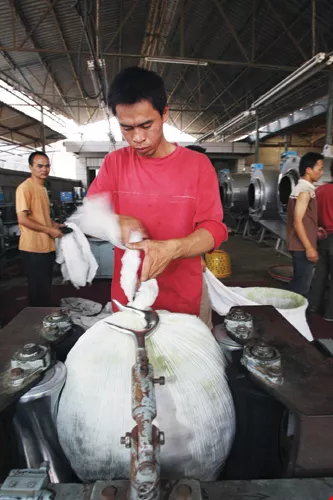
The just-picked flushes are first wilted in the sun, then fermented. The flushes are then fired to stop the fermentation process and preserve their semi-fermented flavor. Rolling breaks some of the cell walls in the leaves, making for a more flavorful beverage when the tea is brewed. It also produces distinctive shapes. Dried, sorted, and roasted, the now fully processed tea exudes a rich aroma.
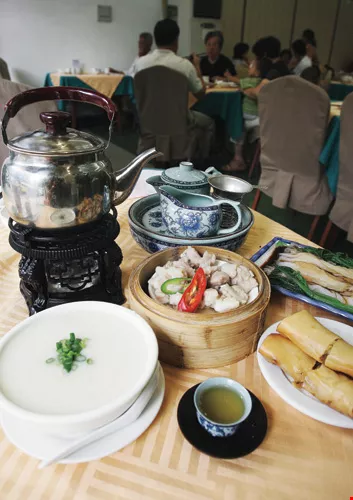
In Guangzhou's popular breakfast tea shops, patrons can order a bowl of congee and dim sum with a pot of tea for a sumptuous breakfast.

The Taiwanese tea merchants in Fangcun lament that their business has been declining the with passing of the heyday of Taiwanese tea. The photo shows Tang Ming Huang Tea's Chen Chih-jen (left) and The Tea Professor's Hsu Lung-pao (second from left).

Tai Pin Tea, a Taiwanese company that grows Taiwanese qingxin oolongs at Yongfu in the mountains of Fujian Province, often has more than 300 people out on the slopes picking leaves. It's an amazing sight.
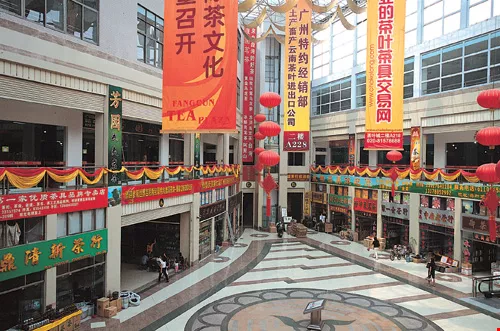
As the reputation and number of merchants in the Fangcun area of Guangdong has grown, its tea wholesaling business has begun to expand beyond the city's confines. The photo shows the recently established Guangzhou Tea City market.

_DSC2938@List.jpg?w=522&h=410&mode=crop&format=webp&quality=80)


