Wangan--An Islet in the Indigo-Blue Sea
Florence Li / photos Arthur Cheng / tr. by Stephen Rabasco
November 1987


Penghu is a separate island off Taiwan. Eighteen nautical miles from Penghu is an islet called Wangan.
In the wave of modernization and development, this secluded land has received very different appraisals.
Three months ago, students from the art department at Tunghai University came here to teach some children drawing. My first impression of this place as I stepped onto shore was not so great. There was barely a tree or modern building in sight. I thought it was deserted."
However, there have been others who have been able to see the intriguing side of Wangan.
Movie director Tseng Chuang-hsiang was searching for just the right sight for the filming of his film Killer. He felt that the villages along the coast running from Taipei to Pingtung fail to capture the original style of a fishing village. Through the advice of photographer Chang Chao-t'ang, Wangan became the major filming site for the movie.
In the eyes on an architect, Wangan is a place filled with attractiveness--especially the village in the western part of the island, which has maintained the 150-year-old architectural style of Fukien. The county government of Penghu plans to set up a traditional cultural village there. Architects Li Ch'ien-lang, Yin Chang-i, and Hsia Chu-chiu agree that Chungshe Village should be protected and preserved.
After leaving Wangan, the students from Tunghai University went to Makung. When comparing the students of both places they discovered that the work done by the students on Wangan was more inclined to nature. On the other hand, the drawings done by the students on Makung were obviously influenced by television, cartoon characters, cars, and so forth.
Outside cultural influences are few here. The only emphasis is on the blue sky, the indigo sea, and the simplicity of the people.
Wangan County comes under the jurisdiction of Penghu County. At present it's home to more than 5,000 inhabitants. The total surface area is 13.8 square meters, and it has eighteen islets.
The island with the largest surface area is that of Wangan itself. It's ancient name is Pachao Islet and was a center of government. If you circle the island you can see the eight outer islands, Chimei, Maoyu, Huayu, Chiangchun, Tungchi, Hsichi, Tungyuping and Hsiyuping. Except for Chimei, all the other islands belong to Wangan County.
Of the seventeen outer islands of Wangan, Chiangchun is the largest, while Huayu is the most unique.
Chiangchun, an island of about 2,000 inhabitants, has a population density higher than that of Wangan. Most of the houses are two or three stories. The people on this island have been involved in gathering coral for a long time, which has given them a good income.
Huayu is an island to the west of Taiwan. It's the closest to Fukien Province and is twelve nautical miles from Wangan. The houses on this island are similar to those on Chiangchun; most are two-storied cement dwellings. However, the size of the villages are smaller, only having about 130 houses. The people here depend on fishing for a living.
Wangan generally refers to the actual island itself, which is made up of four villages: Tungan, Hsian, Shuian, and Chungshe. There are very few shops on the island. There's a beauty shop, two grocery stores, a small restaurant, and a three-storied hotel just completed last year--all of which are located in Tungan Village.
The people of Wangan have been fishermen for generations and have an inseparable bond with the sea.
Fifteen to sixteen years ago the fate of the people on Wangan changed after the development of deep-sea fishery. At that time there were many fishing companies. Because of their fishing experience, the people on Wangan were seen as tops in the industry and were therefore highly sought after by many Kaohsiung fishing companies. After a short amount of time, many were given the position of captain.
After becoming boat captain, many people of Wangan went a step further and started their own fishing companies. Yen Hsin-hsiung, a native of Wangan, who lives in Kaohsiung, now owns five deep-sea fishing vessels.
Many others like Yen Hsin-hsiung have the ability to make money yet were hindered by the limits on Wangan. Instead they chose to go to places such as Kaohsiung or Makung to set up the bases for their deep-sea fishing businesses.
Originally, since around 1893, the population continued to decrease. Moreover, with the development of deep-sea fishery, the rate at which people are leaving the area has been increasing rapidly.
"The population of Wangan continues to move out! Only one seventh of the original population is left. It's as if the entire place has become a paradise for the elderly," says secretary Ch'en Hsi-hua of the public office in charge of the administration of the surrounding villages.
The geology of Wangan, mostly basalt, is similar to that of Penghu. After September of each year, the northeast seasonal winds are very strong, causing much of the soil to be blown away, and exposing the sandstone layer. In addition to the lack of humus, the soil is extremely poor and barren. Although 55 percent of the island is suitable for planting, yet due to economic inefficiency, mostly peanuts and corn are grown.
Located in the back of the county public office, there's a green piece of land dotted with cattle that extends as far as the eye can see. From an economic point of view, cattle herding is not profitable for Wangan. There's a lack of water and since the climate is not good, the harvests are few. In addition, due to the lack of an efficient amount of feed on hand, the cattle on Penghu are somewhat thinner and their growth rate is slow.
Wangan primary school teacher, Hsu Ming-huang says that he knows of five people from the island who passed the civil service examinations. One of them was his grandfather. Wangan, at that time, traded with the mainland and was influenced by its culture because of its close contact.
Even during the Japanese occupation, schooling went on without interruption on Wangan. Both Chinese and Japanese education was taught in the schools, which were funded by private means. The Wangan primary school is the earliest established school on the outer islands aside from Penghu.
Last year, the primary school celebrated its 70th anniversary. Yen Hsin-hsiung, who had been away for eighteen years, was present for the occasion.
Probably the biggest change on Wangan in recent years has been in the area of transportation. Unlike before there are now small planes which fly to Kaohsiung, Chimei, and Makung.
With the limitation of the development of farming, pasturing, and fishing, tourism has almost become the only hope of this island.
[Picture Caption]
Abandoned fishing boats resting next to basalt reveal the leisurely atmosphere of Wangan.
The children on Wangan are great at catching fish.
Blue sky, indigo-blue sea, and green grass--Wangan lslet is far from all clamor.
Wangan Village's Position in Relation to Taiwan
Wangan Village
The only grocery store on Chiangchun; there are few customers, yet many TV fans.
(Left) There are many old people on Wangan. Here, some of them earn extra money making fishing hooks as they chat.
(Right) Sometimes the fishing boats are used for transportation.
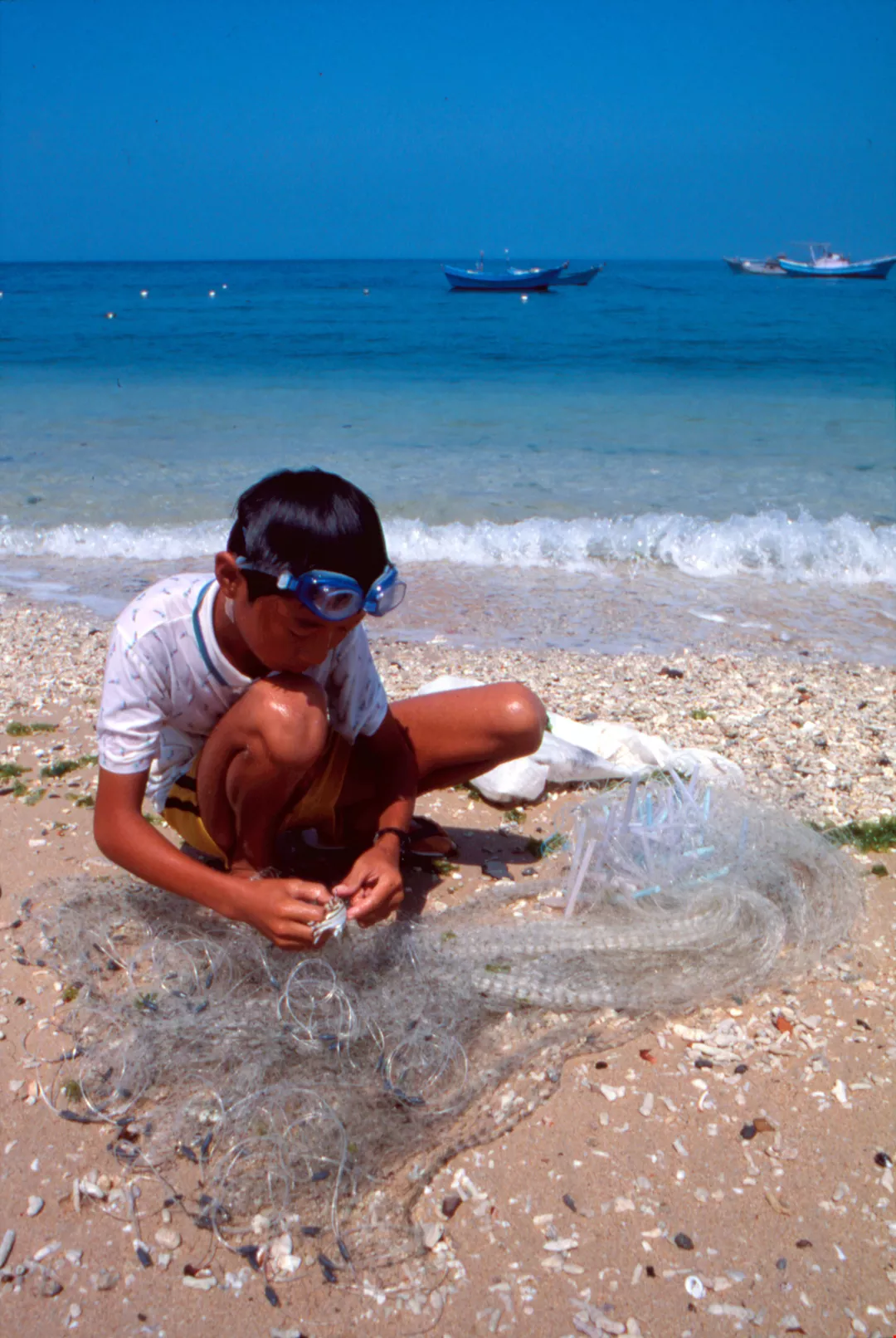
The children on Wangan are great at catching fish.
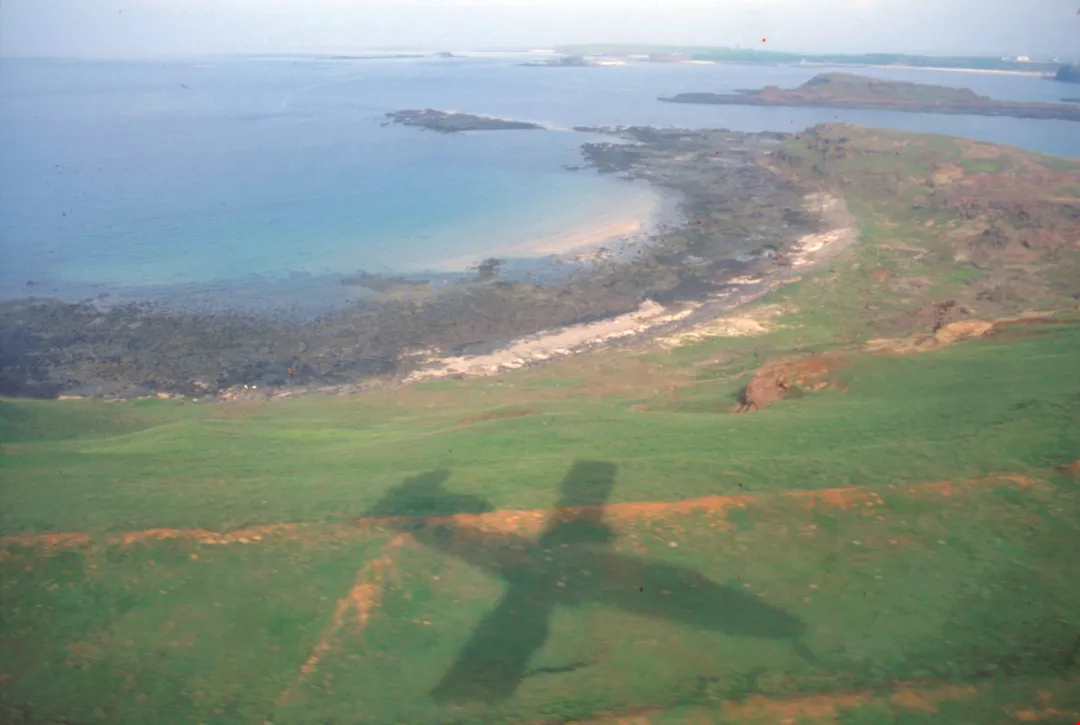
Blue sky, indigo-blue sea, and green grass--Wangan lslet is far from all clamor.

@List.jpg?w=522&h=410&mode=crop&format=webp&quality=80)


