On the Right Track:
The Delights of Taiwan’s Tourist Trains
Chen Chun-fang / photos by Lion Travel / tr. by Phil Newell
September 2025


The Shanlan train, which runs through the East Rift Valley in Hualien and Taitung, has a yellow–green color scheme that helps it blend into the scenery.
Eiji Mitooka, known as the father of specialty trains in Japan, once said: “Riding the train can itself be the purpose of a journey.” In recent years, a number of special tourist trains have been launched in Taiwan, with stylish carriage interiors, exquisite meals, and cordial, professional staff. The itineraries are meticulously planned, so that trains are no longer just a means of transportation, but are themselves worth coming a long way for.
Set against a blue sky and white clouds, a train courses through Taiwan’s East Rift Valley. The warm yellow-green-colored cars are eye-catching yet blend into the landscape. This is the Shanlan, a tourist train of Taiwan Railway (TR) operating from Hualien to Chishang that went into operation in April of 2025.

Stewards of the Shanlan, known as “butlers,” welcome guests cordially on the platform.

3D Chinese characters provide the main visual for the front of the Shanlan train. In combination with the mellow color scheme, the effect is very appealing. (courtesy of TR)
A banquet of mountains and sea
As soon as you board, you find an interior dominated by deep green tones, accented by woodland fragrances, while outside the windows the scenery is framed by verdant mountains and fields of golden rice. As a tourist train, ideally it should have larger windows, but it was converted from an EMU500 electric commuter train and there were limits to how far they could be enlarged. Ye Yu-cian, a section chief in TR’s Commercial Department, states: “When repurposing a train, it is necessary to follow international norms, with impact-resistance and safety being the top priorities. Making the windows too large could weaken the cars’ structure.”
To solve this problem, TR and the design team racked their brains before finally coming up with a clever solution.
As a commuter train, the EMU500 was originally designed with three doors per car to make boarding and alighting easier. But a tourist train doesn’t need this, so the middle doors were sealed and replaced with large picture windows. In this way the structural strength of the cars was unaffected, and the windows are now a selling point with travelers.
A while after the train sets off, staff distribute appetizing meals in compartmented wooden boxes. Eagle Wang, general manager of Lion Travel, who are co-organizers of the train service, explains that the meals on the Shanlan are patterned after gift boxes, with themed main courses. For example, one of the dishes is made using seafood from the East Coast while another incorporates abai, an indigenous specialty from Eastern Taiwan.


The Shanlan provides appetizing rich and diverse meals made with ingredients from Hualien and Taitung. (courtesy of TR)

When the subject of tourist trains comes up, the eyes of TR staff shine with confidence. The photo shows Ye Yu-cian (left), a section chief in the Commercial Department at TR, with Chang Chung-kuang (right), a section chief in the Department of Rolling Stock. (photo by Kent Chuang)

TR’s tourist trains have undergone an aesthetic renaissance and taken on entirely fresh looks. The photo shows a Shanlan train car with a calming green color scheme that evokes mountain forests.
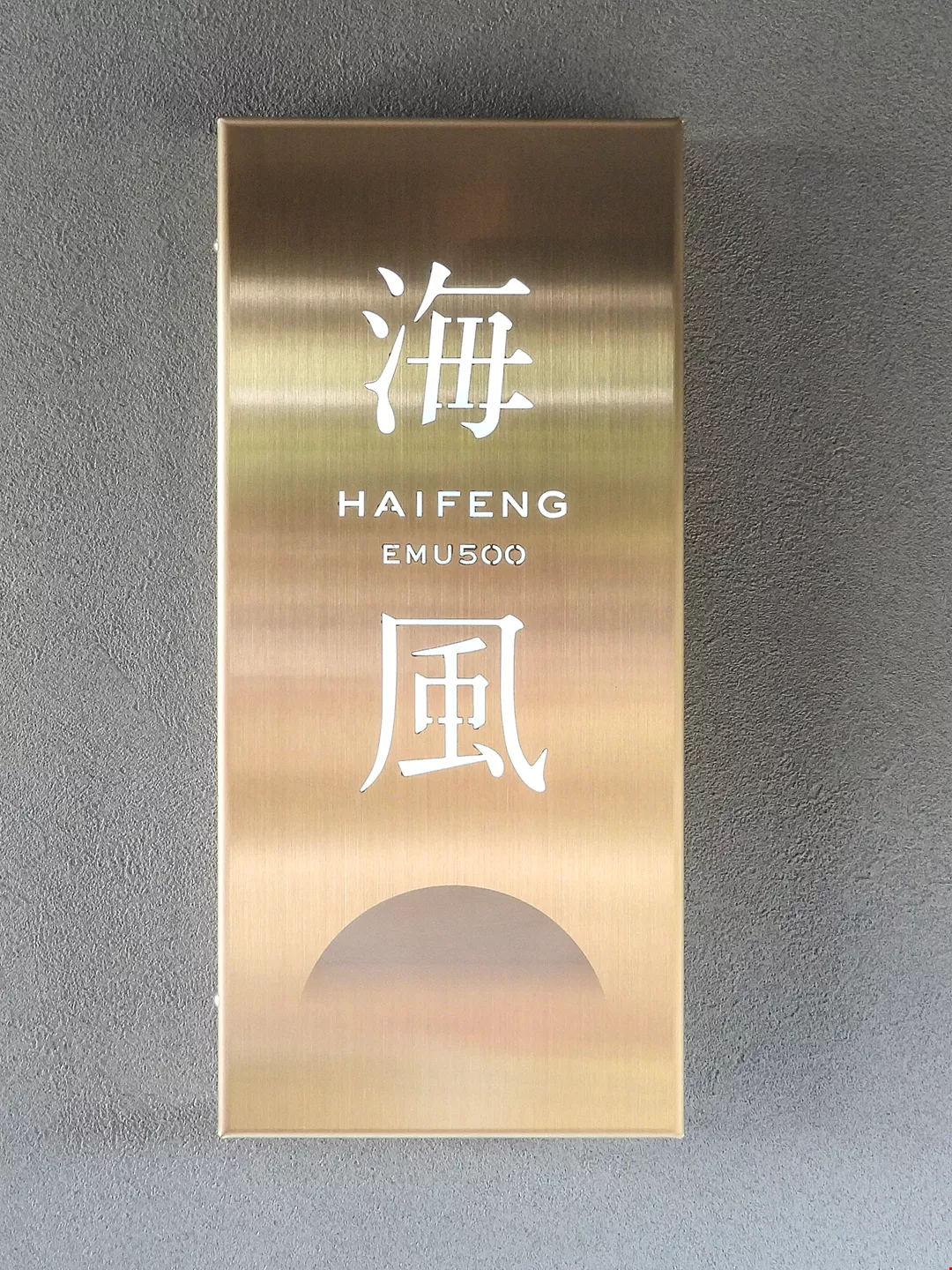
Taiwan Railways brings aesthetics to the Haifeng, crafting a custom logotype as the brand mark to showcase Taiwan’s tourist-train identity. (courtesy of TR)

The Future—The Moving Beauty train has a titanium identification plate as well as chevron markings on the front of the engine. This exterior with its designer feel has led the way in TR’s aesthetic renaissance and the train’s design has won international accolades.
Transforming train aesthetics
Today, tourist trains are capturing a lot of attention in Taiwan, but they have a checkered past.
Ye Yu-cian says that when the South Link Line was completed in 1991, thereby closing the last gap in the round-the-island railway network, then-president Lee Teng-hui raised the idea of round-the-island tourism, marking the start of tourist trains in Taiwan. However, little more was done to improve early tourist trains than changing their exterior appearance and upgrading the seats.
It was only in 2018, when TR's predecessor, the Taiwan Railways Administration (TRA), began renovating old Chu-Kuang Express cars, that new-style tourist trains became available, but they were derided as an “aesthetic disaster.” To keep up with the times, the TRA accepted outside suggestions and hired experts from fields including design, architecture, marketing, and railroad culture. In April of 2019 they established a special “aesthetics and design consulting and review committee” to usher in an aesthetic renaissance for the TRA.
The committee’s first task was to perform “cosmetic surgery” on the old trains.
The committee and TRA staff used every trick in the book, from revamping the train exteriors to redesigning the interior decor of the cars, right down to the trash cans. Every detail was carefully refined. Eventually they came up with a whole new train, which they called Future—The Moving Beauty.

The Future—The Moving Kitchen train offers a mobile feast of fine dining, providing delicacies worthy of a five-star hotel and exquisite hand-brewed coffee.

The colors of the grey and blue chairs on the Future trains are inspired by Hualien marble and the ocean. The design of the curtains, meanwhile, is derived from works by an indigenous artist.

The Future trains provide luxury travel services that enable passengers to experience a different side of Taiwan.
The future of tourist trains
The sleek black color of the exterior exudes a sense of luxury, while the train also incorporates the orange of some express trains. The locomotive preserves the chevron marking of old diesel engines, and includes a specially made titanium identification plate at the front. Car interiors include Taiwania wood and motifs from indigenous art. Passengers can feel the different aesthetic of this tourist train, which won a 2020 Good Design Award from Japan.
With this eye-catching train, Lion Travel, which operates Moving Beauty, has brought a new vision to train travel. The Covid-19 pandemic struck just when Moving Beauty was first being promoted. Countries shifted their focus to domestic travel, and Eagle Wang, who has been involved in the planning and design of a number of tourist trains in Taiwan over the course of his career, argues that the Moving Beauty benefited from a unique combination of timing and circumstances, giving Taiwan’s tourist trains a fresh framework and vitality.
“We have defined Moving Beauty as a high-end cruise-style train, with travel as its core theme,” says Wang. As a luxury travel experience, Moving Beauty had to offer corresponding value. It just so happened that during the pandemic, colleagues who had been stationed overseas returned to Taiwan and spent time in various cities and counties, seeking out local partners and helping to upgrade the train’s services.
Not only does Moving Beauty have its own dedicated platforms and lounges, everything from the stewards’ uniforms, passenger orientation handbooks, and souvenirs to the shuttle buses all have the same black and orange color scheme. Also, local partners have been carefully chosen. For example, one provides indigenous-style fine dining at a viewing platform in a Bunun indigenous community that offers a 270-degree view of the East Rift Valley, while another invites passengers to enjoy tea in a building near a Peinan archaeological site that blends Minnan and Japanese architectural elements.
The TRA later came out with another train named Future—The Moving Kitchen, with Michelin three-star quality food. As the train moves along at a leisurely pace, local ingredients are used to produce exquisite fine-dining experiences. In combination with Taiwan’s fascinating scenery, the result is a moving feast worthy of a five-star hotel. This train, which has won a Good Design Award from Japan, an iF Design Award from Germany, and an International Interior Design Association award from the US, marked a new era for railroad tourism in Taiwan.
.jpg?w=1080&mode=crop&format=webp&quality=80)
Breezy Blue is Taiwan’s one and only vintage train with opening windows. From the train one can directly view the sea.

The Breezy Blue train often promotes itineraries with novel themes, making each journey a fresh experience. (courtesy of TR)

Lion Travel general manager Eagle Wang argues that Taiwan’s tourist trains have special features and a vitality that distinguish them from those in other countries. (photo by Jimmy Lin)
Antique train’s comeback
Unlike the luxury of Moving Beauty and Moving Kitchen, the Breezy Blue train that runs on the South Link Line has a cultural heritage theme. It is Taiwan’s only vintage train with opening windows.
Eagle Wang admits that his company was at first not optimistic about promoting Breezy Blue. Unlike the Future trains’ glamour, Breezy Blue has no air conditioning and seemed like a relic. However, Wang saw opportunity in these disadvantages, because the windows can be opened to admit sea breezes directly inside. He says: “This train takes passengers through one mountain range, past two stretches of ocean, and within sight of three islands. If they are lucky, they can also see nine different shades of blue.”
Every car on Breezy Blue has an expert guide to talk about the old-fashioned electric fans, changes in the lighting, and the stories of places along the way. When passing through Duoliang Station, the train slows down to let passengers take photos of the horizon at this “most beautiful station in Taiwan.” On the return journey, Breezy Blue becomes a “sunset train,” moving toward Fangliao against the background of the setting sun.
Breezy Blue also incorporates in-depth local experiences. Getting off at Jinlun Station in Taitung County, passengers can visit an indigenous community where they can check out a church designed with Paiwan elements and hear local elders explain indigenous lifestyles and culture.
This train, which once carried less than 20 passengers a day, today attracts over 70,000 travelers a year; it has become beloved by domestic and foreign tourists. Breezy Blue turned disadvantages into advantages, making nostalgia the cornerstone of a triumphant comeback.

The food on the Haifeng tourist train, featuring exquisite pastries made by local businesses, is served in “jewelry boxes.”

courtesy of TR

Riding the Tiffany blue Haifeng train in summer, one can get great views of the Pacific Ocean and Guishan Island.
Taiwan as a gift
Ye Yu-cian tells us that she recently met an Australian who came to Taiwan specifically to ride the Haifeng tourist train, while many Japanese railroad representatives have also come to Taiwan to check out the local tourist trains. Eagle Wang explains that Taiwan’s tourist trains take serving “travelers” rather than “passengers” as their point of departure. “We decided how to optimize these trains’ services based on the needs of travelers.”
For example, on most Japanese tourist trains the stops are for buying souvenirs and gifts, whereas in Taiwan they are for learning about local culture and history. There are 241 train stations in Taiwan, and each one has stories behind it. Tourist trains highlight the beauty and uniqueness of many of these small stations.
For example, take the stops made by the Shanlan’s sister train, the Haifeng. This train has a Tiffany blue color scheme and serves treats popular with women. Not only are these foods served in “jewel boxes,” there is even Michelin-starred ice cream. Its stops are just as delightful. The summer itinerary, running back and forth between Nangang and Yilan, calls for halts at Houtong to explore the history of the mining industry, and at Dali, where travelers can walk from the platform to the seaside in two minutes to get fantastic views of the Pacific Ocean and Guishan Island.
In autumn and winter, the Haifeng travels between Hsinchu and Taichung. It stops at little-known Houlong Station to allow passengers to explore the folk culture zone next to the local Mazu Temple as well as the eateries that have sprung up around it. Another stop is at Xinpu, one of the “five gems of the West Coast Line” a century-old wooden station near the sea with beautiful sunset views.
Taiwan is blessed not only with beautiful landscapes, but also diverse cultures. Via tourist trains, everyday scenes become extraordinary. The trains offer up Taiwan’s unique attractions, enable us to see Taiwan as a gift, and give us all the chance to “Say hi to Taiwan!” l

Taiwan’s tourist trains tie together small-town stories, marketing Taiwan’s uniqueness to the international community. (courtesy of TR)
.JPG.jpg?w=1080&mode=crop&format=webp&quality=80)
Tourist trains in Taiwan offer travelers the chance to appreciate Taiwan’s scenery and stories to the fullest. They are worth coming a long way for. (courtesy of TR)


@List.jpg?w=522&h=410&mode=crop&format=webp&quality=80)


@List.jpg?w=522&h=410&mode=crop&format=webp&quality=80)
@List.jpg?w=522&h=410&mode=crop&format=webp&quality=80)
