
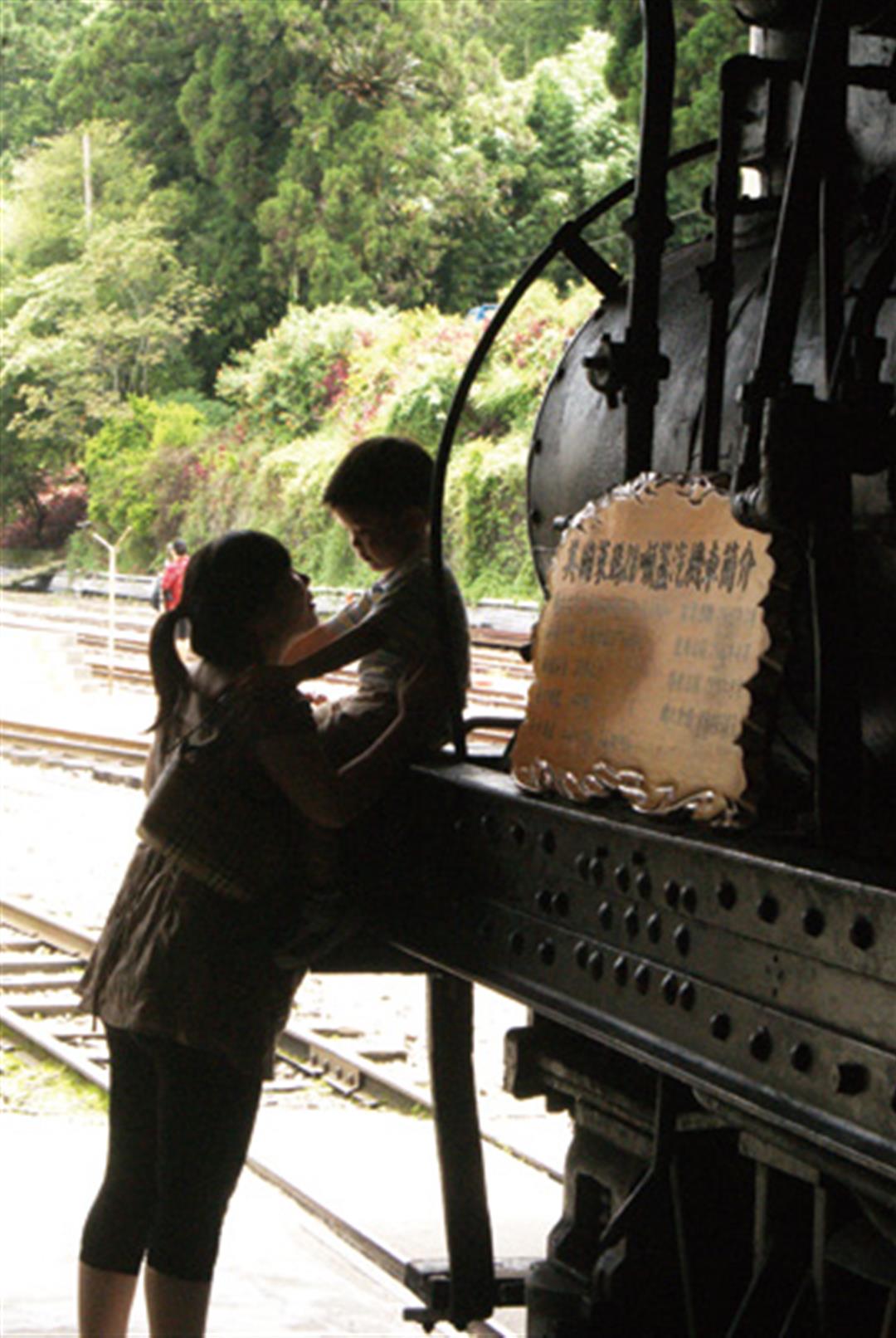
Alishan-Mt. Ali-is not a mountain. Fenqihu-Lake Fenqi-is not a lake. The Aboriginal Tsou tribe that lives there is not actually aboriginal to the area. The common tale of the origin of the name "Alishan" was made up but was taken for real by a reporter, and the Sisters Lake story is likewise a total fabrication.
The Alishan that the locals know, the true face of Alishan, is vastly different to the perception of the area elsewhere.
"It is both core and periphery, heart and frontier," says Chiayi Forest District Office director Yang Hung-chi, encapsulating in a few words the complicated nature of Alishan. As he notes, of all the National Forest Recreation Areas around Taiwan, only Alishan NFRA has people living in it. At present, it is home to three villages, a total of 108 residents, all of whom are Forestry Bureau staff and their families, living in the area under temporary building permits.
"To four generations of Aboriginal people Alishan has been a spiritual home, but from the perspective of the government Alishan is state land and a window into the soul of Taiwan, necessitating management and restriction of everything from logging to hunting to building. The differences in these perspectives are the source of contradictions and conflicts over Alishan," says Yang.
While they have always strived to live in harmony with the area, the lives of those living in the Alishan Forestry Recreation Area have also been affected by changes through their history, from Japanese rule to the ROC's Forestry Bureau and the current waves of mainland tourists. With all the comings and goings, all the changes and adjustments, there have been both gains and losses to the area.

During Japan's rule over Taiwan, the breathtaking peaks of Niitakayama (the Japanese name for Yushan) and Alishan were grouped together as "Niitaka-Arisan" and designated as a national park by the governor-general. Introducing Niitaka-Arisan by Chinese-Japanese artist Tsunemitsu Kaneko, presented a bird's-eye view of the Alishan railroad, giving a clear picture of the environment of Alishan at the time as well as the route of the forest railway.
Who are the real natives?
In most people's minds, the Tsou tribe are the Aboriginal tribe of Alishan.
In reality, the Tsou of Alishan number only 3,000-plus, most of whom live in the foothills, using the vast forests as their hunting ground. The forest recreation area was actually an old-growth forest with no permanent settlements until Japanese colonization, when the colonial government hired over a thousand Japanese and a thousand Taiwanese to work in logging and on the railroad there as they sought to develop the area.
After Taiwan's retrocession Japanese residents were forced out, leaving only three villages of Taiwanese residents who became the "natives" of the Alishan Forest Recreation Area.
In other words, the people of Alishan's forest recreation area are all tied to either the logging or railroad industries.
Take Chen Yuexia for example. Chen's paternal grandfather came to Alishan to work in logging in his teens, while Chen's maternal grandfather was a railroad worker. Living here long-term, each raised their own family, their children following in their footsteps, with those children eventually marrying and taking the families from coworkers to in-laws. Chen's father was a patrolman for the Forestry Bureau workstation after retrocession, while her mother ran a teahouse and grocery store. Then in the 1960s, when Chen was in junior high, they moved into the tourism industry, running a motel and restaurant.
Weng Xingzhao, a driver, is the third generation of his family to be involved with the Alishan Forest Railway. His grandfather was a track laborer, responsible for maintenance of the railway; his father began as a mechanic and eventually became an assistant driver. Weng himself started as an apprentice, becoming an assistant driver, and then a driver proper.
In his father's day, says Weng, there were no patrol cars, and so to look after the safety of the rail line, patrolmen had to walk the line from Chiayi to Zhushan, setting out at 2 a.m. and inspecting each part of the track carefully for obstructions.
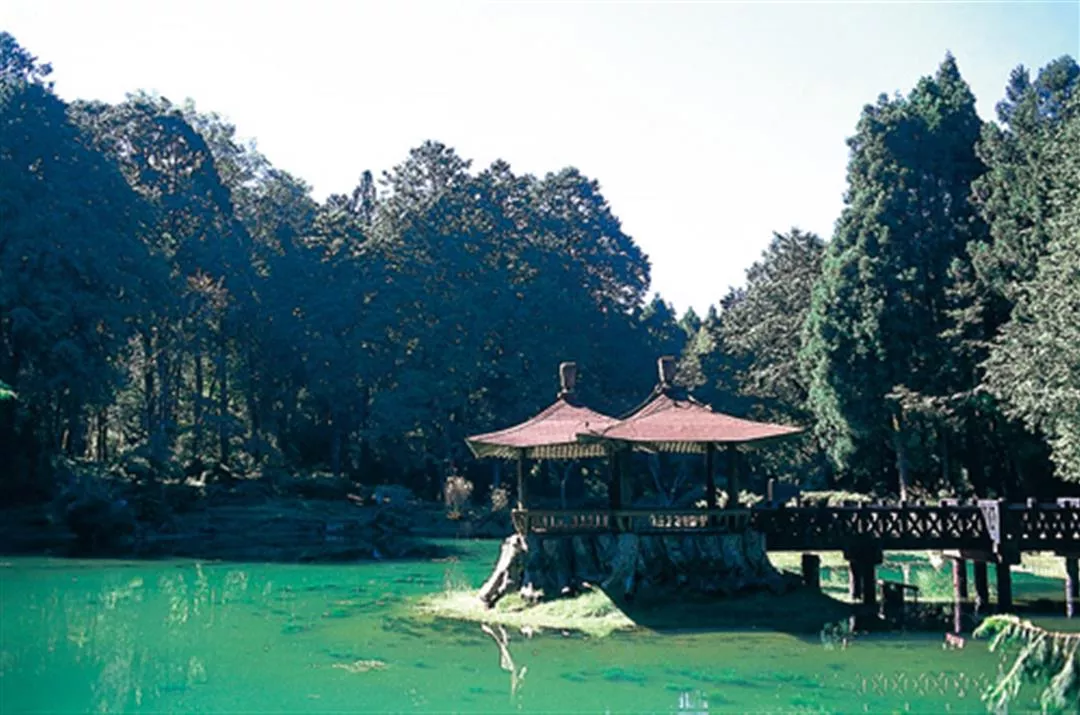
Sisters Lake was a virtual private hideout for a young Chen Yuexia, and although the legend of the two Tsou sisters for which it is named is fictitious, the reality of its beauty is undeniable.
A bittersweet youth
The railway is a vital part of the livelihoods of the people of Alishan, and in the past it was their one and only link to the outside world.
Chen Yuexia, who writes novels about Alishan, was born and raised near the old terminal station of the forest railway and has spent over a decade surveying the area. Thus she has an especially strong passion for the sights and sounds of the area, particularly the railway.
To Chen, the forest railway is like the "cat bus" of Hayao Miyazaki's animated classic My Neighbor Totoro, weaving through the forest and carrying joyful and sorrowful memories of childhood.
As there is no junior high school on Alishan, the children of the area have to leave home and head down into the outside world to study when in their early teens. When they start the semester, the children cry the whole way to Chiayi, and then when summer and winter vacations roll around, they smile and laugh their way up the mountain.
A daughter of Alishan herself, Chen has long been concerned with the changes in the ecology of Alishan wrought by forestry.
"There's no summer to speak of on Alishan," says Chen. In the past the area was even colder, with snows and frosts during the winter-in the depths of winter, if you left a bowl of syrup and plums out on the roof, by the next day it'd be a bowl of plum ice dessert. But after decades of heavy logging, Alishan's climate has grown noticeably warmer.
With the felling of "Shenmu"-the ancient "sacred tree" of Alishan-in late June 1998, the hearts of the people of Alishan were given another reason to skip a beat.
"When Shenmu was about to be cut down, I set out from Taichung at 4:50 a.m. and arrived with my mother at 9:10 a.m. to take one last photo with the tree. At 12:52 p.m. that three-millennia-old tree that so many had grown up alongside fell. Some couldn't stop crying, seeing through the tears what a deep spiritual scar would be left by the loss of the tree," says Chen in her essay "The Tale of Alishan Shenmu," recording clearly this historical moment for Alishan.
Rectification of names
Seemingly constantly shrouded in mist and cloud, Alishan's true face has long been somewhat hidden from outsiders. It has also been the subject of many erroneous tales and stories, with the biggest such error concerning the name "Alishan" itself.
Over 250 years ago there was a Tsou chief called Abali. A brave and skilled hunter, every member of every hunting team he led came back alive and fully loaded up, and to honor him, the tribespeople named the area for him, calling it Mt. Ali. Or at least, such is the explanation found in materials big and small about Alishan National Forest Recreation Area. Research has found, though, that the story was actually fabricated out of whole cloth by a then area office director being interviewed by a journalist in 1963. Today, the Tsou people often joke about the story, saying it's a good thing the man said "Abali" and not "Ali Baba," because no one would ever buy that.
Another such erroneous tale is that of the legendary Chinese figure Wu Feng, who sacrificed his own life in order to break the Tsou of their tradition of headhunting. In actuality, Wu Feng's tale was at the least embroidered, if not simply made up, by the Japanese colonial government. In the late 1980s, with the rise of Aboriginal consciousness, the Tsou could no longer tolerate their reputation being sullied by this tale of the Chinese "civilizing" them, and Wu Feng's story was finally erased from elementary school textbooks and dropped completely. Even the village on Alishan that bore his name was renamed Alishan Village.
There's another beautiful tale told about one of Alishan's famous scenic spots, Sisters Lake. It tells of a pair of Tsou sisters who, frustrated in pursuit of their respective loves, drowned themselves here.
"The problem with that is that back then there was no lake here, nor were there any Tsou Aborigines here!" points out Chen. In reality, this too was a fabrication, this time by a photographer embroidering his photo with a story to make it more beautiful, but since then it has gained a life of its own.
While the story about Sisters Lake might be less than authentic, Chen has her own beautiful memories and stories from there, and these ones are the real deal.
In the past, Sisters Lake was like a private hideaway for Chen, who could spend entire days out there without seeing hide or hair of another person, lying between trees on a hammock, reading Dream of the Red Chamber, or just daydreaming. Today the flow of people visiting it is virtually ceaseless, with people wandering around looking for this and pointing out that. "Oh, how are the mighty fallen," remarks Chen.


@List.jpg?w=522&h=410&mode=crop&format=webp&quality=80)


@List.jpg?w=522&h=410&mode=crop&format=webp&quality=80)
