Ta-An River Crafts (PartⅠ) --Yuanli Rushwork, Sanyi Carving
Jenny Hu / photos Hsueh Chi-kuang / tr. by Robert Taylor
July 1994


The broad gravel river bed, the towering red mountain ridge and the dazzling blue sky cut three swathes across one's field of vision. There can be few among the travellers hurrying north or south along the section of the freeway between Tai-an and Sanyi who are not struck by the sudden appearance of this desolate, barren scenery where plain meets plateau, as they pass by the Taan River and Huoyan Mountains. As far as the eye can see, there is no sign of human activity, apart from the matchbox-like gravel trucks on the river embankments.
The place where human activity is to be found is in the hinterland to the north and south of the river. The river's north bank lies in Miaoli County. Yuanli Township runs down to the sea; Sanyi Rural Township, its neighbor on the other side of the Huoyan Mountains, is ringed by hills. Facing them far away on the south bank of the river are Tachia Township and Houli Rural Township, both in Taichung County. Thanks to its unique natural resources and the ingenuity of local people, over the past two centuries this seemingly unimpressive looking area has given birth to two Taiwanese craft products which have won fame overseas: rushwork and woodcarving.
But times have changed, and the "Tachia rushwork" which once earned Taiwan large amounts of foreign currency has been steadily losing its popularity. Fortunately, three years ago a "Weaving Crafts Center" was established to shoulder the task of keeping this local handicraft alive; and while the traditional mass-produced "Sanyi woodcarvings" are still in plenty of demand, a new generation has begun to inject a spirit of variety and individual creativity into the hill town's products. And in recent years a husband and wife team filled with love for their native land have built up their "Hwa Tao Pottery Kiln" at the foot of the Huoyan Mountains, and have raised a garden full of Taiwanese plant life and human culture; they have many stories to tell visitors.
For this issue's "Exploring Taiwan Anew" we have come to the home of some of Taiwan's traditional handicrafts--the country on both sides of the Ta-an River--for an intellectual tour on the theme of "local handcrafts," to appear in two parts in this month's and next month's issues. This month, we visit Yuanli and Tachia, the home of rushwork, and the woodcarving town of Sanyi; next month we will enter the cultural world of "Hwa Tao Kiln."
Stepping out of Yuauli station, one sees before one a lonely little square and a town center made up of two or three streets lined with old and new houses, centered around a vegetable market. This simple, quiet scene betrays nothing of the place's former prosperity as the "home of mats and hats," but today's Yuanli still counts as one of the "livelier" townships in southern Miaoli County. Mat Company," has half-finished hats drying outside its doorway, through which a faint aroma of straw wafts out from inside the shop. Inside, all kinds of woven rush hats, mats, bags, seat mats and sandals festoon the plain interior. In a back room, the 77-year-old owner Chang Shui-lien is energetically packing up a large order of chair mats.
Turning from Weikung Road, which leads away from the station, into Tienhsia Road, we find a row of two-storey brick buildings dating from the Japanese occupation--the old rush weaving street. It is said that in its heyday, the street had over 100 rushwork shops. Today many shops stand idle, and only two are really still in the rushwork business. One of them, the 70-year-old "Tsin Far Hat and ordered through the post by a customer in Taipei. "People talk about Tachia hats and mats, but actually they're made in Yuanli." As a respected elder of the local community, who has stayed in business to this day against all the odds, his greatest wish is to give the name of "Yuauli rushwork" its rightful status.
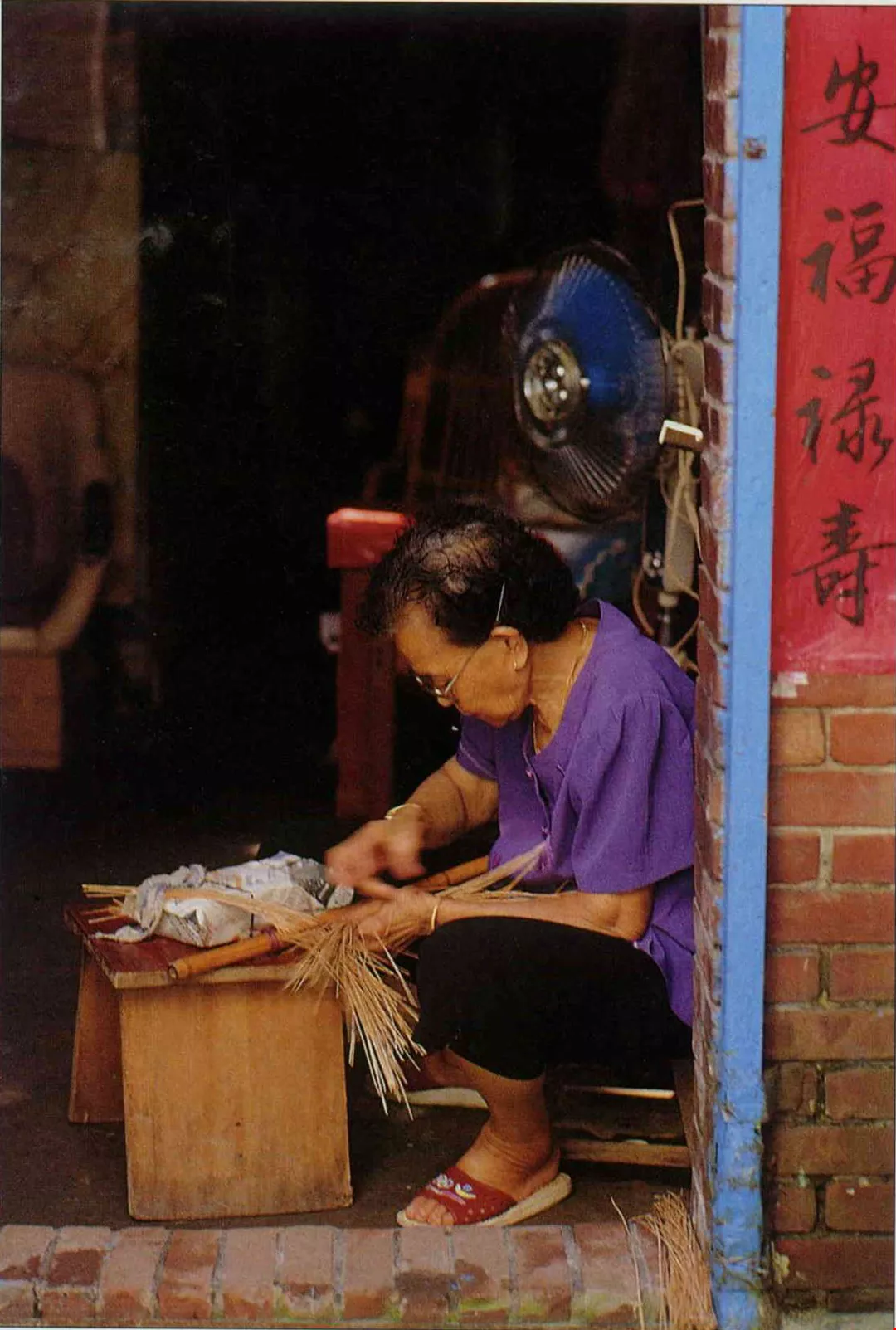
Wandering through the alleys of Yuanli, one can sometimes still see Women weaving rushwork. Almost all of them are over 60.
Ancestral ingenuity
But whether it is "Tachia rushwork" or "Yuanli rushwork," the raw materials are all rushes from the Ta-an River valley. The people of earlier times took this local material and ingeniously used it to create a local folk handicraft product with a style all its own.
Two-and-a-half centuries ago, what is now Yuanli Township was the location of the Peipo tribe's Wowanli settlement. At that time, two Peipo women discovered by chance that when dried, the wild rushes from the wetlands where the Ta-an River flows into the sea are extremely tough and flexible and highly resistant to splitting, making them a very suitable material for making everyday utensils. After this, the craft of rush weaving quickly became widespread.
Forty years later, another Peipo woman had the clever idea of splitting the rushes into thin strips to make bed mats for sleeping on in summer. The mats are cool and fragrant, and can also be folded up making them easy to carry. Han Chinese migrants to Taiwan who tried these mats were all enthusiastic about them, so many women started making them. The addition of hand-woven patterns started a real fashion for the mats, making them a much-sought-after commodity, and high officials and rich folk going to the capital also looked on "dragon and phoenix mats" as ideal gifts to present to superiors. The rushes began to be specially cultivated instead of just being cut from the wild.
Three years before the end of the 19th century another new product was invented. The son of Hung Yuan, a woman from Yuanli, had an ulcer on his head, and to protect it from the sun she improved on the weaving method used for patterned mats to produce the first rushwork hat, in the style of Western woollen hats. Later this technique spread all along Taiwan's western coast, and rushwork traders from Tachia further developed the product and went to Japan to build up an export market.
Because in those days Taiwan's coastal railway had not yet been built, Yuanli did not have good transport links with the outside world, nor did it have any export traders. Tachia on the other hand had Ta-an Harbor through which products could be shipped for export by sea, and it was linked by a sugar refinery railway to the mountain railway line, enabling products to be sent for sale all over Taiwan. Thus Tachia became the distribution center for Yuanli's rushwork, and as export markets in Japan, Europe and America were developed, the fame of "Tachia rushwork" was spread far and wide, stealing some of the limelight from Yuauli, its real place of origin.
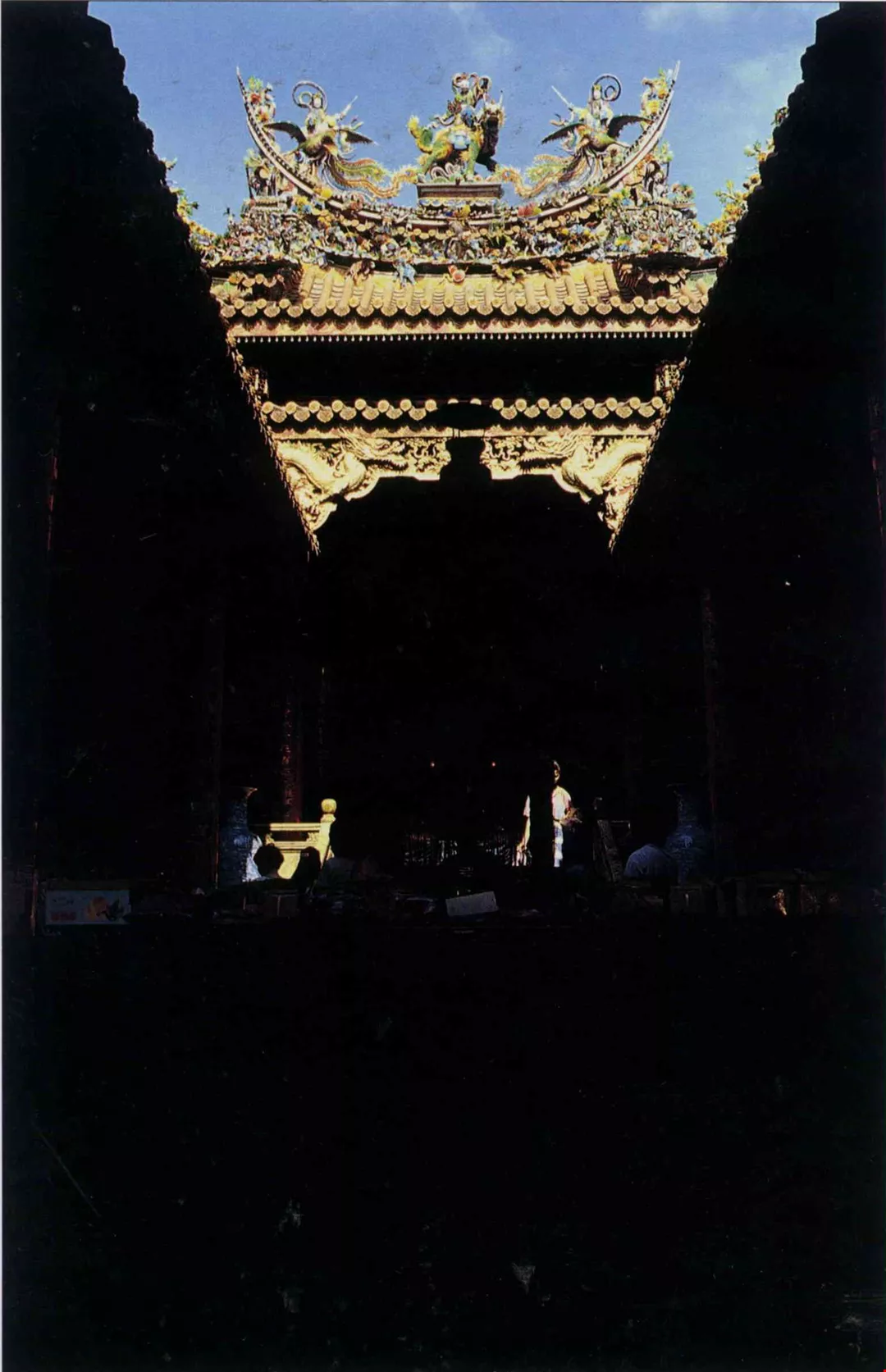
Chen Lan Kung temple in Tachia is famed for the power of its main spirit, Matsu. But the temple's intricate carvings and the beautiful symmetry of its structure also give it a special character.
A golden age
The price and quality of rushwork are mainly judged by how finely it is woven. More than 16 rows per inch indicates fine material and workmanship and is a sign of a top-quality product, and the straightness of the rows and how tightly they are pressed together is another criterion. A fine rush sleeping mat is smooth to the touch and does not catch on the skin, while after a night sleeping on a rougher mat, one may find one's skin imprinted with a criss-cross pattern.
Chang Shui-lien remembers how, when he was a child, almost all the women he knew supplemented their household income by making rushwork. "One girl in a family doing rushwork could feed six or seven people, and in the early years Yuauli Town-ship's income from rushwork was actually more than the whole township earned from the rice grown in its 3000 chia (c. 2900 ha) of paddy fields."
When the Japanese crown prince Hirohito visited Taiwan, the governor of Taiwan assigned the most skillful rush weaving women to make mats to be presented as gifts to the prince. When Japanese people wear kimonos, they like to also wear triangular woven rush shoes, for these can prevent foot odor and eczema. Chang Shui-lien's father was a rushwork trader who specialized in selling to Japan and to major cities in mainland China such as Shanghai, Nanjing and Beijing. "In those days, rushwork mats and hats were given as high-class wedding gifts," recalls Chang Shui-lien, who cannot help a rush of excitement when looking back on those halcyon days.
But after war broke out between China and Japan, the mainland market gradually declined, and then as war spread throughout East Asia, shipping became difficult and many rushwork traders went out of business. After the war ended, things looked up economically, but then mainland China fell victim to civil war, which continued until the Nationalist government withdrew to Taiwan, and the state of the rushwork trade went from bad to worse. In 1955, seeing that the trade was in dire straits, Chiang kai-shek's wife Soong Mei-ling suggested that middle school pupils throughout Taiwan should wear straw scout caps. It was Chang Shui-lien who devised the straw scout cap in question. This reversed the fortunes of Yuanli's hat trade and in 1958 the "Miaoli County Rushwork Production Cooperative" was set up. The cooperative took steps towards improving quality control and developing new designs, and with the revival of the Japanese economy, prospects were looking excellent. But a tax evasion scandal involving tens of millions of NT dollars destroyed the cooperative's reputation, and from then on it existed in name only, and Yuanli's rushwork trade has never recovered from this setback.
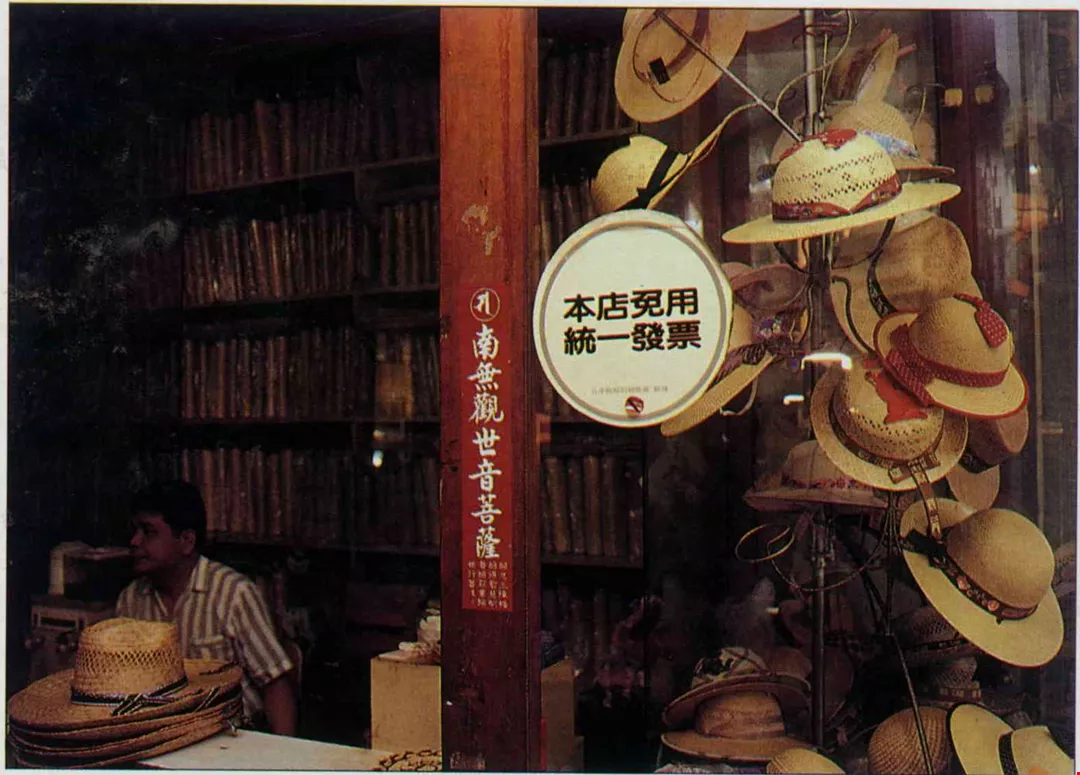
In the rushwork shops of Tachia and Yuanli, goods imported from mainland China and Southeast Asia are as numerous as local products.
Disappearing rush fields
"Actually there's no shortage of orders, it's just that the skilled workers are all old, and there are less and less of them, so I just can't accept large orders. I can't fill them using local labor, so it's just not worthwhile," says Chang Shui-lien. Lack of workers is the biggest problem facing Taiwan's rushwork industry, and this is why many products on the market today are imported from mainland China or Southeast Asia and finished in Taiwan, or simply imported directly as finished products.
Wandering along old Tienhsia Road, in the alleys and courtyards between the old houses one can still see one or two grey-haired old women sitting on low stools in the light from the courtyard, skillfully weaving articles such as hats or shoe soles, more by feel than by sight. This is all that remains of the old glory days. In fact, one of their handwoven rush mats with a fine pattern can fetch as much as NT$20-30,000, but to make one requires two or three months' hard work.
The situation in Tienhsia Road is a microcosm of the state of the rushwork trade throughout Yuanli, and indeed the entire Tachia area. In past years the area was full of fields growing rushes, but today without someone to point out the way one would not find the few fields which remain. Out along county road 130 towards Sanyi one can still see some rush fields, which look like paddy fields. The rushes which grow around Tachia and Yuauli along the lower reaches of the Ta-an River are known as Tachia rushes and are harvested three times a year. After harvesting they are tossed and laid out to dry in the sun. Broken or badly formed rushes, and any which become damp due to rain while drying are sent to be processed at a factory.
The rush processing factory located in an alley and bearing a plate marked No. 90 Chuncheng Li is said to be the largest remaining one in Yuanli. The wooden buildings and warehouse are stacked high with dried rushes like a grain store, and with the air full of their aroma, one has the feeling of having been transported back to a bygone age. "How many rush fields will there be next year?" The owner, Mrs Wang, answers with a sigh as she continues to toss rushes, "I don't know, perhaps next year we'll have to close down!"
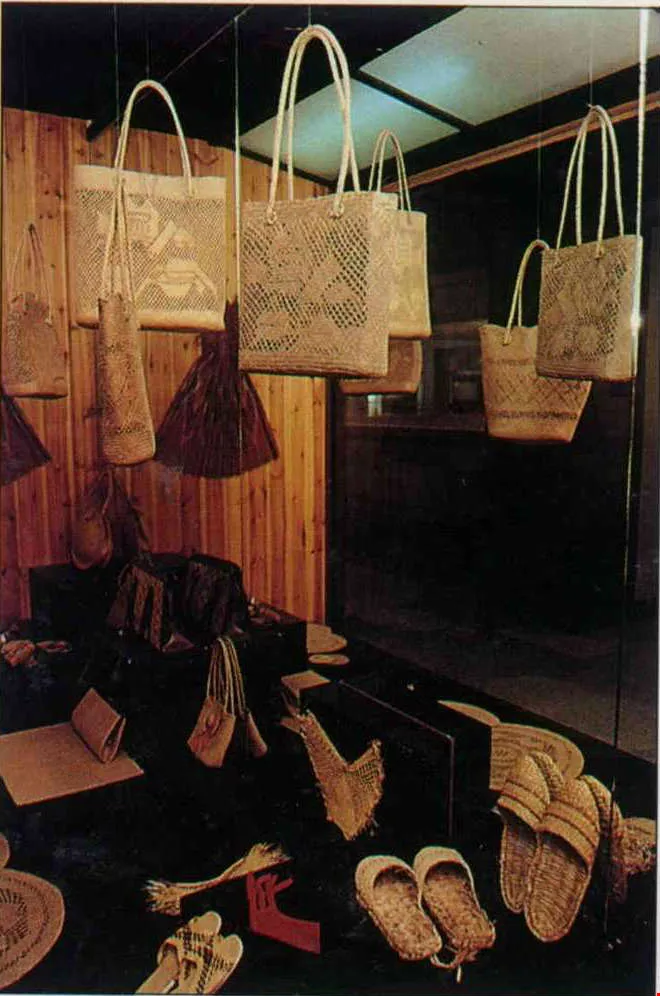
The Weaving Crafts Center gives a complete picture of Tachia rushwork, from the raw materials and manufacturing processes to the finished products.
Tachia rushwork upstaged by Matsu
Taking the train south from Yuanli, one passes through verdant paddy fields. Because the ground in the Ta-an River valley is full of stones, the low walls which divide the fields are built of stone, and this gives a special character to the scene.
Crossing the Ta-an River we enter Tachia Township--formerly a bustling trading port and a great distribution center for rushwork products. Arriving in such a historically famous place, one cannot help being filled with suppositions and expectations.
The moment one gets off the train, one can sense the difference between Tachia and Yuanli. Yuanli is like a village girl, simple and quiet, while Tachia is like a local worthy: its lively commerce has created a flourishing appearance. Before making our interviews we were aware of the decline in the rushwork trade, but when we saw only two shops selling rushwork on the streets of the town center, we still found it hard to believe. And one of these shops has already gone over to also selling an assortment of other products, so that it resembles a hardware shop. The Sanyang rushwork shop, which stands on a street corner, is probably the only remaining shop in Tachia which wholly specializes in selling rushwork.
Belief in Matsu is widespread in all Taiwan's ports, and Tachia is no exception. Incense has been burned at Chen Lan Kung temple for over 200 years, but the present temple building was constructed in 1982. The pillars and beams inside the temple are intricately carved and painted, with the gold-leaf-covered carvings around the niche in which the statues stand in the main hall winning particular acclaim from visitors. We were told that the sculptors were all first-rate folk artists. Chang Ching-tsung, a teacher at Tachia's Wenchang Elementary School, who has studied temple art in great depth and who often acts as a voluntary guide at Chen Lan Kung because he likes it so much, says that although Chen Lan Kung is "sumptuous," its sumptuousness is based on research into and refinement of traditional temple art and building layout. He cannot help exclaiming enthusiastically "It's even better than Tsu Shin Miao temple in Sanhsia. It's a first-class example of a big, no-expense-spared modern temple."
Very few of today's visitors to Tachia come there to buy genuine local rushwork. The largest numbers are believers in Matsu who come to visit Chen Lan Kung temple, followed by people coming to eat seafood.
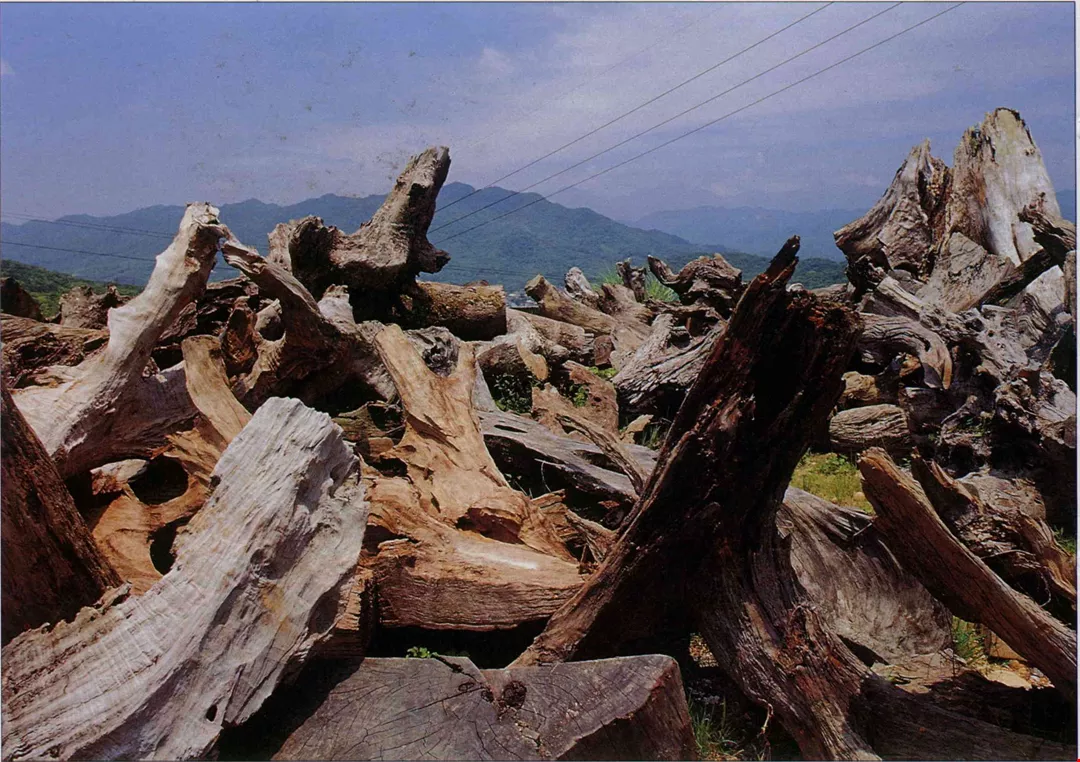
The camphor, cypress and fir wood stacked by the roadside provides the raw materials for Sanyi carvings.
Fine works on display in the Weaving Craft Center
As its skilled women advance into old age, Taiwan's once world-famous rushwork craft industry seems destined to pass into history. In an effort to preserve local traditional craft skills, Taichung County Cultural Center's "Weaving Craft Center" in Fengyuan was opened in late 199O. It is currently the world's only center where the four crafts of plaiting, weaving, embroidery and dyeing are all represented.
The craft center was set up to collect and display examples of Taiwan's traditional weaving crafts, and also to research the processing of materials and to find ways of maintaining craft skills. During this year's National Festival of Culture and Arts, the Craft Center put on a highly-publicized "Tachia Rushwork Exhibition," with live events such as rushwork craft demonstrations, which has reawakened awareness of and interest in this local craft. Chang Hui-ju, who runs the Craft Center, is very energetic. She hopes that the traditional crafts will survive, and to this end she invites craft masters to teach courses, and plans to award a "Weaving Craft Prize" to encourage creative design. She believes that one of the main reasons for the decline in the traditional weaving crafts is the lack of people skilled in product design, and that the only real way to keep them alive is through training.
Traditional looms, colorful aboriginal clothing, utensils woven from straw and bamboo, Tachia rushwork materials and products, batik made by mainland Chinese minority peoples, modern woven craft products showing rich creativity in materials and design ... --if you look closely at the exhibits in the Craft Center, you can discover how rich and how close to everyday life the world of weaving is. Chang Hui-ju hopes that one day this place can become a focal point for Taiwan's weaving crafts.
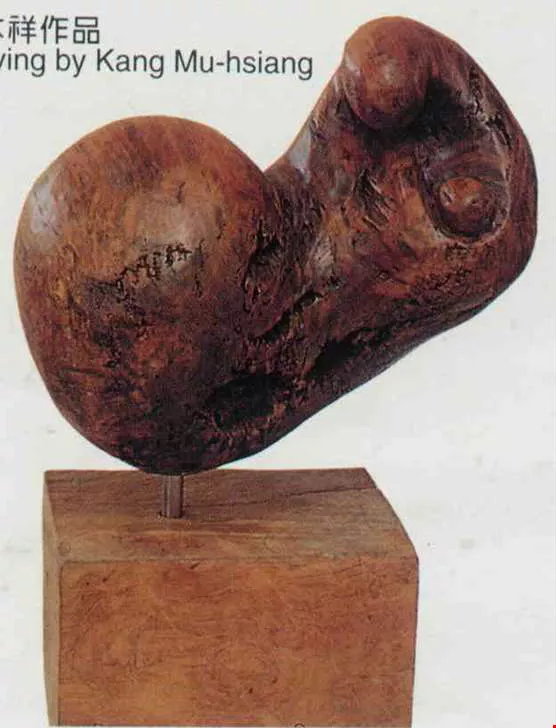
Carving by Kang Mu-hsiang.
A wood carving town by Huoyan Mountain
To the north of Fengyuan, passing through Houli, and crossing the Ta-an River, the railway and road keep climbing upwards until we arrive on the Miaoli plateau and reach the wood carving town of Sanyi.
One can say that the development of wood carving in Sanyi combined the inevitable and the accidental. The high altitude and highly acidic clay soil make it suitable for growing tea bushes and camphor trees. In Miaoli County, aromatic camphor wood has long been refined to make camphor, and has also been used as a building material; its tender leaves can be eaten, and its seeds pressed to produce oil and wax. The whole tree is very "useful," but in early days nobody had thought of using it as a material for artistic creation.
The camphor tree's root system is shallow and spreading, and termites often build their nests among the roots. After years of gnawing by the insects, the camphor roots take on all kinds of bizarre shapes. Early this century, a local named Wu Chin-pao was clearing a patch of land on a hillside when by chance he discovered the strange beauty of these dry tree roots and took the wood home where he cleaned it up, lacquered it and put it on display in his house. Some Japanese noticed the artistic merit of these pieces and together they and Wu began to produce them and sell them in large quantities. In addition to naturally shaped pieces of wood, they gradually began to produce carved mirror frames, wall decorations, landscape pictures and all kinds of other products. Later a Japanese art teacher gave classes in carving techniques, and a carving training center was opened locally. As the skill spread wider and wider among local people, Sanyi's carving industry began to boom. After the end of World War II, wood carving went from being practiced as a household sideline to production in small specialized factories. The departing Japanese were replaced as customers by American servicemen, and the products found a large market in the United States.
For 30 years, Sanyi sold its products for export, but later Taiwan's withdrawal from the United Nations and the international energy crisis brought a decline. Over the last decade, with a booming stock market and economic development, there has been an excellent market within Taiwan, especially for carvings of religious figures such as Maitreya Buddha, which are seen as symbols of prosperity by local people.
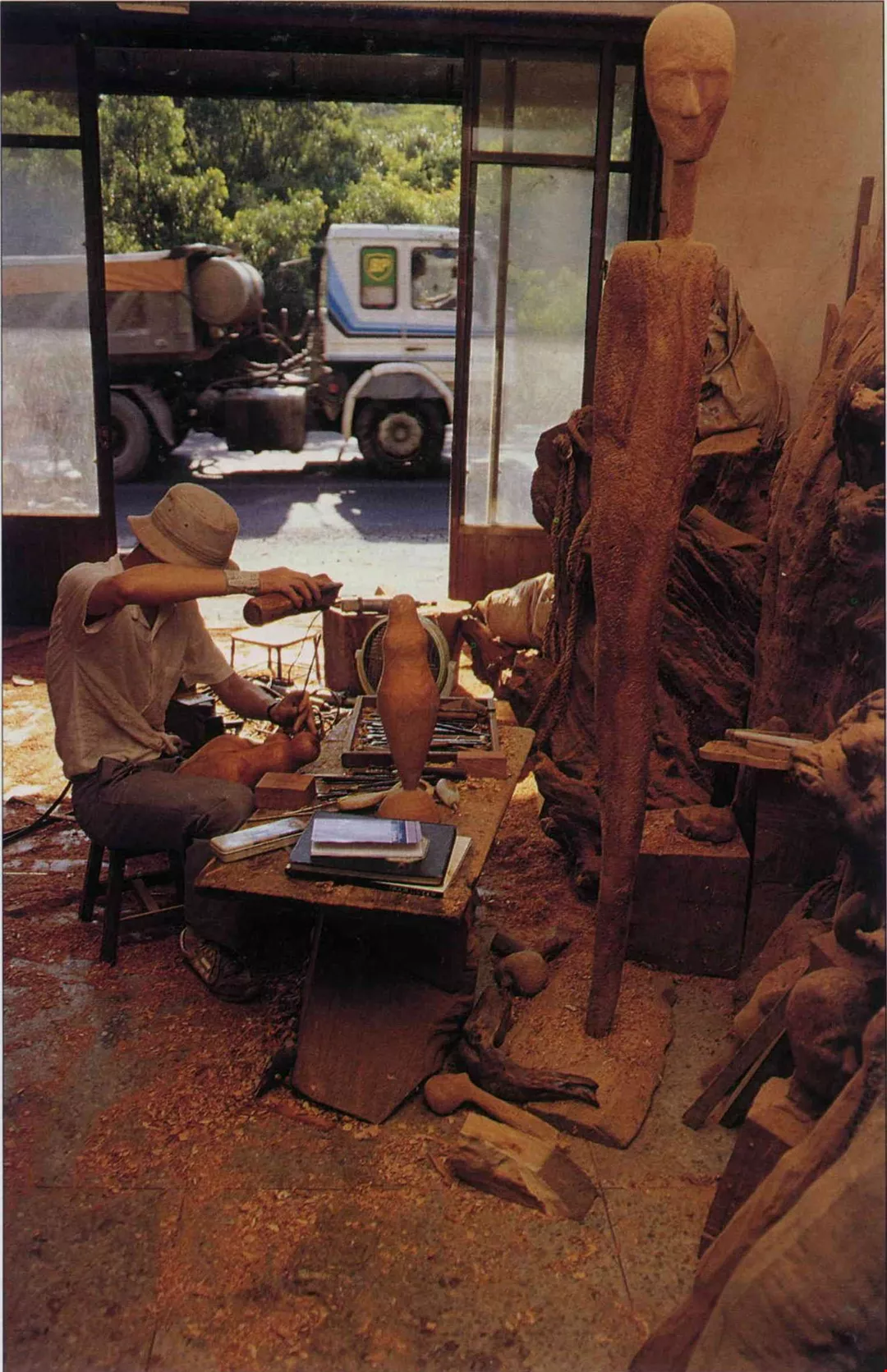
Among the shops of Sanyi s wood carving street, one can also find artists who care nothing for commercialism, but pursue only their individual creative inspiration. Pictured here is the studio of Huang Ming-chung, a wood carver whose works have gradually gained a reputation in Taipei's art galleries over recent years.
Mass production and creativity
Provincial road 13 (Shuimei Road) runs straight through Sanyi, and a long stretch near the freeway's Hsihu interchange is lined with shops selling wood carvings. Lumber and tree trunks are stacked high in heaps all along the roadside, and everywhere carvers can be seen at work with electric and hand carving tools. This is the widely renowned wood carving street.
In Sanyi, wood carving is done largely in the form of high-volume commercial production, with small "specialized" factories everywhere. "Specialized" refers to the categories of subject matter into which the carvings fall. For instance, some factories only carve all kinds of Bodhidarma figures, while others specialize in human figures, or birds and animals, and so on. "Collective creation on a production line" is also a widespread method. To take a religious statue as an example, after the rough wooden blank has been cut out, the carving of its face, hands, curves and background, the application of gold leaf and other operations are all the responsibility of different specialists. Thus some carvers may spend months or years or even half their lives just carving hands, and never have time to try anything else, let alone get the chance to create works in their own style.
A tourist visiting Sanyi for the first time with a lively interest in wood carving but no particular goal in mind may find that after visiting three shops or so, their interest wanes drastically, because most of the craft shops look pretty much the same. But among the many mass-produced items, there are a few shops with a more unique flavor which are worth mentioning:
Chuomu Studio: Over recent years a group of young wood carvers who served their apprenticeships in Sanyi have been actively pursuing individual creativity. Liu Ming-yuan, Huang Jui-yuan, Huang Shih-yuan, Liu Pang and Wu Yen-chung work together in their collective studio "Chuomu Studio," and three of their wives run the craft shop of the same name.
The items in the shop are all exquisite and original wood carvings and pottery, and are ingeniously displayed among small bonsai plants, with unexpected delights in every corner. The upper floor of the shop is reserved for a display of the studio's own products, and gives the impression of an austerely simple art gallery. Here one can see the new life of Sanyi wood carving.
Yayi Mingpin: This shop specializes in folk craft decorations from rich old houses in Taiwan and mainland China, including doors, carved decorations, kitchen utensils and all kinds of craft artifacts. The shop tries to maintain the original style and proportions of the pieces even when they require renovation. In the gallery upstairs, works by the famous Taiwanese bottle-gourd carver Lin Ling are on sale.
Chiutingkan: Specializes in bizarrely-shaped wood pieces and pottery. The owner, Wu Yu-min, is the grandson of Wu Chin-pao, the founder of the wood carving industry in Sanyi. He has lived and breathed wood carving since his early childhood and has a particular love for gnarled outgrowths on trees. He only takes these from trees growing more than 1500 meters above sea level, for only then do they really show "the trees' vitality in their struggle with nature." In his carving, he tries hard to preserve the wood's natural shape, "to make the wood seem even more like wood."
Liu Jui-jung Studio: Specializes in carvings made from large pieces of misshapen wood. Liu prefers bird and animal themes. Because each piece of wood has its own special shape, he does not go in for mass production--every piece is unique. He also makes creative use of any bric-a-brac which comes his way, for instance turning an old window lattice into a primitive-looking clock, or hollowing out an old brick to take a motor-driven pair of clock hands. He also collects folk crafts such as aboriginal hand-woven cloths or an old table made of Taiwanese sandalwood, and has many rare and valuable pieces.
Chi Ta Hang: The owner Huang Kuo-nan is publicly acknowledged as one of the most conscientious and professional old master craftsmen in the Sanyi traditional wood carving scene. He makes furniture from misshapen wood, and also carves gnarled outgrowths. Following the inspiration given by the shape of each individual growth, he carves them with such human and animal characters as children setting crickets to fight each other, bodhisattvas, etc.. The refinement of his pieces is very much admired by the young sculptors of Chuomu Studio.
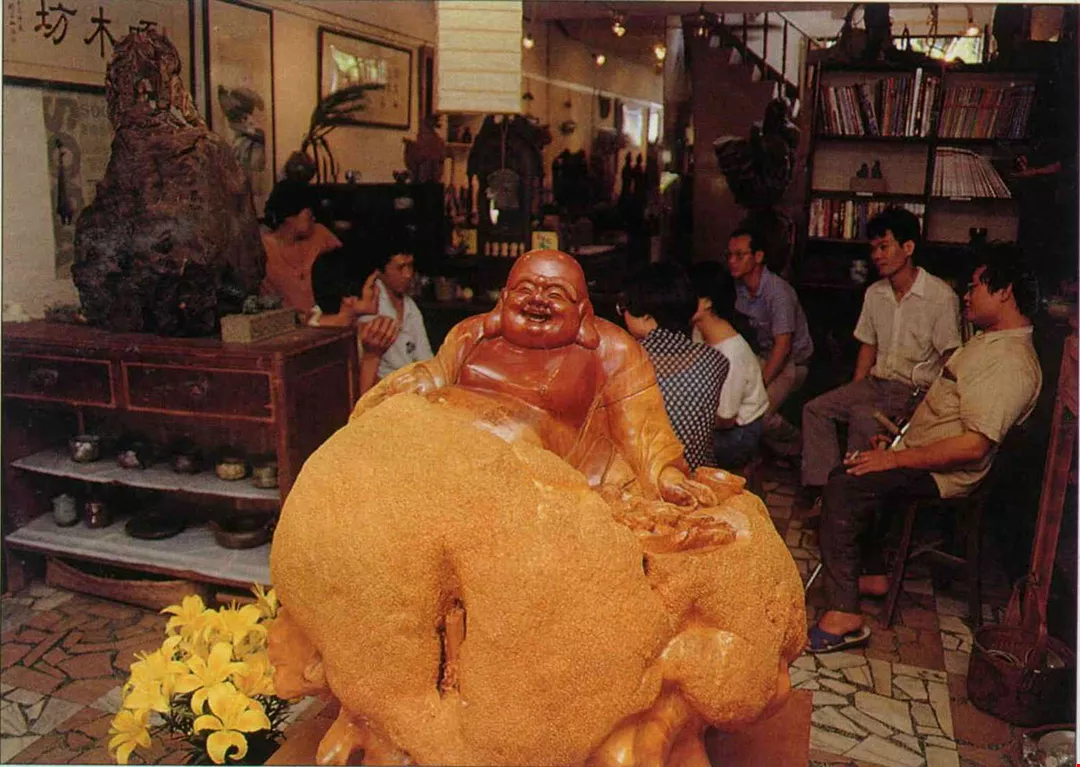
Look around the shop, sit down for a cup of tea and a chat with the owner--if he enjoys the conversation, you might get a chance to see his private collection of exquisite pieces.
Sanyi's new carving street
In recent years, because of the "wood carving museum" which is now about to open in Kuang-sheng New Town on a hill above Sanyi's wood carving street, this new neighborhood has also acquired a streetful of workshops, and the piles of tree trunks and the buzz and chatter of electric saws and gouges create a lively, busy atmosphere.
Kang Mu-hsiang, who applies sculptural concepts in his carving, attracts customers to his studio with a large picture of himself holding a chisel and a gouge. Tseng Chin-tsai's sign uses the theme of a swineherd in the old agricultural society and the song "When Will You Return?" to allude to the inevitability of suffering in human life. Here one can also find pottery studios, a studio producing mainly carvings of horses, and so on. All the color of Sanyi is concentrated in this one short street.
As well as the large mass-producing wholesale craft markets, the creative efforts of many individuals are evident at every turn. Sanyi is not simply a commercial city. You only have to search a little and you will discover the vitality of art in this hill town.
Yuanli Township:
Tienhsia Road: Old rushweavers' street. built under the Japanese occupation
Hsin Tiao Chu: The studio of the late aboriginal wood carver Chen Chiung-hui. The one-storey brick building stands by the new road to the beach. Aboriginal mortars and pestles and wooden wheels are stacked high outside. In the garden are low, snaking stone walls and a native style pavilion. The studio is now used by Chen's student Huang Shen-chung, who plans to set up a memorial hall to Chen. (037) 867339.
Tsu He Kung temple: Beside the highway from Yuanli northwards to Tunghsiao. The temple contains many artefacts brought from mainland China last century.
Peifang old street: Peifang, towards Tachia from the railway station, has many old brick-built courtyard houses, including the Tsai family house built in the reign of the Ching emperor Kuang-hsu (ruled 1875-1908). The courtyard features unusual round pillars of curved red bricks.
Chungcheng Li: Rush fields and a traditional rush processing factory.
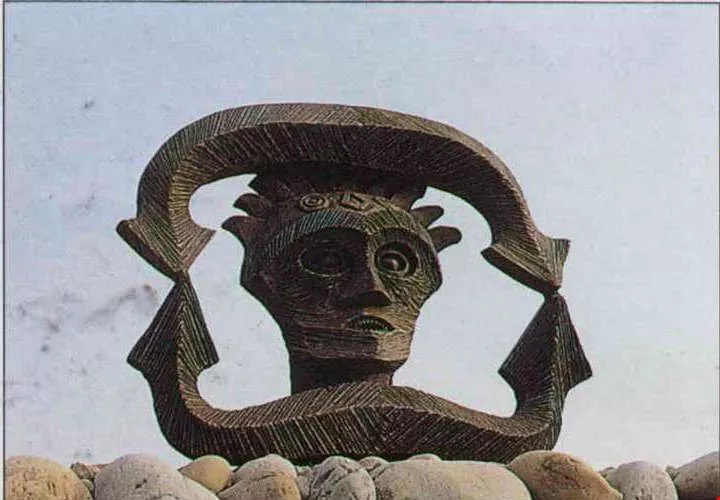
Carving by Chen Chiung-hui (photo by Cheng Yuan-ching)
Sanyi Rural Township:
Shuimei: Famous wood carving street.
Kuangsheng New Town: Street of carving workshops.
Shenghsing Railway Station: The highest point on western Taiwan's mountain railway line. The structure contains no metal nails. The Eight Trigrams design fixed to the beams is intended to ward off evil. Between Shenghsing and Tai-an, the railway passes over bridges and through tunnels, past green farmland and countryside, with scenic spots such as the Yutengping river valley and the "broken bridge" at Lungteng, which was split in two by a great earthquake over 50 years ago. The line is a favorite with railway enthusiasts and lies at the feet of central Taiwan's famous Shankuantao Mountains.
Liyutan Reservoir: Mountain, river and farmland scenery.
Huoyan Mountain Nature Conservation Area: Collapsed cliff terrain, many native Taiwanese plants including protected stands of horsetail pine (Pinus massoniana).
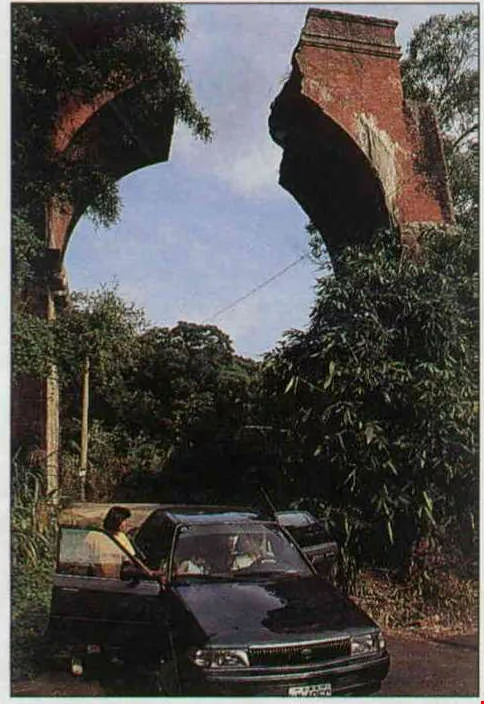
The "Broken Bridge" at Lungteng.
Tachia Township:
Chen Lang Kung temple: A Matsu temple famous throughout Taiwan. On Chiangkung Road, which leads away from the railway station.
Chastity Arch: Near Chen Lang Kung. Erected in the Tao-kuang period (1821-1850) of the Ching dynasty in honor of Lin Chun, a local woman who remained chaste in memory of her late fiance, cared for his family and kept the incense burning for his ancestors. The arch is a Grade 3 historical monument and contains inscribed tablets from the Tao-kuang and Hsien-feng (1851-1861) periods.
Wen Chang Tsu: An old ancestral temple from the Kuang-hsu period (1875-19O8).
Tiechen Mountain Scenic Area: To the north of Tachia. An important military area in olden days. Includes Cheng Cheng-kung's "sword well."
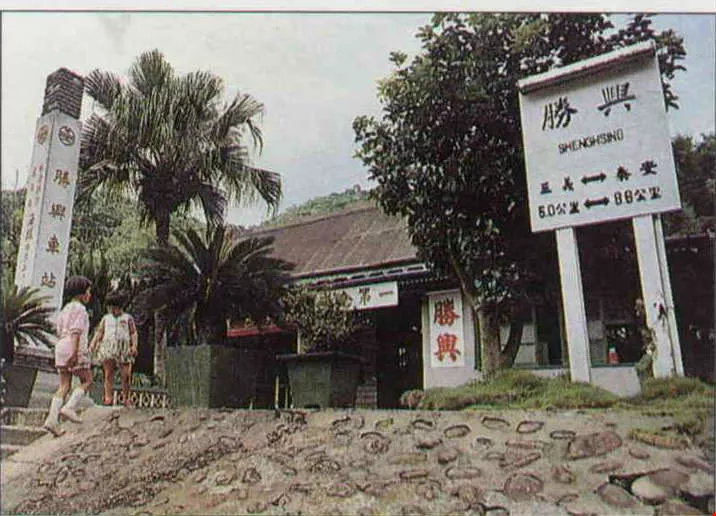
Shenghsing Station.
Fengyuan City:
Tsu Chi Kung: A Matsu temple on Chungcheng Road. 186 years old, it has always marked the center of Fengyuan. Beside the temple is a night market with food stalls.
Weaving Crafts Center: Inside Taichung County Cultural Center. 782 Yuanhuan East Road. Exhibits include Tachia rushwork and woven articles from all Taiwan's peoples.
Chungcheng Park: This quiet, charming park with its hill and riverside landscape is a welcome green space in Fengyuan's northeastern suburbs.
Hsiao Family Gardens: I km up Shuiyuan Road from Chungcheng Park. A private garden with flowering cherries.
Chiu Feng-chia Memorial Park: Views over the Tachia River.
Scenic orchards: Yunhsientu and Kunglaoping scenic orchards, at the far end of Shuiyuan Road.
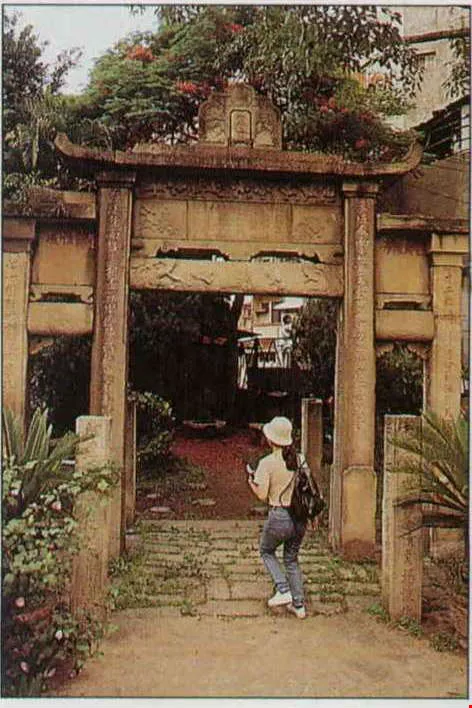
Chastity Arch.
Transport:
Yuanli and Tachia are both on the coastal north-south railway line, while Sanyi and Fengyuan are on the mountain line. They are also linked by provincial roads and the freeway. Between Yuanli and Sanyi, take County Road 130; from Tachia to Fengyuan, first take County Road 132 to Houli, then take Provincial Road 13 to Fengyuan. The area has good roads and good rail and bus services.
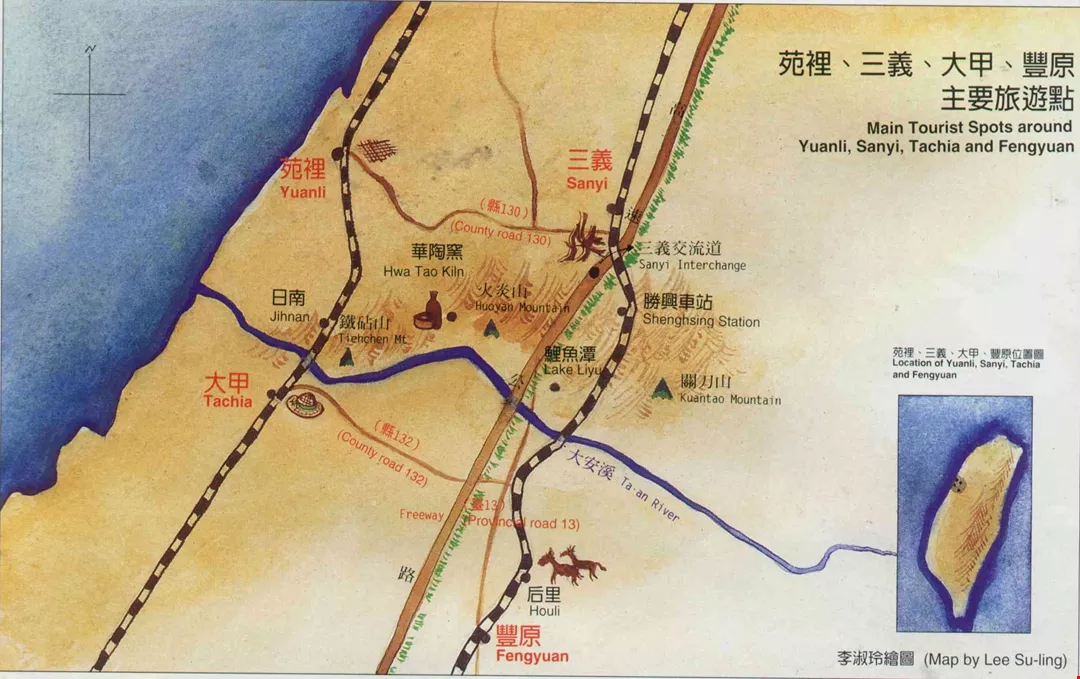
Main Tourist Spots around Yuanli, Sanyi, Tachia and Fengyuan (Map by Lee Su-ling)
Food and accommodation:
Yuanli and Tachia are by the sea and both have seafood restaurants. Tachia also has a night market. In Sanyi, try Hakka food. Fengyuan has the Tsu Chi Kung night market with many different snacks. For accommodation, Fengyuan has the widest and best choice, followed by Tachia; Yuanli has only two small hotels, while Sanyi has none. Thus it is best to stay in Fengyuan when touring this are.
Travel Information.
Suggested itinerary:
The following itinerary is based around the local crafts of rushwork and wood carving, and requires at least two days with one overnight stay.
Day 1: Visit Yuanli's old rushwork street, Hsin Tiao Chu and the surrounding countryside; then take the train to Tachia to visit Chen Lan Kung temple and Chastity Arch. Eat seafood or try the snacks in the night market. Stay overnight in Fengyuan.
Day 2: Visit Fengyuan's Weaving Crafts Center, look at the town, then go to Sanyi to see the wood carving.
(If you want to take in Hwa Tao Kiln. add an extra day, also staying at Fengyuan).
Notes:
1.For more detailed tourist information, contact the following organizations:
Miaoli County Government Tourist Office: (037) 322150
Yuanli Township Council:(037) 682100
Sanyi Rural Township Council: (037) 872802
Taichung County Government Tourist Office (04) 526-3100
Fengyuan City Council: (04) 522-2106
Tachia Township Council: (04) 687-2101
2.In Sanyi, many craft shop owners have collections of special favorite pieces which are not displayed in the ground floor shop, but kept upstairs and only shown to "aficionados." Therefore interested visitors should not be discouraged by the mass-produced goods on the ground floor-better pieces await your discovery. If you wish locate creative wood carvers in Sanyi, you may enquire at Choumu Studio.(037) 875977.
3. To find skilled local rush weavers, enquire at the Weaving Crafts Center, (04) 526-0136 (ask for the Museums Dept.).
4. Visitors wishing to learn in depth about the Chen Lan Kung temple building may contact Mr.Chang Ching-tsung, a teacher at Wenchang Elementary School in Tachia Township. (04) 687-2076.
[Picture Caption]
p.73
The special variety of rushes (Scirpus tripueter) which grow in the Yuanli and Tachia area by the lower reaches of Ta-an River gave birth to the area's rushwork industry. Today these rush fields, which look much like paddy fields, are gradually disappearing as the industry declines.
p.75
Wandering through the alleys of Yuanli, one can sometimes still see Women weaving rushwork. Almost all of them are over 60.
p.76
Chen Lan Kung temple in Tachia is famed for the power of its main spirit, Matsu. But the temple's intricate carvings and the beautiful symmetry of its structure also give it a special character.
p.77
In the rushwork shops of Tachia and Yuanli, goods imported from mainland China and Southeast Asia are as numerous as local products.
p.77
The Weaving Crafts Center gives a complete picture of Tachia rushwork, from the raw materials and manufacturing processes to the finished products.
p.78
The camphor, cypress and fir wood stacked by the roadside provides the raw materials for Sanyi carvings.
p.79
Carving by Kang Mu-hsiang
p.80
Among the shops of Sanyi s wood carving street, one can also find artists who care nothing for commercialism, but pursue only their individual creative inspiration. Pictured here is the studio of Huang Ming-chung, a wood carver whose works have gradually gained a reputation in Taipei's art galleries over recent years.
p.81
Look around the shop, sit down for a cup of tea and a chat with the owner--if he enjoys the conversation, you might get a chance to see his private collection of exquisite pieces.
p.82
Carving by Chen Chiung-hui (photo by Cheng Yuan-ching)
p.82
The "Broken Bridge" at Lungteng
p.82
Shenghsing Station
p.82
Chastity Arch
p.83
Main Tourist Spots around Yuanli, Sanyi, Tachia and Fengyuan
Location of Yuanli, Sanyi, Tachia and Fengyuan
(Map by Lee Su-ling)
p.83
Travel Information

@List.jpg?w=522&h=410&mode=crop&format=webp&quality=80)


@List.jpg?w=522&h=410&mode=crop&format=webp&quality=80)
@List.jpg?w=522&h=410&mode=crop&format=webp&quality=80)
