Lucky Beasts!-Taiwan's Animal Protection Law
Chang Chin-ju / photos Vincent Chang / tr. by Robert Taylor
May 1999


After the passage of the Animal Protection Law, many homes for stray animals, whose operators supported the bill, will also be subject to its regulations. They will have to make improvements in such areas as their equipment and the animals' accommodation.
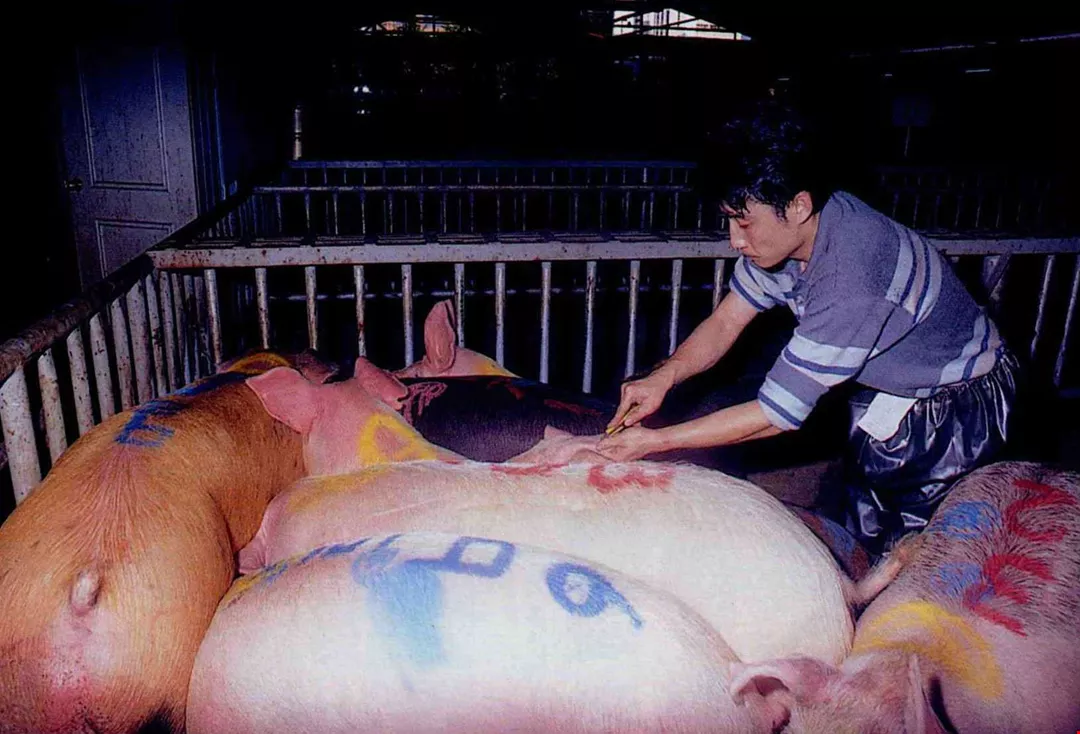
Abattoir workers cut marks into pigs' backs with craft knives so that the owners can be identified after the animals are slaughtered. In the future, if they change to electric slaughtering, they can quickly mark the carcasses with metal stamps, thus reducing the pigs' needless suffering.
After the Animal Protection Law was passed by the Legislative Yuan in November last year, it immediately showed its teeth. An elementary school teacher was fined NT$10,000 for killing a cat by throwing it out of his classroom, and in a crackdown on dog fighting in Taipei County, dog owners were not only charged with illegal gambling, but also with the new offense, defined in the Animal Protection Law, of "exploiting animals' competitive behavior for the purpose of gambling." But the Legislative Yuan candidate who vented his anger at an opponent by hurling piglets at his campaign headquarters got away scot free, because the incident took place before the new law came into force. In future, however, politicians who continue such long-standing practices as swearing oaths while chopping the heads off chickens, or using animals in their election campaigns, may find themselves being had up for "abusing or harming animals without good cause."
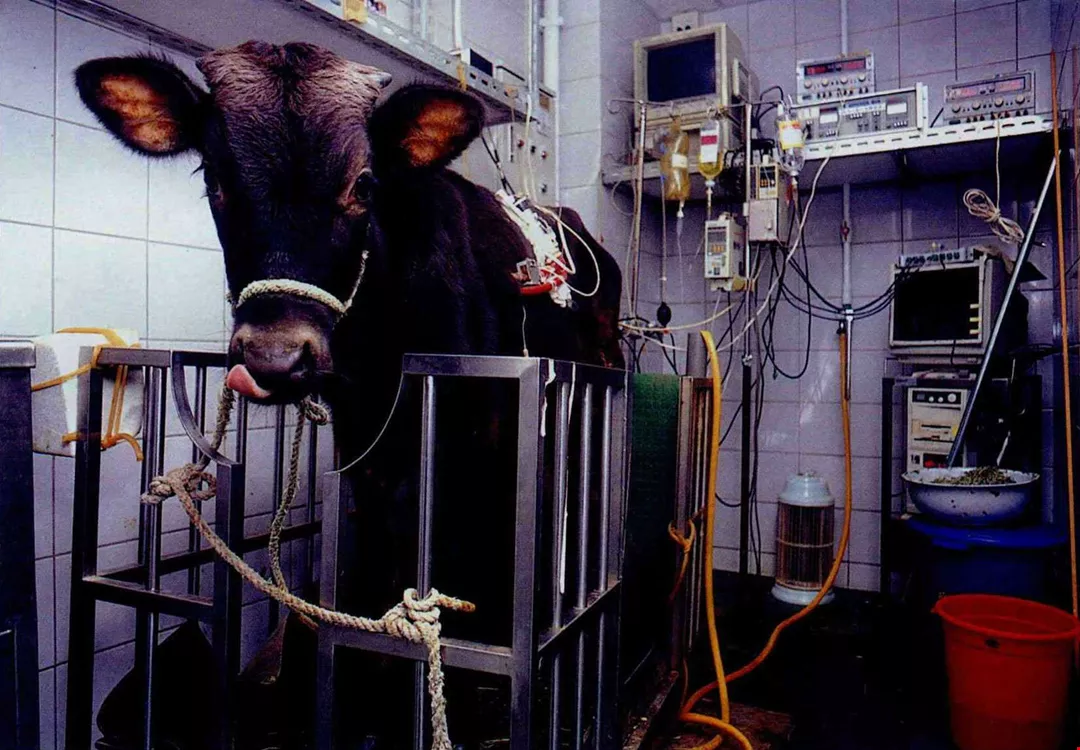
This six-month-old calf was fitted with a left ventricular assist device at birth as part of National Taiwan University Hospital's trials of the latest such devices. As more and more animals are used in scientific experiments, how to reduce the suffering they endure is a test of researchers' consciences and ingenuity.
Many people applaud the new law. But there are also those who feel obliged to ask: If throwing cats and pigs and decapitating chickens are all to be punishable offenses, then shouldn't slaughtering poultry, cattle or pigs be crimes too? And what about poisoning rats or swatting cockroaches? Just how far should animal protection go?
Seventeen years ago, in a short story entitled "The Yorkshire's Twilight," author Chung Li-ho described through the eyes of a Yorkshire boar how, in the days when it was still common for farming families in Taiwan to raise pigs as a sideline, the boar's owner made a living by hiring him out as a stud. He would often be led through the villages to service other farmers' sows, and before each sortie his owner would never forget to feed him some eggs, in the hope that the sows would produce "a dozen piglets in every litter, and nary a runt among 'em"-thus securing the customers' confidence, and his owner's prosperity.
Whenever the other farmers saw the Yorkshire coming, they too would bring out his favorite eggs to build up his strength. Chung Li-ho wrote that in those days, when people boiled rice for their three daily meals they would take the rice out when it was half cooked and finish it in the steamer; the precious water would be kept for the pigs. It was nothing unusual to see farmers living in tumbledown hovels themselves, but providing solidly built, airy sties for their pigs.
Although "The Yorkshire's Twilight" is a work of fiction, it reflects the natural affection between animals and their owners in an agricultural era when each was dependent on the other. But society has changed, and today relations between humans and animals need to be explicitly regulated by an "Animal Protection Law."
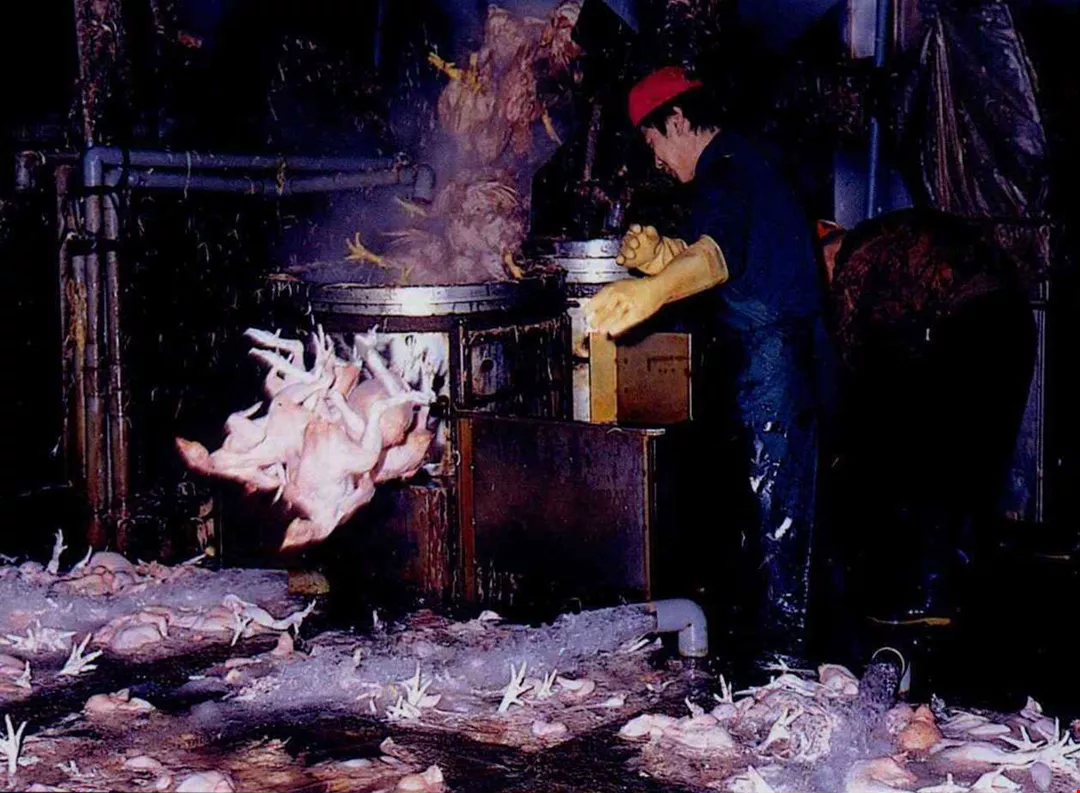
The more than 100,000 chickens consumed by the people of Greater Taipei each day are still slaughtered manually at Huannan Market after being transported from southern Taiwan. In the future, they will be killed electrically in the south, which as well as being more humane in it will also end the suffering the poultry endure in transit.
Triple protection
The 1989 Wildlife Conservation Law aims to protect wild animals, but the recently passed Animal Protection Law extends the law's protective umbrella to all vertebrate animals reared or managed by humans, including pets, "economic animals" (poultry, farm animals, etc.) and laboratory animals.
The Animal Protection Law covers virtually all aspects of the lives of these three types of animals over which mankind has dominion. Their owners are not only required to provide them with sufficient food and drinking water and a safe living environment with adequate shelter, air and light, but must also prevent them suffering unnecessary disturbance, abuse or injury. Animals must not be subjected to fear or pain when being transported, and they may only be slaughtered by humane methods which cause the least possible suffering. Animal owners who infringe these regulations may be fined, ordered to make improvements within a specified time, or even have their animals confiscated.
Many people would regard taking proper care of animals as a basic standard of human morality, and many lavish great devotion on their family pets. But in fact, when the interests of pets or of animals raised as food or for medical research conflict with those of humans, people often fail to consider their physical and mental well-being.
The Animal Protection Law was first proposed in order to address the issue of urban pets. Dogs being abandoned to become strays on city streets had long been a problem, and without the benefit of relevant training or the assistance of veterinary surgeons, municipal and county sanitation workers often destroyed strays by electrocution, drowning, clubbing or whatever other methods came to hand. In the past, provincial and municipal regulations for the management of livestock and dogs were administrative orders which did not clearly define the rights and duties of animal owners. Hence in 1992 the Council of Agriculture (COA) commissioned academics to draft a law to deal with stray dogs.

Before entering the abattoir, workers at Taipei County Meat Market first pray to Guan Gong for peace of mind. The profession of slaughterman is one exercised reluctantly as a necessity of life.
No racing, betting or cockfighting
During this drafting process, the COA discovered that other countries' animal protection laws cover not only pets, but also other creatures whose lives are closely connected to ours, according to the principle that their mental and physical well-being should be assured too. The fact that they will sooner or later end up in the abattoir or the laboratory does not mean that they can be mistreated at will.
In recent years there have been a number of cases of foreign circuses on tour in Taiwan experiencing cash crises which led to animals being abandoned and left cold and hungry. The spring chicken chases held in some localities, in which the fowl are sent scurrying in all directions as people try to grab them, have also attracted accusations of animal abuse. Such incidents and practices made the question of whether it is inhumane to use animals for public performance, for sport or for gambling a subject of public debate. Hence the scope of the proposed legislation was expanded from pets to include economic animals and laboratory animals.
Animal welfare groups also pushed for a ban on animals being trained to compete for gambling purposes. Their views did not find universal support: a minority of people advocated the introduction of horse racing in Taiwan, and the Tainan Pigeon Racing Association also protested against the proposed legislation. But with aggressive lobbying by animal welfare groups, and with the majority of legislators taking the position that in view of local people's excessive love of gambling, government support for any form of gambling activity would send the wrong signal to the public, the legislation which was eventually enacted prohibits all competition or combat between animals and animals or animals and humans for the purposes of gambling, entertainment, profit or publicity.
LY member Shen Fu-hsiung, who was the bill's strongest supporter in the legislature, says that in order to get the law passed, animal welfare groups did make some concessions. For example, the Animal Protection Law does not explicitly prohibit circuses.
Last year animal welfare groups staged a coordinated protest in over ten countries against Taiwan's neglect of stray dogs. This protest added impetus to the legislative process, and after finally receiving its first reading in July last year, the Animal Protection Law passed its second and third readings in only six months.
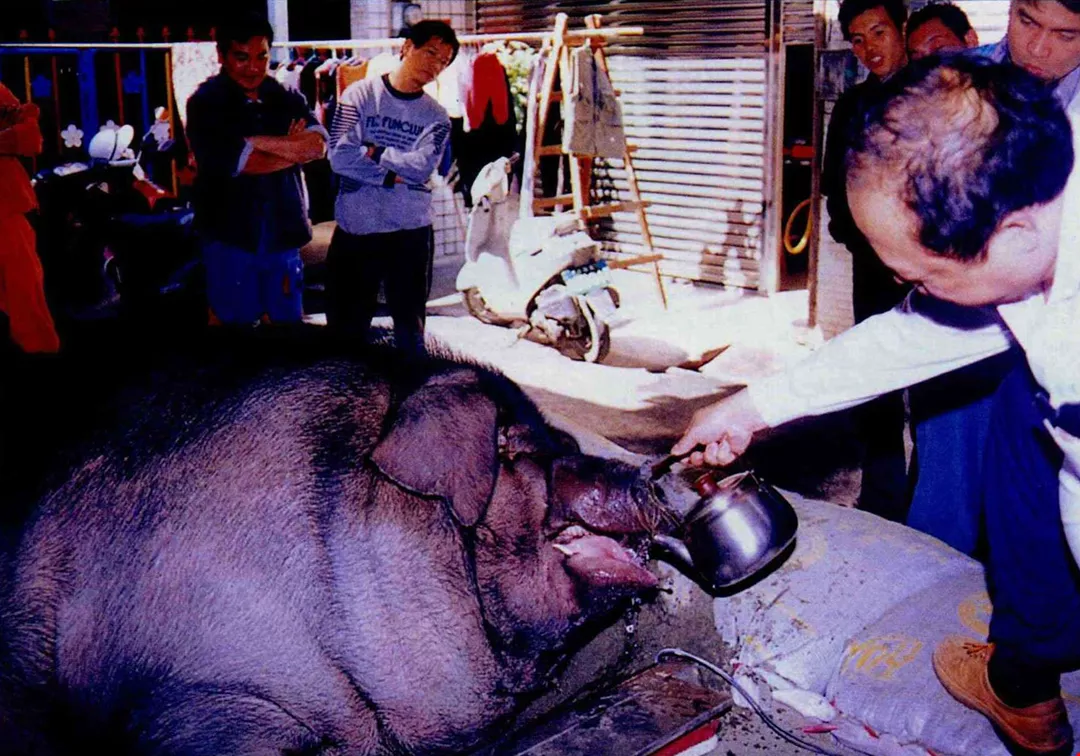
For many years farmers in Taiwan have competed to see who can raise the largest boars. The big porkers are treated with great respect, but they are so fat that they can hardly even roll over. Is this a form of cruelty? For the moment the Animal Protection Law has "reserved judgement" on such folk customs, but they may be banned in future. (photo by Chen Yu-hsien)
Happy free-range chickens
Once the relevant regulations under the new law come into force, pet owners will have to register their pets and pay fees, and dogs will have to have an identity chip implanted to prevent them being abandoned by irresponsible owners. There will also be specific regulations on how to catch stray dogs humanely.
It seems reasonable to protect pets, as humans' intimate companions. But is it necessary for poultry and farm animals, which serve as food for humans, to be carefully protected from fear and pain while they are being transported or slaughtered? Many people now in middle age remember chasing chickens as children. The hens which Mother raised would leisurely lead their chicks around the yard, pecking at little stones, taking sand baths, preening their feathers, and rushing to eat grain and leftover rice. When the cockerels had eaten and drunk their fill they would stretch themselves, spread their wings and have brief pecking skirmishes, and at dusk they would one by one fly up into the branches and fall asleep all in a row.
Today, Taiwan "consumes" one to two hundred million chickens a year. Whether introduced or local breeds, the vast majority are raised in enclosed spaces and slaughtered at only six to thirteen weeks old. They barely have room to spread their wings or turn round, and may even be force fed and injected with antibiotics.
As industrialization and urbanization have progressed, animal husbandry has also developed towards intensive rearing. Farmers invest large amounts of capital and technology, in the expectation of greater returns and yields. Furthermore, in today's world producers, distributors and consumers have little to do with each other. Divorced from the animals they eat and use, people regard them with indifference. There have been frequent cases in Taiwan of overcrowding at livestock farms, or of animals being left unfed or undernourished when prices fall. Long-distance transport and intensive slaughtering also cause distress to the animals.
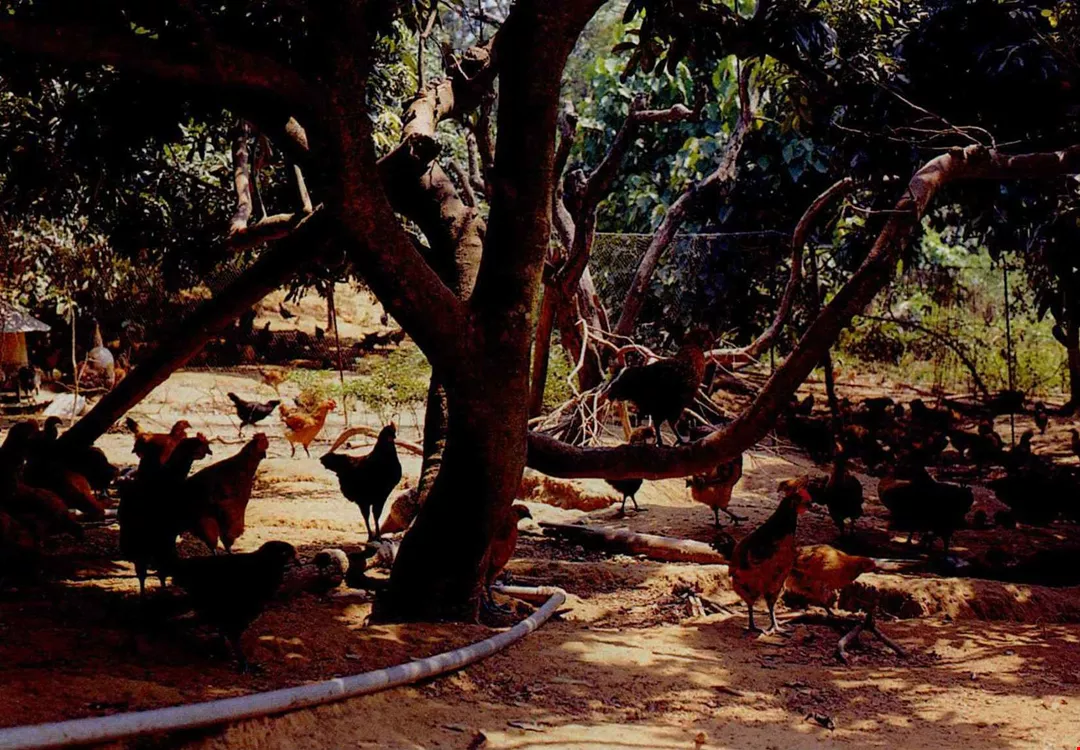
Compared with the modern practice of raising chickens and ducks by the thousands in closed batteries, the traditional free-range method of poultry rearing appears much more humane.
During the outbreak of foot-and-mouth disease the year before last, we saw harrowing scenes of diseased pigs being hurriedly buried alive in many places. "In the future, such hasty burial of diseased pigs will be punishable as inhumane," states Jefferson Lee, a researcher in the Livestock Administration Division of the COA's Animal Industry Department. He says that under intensive rearing conditions, there is an increased likelihood of disease or overproduction requiring a large number of animals to be destroyed. Farmers need regulations which provide guidance on how to deal with these animals more humanely. Lament of the laboratory animals
On TV we often see reports of Western activists attacking laboratories, freeing laboratory animals, and accusing research organizations of butchery. No similar conflicts have occurred in Taiwan so far, but in view of the general trend, the government "pre-emptively" extended protection to laboratory animals.
Domesticated fowl and livestock are reared to satisfy a basic human need, and there is actually little deliberate abuse in the process of rearing them. But laboratory animals are subjected to such procedures as forced organ transplants, being injected with cancer cells or being deliberately bred with various genetic abnormalities to facilitate experiments. This is why Western anti-vivisectionists are especially passionate. Although such research helps prolong human life and reduce suffering from disease, many people question its morality.
In Taiwan, animals have rarely been used for more controversial research, such as the development of cosmetics or military weapons. But there is growing use of animal research in the biotechnology, medical and pharmaceutical fields. The recently passed Health Foods Management Act requires that in future health foods must undergo toxicity trials. Last year alone the National Institute of Preventive Medicine used up 450,000 mice in pharmaceutical and medical research.
Hitherto, the only guarantee of laboratory animals' "rights" at research establishments has been moral obligation. "At present there is great freedom in the way laboratory animals can be used," comments John Yu, president of the Chinese Society of Laboratory Animal Sciences. Yu says openly that there is no rigorous control over such things as the number of animals used in experiments, whether they are destroyed painlessly afterwards, or whether they are subjected to further experiments before they have recovered.
Liang Shan-chu, director of the National Science Council's National Laboratory Animal Breeding and Research Center (NLABRC), says that researchers do indeed have room for improvement. For instance, in the past there have been cases of research establishments applying for animals but then canceling at the last moment, leaving the center with no choice but to destroy the surplus animals. Thus the animals were sacrificed in vain, and resources were wasted too.
In future, researchers will have to state in detail on their applications the number of animals they intend to use, the procedures to which they will be subjected and the possible effects on them, and the experiments may only be carried out after the application has been approved by an animal research ethics committee. But the regulations on animal experiments under the Animal Protection Law are being drafted by the COA mainly on the basis of advice from the NLABRC. Thus, as well as researchers fearing that their work will be bogged down in bureaucracy, some worry that with the NLABRC acting as "both player and referee," the law will turn out to be ineffectual.
Associate Professor Yeh Li-sen of National Taiwan University's Department of Veterinary Medicine explains that thus far no "alarm bells" have rung among the public on this issue, and people involved in research using animals have the best understanding of actual conditions. Thus it is best to let them establish workable ground rules, to avoid the risk of introducing a system which is impracticable. As public interest in the issue grows, one can then seek further improvements. Many grey areas have been left to be decided by the future laboratory animals ethics committee. For instance, the question of whether using stray dogs for experiments should be allowed requires more debate and public consensus.
"Compared with other countries' laws, our Animal Protection Law merely sets a basic initial standard." Yeh Li-sen says that in order to reduce the social impact, many provisions have been watered down. Animal rights
The animal protection laws in place in Western countries are the result of long periods of maturation and debate. Opinions about the goals of animal protection also come in many different shades. At the most extreme, there are those who oppose any use of animals to gratify human needs, and take the view that even the improvement of animal breeds for human benefit is immoral.
Some go so far as to reject the notion of human superiority over other species implied by using the word "protection." Thus in both the Netherlands and the US the word "welfare" is used instead, and the relevant laws are termed animal welfare legislation. Inspired by awareness of human rights, some people have also proposed the concept of "animal rights." Although such questions as whether animals can think, and how to accord them rights, are controversial, this trend has nonetheless encouraged people to actively seek alternatives to using animals in experiments, and has gradually led to stricter laws and regulations.
For instance, in Germany there are regulations covering all aspects of stock rearing and slaughtering, from the height of the roof over abattoir enclosures and the height of the passage to the point of slaughter, to the provision of bathing facilities and an adequate supply of clean drinking water. Different space requirements are prescribed for pigs, sheep and cattle, and after their tiring journey to the abattoir, animals must be given eight hours' rest before they can be slaughtered.
In scientific establishments, the preliminary stages of many experiments can now be carried out directly on cells taken from the human body. Although there is no way round eventual tests on animals, at least the number of animals sacrificed can be reduced.
Shen Fu-hsiung recounts how when he was studying in the USA, he was closely questioned by a member of an animal experiments authorization committee about a small procedure like castrating a laboratory mouse. The committee member asked him such things as: "Will it hurt the mouse? How much anesthetic will you use? Will you sew up the wound?" which to a physician seemed very uninformed and silly.
"But this is the trend of the times," says Shen, adding that animal protection legislation is a necessity in a civilized society. Whether a human society is civilized is reflected not only in relationships between people, but also in people's behavior towards animals. Just as the idea behind child welfare legislation is the demand that adults should respect children, animals involved in the workings of human society also need people to legislate on their behalf and gain for them the most basic "right" of not being subjected to undue fear or physical cruelty, in the same way that people show concern for disadvantaged groups.
The cost of moral values
"Of course, the rules imposed by society increase the administrative burden on researchers, but scientists can't just pursue efficiency to the neglect of morality and conscience." Yang Tien-shu, a research fellow at the Taiwan Pig Research Institute, says that in the past livestock farmers only spent money on promoting profitability, but now they also have to spend money on protecting the environment, and one can say that the advent of animal protection laws will add a "moral" component to their production costs. The livestock industry must not allow animals to endure unnecessary suffering in order to reduce costs.
But in deciding what level of protection animals should be given, one still has to take the real world into consideration. If chickens, ducks and pigs are all to be reared in a free-range setting, this is likely to cause greater damage to the environment. And should vermin which threaten humans' living environment also get favorable treatment?
Extreme views are unlikely to be accepted by the majority. "We don't even have halfway houses for people, so how can you talk about homes for animals!" Such comments were typical of the reaction when recently, in response to the Animal Protection Law's provisions, county and city governments throughout Taiwan put forward plans to build luxuriously appointed halfway houses for stray dogs.
The clock can hardly be turned back so far as to allow more than 200 million chickens to return to nature. But, says Yang Tien-shu, "there's plenty of room for improvement as far as reducing animals' distress before slaughter is concerned." Yang says that over 50% of pigs in Taiwan are still slaughtered by hand, usually without being stunned first.
Pigs are intelligent animals and rather sensitive to the atmosphere around them. At auction grounds one can often see them trembling and fainting with fear. In future manual butchering will have to give way to mechanized slaughtering with electric stunning. The well over 100,000 chickens and ducks consumed in Greater Taipei each day will also have to be slaughtered electrically close to the farms in central and southern Taiwan, to reduce the suffering they now endure when transported tightly packed in cages.
Far from the slaughter?
The requirements for humane slaughter include a ban on "slaughtering animals in public places or in places to which the public have access." This will oblige market vendors of fish and poultry to change their way of operating, and in turn may force many ordinary city dwellers to adjust their shopping habits, thus impacting their everyday lifestyle. As well as the use in leisure angling pools of hooks which snag the fishes' skin being clearly defined as cruelty, the practice in seafood restaurants of killing fish openly in the restaurant to prove that they are fresh will also be classed as illegal.
Last year in San Francisco ethnic Chinese were faced with the demand that they should not slaughter animals at market, but the Chinese engaged a lawyer and successfully appealed on the basis of minority cultural practices. Some people felt that the Chinese involved devalued themselves by calling this practice a "cultural characteristic," but it cannot be denied that people of different nations often have different ways of using and dealing with animals.
What is the thinking behind the prohibition in Taiwan's Animal Protection Law on animals being slaughtered in public places? Has the practice of slaughtering chickens and fish at market, as carried on for hundreds or even thousands of years, really suddenly become evil? Many people have childhood memories of hearing their grandmothers recite sutras while killing chickens, to help the birds' souls into the next incarnation. This helped them realize that there are things in life beyond one's control, giving them greater compassion for living things. Should inevitable aspects of the cycle of life, such as birth, aging, sickness and death, be hidden from people's gaze?
"Witnessing death and witnessing cruel killing are different things," counters Yeh Li-sen, who says that although witnessing and becoming accustomed to the slaughter of animals does not inevitably lead to an abusive and violent character, it is a fact that many violent criminals have a record of abusing animals as children. Hence the Animal Protection Law seeks to prevent children being exposed to the negative example of acts of killing, and in the future the government will suggest that markets provide areas out of public view for slaughtering animals. In future, schools too "shall not, except as prescribed in Ministry of Education curricula, conduct teaching exercises likely to cause injury or death to animals." The biology-class frog dissections which many children find so off-putting can also be replaced by video tapes or other teaching methods. Changing times, changing values
But where social customs and lifestyle habits are involved, such as spring chicken chases or eating dog meat, more time is needed to reach a public consensus. Hence the Animal Protection Law leaves the COA the option of granting individual exemptions.
In fact, customs and habits are not immutable. As far as eating dog meat is concerned, Yeh Li-sen feels there should be public debate in Taiwan as soon as possible about whether it should be banned-we should not keep avoiding the issue. Some people worry about Taiwan's international image, especially because-due to the elevated status of dogs in the West since keeping pets became fashionable there in the 17th century-Western societies have a low tolerance for other cultures retaining the custom of eating dog. But this isn't just a case of slavishly following mainstream Western ideas-if we only think of how dogs have been man's best friend for thousands of years, and how living in Taiwan today we have adequate sources of protein and really don't need to develop another animal as food, surely many people would already agree that we shouldn't eat dog.
Similarly, although people in Taiwan believe the meat from electrically slaughtered pigs is not as good as freshly slaughtered, manually butchered pork, this opinion may change as electric slaughtering techniques improve and people's views on the value of animals' lives evolve. Yang Tien-shu says that today commercial practices have changed, and so have people's lifestyles; with evening markets and refrigerators, storage is not a problem. There are very few people under 30 nowadays who could still slaughter a chicken themselves, and everyone buys chicken meat ready cut. Lifestyles do not remain unchanged over the millennia, and as times change moral standards can also be adjusted. "The future consensus can be different from the past consensus," says Yang. Not the 82nd horse-racing nation
All-embracing as Western countries' legislation on livestock and laboratory animals may be, where long-standing cultural practices are concerned, those countries too cannot easily break with the past.
In the USA, which is today seen as doing the most to protect animals, there are still 21 states where dog racing is allowed. In view of the fact that 81 countries allow horse and dog racing and betting, some people find Taiwan's Animal Protection Law "over the top."
"As a veterinary surgeon you might not expect me to oppose horse racing," says Yeh Li-sen. He comments that for centuries horses have been accustomed to being ridden, and having to gallop and to jump over obstacles. But that is different from training them to race without regard for their own lives. The European Union opposes betting on horse racing, and as early as the 18th and 19th centuries Britain gradually introduced laws to regulate it. But with so many people's interests involved, it would be very difficult to eliminate it completely.
The Taipei County Government recently cracked down on dog fighting, but Britain's animal protection laws explicitly prohibited setting dogs on each other as early as the beginning of this century, and in 1988 the penalties were increased. In particular, following a spate of dog attacks on humans, Britain now forbids rearing pit bull terriers, which are bred to be especially aggressive.
In the USA there have been many reports of large numbers of greyhounds being killed. In Arizona there was a case of 143 greyhounds being killed and dumped in a lemon grove after their racing days were over. This prompted members of the Arizona House of Representatives to propose a law to penalize people who kill racing dogs and to more strictly regulate dog tracks.
"Who sees these darker aspects?" asks Yeh Li-sen. He says that unlike other laws which benefit humans themselves, animal protection laws have no direct bearing on people's welfare. Hence it is not easy for them to gain acceptance. But by being a step ahead of society's moral values they can lead the way in changing attitudes. Perhaps society is not fully ready for this legislation, but we need it so that we do not have to go through a slow and painful process of conflict and of seeking solutions by trial and error. We do not have to repeat other countries' past mistakes.
Furthermore, although various countries' animal protection laws may differ in the degree of protection they give, they are all inevitably moving in the direction of greater overall protection. Recently, for instance, for the good of its tourist industry, Thailand moved to make cockfighting less brutal by forbidding the practice of tying sharp blades to the birds' legs and wings.
Not dumb
"The Animal Protection Law doesn't have to be seen from a high moral plane," says Shen Fu-hsiung: animal protection laws are as much to do with human welfare as with animal welfare.
Stray dogs are a health hazard and a danger to traffic, and may attack children; there are also public health issues associated with poultry and livestock being butchered at the point of sale. A vet who oversees the slaughter of poultry at a Taipei City poultry market says it actually makes no difference to the chickens whether they are slaughtered electrically or manually, but the public health problems associated with manual slaughter, such as floors covered in blood and feathers flying everywhere, urgently demand improvement.
There have also been news reports of laboratory rabbits finding their way onto the market and being served up at night-market food stalls. "It would be more accurate to say the law is intended to protect humans than animals," says Jefferson Lee.
Many people take a negative view of the Animal Protection Law, but for livestock farmers the concept of "animal welfare" is nothing new. Just as described in "The Yorkshire's Twilight," in their own best interest farmers would traditionally make sure that their animals' basic ecological and biological needs were satisfied. Thus the animals lived happily.
Yang Tien-shu notes that it is very important for pigs, which are social animals, to be able to give vent to their emotions and to have a stimulating environment. Bored pigs will bite each other's tails and ears or even eat their own droppings. Hence hanging up chains and old tires and putting down straw can make their lives fuller and more meaningful, which in turn can reduce stress, restore social order and eliminate "disruptive behavior."
Just like humans, pigs are averse to confined spaces. Hence it is best not to rear more than 30 in the same pen, or they are likely to engage in bloody group battles and gain weight slowly, thus causing serious losses for farmers. There are many areas in which the Animal Protection Law coincides with good farming practice-no-one neglects their own "means of production." With economic incentives, livestock farmers can do just as well as anyone else.
NLABRC director Liang Shan-chu says that as far as the new law's provisions are concerned, the center has little scope for improvement in the short term, because not only are the rooms in which the animals are reared kept clean and at suitable temperatures, but the animals' drinking water is even filtered, and out-of-date feed is not used. Protection measures have long been incorporated into the animals' management. After the law was passed, the US-based International Council for Laboratory Animal Science congratulated the center on its good treatment of its animals. As well as symbolizing improvement in Taiwan's humane image, this also represents an advance in the quality of scientific research. ID's for country dogs too?
As for how well individual owners treat their animals, in the future there will certainly be difficulties in enforcement. Chen Chi-tung, former president of the Taipei Veterinary Medical Association, says that although the Veterinary Surgeons' Act has been in force for many years, many pet beauty parlors continue to give immunization jabs to pets even though they have no licensed vet on their staff. This is in clear breach of the regulations on the use of pharmaceuticals on animals, yet only one or two cases a year are prosecuted. "If they don't prosecute the blatantly illegal pet shops out on the streets, who is going to go from house to house checking on whether pet dogs are given enough space?" asks Chen.
Prosecutions for animal abuse are unlikely unless members of the public volunteer information to the authorities. But this compares with the Children's Welfare Law: although it has been on the statute books for some time, most people still have the attitude that they have no business interfering in how other people discipline their children.
"Initially we can only address a few of the biggest problems, which cause the greatest suffering to animals," says Yang Tien-shu. In his view the most urgent concerns are what to do with several hundred thousand stray dogs, and what methods are used to slaughter several million pigs a year. It really will not be possible to worry about how someone living in the mountains who keeps two chickens goes about slaughtering them, or whether dogs in the countryside, which are usually kept outside, have ID chips implanted, and whether they are always accompanied by humans when they are allowed out. "But if we start from the biggest problems, once the public at large gets involved the smaller problems may be solved quite easily too," says Yang optimistically.
But what about the size of the enclosures in which animals are reared, the number of animals transported together in vehicles, whether chickens' cages are full of feed which has gone sour, whether odors are kept under control, and so on? There are so many things to do and specific situations involved that "improving things will take time, especially in the areas where the law affects people's livelihoods," says Hsu Kui-sen, chief of the COA's Livestock Administration Division.
The Yorkshire's Twilight
"Before conducting an experiment, please weigh the possible results against your conscience." These words are printed on application forms for permission to conduct experiments on animals in Germany. Meanwhile Britain requires all scientists doing experiments on animals to attend ethics courses.
For animal protection to be genuinely implemented not only requires the full force of the law, but also constant reminders and self-examination in education and culture.
In "The Yorkshire's Twilight," when Taiwan's frozen pork export market begins to develop, the Taiwan Sugar Corporation starts raising large numbers of pigs. Small farmers are unable to compete, and many have to sell their animals. By this time the Yorkshire is getting old, and his owner shakes his head as he looks at him again and again with a kindly, sorrowful gaze. The Yorkshire thinks to itself: "Why is the boss still keeping me? It must be more out of sentimentality than for my usefulness. . . ."
As we stand on the threshold of the 21st century, the Yorkshire can only walk into the sunset. But will the mutual affection between humans and animals, formerly based on mutual advantage, also fade away, so that it can only be kept alive by legislation?


@List.jpg?w=522&h=410&mode=crop&format=webp&quality=80)


