Dancing With Fire: Ho Jen-zon
Chang Chiung-fang / photos courtesy of Ho Jen-zon / tr. by Chris Nelson
July 2009


Fireflies are delightful playmates of many during childhood. But with the environmental damage that accompanies growing industrialization, it has become harder to see traces of them. "As a conservationist, I feel I have a mission and obligation to defend their right to exist," says Ho Jen-zon, chief of the Low Altitude Experimental Station of the Taiwan Endemic Species Research Institute. Though he knows he can't fix the environment all by himself, "I'm working hard at it and doing what I can."
Thankfully, Ho is not alone in his firefly stewardship efforts. More and more community residents are pitching in, their hard work kindling shimmering lights all over Taiwan.
Some people enjoy chatting and having some beers with a few friends; others prefer escaping from their cares by reading and listening to music. Ho, however, loves to stroll alone in pitch-dark forests, opening his eyes and his heart, spending a quiet hour or two communing with fireflies. Ho finds this the most contemplative form of enjoyment in his life. In his eyes, each firefly has its own beauty and demeanor: some coquettish, some reticent, some romantic.
This past March, after undergoing surgery for a myocardial infarction, this eco-conservationist who constantly seeks habitats for fireflies began to formulate ideas for his retirement. Yet despite his impending retirement, Ho cannot let go of his fixation with fireflies. "My greatest wish now is to buy a small hill after retirement and build a home for fireflies."
Fireflies go through four stages of metamorphosis: egg, larva, pupa and adult. The photo on the left shows snail-eating larvae, in the middle is a pupa, and on the right are adults mating.
Nocturnal life
With a master's degree in entomology that he completed at National Chung Hsing University in 1992, Ho has conducted entomological research both at the university and at the Taiwan Endemic Species Research Institute. After being commissioned by the Tainan County government in 1995 to conduct a firefly survey, Ho set out for the underbrush and never turned back. In addition to doing field surveys, he also travels to communities and schools to promote science education and takes part in international conferences all over the world. Ho is like a firefly himself, constantly striving to light up the darkness, not letting others ignore his existence.
After Ho became chief of the Low Altitude Experimental Station, his administrative work cut into his firefly research time. But no matter how hectic things got, he would still find time to conduct surveys and record data around Taiwan. Barely two months after his heart surgery he was invited to carry out a survey in Matsu. "The fireflies there are quite unusual, feeding on millipedes," says Ho, barely containing his excitement.
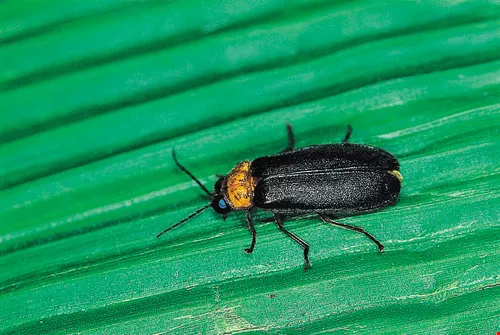
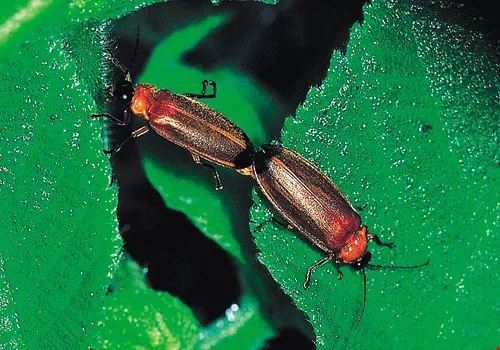
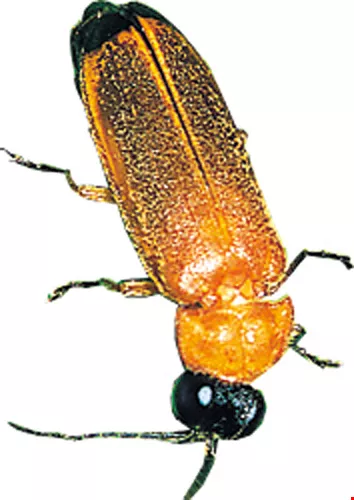
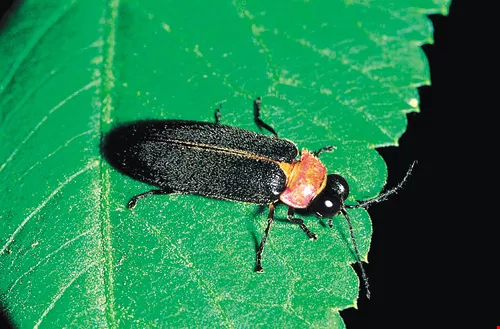
(left to right) Luciola kagiana (April-June) likes to fly around in wooded areas, and it flashes its lights with a relatively quick frequency. The black-winged firefly (Luciola cerata) (March-June) prefers to congregate over meadows, flashing in unison. It's a species well worth watching. Luciola anceyi (June-August) is numerous and widely distributed, preferring to flit about the treetops. The orange firefly (Diaphanes citrinus) (September-November) is a common autumn firefly living in Taiwan's low- to mid-elevation mountains.
Searching for lightning bugs
With vast numbers of vanishing species around the world, what is it about fireflies that makes them so important and Ho so infatuated with them? Just like carnivorous animals such as eagles and owls, fireflies, which eat snails and shellfish, occupy a high position on the food chain. If lower links in the chain are affected, it will influence the fireflies' living conditions. Thus, these insects serve as an excellent gauge of the condition of the natural environment.
Firefly larvae feed on small mollusks. During feeding, they latch onto their slow-crawling prey with their mandibles and secrete saliva that anesthetizes them. Next, external digestion takes place: digestive juices dissolve the food into liquid form, which they consume. Their mouthparts atrophy when they become adults, from then on normally consuming only dew. About 20 days later, after reproducing, they die.
Because of this, some people think that if you set snails free in an area, soon you'll see swarms of fireflies. "Impossible!" says Ho. For the species to survive, they need more than food; they also require a setting conducive to reproduction and other activities. If the habitat isn't just right, how can one hope to see fireflies?
Light pollution is a chief offender in the disappearance of fireflies.
"Light pollution interferes with fireflies' signaling abilities," says Ho. No matter how much effort they put into flashing their lights, they can't mate if they can't see each other. As a result, fireflies are doomed to annihilation in bright, neon-lit urban areas.
The Urban Forest-Bathing Area of Zuoying, Kaohsiung, is one of the few successful examples of urban firefly restoration. After three years of painstaking habitat conditioning and efforts by the city's Bureau of Public Works to minimize urban lighting during firefly mating season, these insects have finally found a place to live in the city.
In rural areas less affected by light pollution, fireflies are met with additional problems: water resources polluted by pesticides and herbicides, as well as inappropriate management of rivers and streams.
There are two kinds of fireflies: aquatic and terrestrial. Aquatic fireflies lay their eggs on clay mounds by the water's edge, so when concrete embankments are laid by streams and drainage ditches, suitable egg-laying spots are eliminated, hampering firefly reproduction. In Taiwan, only three such species remain: Luciola ficta, Luciola hydrophila and Luciola substriata.
Clean water is a necessary condition for the survival of fireflies. "Fireflies have quite high standards for water quality. To survive, they require an oligosaprobic environment; that is, one in which the water is rich with oxygen and low in organic matter."
On top of this, fireflies are unable to survive in places sprayed with pesticides and herbicides. "Fireflies are very sensitive to pesticides," notes Ho. He once fed firefly larvae with snails that he found by the roadside, and observed that the fireflies died soon after eating. He found after dissection that the narrow anterior gut of the larvae, which derive their nutrients through external digestion, was ulcerated by the pesticides consumed by the poisoned snails.
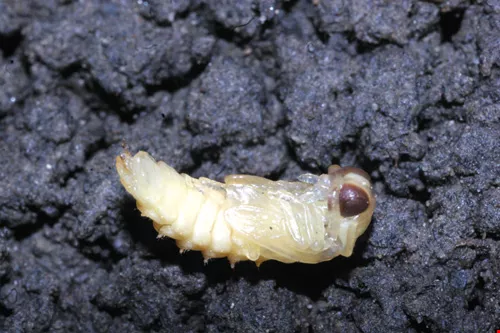
Fireflies go through four stages of metamorphosis: egg, larva, pupa and adult. The photo on the left shows snail-eating larvae, in the middle is a pupa, and on the right are adults mating.
The right conditions
Besides serving as an ecological bellwether, fireflies are well loved by people.
Ho mentions that the Japanese have a specially strong attachment to fireflies. Hayao Miyazaki's celebrated animated film Grave of the Fireflies is a wartime tragedy which begins with firefly lights flitting about in the grasslands and ends with a juxtaposition of fireflies and city lights. The story's protagonist is seen burying dead fireflies in remembrance of his mother.
The Japanese consider fireflies to be nature's commemorators, and each village has firefly conservation statutes tailored to local conditions. Taiwan, which was administrated by Japan for 50 years, carries on the Japanese tradition of knowledge of and emotional attachment to fireflies.
Fireflies belong to the family Lampyridae in the order Coleoptera. Over 2,000 firefly species in the world have been named, with 63 so far recorded in Taiwan. "This is a richer variety than in Japan with just over 40 species and Korea with 13." Of these, thanks to Ho's advocacy, the rare Pristolycus kanoi and Luciola hydrophila have been listed as protected species in Taiwan.
The most numerous and commonly seen species in Taiwan is the black-winged firefly (Luciola cerata). This firefly's penchant for flitting about in grasslands and along forest paths as well as its large green lights make it well suited for observation.
On the plains, the most commonly seen species is Pyrocoelia analis. This species ranges in areas under 300 meters in altitude, and its glittering yellow-green lights can be seen on the plains from April to October.
According to Ho's surveys, evidence of firefly activity can be seen Taiwan in all four seasons from the sea coasts to mountains up to 3,500 m high. But the areas with the greatest number and variety of fireflies are mountainous regions with elevations under 800 m.
"Fireflies prefer cool, humid habitats sheltered from the wind and with no light pollution," says Ho. For example, the Daxueshan Community of Heping Township, Taichung County, at an elevation between 850 and 1,200 m, boasts humid valleys and expansive forests. Moreover, local residents willingly turn off their lights and quiet down at night for the fireflies. The favorable topography and human cooperation have made this community a successful model in firefly restoration.

Known as the "Father of the fireflies," Ho Jen-zon is so fascinated with these shimmering little bugs that he wants to grow old with them after retirement.
Firefly love songs
Though unassuming in appearance by day, fireflies start showing their radiance at nightfall, resembling terrestrial stars. This enchanting, mystical light captivates Ho.
But fireflies aren't the only life forms on the land that emit light. There are phosphorescent mushrooms, for instance. There is also a species of springtail; however, its body is so small as to render it invisible, making it hard for people to be even aware of its existence.
Why do fireflies glow? How does the glow differ from, say, that of luminescent jellyfish?
Both organisms emit light, but jellyfish and fireflies have different mechanisms of fluorescence. Within the body of a luminescent jellyfish is a special protein, aequorin, which produces a green glow when it comes into contact with a calcium ion. The source of a firefly's glow is luciferin within its light-emitting cells, which produces energy through peroxide catalysis. Only 2-10% of the energy is converted into heat, with the remainder being given off in the form of light (called "cold light").
"Knowledge of how and why fireflies glow is limited among biologists," notes Ho. According to overseas researchers, the purpose of firefly luminescence is to seek mates and communicate, and it may also serve as a warning to enemies.
The riddle of firefly luminescence is excellent material for guides and firefly watchers. Says Ho, academic descriptions of luminescence are not detailed or accurate enough. After completing his Taiwan-wide habitat survey, he plans to categorize the light-emitting properties of Taiwan's fireflies, as if compiling a compendium of firefly love songs.
Firefly luminescence is not a simple subject. Different species emit light with different patterns, brightnesses, colors and continuities. Some give off reddish-orange light, such as Luciola kagiana; others emit yellow-orange light, like Luciola anceyi and Luciola trilucida); others shine with yellow-green light, including Luciola hydrophila, the mountain firefly (Lychnuris praetexta), Curtos obscuricolor, and the orange firefly (Diaphanes citrinus); and still others glow blue-green (Cyphonocerus sanguineus).
Just as colors differ greatly, so do the patterns of the flashing. Interestingly, environmental temperatures affect the pattern frequencies. The higher the temperature, the faster the flashing. Ho mentions that some friends of his, who run a firefly farm in Pingtung, transported fireflies from the north to the south after the peak May firefly season in the south had passed, so that tourists could enjoy fireflies for a longer period. Ho, who had been invited to attend, found by happenstance that the flashing of the black-winged firefly, originally from the north, quickened its pace after arriving in Pingtung, making it hard for him at first to identify it on sight. He almost thought he had discovered a new species!
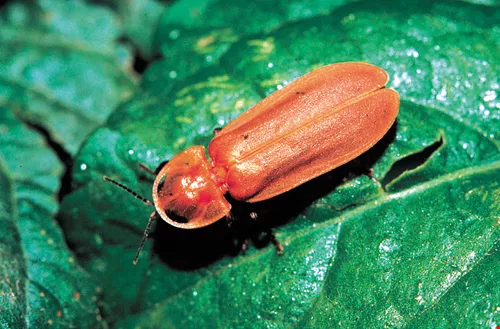
(left to right) Luciola kagiana (April-June) likes to fly around in wooded areas, and it flashes its lights with a relatively quick frequency. The black-winged firefly (Luciola cerata) (March-June) prefers to congregate over meadows, flashing in unison. It's a species well worth watching. Luciola anceyi (June-August) is numerous and widely distributed, preferring to flit about the treetops. The orange firefly (Diaphanes citrinus) (September-November) is a common autumn firefly living in Taiwan's low- to mid-elevation mountains.
Showing up without invitation
In recent years, some have used artificial means to raise fireflies (mostly the aquatic firefly Luciola ficta), selling them to eco-farms and reconditioning projects for breeding. But while a butterfly completes its life cycle through the egg, larval, pupal and adult stages in just over 30 days, fireflies need a year. This takes long-term nurturing and food preparation, consuming a great deal of effort, to produce a mere 20 or so days of glowing swarms. One can say that this is one of the more costly insects.
It is not hard to raise fireflies, but it is not easy to boost their numbers in the wild.
For instance, over the six-year restoration of Taichung's Dakeng Scenic Area, some 1,000 to 2,000 Luciola ficta larvae were released into the area each year. But there has been a low survival rate for the larvae due to water pollution from pesticides and herbicides used on nearby mandarin orange plantations. The proportion reaching adulthood and breeding is estimated to be only 10-20% of those that hatch naturally each year. Serious flooding and landslides from typhoons can also wipe out firefly eggs that are incubating in mounds of earth by the water.
"Directly releasing larvae and adults is not a very effective method and should not be encouraged," says Ho. The goal of firefly restoration is not the enjoyment of people; rather, it is to preserve habitats. Ho tells us that habitat changes that lead to firefly die-outs may also threaten human beings. From another standpoint, as long as a suitable habitat is available, the fireflies will show up without invitation. "Isn't it best to let nature look after them?"
Tianshan Farm in Sanxing Township, Yilan County, is an excellent example. The farm's director, Huang Zhengde, who used to raise pigs for a living, once planted willows by a riverbed on property he bought. One day, after the trees had grown large, he suddenly noticed that the area under the trees was swarming with fireflies. He had not known that these willows would attract these charming guests. This inspired him to start up a leisure farm, with firefly conservation as one of its goals.
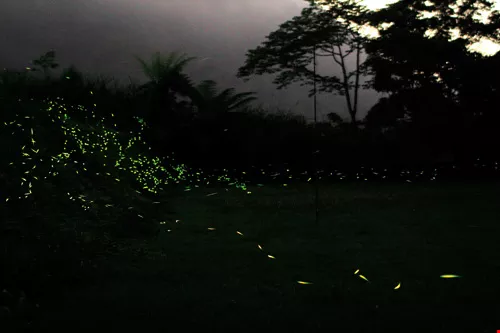
An impressive sea of firefly lights appears at the Low Altitude Experimental Station of the Taiwan Endemic Species Research Institute, headed by Ho, which is located in Heping Township, Taichung County.
Fathers of the fireflies
As among the few scholars in Taiwan to study fireflies, with over a decade's worth of work, Ho, along with another scholar, Prof. Chen Jen-chiao of the National Pingtung University of Science and Technology, are lauded in Taiwan as "Fathers of the fireflies." But due to fireflies' glow-by-night peculiarity, Ho has to go far from his wife for long periods when he surveys firefly habitats. This is especially true from March through October when peak periods of firefly activity take their turns, requiring him to remain in the field often until after 10 at night before he can go home. Not only does he have little time to eat dinner with his wife and children, but he's sometimes so busy that he barely has a chance to speak to them. This is a matter of great anguish and regret for Ho, who says "I consider myself lucky that my wife hasn't left me!"
However, at the fall of night, when the scintillating points of light flit about the mountains and plains, Ho cannot resist the urge to step out into the wilderness. Whether it's his fascination for bugs or his mission as an eco-conservationist, Ho's love affair with fireflies is difficult to describe to outsiders.
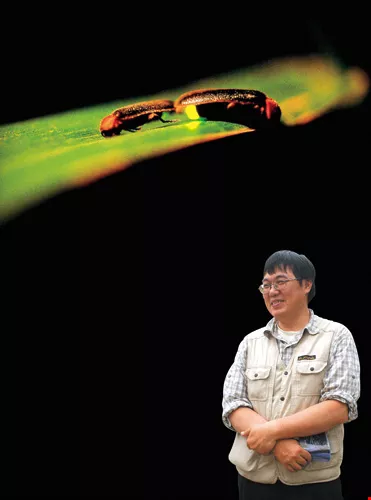
Firefly Fact File
Taxonomic classification: Class Insecta, Order Coleoptera, Family Lampyridae.
Natural enemies: Fungi, spiders, fish, shrimp.
Growth stages: Egg (18-25 days; or 90-150 days in winter); larva (three to 10 months), pupa (seven to 14 days), adult. As adults, they have 10-20 days to mate and lay eggs before they die.
Reproduction: One generation per year. For most species, a female can only lay one brood per year, each time producing 100-300 eggs.
Diet: Aquatic larvae feed on shellfish; terrestrial larvae feed on snails, slugs and earthworms. Adults only consume dew water.
Luminescence characteristics: Most fireflies glow during the larval stage ("glow worms"), but they can't easily be found because the glowing underside is hidden by the ground. Males have two tail segments that glow quite conspicuously; in females, only one tail segment has a light-emitting organ. They die immediately after mating and egg laying. Also, contrary to a Chinese adage, fireflies in a sack can't generate enough light to read by.
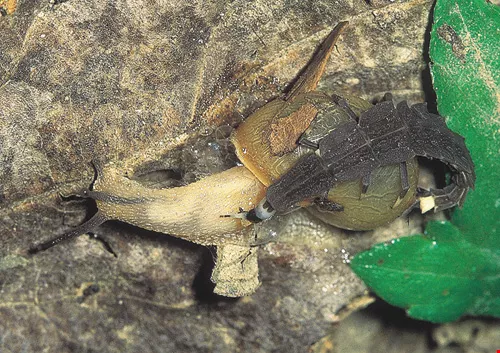
Fireflies go through four stages of metamorphosis: egg, larva, pupa and adult. The photo on the left shows snail-eating larvae, in the middle is a pupa, and on the right are adults mating.
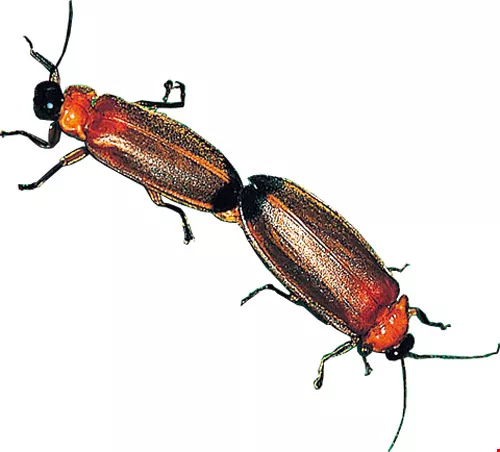
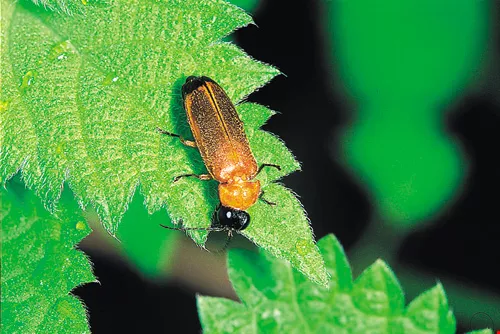
(left to right) Luciola kagiana (April-June) likes to fly around in wooded areas, and it flashes its lights with a relatively quick frequency. The black-winged firefly (Luciola cerata) (March-June) prefers to congregate over meadows, flashing in unison. It's a species well worth watching. Luciola anceyi (June-August) is numerous and widely distributed, preferring to flit about the treetops. The orange firefly (Diaphanes citrinus) (September-November) is a common autumn firefly living in Taiwan's low- to mid-elevation mountains.

_DSC2938@List.jpg?w=522&h=410&mode=crop&format=webp&quality=80)

@List.jpg?w=522&h=410&mode=crop&format=webp&quality=80)


