Escaping Poverty--Mother Cheng and Her Daughters
Kaya Huang / photos Jimmy Lin / tr. by Anthony W. Sariti
December 2007


"I believe poverty is created by the social system. If the poor are given opportunities, they can become wealthy. If poor people are able to receive financial assistance they will have the chance to create the miracle of economic development. Their own dignity is their guarantor." These were the words of Muhammad Yunus, known as the "banker to the world's poor," in an interview he gave to the US press upon learning he had been awarded the 2006 Nobel Peace Prize.
Over the last 20 years, under the pressures of changing industrial structure, globalized competition, and the dysfunctional and disintegrating family, the gap between rich and poor has gradually widened in countries around the world. The poor have gotten poorer, the rich richer. Taiwan is no exception. From the cities down to the village level, many people are capable of working, yet they lack employment opportunities. They have been called the "new poor."
The new poor have a bitter pill to swallow, yet many refuse to be disheartened. They know pessimism and complaining can only drag them down further, that only by gritting their teeth and struggling can they find the road to their own and others' salvation. Mother Cheng, who lives in Kaohsiung County, the area with the lowest disposable income in all Taiwan, is a good example. With help from the government's "Great Warmth" policy, and through her own determination, Mother Cheng has warded off the blows of adversity.
Our story begins in Yenshan, Kaohsiung County, in southern Taiwan.
"He didn't just beat me; when the children were in kindergarten he started beating them as well. But I was naive and didn't realize this was domestic violence." Fifty-three-year-old Mother Cheng pours out her story. For wives of the previous generation, the husband was king and the wife was the husband's "property." So when a wife was hit by her husband, she did not respond; when she was cursed, she did not trade insults. Such was her wifely "duty." A primary school graduate, Mother Cheng began taking care of her family after marriage and unfortunately had an abusive husband. When things didn't go his way, her husband, who did construction work, was likely to drown his sorrows in drink.
"Normally, things were OK. But when he started drinking, everything irritated him. If you didn't do just as he said, he would turn the whole place upside down," says Mother Cheng tearfully. When her husband raised his fists at the young girls, Cheng thought nothing of the blows that might fall upon her and only of protecting her daughters. The punches and kicks that ensued there in the living room are a painful memory that is etched deeply into the minds of the three girls and their mother.
For the sake of "not breaking up the family," Mother Cheng and her three daughters endured this treatment in silence until four years ago. Unable to take it any more, the second eldest daughter, who was 14, picked up her cell phone and dialed 113, the domestic violence hotline. When the police came, the drunken father was still in the living room ranting and raving. That night Cheng and her daughters stayed at the police station. They sat there cold and despondent, but small flames of hope had begun quietly to take shape.
From that day on, Mother Cheng never again set foot in her home. At the police's suggestion, she applied for a restraining order and rented a place for herself and her daughters 100 meters behind her original home. Unfortunately, her husband found her there. When the petite Mother Cheng heard the familiar roaring at the front door, she was frightened to death. "You're not afraid I can knock you dead with one punch? You can get all the court orders you want, it means nothing to me!" Her husband was constantly at the door threatening her. If he wasn't waving a cleaver at her, he was setting off firecrackers to harass her.
Mother Cheng felt things could not go on like this. She made a momentous decision and that night moved to Taliao Township, ten kilometers away. Because she had no job or savings, she joined the ranks of the 1.38 million "new poor" in Taiwan.

Even though the picture of her life is missing the image of a peaceful and happy home, the youngest Cheng daughter does not blame everyone else but strives upward with a positive spirit.
Coming to terms with poverty
"Some of Taiwan's new poor are alcoholics, drug addicts, or gamblers, or come from broken homes. Most do casual work or are members of single-parent households. Mother Cheng is a classic example," says Chen Mei-li, specialist in the public assistance section of the Kaohsiung County Bureau of Social Affairs (BSA). Such people, with low wages, low skills, living on the margins of poverty and earning just enough to stay alive, with a demoralizing quality of life and no power to become upwardly mobile, do not normally qualify as low-income households according to the government's criteria because they are technically employed.
Mother Cheng and her three daughters now live in a 60-square-meter apartment in Taliao where they moved after spending a year in an old house in Linyuan. With a table and chairs plus a computer table in the living room, guests can hardly even turn around in the place. To survive, Cheng initially held down two jobs as a dishwasher in a couple of restaurants, working over 12 hours a day for only NT$5,000. But she had to pay her three daughters' school costs as well as monthly rent of NT$3,000.
One night, riding home on her motorcycle, Mother Cheng crashed into an oncoming car at a cross street near her home. Because she had jumped a red light, she was at fault. Unable to work, she had also to bear the cost of all her medical expenses. The family's finances hit rock bottom.
How poor were they? "Every time I went to a store, even if it was for a NT$30 bottle of soy sauce, I had to see exactly how much I had on me before I dared go in." She also thought of ways to economize, like in the Japanese movie Gabai Granny (2006): "Going to bed early can save on electricity." For those with no ready money, a dollar saved is a dollar earned. The nightmare of being "hounded to death for a dollar" often startled Mother Cheng awake in the middle of the night.
Fortunately, her three daughters are sensible girls. To save NT$10 on her bus fare, the eldest daughter forced herself to get off two stops before her destination. The youngest daughter was studying in the Cosmetology Department at the private Shu-te Home Economics and Commercial High School; to pay the school fees of NT$20,000 a semester, she rushed off to the Han-Hsien International Hotel right after her classes, with no time out for dinner, to work for NT$90 an hour and lighten her mother's burden a bit.
But no matter how hard you try to bear the bitterness alone, you can't ward off the pangs of hunger. The second daughter, then studying at Kaohsiung Municipal Girls' Senior High School, decided to seek outside assistance. She applied for student aid through the Kaohsiung City Social Affairs Bureau. But because the family's registered domicile was in Kaohsiung County the request was referred to the Kaohsiung County BSA and ended up in the hands of Chen Mei-li. Chen was sympathetic to the family's situation but because financial assistance to low-income households was determined on the basis of household income, personal property and real estate holdings, and Mother Cheng was not yet divorced from her husband, her husband's property and income meant they were not entitled to financial assistance, nor to student aid for her three daughters.
"In practice, many problems arise because of these inflexible criteria, which lead to many people in desperate need not receiving protection from the social welfare network. They are left to cope on their own," says Chen Mei-li.
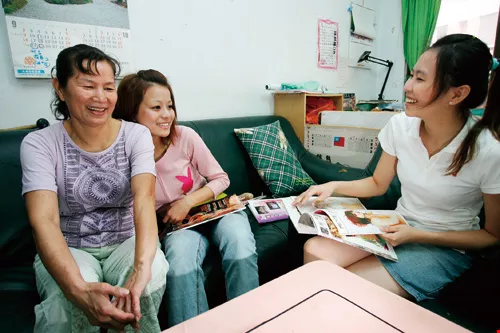
In addition to the public sector financial assistance under the Great Warmth project, Yang Yu-lin, a staff member of the Philanthropic Association of Kaohsiung County, visits the Chengs each week to offer emotional and spiritual support.
Getting out of poverty
Seeing the gaps in the social welfare system, the government felt the need to care for disadvantaged families. To revise the relevant legislation would probably be too slow an approach to save the situation, so on New Year's Day, 2007, the Executive Yuan began to implement the social welfare program known as "Great Warmth." Priority was given to helping disadvantaged families and a free telephone hotline was provided for people in need of help. This program immediately pulled Mother Cheng and her family under its wings.
Through the BSA and with the help of civil organizations like the Philanthropic Association of Kaohsiung County (PAKC), Mother Cheng first transferred her household registration away from her husband's and applied for financial aid under a program entitled "Up From Poverty-Hope for the New Generation." Under this plan each child can receive NT$4,000 a month in scholarship aid to continue their education. In addition, Mother Cheng was given an introduction to a job in the BSA staff cafeteria, earning about NT$15,000 a month. Although this is not much, at least the family's basic livelihood is now assured, and unemployment is no longer a concern. The stress of years of anxiety and tension has finally eased a bit.
"For the first generation, limited by insufficient workplace competencies, escaping poverty is difficult, and they can only get to the level of basic survival; for this reason, effort is spent in getting the second generation out of poverty primarily through guaranteeing educational opportunities," says Tien Li-fang, director of the BSA's public assistance section. For Mother Cheng's three daughters, one in college and the other two still in high school, tuition is reduced. They must pay just a few thousand NT dollars each semester and each month they receive NT$4,000 in school fees assistance. In addition to this assistance, the BSA and PAKC have provided the youngest daughter with funds to cram for the grade two cosmetology license examination. "At least in education, the children will not lose out to others at the starting line. They will not end up in abject poverty and will have a fair opportunity to get ahead," says Tien Li-fang.
"Other people enjoy domestic bliss and perfect family harmony. Why aren't we like that?" The youngest daughter, with a face like a movie star, does not openly blame anyone, but she is often awakened by the nightmare of her father's yelling and beating. Mother Cheng also says she has no resentments about her fate. "I am very independent now. I don't have to rely on anyone else, and I don't have to be abused. Many people help us. This society is warm and caring."
"My thinking is very simple. I go all out and work hard to make money. Some day I will be wealthy." Mother Cheng has a soft voice and a slight figure but like the clear light that pokes through the glowing sunset clouds on the western horizon, she dazzles the eye.


@List.jpg?w=522&h=410&mode=crop&format=webp&quality=80)


