Great Love, Great Change:A New Namasia in the Lowlands
Coral Lee / photos Jimmy Lin / tr. by Jonathan Barnard
August 2010


So that the traumatized and home-less victims of Typhoon Morakot would have a place to resettle, the ROC government, the Buddhist Tzu Chi Foundation and Foxconn Technology Group banded together to create the "Tzu Chi Great Love Village," at Yuemei Farm in Shanlin. This large town-building project was accomplished in 88 days. The number has commemorative meaning, since Morakot hit Taiwan on August 8, 2009, but it also is a particularly auspicious number in Chinese culture. Now efforts here are focused on finding employment opportunities for residents and laying a foundation for local industry.
Since the first refugees arrived at Great Love before the lunar new year, more than 3000 individuals comprising 695 households have come, including Aborigines from three villages in Namasia Township and eight in Taoyuan Township. Ethnic Han Chinese refugees from various townships in Kaohsiung County have also arrived. Meanwhile, basic infrastructure has been established at the Foxconn-funded Yonglin Organic Farm, which is next to Great Love Village. Crops have been planted, and the refugees have come for work and training.
Now that nearly 1000 refugees from Namasia have come to Great Love, which is being called a "model for post-disaster reconstruction," what are their lives like? And can the economic reconstruction and occupational training efforts provided by various groups truly assist these refugees in adapting to their new environment?
Now, a year after Typhoon Morakot hit, it's easy to find Great Love Village by taking Provincial Route 21 north from Qishan. The grass mounds and rock piles at its entrance create a visually arresting scene. Once you've entered, there are sweeping lawns and structures built out of driftwood. The wide, straight roads are made from interlocking pavers that allow for rainwater to pass through. The simple elegance of the gray pebbledash homes that line the roads and the small trees planted next to the drainage channels (which nevertheless seem somewhat sparse for the vastness of the space) are further demonstrations of ecological awareness. The street names-Hexi ("friendly") and Hexin ("harmonious at heart)-point to Tzu Chi's Buddhist values.
Great Love occupies 60 hectares and is divided into four zones: One each for Aboriginal families from Namasia and Taoyuan townships, one for those from Xiaolin Village, and one for Han Chinese refugees. It has three churches and three plazas for holding activities and celebrations. At the edges of the plazas are classrooms. The atmosphere combines peaceful seclusion with vast open spaces. It's very much like the Great Love villages that Tzu Chi has built overseas. Unfortunately, it lacks a little of the rough-hewn exuberance and passionate color of traditional tribal villages.

We visited the new home of Zhang Huizheng, director of the Nansalu Village Benevolence Association. His family of seven resides in a two-story, four-bedroom house with separate living and dining rooms. The layout is clean and simple and has excellent natural light. A retired policeman, he is now focused on fighting for villagers' rights. "Our fields up on the mountainsides have all been washed away; only some extremely steep slopes are left. We had no choice but to leave the mountains." Up there, agricultural harvests were shared among all families, he explains, whereas down here money has to be spent for everything, so if you don't work, you can't eat. That's the biggest difference in their lives. Originally they hoped that the government would provide every household with about 2000 square meters of land so that they could plant crops and save on expenses. But the plan fell through.
In the evening, Mrs. Zhang is barbecuing pork in the alley behind her house. The mouth-watering scent carries on the wind. Several neighbors and children sit on the steps, eating and chatting. "We Aborigines always eat this way!" She complains about only being able to find softer pork from pigs that are only "half" mountain boar. There's much that requires getting used to down here, she says. When the situation in the mountains becomes more stable in two or three years, she plans on going back.
Mrs. Zhang's adopted sister Wu Lizhu grabs hold of this reporter to explain a grievance. Originally her family had been renting a home in Minzu Village, which was washed out in the Morakot floods. The Tzu Chi Foundation told them that if they moved here, the family would able to obtain rights to live permanently in one of the homes it was constructing. They agreed to come and be reunited with their fellow villagers, but when they applied for a residence, they were turned down.
"If they had said clearly that ownership of one home would be swapped for one home, we would have made other plans." Currently, she and her husband each have taken one child and are living with friends and relatives. It's a very unfortunate situation.
Zhang Sufang is a young mother who was among the first group that moved in, arriving before the lunar new year. Apart from finding it difficult to cope with the heat in the lowlands, she is gradually getting used to life here. When asked if she likes it, she replies: "Of course I would still prefer to be up in the mountains, but it's safer here!" She says that one main consideration is the children's education, and the other is that she and her children are scared by the mere sound of rain and thunder. How could they live in the mountains? But when the weather is good, they often return to have a look at their old home and fondly recall their old lives.
In numerous interviews with refugees from Namasia Township, Taiwan Panorama heard a lot of resignation-comments such as "We had no choice but to move down here" or "We have to get used to it whether we like it or not." Many mentioned going back to their mountain homes to have a look or do some planting. Their expressions and tone of voice conveyed a sense of melancholy at being away from home.
Currently, many residents of the village are participating in workfare projects sponsored by government agencies, such as the Council of Indigenous Peoples and the Council of Labor Affairs. Work includes making security patrols, keeping the environment tidy, providing eldercare, producing handicrafts and so forth. Participants receive NT$800 per day in wages for six months. The program will end two years after the typhoon hit.
"I know that many people are pretty worried about the future," says He Ruyuan, a former resident of Minzu Village, who teaches a bead-stringing class in Great Love. There are no factories in Shanlin, so when the workfare jobs end, what will residents do? Qishan is more than 10 kilometers away, so commuting there for work-let alone to Kaohsiung, 40 minutes' drive away-will mean spending a lot on gasoline. Otherwise, families would have to put up the cash to rent a flat there.
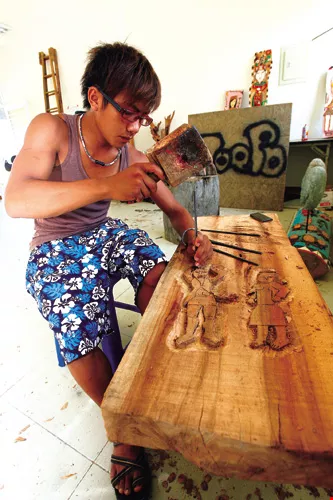
Villagers are studying traditional handicrafts, such as woodcarving, beading and weaving. According to plans developed by the government and the Tzu Chi Foundation, tourism and cultural industries will be used to jumpstart the economy here.
In order to resolve the most pressing problem for these Aborigines who have come down to the lowlands-namely, how they can earn a living-the Tzu Chi Foundation has put on a series of nearly a dozen different training programs, including handicrafts and sewing courses, as well as classes on organizing handicrafts markets, serving as cultural tour guides, developing blogs, or marketing on the Internet.
The handicrafts program offers classes in woodcarving, patchwork, beading, bamboo weaving and so forth. When this reporter visits, the students are hard at work in different classes. The wallets, hanging ornaments and other student work on display in the patchwork class show a level of quality beginning to approach that of products offered for sale in city shops. The teacher Chen Jinshu, who lives in Qishan, explains that there are nine students in the class. Tzu Chi is providing two terms of training lasting six months altogether. The students receive a stipend of NT$400 per day. Many of these students have learned very quickly, and they don't complain when they're told they have to tear apart something nearly finished and start over. She has encouraged students to establish workshops, like those found in some small towns in Japan or in Wutai, Pingtung. In that way every home becomes a handicraft shop, and with each household featuring its own unique style, visitors will linger.
Beading instructor He Ruyuan explains that Tzu Chi and the Council of Indigenous Peoples have provided this kind of training so that Aborigines can acquire a foundation of basic skills before giving them free rein with their own creativity. Making handicrafts is a good way to stay home and keep a close watch on children while still earning some money. Yet He doesn't neglect to mention that choosing this path will require the investment of considerable money and time; it's not easy. Early on, she spent a lot of money on materials, books and tuition, and then experienced six or seven years of financial hardship before finally turning a corner. She returned to her home village before the August 8 floods to establish a workshop, and she has also found opportunities to teach at schools and other organizations.
When this reporter gets a chance to interview the students, most express an interest in the subjects, but the stipend of NT$400-800 per day was key, and they don't expect to be able to use these skills to earn a living. "The teacher's work is so good, but she's been at it for decades and is still studying," Zhang Sufang, a student in the patchwork class, says with a marked lack of confidence. "How could we afford to keep paying tuition?"
He says that if Aboriginal art is to succeed in the marketplace, apart from needing a unique style, marketing and branding are also important. At the end of June, Tzu Chi put on a handicrafts market at Great Love, letting tourists either purchase various beaded products or make them for themselves. The response was pretty good. If such markets become a regular fixture, perhaps more students could do this sort of thing.
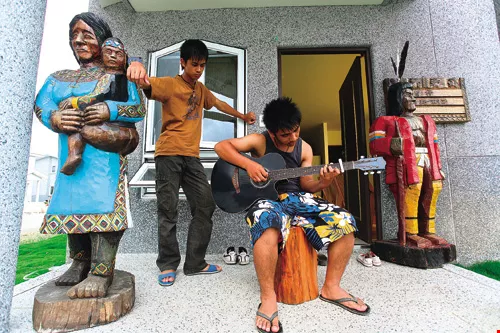
The permanent residences in Great Love, constructed using lightweight steel beams, are resistant to earthquakes, wind, fire and moisture. In them, refugees whose former homes were destroyed by the Morakot floods are building new lives. Pictured here are Great Love residents relocated from Taoyuan Township.
Lu Fangchuan, Tzu Chi's charity development director, explains that to add value to traditional Aboriginal handicrafts, it is necessary to integrate them with other products. For instance, beading can be added to the latest fashions, leatherwear, or home ornaments. LED lamps can be given an Aboriginal flavor. If Aboriginal artisans move in new creative directions, they'll be able to sell their work for higher prices.
Lu notes that Great Love hopes to combine various unique features of Aboriginal life to stimulate tourism there. The first step was to bring six or seven households together to cook Aboriginal-style meals for tourists. At NT$300-350 per lion's mane mushroom hotplate special, a busload of tourists can bring more than NT$10,000 worth of business. What's more, the meals are offered on tables unfolded on Qilao Plaza, so there's no rent to pay. In the future, these cooks will also supply coffee they've grown themselves, fig jelly, fresh-made steamed buns and so forth.
"Tzu Chi is continuing to play the role of occupational matchmaker," Lu says. According to its surveys, 40% of the households in the village (not including the 100-plus families that moved in in July) have acquired steady work as military personnel, teachers, or government employees, or in other capacities in the lowlands. As for those that need to find new occupations, job training personnel from Tzu Chi are promoting various kinds of employer-jobseeker matchmaking, as well as offering training courses and programs to develop industry at Great Love. "Having accomplished the miracle of building permanent housing in 88 days, Tzu Chi is now throwing itself full force behind long-term employment for residents!"
But it is worth noting that whereas Tzu Chi is providing all kinds of resources to community groups at the village-including the Reconstruction Center and the Ecological Benevolence Association-interviews with residents revealed complaints that the employees of these organizations are "taking all the advantages for their own families and friends." These perceived abuses are creating divisions among the villagers and should be a focus of concern going forward.
Great Love Village is the first refugee settlement of its kind that Tzu Chi has built in Taiwan, and the foundation hopes that it will serve as an international model. Consequently, apart from the "reconstruction" involved in building new homes and fostering new economic opportunities, Tzu Chi is also actively encouraging refugees to "reconstruct their lives" through 30 different kinds of offered services, including community building, eldercare, and psychological counseling.
One focus of "reconstructing lives" is promotion of the "three no's": no smoking, no drinking and no chewing of betel nut. Tzu Chi staffers regularly promote these prohibitions whenever talking to residents of Great Love. They've even created a "Three No's" song-and-dance routine that they've got village residents to put on. And they've held culture camps to promote such values as helping others and family harmony. "These efforts at cultural and moral inculcation can influence villagers' behavior for the better without them even knowing it," says Luo Chunmei, a Tzu Chi "big sister" responsible for planning cultural camps.
Some villagers are very enthusiastic about these new activities, declaring: "These are good for us Aborigines." And at the culture camps some have vowed to give the money they save from quitting smoking and drinking to victims of the Haitian earthquake. But others say they can no longer stand the constant efforts at moral suasion by the "big brothers" and "big sisters" of Tzu Chi: "Changing habits is a long-term proposition, and constantly nagging at us to change is counterproductive." Others say, with even more animation: "We are already suffering from being uprooted by the August 8 floods. And now those in Tzu Chi are trying to push us into lives of 'quiet reflection.' It gives me a sense of being colonized all over again!"
"Do residents necessarily agree with Tzu Chi about what's best?" asks Lin Yih-ren, an associate professor in the Department of Ecology at Providence University. Lin explains that he has heard gripes and sarcasm from Great Love residents along the lines of: "We're like Formosan rock monkeys in a zoo. We're continually on view for tours." Or, "We used to say 'Peace' when we met; now we have to say 'Gratitude'!" These kinds of responses actually reflect that the organizations providing assistance are overreaching with their ambitious aims. He suggests letting the residents "breathe" a bit. Modestly listening to what Aborigines have to say would better enable continued favorable interaction.

Currently, Great Love residents are getting NT$800 per day fom Foxconn to work at the farm. Because the farm is still under construction, the work is physically taxing. Many residents are showing little enthusiasm, taking a wait-and-see attitude toward employment there.
Cut to the Yonglin Organic Farm, which is sponsored by Foxconn. Just a three-minute drive from Great Love, the farm sits on 65 hectares of land provided by the government. Foxconn commissioned Tainan's Tenha Organic Farm to manage it. It is predicted that it will take six years to fully train the refugees in Great Love to operate it. For the first three years of their training, the villagers are studying organic agriculture techniques, and for the last three years they will study business management models. The ultimate goal is to turn the farm over to the villagers to run themselves.
A tour of the farm reveals that villagers are already experimenting with planting corn and cucumbers in the No. 8 "open-air" area. They can be seen squatting in the fields, weeding and applying organic fertilizer. "This was originally reforested Taiwan Sugar Corporation land," explains Chou Chun-chi, chairman of Tenha, which started with a focus on microorganisms beneficial to agriculture. "Because fertilizer hasn't been applied for many years, the soil quality is low, so we plan on spending two to three years amending the soil."
When our car arrives at Area No. 5, we view some greenhouses being erected in a grassy area. A dozen or so villagers are in the midst of anchoring the pipes used to build them.
Chou explains that in the first phase they plan on building 64 greenhouses. "We signed a contract with the supplier committing them to construct the first 32 greenhouses for us. For the next 16, they will build and instruct our workers at the same time. For the last 16, the farm's workers will construct the greenhouses themselves under the supervision of the supplier's personnel." In the future, if the greenhouses need repairs, the farm won't have to hire outsiders to do it.
Chou opens up the illustrated plans for the farm and explains that there are a total of 52 hectares available for cultivation: The "delicate crops" area will largely be devoted to sprouts and mushrooms. The greenhouse area features leafy vegetables and melons. The open-air production area features mainly grains, root vegetables and melons. In the "organically fed livestock area," the plan is to raise chickens, which will assist in controlling insect pests and weeds.
In the future, after each crop is harvested, it will be sent to the farm's processing and distribution center to be packaged and shipped off. Each area will have its own small "management station," which will provide a place for workers to gather, talk, rest and eat, and will also be used for storing equipment. What's more, each area will also have a composting shed to put the area's leaves, fruit peels, and other organic waste.
According to plan, Yonglin will produce only a small amount this year. Next year it will produce close to 1000 metric tons, and it will start breaking even by its fourth year (2013). The farm will also have an "organic life demonstration area," where it will promote organic farming through a community gardening scheme. "We will find businesses or communities to come here and participate, and our staff will teach them about organic agriculture and offer them chances at hands-on experience."

In Great Love Village, far from the mudflows, one of Namasia's children plays outside his mother's patchwork class.
Ultimately, how many jobs can the farm provide?
"The farm will need 200 workers during the construction stage, and 300 during the training stage, for a total of 500." Chou explains that although the construction phase will be hard work, it can also serve as a trial period of mutual observation. If villagers aspire to continue working at Yonglin, then they'll have to finish 200 hours of training to obtain formal worker qualifications. After training, they could also elect to rent some nearby farmland and establish a satellite farm to Yonglin. In that case, Yonglin would supply seeds, fertilizer and assistance with marketing and sales.
Although the plans may be very detailed, the implementation continues to meet with obstacles. First of all, sighs Chou, the process of obtaining the land was very difficult. It wasn't until March of this year that the farm started with general site preparation and basic infrastructure such as irrigation ponds. Because the farm was taking too long to launch, many Great Love residents applied instead for government temporary jobs provided to those displaced by Morakot. Furthermore, many of the villagers felt too hemmed in by having to work at the farm every day from 8 a.m. to 5 p.m. Although it is hard physical labor, the NT$800 wages per day are below what they used to get as day laborers. Consequently, interest has been waning. Currently, 104 Great Love villagers are working at the farm, mostly because of Foxconn's golden reputation.
Li Weiyu, the farm director, explains that Aborigines show some differences in their work attitudes in comparison to ethnic Han Chinese. Perhaps because they naturally have a more innocent and optimistic disposition, he says, Aborigines often think only as far ahead as tomorrow. It's tough for them to think six years into the future. Consequently, you've got to spend a lot of time talking about these issues. For instance, they often complain that they would get NT$1600 per day cutting grass as day laborers, but they can't see the difference between "temporary work" and "formal employment."
What's more, Aborigines don't like being managed and don't like to be managers. "Perhaps that's because in the past they were typically pretty self-sufficient and would rarely hire each other." For instance, Li says that Aborigines ask him: "Why do I have to do what you say?" and "Why do you earn more money than everyone else?" Worried about being ostracized, moreover, they don't want to be placed in charge. As a consequence, there may end up being "too many Indians and no chiefs."
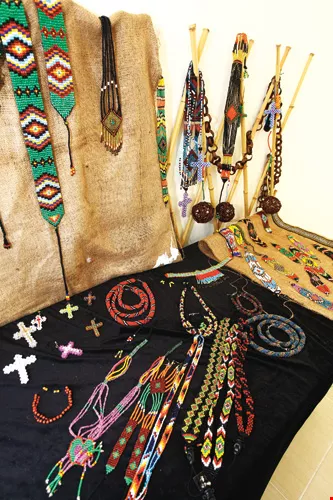
Villagers are studying traditional handicrafts, such as woodcarving, beading and weaving. According to plans developed by the government and the Tzu Chi Foundation, tourism and cultural industries will be used to jumpstart the economy here.
Some ask: why create an organic farm on such a large scale? Isn't the spirit of organic agriculture all about "quality, not quantity"? Furthermore, wouldn't dividing up the land into small family-owned farms be better suited to Aboriginal customs? Li explains that the farm is organized the way it is to take advantage of economies of scale. Only with sufficient quantities can you lower costs and establish a comprehensive industrial ecology. Furthermore, you've got to plan production, so small producers don't all plant the same thing, crashing prices. Only when farmers make good money will they stay at it long term.
"This model represents an instance of Taiwan being innovative," Li says. With government, industry and agriculture all looking on intently, there's a lot of pressure, so they have no choice but to do their very best.
"I believe that the attitude of the villagers is key. Once everyone feels that the farm isn't Foxconn's or Tenha's but 'ours,' then success won't be far off!"
Apart from commemorating the first anniversary of the August 8 floods, we should put ourselves in the shoes of these Aborigines, who, after dealing with the loss of their loved ones and the destruction of their homes, have been forced to move to a new, completely different environment, where their network of relationships is broken and their work situation entirely different. "Who could adapt immediately to such tremendous change?"
Lin Yih-ren reminds us that Great Love Village and the Yonglin Farm are full of people from various places who have been torn out of their social networks and abruptly placed together. Their variety of backgrounds means that they have different problems and needs. Can those in charge recognize that this is a very complicated, very difficult social undertaking, and be mentally prepared for the high level of commitment and time that it will require? If they concern themselves only with Han measures of success, such as high efficiency, then they're likely to hold expectations that are too high and create a lot of anxiety. It's not going to be the best long-term approach.
Namasia in transformation encapsulates all the dilemmas faced by those considering whether to relocate their tribal settlements. It represents all of the limitless potential and all of the many obstacles experienced by those who have moved and started afresh somewhere else. Can these refugees successfully navigate this passage and establish new lives for themselves down in the lowlands? It will not only test the determination of the refugees, but also the compassion and wisdom of society.
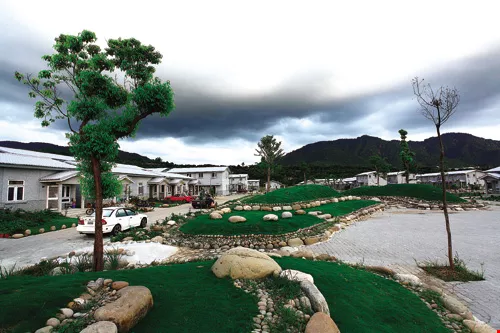
Shanlin's Great Love Village, built by the Tzu Chi Foundation, has a simple and elegant style. So far, 695 households totalling over 3000 refugees have moved in from areas of Kaohsiung County devastated by Morakot's floods.

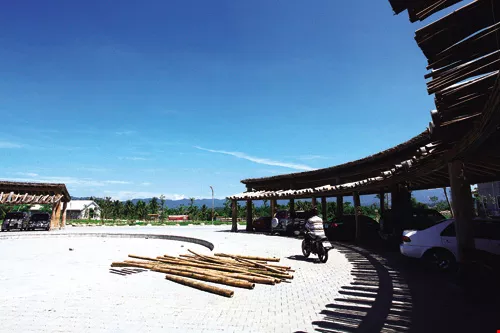
This plaza at Great Love, which has an "Aboriginal style," has hosted a variety of activities, including performances of Aboriginal song and dance, as well as handicraft fairs. How the tourism industry develops at the village will be closely watched.
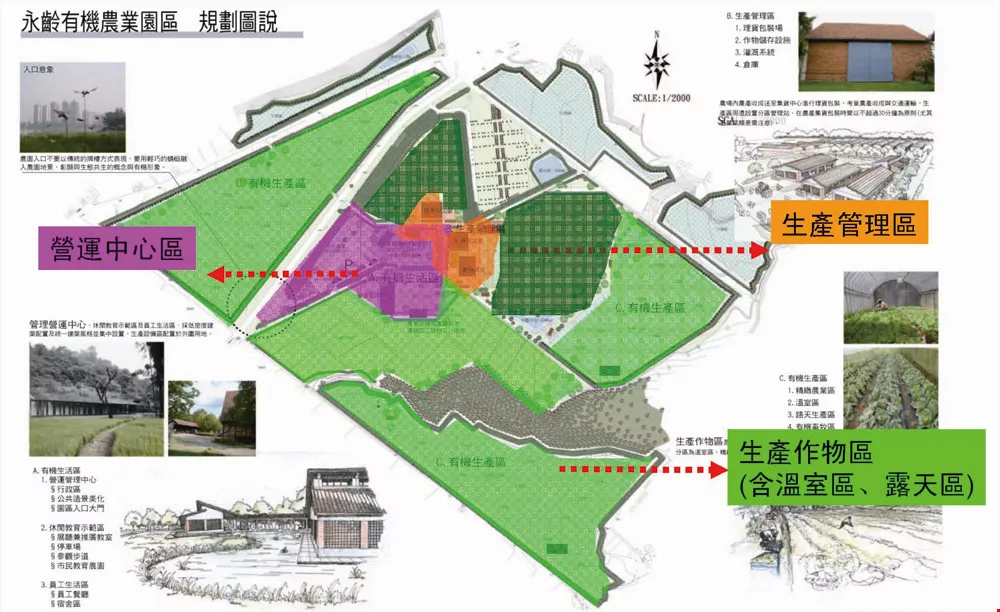
The Yonglin Organic Farm, which is funded by the Foxconn Technology Group, plans to train Great Love residents for six years in the methods of organic agriculture before turning the farm over to them to run by themselves. Shown here is the planned layout of the farm.
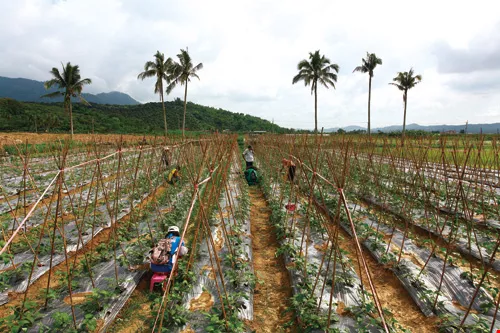
The 65-hectare Yonglin Farm has already been planted with crops of melons and root vegetables. The hope is that large-scale production will foster distribution systems and a local business ecology that will be supportive of the organic food industry.
@List.JPG?w=522&h=410&mode=crop&format=webp&quality=80)


