Building a Real Utopia--The Jenju Community
Coral Lee / photos Hsueh Chi-kuang / tr. by Scott Williams
August 2003


In just the last few years, the Jenju community in Ilan County's Tungshan Township has become one of the county's rising stars. Its rice-straw handicrafts, hands-on agricultural tourism and down-home delicacies have been featured frequently both on television and in the print media. Jenju has also won numerous awards, including the Ministry of the Interior's Outstanding Community Award and the Council of Agriculture's contest on innovation in agricultural and fisheries parks. How has this traditional rice-farming community with no resources to speak of turned itself into a shimmering pearl on the banks of the Tungshan River in just two short years?
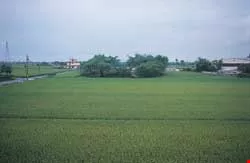
The serenely beautiful farming community of Jenju lies on the banks of the Tungshan River, about three kilometers upstream from Ilan's Chinshui Park, the well-known site of the county's annual International Children's Folklore and Folkgames Festival. Over the last two years, tour busses full of visitors have become a frequent sight in Jenju. These visitors include corporate and official groups experiencing agrarian life first hand and children on educational field trips to the countryside, as well as city, county, and community workers who have come to study Jenju's transformation. Lately, however, a surprising number of these visitors are just plain holidaymakers.
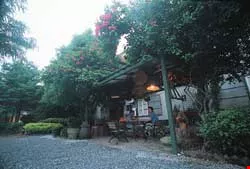
Arriving in Jenju, visitors are immediately granted a vision of beautiful, homey farmlands and farm animals. The fields are interspersed with buildings-traditional farmhouses made of plain concrete and tile, and a smattering of elegant European-style structures. Whether rough or refined, each house has its own luxuriant garden, and it is that lush greenery that catches the eye and slows the step of most visitors.
Local guide maps reveal that the somewhat different-looking homes that line the road are actually guesthouses. Jenju's innkeepers eagerly introduce visitors to the community's rice-straw handicrafts, its kite museum and the hike-and-bike trails that run along the river. Some not only treat their guests warmly, but even generously introduce them to other innkeepers. "We're all friends here. We often refer guests to one another." Hsiang Shu-chun, the owner of the Orchid Garden guesthouse, even takes her guests for a visit across the street to the Rainbow Garden guesthouse.
The innkeepers like to gather on the broad balcony of the Rainbow Garden at sunset. While the cool evening breeze caresses their faces, they share their impressions of the light from the lanterns that decorate every garden in Jenju and their ideas for lantern activities for August's Lovers' Day. "We innkeepers have all agreed to work together, supporting each other, and not undercutting one another's prices," says Yin-tsai Garden proprietress Lee Pao-tsai. "We feel that this is the only way to bring prosperity to the whole area." As she chats about the community's spirit of cooperation, her eyes gleam with pride.
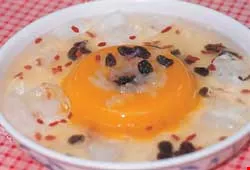
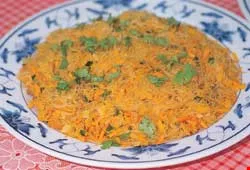
Pumpkin sweets, pumpkin puddings, pumpkin noodles, curry with pumpkin and pork. . . In addition to partaking of a pumpkin feast, visitors to Jenju can also pick up a few pointers on cooking pumpkin with which to impress their friends back home.
A "utopian" community
The human warmth of these guesthouse owners is a rarity in a commercial society that thrives on competition, and it is indicative of one of the major traits of the Jenju community.
According to the community's website, it is striving to "build human relationships based on loyalty and forgiveness, and to create a cultural arena with honesty at its core." It is surprising to see such idealistic development objectives on a website, but when you actually enter the community, you discover that these goals are anything but hot air, and encounter the possibility of actually realizing a modern "Peach Blossom Shangri-la."
Lee Hou-chin has been the driving force behind the community's development, and for him the experience has truly been a dream-come-true.
The soft-spoken Lee studied sociology at university, and for more than 20 years has built his career around social work. In the 1990s, while running an Ilan halfway house, he also began training as a counselor to better help people deal with psychological disorders. Lee then returned to his hometown of Tungshan in 1997 and established a counseling center.
In 1999, Tungshan attempted to hold an election for the position of executive director, but no one wanted to run. Lee was both interested and a professional social worker-when they offered him the job, he happily accepted.
Granted the opportunity to give something back to his hometown, Lee looked back to his studies and put together a blueprint for community development. "In the old days, the influence of Confucian thought on farming villages led to an emphasis on honesty, loyalty and forgiveness," says Lee. "But in recent times, this spirit has been largely lost. Even though a few farming villages preserve this kind of culture, almost no one is talking about how to renew this spirit and pass it on in a commercial society."
According to Lee, community work is an educational process that awakens people to their own interests, helps them develop their potential and gets them involved in the community. But many Taiwanese communities are run in a way that ignores the importance of human interactions, with the result that projects are often derailed by "human" factors such as factionalization or inter-personal conflicts. Lee therefore made reestablishing Confucian ethics in the community his objective.
"Jenju's development process has been different from that of other communities," says Lee. He explains that they had a clear goal right from the outset; their focus was squarely on human relationships and ethics. Of course, they encountered conflicts as they were moving towards a harmonious community, and when they did, they had to remove the pressures that tradition placed on interactions, and replace those customs with more open, more truly honest ways of communicating. Members of the community had to learn to treat both themselves and others with respect, and had to incorporate these changes into their lives.
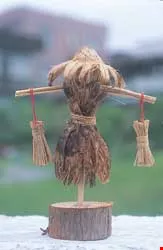
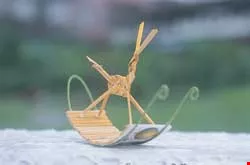
The simple elegance of Jenju's rice-straw painting and rice-straw decorations have caught the eye of many a visitor.
Reconciling the gods
Lee says, "Before the residents of the community could change, the workgroup had to change." He worked hard to put the community-building ideas he had espoused into practice in his community-building and management work, for example, in the management of the workgroup and in the gathering of opinions on pubic affairs. Take the bike path planned for the Lin Pao-Chun irrigation canal: "Eleven families hold rights to the land through which the Lin Pao-Chun Canal passes. They've been growing vegetables here for decades. Naturally, this created numerous obstacles to the bike-path project." Lee explains that because the canal itself is public property, the township could simply have appropriated the land it needed. However, such an approach would have created conflicts with residents, which would likely have given rise to other problems down the road for the township's development. Lee did not want to see that happen, so he offered compensation to win the landholders over. After two months of patient talks, he succeeded in assuaging everyone's concerns. In the end, one of the families declined all compensation, two gave theirs to charity, and the remainder took only symbolic compensations of NT$1,000 each.
To draw the residents of the community together and to heal a long-term split between the members of the local Chin-hsing and Shen-fu Temples, Lee and his workgroup went all out to plan an event to bring about reconciliation. In a gesture of goodwill, in March of 2001, 700 members of the Chin-hsing Temple burned incense in the Shen-fu Temple. That gesture allowed the two sides to come together to jointly organize that year's Pudu ceremony of salvation for the dead. Sometime after the reconciliation, some 800 villagers came together to erect a giant tsao-fu-a conical pile of rice straw similar to a small haystack-as a community marker beside the development association's plaza. The main deities of the two temples are painted on opposite sides of the tsao-fu, representing the idea that these two different aspects of the gods can be united in one body.
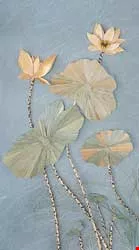
The simple elegance of Jenju's rice-straw painting and rice-straw decorations have caught the eye of many a visitor.
Rice straw reborn
"In addition to shaping and achieving goals, it's also important to fill people's bellies," says Lee. He notes that after Taiwan joined the World Trade Organization (WTO), local factories moved abroad and unemployment became a serious problem. Consequently, the community development program will only be judged a success if it is able to revive the community and resolve residents' economic difficulties. With that in mind, the development of distinctive local industries has been an urgent concern.
The idea for Jenju's rice-straw handicrafts industry came to Lee while he was traveling in Indonesia. While there, he had visited an arts community, where he saw a mask carver putting on a performance with his wooden masks. Lee realized that masks were a great tool for psychotherapy, and began to think about how he might use them back home. Lee thought that Jenju residents might use the masks for personal growth and healing, while also developing their own performative art form. With this in mind, Lee invited a friend named Huang Chien-ta, who worked on the stage in Taipei, to come down to Jenju to develop some ideas on how to promote mask arts and integrate them into the community. Rice-straw masks were the result of their brainstorming. Kao Hsi-lin, another artist friend, developed the idea further: people needn't limit themselves to making masks; they could use rice straw to produce all kinds of handicrafts, everything from paintings and dolls to traditional straw huts. With a little promotion, rice-straw handicrafts could become a distinctive local industry.
"It's the plainness of rice straw that attracts people to it," says Kao Hsi-lin. "It gives rise to a desire for a natural, rustic life."
Kao is a vibrant man who builds installations, paints and studies creative media. After several years spent working on community building, he is now giving new life to rice straw, a material that the people of Jenju had previously thought of as a waste product. He made a name for Jenju's rice-straw handicrafts by creating rice-straw people, horses and even dragons that were exhibited at events such as Ilan's E-Land Green Expo, the opening ceremony of the National Center of Traditional Arts and Ilan's New Year's festivities.
The ideas that artists come up with open a window of opportunity for the culture industries. But unless others become involved in producing and promoting those ideas,that window can close again.In 2001,Lee received support from the Council of Labor Affairs' (CLA) Sustainable Employment Project, and recruited 15 Jenju locals to train as rice-straw handicrafts masters. When the training wrapped up, six decided to stick with it, producing handicrafts and teaching visitors how to make rice-straw paintings. After two years of rice-straw handicrafts festivals, people visiting Jenju now rarely pass up the chance to check out the town's handicrafts and take a stab at working in rice straw themselves.
Throwing open the doors
To increase Jenju's appeal to tourists, the community has applied the same model it used in promoting rice-straw handicrafts to other areas. Specifically, it has applied for employment assistance funding from the CLA for a whole series of projects, including replanting the bamboo fence surrounding the village, as well as projects entitled "Kite-town" and "Make Our Community Safe and Beautiful." These projects have, on the one hand, provided employment opportunities for locals,and on the other have helped establish the foundations of a culture industries' labor force.
The 10 kite-makers the program has trained since 2002 have done quite well. Under resident master kite-maker Lee Hou-jui's tutelage, local mothers have not only learned a craft and acquired a source of income, but now also travel to schools all over Taiwan teaching students how to make kites. They were also very successful at last year's National Council on Physical Fitness and Sports' Kite Contest,where they won several prizes.
Also in 2002, Jenju began to actively promote its guesthouses. The community currently has 16 guesthouses that together have about 400 beds. In most cases, they are a sideline for their owners, who have redecorated spare rooms in their own homes for guests. "When we first started out, we were a little dubious that people would actually come to stay with us and concerned that we might get unpleasant guests," reveals the Orchid Garden's Hsiang Shu-chun.
Hsiang says that after repeated explanations and encouragement from Lee Hou-chin, she decided to give running a guesthouse a try with the idea that she would just see how it went. One year later, she says that the more involved she gets in the business, the more interested she becomes. Not only has the guesthouse been a great financial help to her family, but it also lets her take care of her children, while at the same time learning, growing and making new friends.
Attentive visitors can also learn some of the many stories the guesthouses have to tell. For example, the exceptionally stylish Garden of Rushes has a beautiful garden, an elegantly decorated interior, and a marvelously graceful innkeeper who looks as if she had just stepped out of one of Chiung Yao's romances. But the kicker is that the garden, which features a small bridge over running water, was designed and built by the innkeeper and her husband in their spare time. The innkeeper takes it upon herself to share with her guests what she has learned from keeping such a gorgeous garden: "Don't talk about buying a piece of land after you retire. If you want to build a garden, start it now."
Perhaps as a result of Lee Hou-chin's influence, all of Jenju's innkeepers have something in common-they are honest and enthusiastic, and treat their guests as friends. When those guests return home, many post grateful messages and pictures of themselves with the innkeepers on the guesthouses' online message boards.
Pumpkin sweets, pumpkin puddings, pumpkin noodles, curry with pumpkin and pork. . . In addition to partaking of a pumpkin feast, visitors to Jenju can also pick up a few pointers on cooking pumpkin with which to impress their friends back home.
The creative group
"In our community building, we not only take the 'teach a man to fish' approach, but also hope to build an environment rich in fish," says Jenju Director-General You Chien-fung.
According to You, most previous community building-and-management efforts have started by attempting to preserve artifacts, green the community, or pass on traditional culture. In Jenju, however, planners took a different path, deciding instead to prioritize building community industries to create employment opportunities. Jenju's planners believed that they would only be able to better the people in the community by improving the local economy. You says, "We are not seeking wealth, but hope that all residents can achieve a more leisurely life."
The tanned, muscular You lives next-door to Jenju in Pucheng Village. After graduating from university with a degree in social work, he spent two or three years as a social worker then met Lee Hou-chin in 2001. Lee asked him to manage the workers in the CLA's Sustainable Employment Program and also to take care of the community development association's affairs. You jokes that he is someone who likes challenges, and says that that's why he took the job. Regardless of his reason, there's no denying that he and the two other professionals added to the staff have been a key to invigorating Jenju's community development work.
Jenju has even arranged a pretty special package tour that allows visitors to experience the genuine friendliness of the community. On the morning of the first day, visitors make rice-straw paintings or masks before moving on to the community's expo center, where they can buy rice-straw souvenirs of their own. In the afternoon, there is a kite-making clinic that teaches participants the principles of kite-making and the forms kites have taken over the years. Once visitors have completed their own kites, they take the fruit of their labors out to a verdant green field for a test run. They can also rent bicycles for a ride along the banks of the Tungshan River to see the birds or to just enjoy the breeze. In the evening, after a pumpkin-based feast, they move to the riverside to see the fireflies, before spending the night in a cozy guesthouse. On the second day, visitors can travel to the nearby Chungshan, Tachin, Tunghsi, and Paimi communities to get a fuller picture of community life, or choose a selection of museums in neighboring townships that address their own particular interests. The development association even offers guides and reservation services for Jenju.
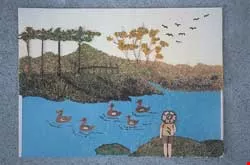
The simple elegance of Jenju's rice-straw painting and rice-straw decorations have caught the eye of many a visitor.
A stage for all
By the end of 2002, after two years of development, the community-development association's annual revenue has swelled to more than NT$4.5 million from activities including rice-straw handicrafts, kite-making, bicycle rentals and taking reservations for the guest houses, or just enough to support the daily operations of the association and cover the salaries of its 14 employees. Rice-straw craftswoman Wang Hsiao-mei says that although she doesn't make much from her work, it is interesting-she gets to see her own pieces on display in the rice-straw handicrafts exhibition hall, and has broadened her horizons through her interactions with the many visitors she guides around town. "The Executive Director also often gives classes on interpersonal relations and personal growth that have helped me grow a lot." Wang feels that the outlook is bright for rice-straw handicrafts, noting that, "some people who have visited before make a special trip back just to buy pieces to give to friends."
In voicing her thoughts on the reasons why Jenju's community-building efforts have drawn the community together, Wang mentions the economic inducements, as well as the opportunity to participate in continuing education classes, and the community's shared vision for the future.
Lately, residents have been hard at work rehearsing "Jenju Love Song" and "Song of Jenju," the latter of which runs: "As long as I have your companionship, I don't care how hard the work. . . . As long as I have your faith, our dream will come true. . . . Hurry, hurry, hurry to Jenju to realize our dream. . . ." After dinner, they gather at the activities center where Lee Hou-chin's wife plays the guitar and directs the rehearsal. The singers include the innkeepers, the masters of rice-straw handicrafts, the masters of kite-making, the mothers who develop new popsicle flavors and even the association's supervisors. Lee believes, "Music stirs people's feelings, and increases their sense of belonging." With that in mind, he plans to pen eight more songs and record a CD. Lee hopes that in the future the community's innkeepers will be able to teach visitors Jenju's own songs.
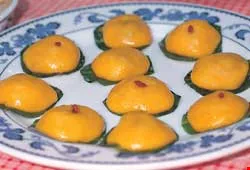
Pumpkin sweets, pumpkin puddings, pumpkin noodles, curry with pumpkin and pork. . . In addition to partaking of a pumpkin feast, visitors to Jenju can also pick up a few pointers on cooking pumpkin with which to impress their friends back home.
International tourism
In the future, Jenju has bold plans to promote international tourism. Lee notes that the town is situated close to the site of Ilan's International Children's Folklore and Folkgames Festival and the E-land Green Expo, events which are already well-known internationally. If the community makes use of its location, it should be able to attract some international visitors of its own. Such an effort would also be in accord with Ilan County's efforts to court international tourism. Supplemental events have already been lined up for the county's monthly themes, including a museum festival, a Lovers' Day event, a rice-straw handicrafts festival, a kite festival, a guesthouse festival and a pumpkin festival. Of course, a number of issues related to facilities and personnel have yet to be resolved, including arranging for signs in other languages and improving the English- and Japanese-language skills of staffers, but plans are slowly coming together.
Jenju has grown from a mere rice stalk into a nationally renowned community. Many locals now feel that it is an honor to live here and are willing to throw themselves into community-development work. While Lee is gratified by the progress the community has made, he doesn't deny that a great many hurdles remain, including further refining local rice-straw handicrafts, establishing distribution channels for those handicrafts, and finding a way to generate enough revenues to cover the costs of running the community.
Greater responsibilities and more diverse tasks are already before them. But Lee and his team look confident. Asked how he can remain so upbeat and undrained after several years as a "volunteer" executive director, Lee responds: "It's the joy of seeing everyone grow, and of realizing a fair and just 'Pure Land' on Earth."
In recent years, as well as working to develop the economy, many caring people in Taiwan have come to attach importance to community regeneration, and in the process of exercising "good-neighborly concern," have brought a more individual and cultured aspect to previously drab communities. If we look more closely at the success stories among efforts toward community regeneration, we see that they all involve felicitous combinations of the three factors of "individual contributions," "unique characteristics," and "effective strategies," through which some communities have been able to create an attractive sense of warmth.
To give readers inside and outside Taiwan an insight into the current situation and the strategies being adopted in community regeneration in the ROC, Sinorama is collaborating with the Council for Cultural Affairs to produce a series of reports introducing distinctive communities in Taiwan, which we hope readers will find informative and enjoyable.
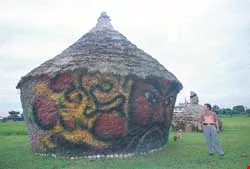
To encourage the re-use of rice straw, the Jenju community has turned the post-harvest custom of piling up tsao-fu into a contest that allows tourists to experience an aspect of agrarian life by building their own. (photo by Chen Hung-chi, courtesy of the Jenju Community Development Association)
The traditional bamboo fences of the Lanyang Plain protected villages from both the wind and enemies. Lee Hou-chin is now planning to add a "bamboo-fence guest house" to Jenju's list of attractions.
The scent of flowers and an air of human kindness permeate Jenju's beautiful guest houses.
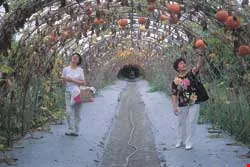
Lee Chi-sen, the owner of Jenju's 100-meter long "pumpkin tunnel," has widened eyes with the more than 30 varieties of pumpkins he cultivates.


@List.jpg?w=522&h=410&mode=crop&format=webp&quality=80)


