

Poverty has always been with us. Will it really never be eradicated?
Four years ago, the Taipei City Government launched a program called "Household Development to Escape Poverty" (HDEP), aimed at helping people help themselves, for an initial period of three years. Positive results are becoming apparent and other counties and cities plan to follow Taipei's example. The war against poverty is being joined all over Taiwan.
Next to the Taipei Municipal Sungshan High School of Commerce and Home Economics on Fute Street, there is a drink-and-snack bar measuring just 170 square feet. From the outside it looks like any other drink-and-snack bar, but what makes this one special is not just that it has helped a family escape poverty, but also that it was opened with the support of HDEP planners, policy makers, sociologists, and social workers who worked heart and soul to make the project a success.
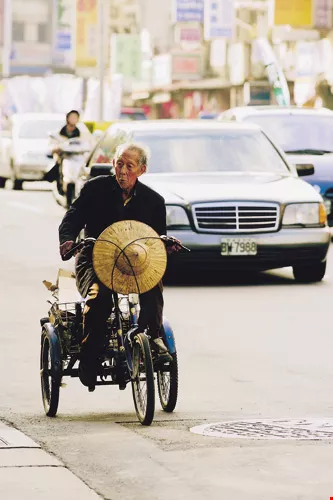
The gap between rich and poor is widening rapidly as a result of globalization and economic and social changes. Every society needs to formulate its own policies to eradicate this scourge.
Helping people help themselves
For three years, Wu Hsiu-chu salted away her savings in her Taipei Family Development Account (TFDA). When she had saved NT$288,000, she was finally able to open her drink-and-snack bar.
Ms. Wu has a slight facial disfigurement and her husband had his right hand amputated when he was a child. Several years ago, he suffered a business failure and the whole family of seven found itself without an income. They had to depend on a government subsidy for low-income households.
To participate in the HDEP program, over a period of three years Ms. Wu, her husband, and their oldest son found work, drew up a business plan, made fixed deposits into their savings account, and attended classes. In September 2003, they were finally able to realize their dream. The day Ms. Wu inaugurated her drink-and-snack bar, Taipei mayor Ma Ying-jeou was there to congratulate her in person. He declared that the first business started with the support of the HDEP program must not be allowed to fail. This was also the fervent hope of Ms. Wu and everyone who had helped make the HDEP program a reality.
Ms. Wu begins working in her drink-and-snack bar before 6 a.m., and she only goes home at 7 or 8 p.m. She works more than ten hours a day, and spends most of the day rushing around making deliveries, never complaining of being tired. Still, starting a business is not easy and the real challenge comes after you've started it. Ms. Wu faced her first crisis during her first winter in business. The weather turned very cold, and people were not buying cold drinks. She lost NT$60,000 in one month. She gritted her teeth and decided that she would persevere until the summer, and that if she failed to break even by then, she would simply give up. But then she thought that speaking so lightly of giving up was betraying the promise she had made to herself, the HDEP program and society that she would save money, start her own business, and do what it took to make it succeed. The HDEP program helped those who helped themselves.
Fortunately, Ms. Wu's "low margin, high turnover" strategy paid off. Thanks to her customers' encouragement and steady improvements in her skills, business gradually picked up. Ms. Wu brims with confidence: "After costs, rent, and personnel expenses, I now make a monthly profit of NT$20,000."
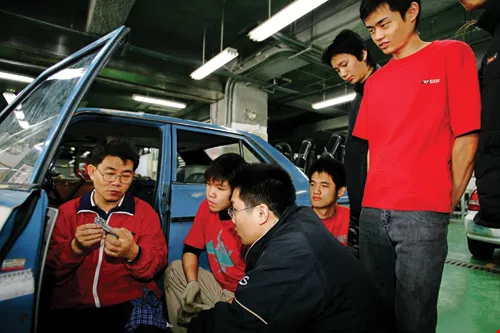
The Taipei City vocational training center offers all sorts of classes, from dressmaking to cooking and catering to auto repair. Acquiring a marketable skill is the best way to avoid falling into poverty.
Making a happy home
Kao Kuo Kui-mei, a single mother who heads a family of six, is also a fortunate beneficiary of the HDEP program. In 2002 she was able to move out of the 46-square-meter low-income subsidized apartment she had occupied for ten years, and moved into a home she bought on Yenping North Road.
Mrs. Kao's husband died 14 years ago, when she was only 38. Her eldest child had just graduated from junior high school and the youngest was still a toddler. To avoid becoming homeless and sleeping on the streets, she swallowed her pride and applied for low-income subsidized housing.
Mrs. Kao recalls, "The apartment we got was little more than a shell. It was dark and worse than a pigsty. I spent tens of thousands on getting it painted and having a rain canopy put up over the roof to make the place feel halfway livable." The dilapidated state of the apartment was the least of Mrs. Kao's problems. What worried her most was that she would be too busy at work to keep an eye on her children and that they would fall in with the wrong crowd.
To support her family, Mrs. Kao juggled three jobs. In the morning she worked at a temporary job, at lunchtime she helped out at a noodle shop, and in the evening she worked at a night market. Before going out each morning she would prepare three bottles of milk for her youngest son to drink after he woke up. While at work she would constantly worry about her children being left at home alone. Fortunately, her five children are growing up safe and sound. They all know how hard their mother works and display self-respect and the ability to stand on their own feet.
After she joined the HDEP program, Mrs. Kao spent three years saving every penny in her TFDA and borrowed money from relatives and friends to make a down payment of NT$750,000 for a 72-square-meter apartment that cost NT$2.5 million. Although it was an old apartment, being a first-time homeowner felt wonderful. The mortgage of a little more than NT$9000 a month has not been a big burden, because once Mrs. Kao's children got jobs of their own, they began paying their share. Mrs. Kao is proud to say that her second-oldest son has also started a family and bought his own home. Mrs. Kao and her family have evidently succeeded in putting poverty behind them.
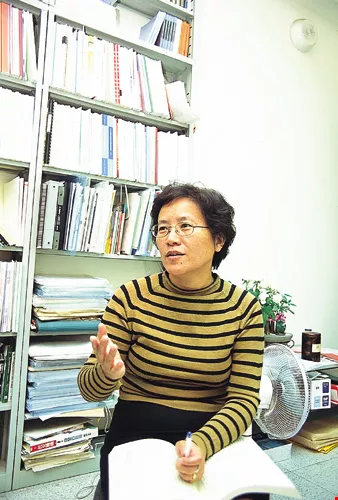
Cheng Li-chen, associate professor at the Department of Social Work, National Taiwan University,says that a growing number of people are entering the class of the working poor whose expenditures exceed their income.
Investing in the next generation
Every family working to escape poverty needs to follow its own strategy. Sung Kuei-hua, another HDEP participant, did not have enough savings to buy her own home, thought that starting a small business was too risky during an economic downturn, and was not in good health. So she decided to invest in her children's higher education.
Ms. Sung is 50 and got divorced seven years ago. Her former husband not only abandoned his three children and refused to pay alimony, but he also left her with a pile of debts. To add to her miseries, her mother, who had helped her out after the divorce, passed away. Soon afterward Ms. Sung got her hand caught in an elevator, and lost a finger. The monthly light-disability compensation of NT$4,000 she got could not make up for the suffering and inconvenience of losing a finger.
To try to find a job, Ms. Sung took computer lessons at the Bureau of Employment and Vocational Training and earned a computing diploma. She also took a childcare class and got a nanny diploma. Three years ago, she joined a state-funded work program and got a job cutting newspaper clippings at the Taipei City Government's Department of Social Welfare (DOSW). To provide for her three children, Ms. Sung was industrious and frugal, but she still struggled to make ends meet.
Ms. Sung's eldest son has graduated from college and is now doing his military service. In the future he would like to go to graduate school. Her second-oldest and youngest sons work part-time and study part-time in a junior college. Ms. Song is working heart and soul to support her children's educational aspirations.
Thanks to her TFDA savings, Ms. Sung has helped her children buy computers for their studies and motorbikes to get to work. She hopes that they will soon be able to stand on their own two feet, get good jobs, and escape poverty for good.
As a graduate of the National Taipei College of Business, Sung Kuei-hua certainly has the skills to fend for herself in the job market. When she was young, she never imagined that she would one day be mired in poverty. But she married the wrong man, had a run of bad luck, and was almost unable to get back up on her feet again. The alarming thing is that there are more and more people just like Ms. Sung.
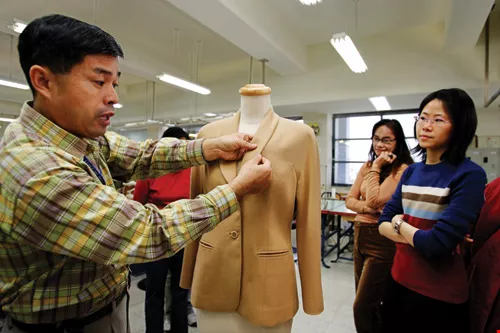
The Taipei City vocational training center offers all sorts of classes, from dressmaking to cooking and catering to auto repair. Acquiring a marketable skill is the best way to avoid falling into poverty.
The new face of poverty
To eliminate poverty we first have to investigate what poverty actually is. Some people say that poverty is a necessary evil and that providing government assistance to the poor is an important task for every society.
What kind of people are more likely to fall into poverty? Most people's stereotype is that poverty only afflicts the old, the weak, and the disabled. In fact, the face of poverty has changed along with rapid changes in society and the economy.
According to statistics from the Directorate-General of Budget, Accounting, and Statistics, Taiwan had 70,417 low-income households in 2002, representing a 60.8% rise on the 43,780 registered ten years earlier. In ten years, low-income households rose from 0.8% to 1% of the total number of households. In Taipei alone there are approximately 15,000 low-income households, which is considerably more than the 7,000 there were five years ago.
Taiwan's low-income households are divided into three categories. From 1992 to 2001, the number of households in category 3 (whose average family income is less than an individual's minimum monthly expenses) rose 1.4-fold.
In other words, the working poor have become a new class of poor people in modern society. In Taipei, 40% of low-income households are composed of low-wage earners.
Cheng Li-chen, associate professor at the Department of Social Work, National Taiwan University, says, "As a result of global economic polarization and the East Asian financial crisis of 1997, Taiwan's poor went from being predominately people who were old, weak, or in poor health to being predominantly working poor." Many people who are low-skilled or have service-industry jobs work long hours and endure appalling working conditions, but they earn too little to support their families. If they have an accident or another serious misfortune, they can easily sink into poverty.
What makes people fall into the poverty trap?
According to figures from the Ministry of the Interior, the main reasons why low-income families fall into poverty are infirmity in old age, death of the main wage earner, too many non-working mouths to feed, prolonged illness, and physical or mental disability. Social background, life events, and personal problems are the three principal contributing factors.
It is worth noting that an ever-increasing number of single-parent families are sinking into poverty because they lack a support network. Studies indicate that 23.5% of low-income households in Taiwan are single-parent families and that there are eight times as many single mothers as fathers. In Taipei, a third of subsidized apartments are occupied by single-parent families, more than half of which are headed by women.

Being down on your luck doesn't mean that you'll never get back up on your feet again.The important thing is not to give up and to keep in mind that spring follows winter.
New answers to old questions
Cheng Li-chen points out that Taiwan has a far lower poverty rate than countries with relatively good social welfare systems such as Britain, the US, Japan, and Sweden. The main reason is that Taiwan has very strict welfare entitlement criteria and sets a low poverty line to discourage people from sponging off others and prevent too many people from receiving welfare benefits.
In Taiwan, the poverty line, that is to say the "minimum standard of living," is set at 60% of the previous year's average individual living expenditure as ascertained by the DGBAS.
Cheng points out that under Taiwan's strict criteria, almost every family that qualifies as low-income is utterly destitute. That is why they tend to stay longer in the social welfare system than their counterparts in other countries.
According to Cheng, there is concrete evidence that the longer low-income households stay in the social welfare system, the less likely it is that they will ever achieve economic independence and the more likely that they will come to view relying on welfare benefits as a normal lifestyle.
Moreover, she feels that Taiwan's reliance on "asset surveys" to determine whether someone qualifies for welfare benefits should be reexamined. In Taipei, a person must own less than NT$150,000 in movable property and NT$5 million in real estate to qualify for welfare benefits. Consequently, families that have sunk into poverty no longer aspire to own or acquire property and are unable to free themselves of their dependence on welfare.
The crux of the problem is that there is no mechanism to encourage people to try to escape poverty. Wang Yu-shan of the Taipei DOSW notes that Taiwan has always used cash benefits to assist the poor. This merely alleviates the symptoms and does not get at the root of the problem.
Wang says, "Economists have a saying: the road to hell is paved with good intentions." Welfare dependency has far-reaching implications and may distort the younger generation's outlook on life and system of values.
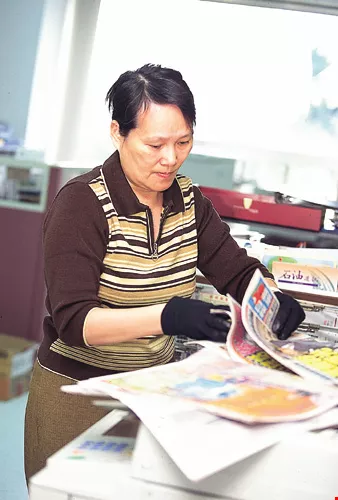
Although Sung Kuei-hua was abandoned by her husband and lost a finger in an accident, she is investing every penny in her three children's higher education to give them a good future.
The Taiwan dream
Given that poverty has become a growing social cancer both in advanced nations and in Third World countries, the United Nations declared 1996 the International Year for the Eradication of Poverty and pledged that by 2015 the number of people subsisting on less than US$1 a day, which stood at 1.2 billion, would be reduced by half. In response, in 1997 the Taipei City Government began to sponsor a series of programs to eradicate poverty in the capital. By guaranteeing the right to subsistence, the right to health, the right to housing, the right to an education, and the right to work to low-income people, the city government hopes to enable citizens to become content with their life and to fight and escape poverty for good.
Sun Chien-chung of the Department of Social Work at National Taipei University says that during the 1990s a new trend in thinking about social welfare came to maturity in the West, as a result of which encouraging the poor to build assets through savings and investment became the focal point of welfare policy. This is how the American Dream Demonstration (ADD) project was born.
In July 1990, the Taipei DOSW launched the TFDA program to help families escape from poverty and stand on their own two feet. The TFDAs were based on the ADD project.
The Taipei City Government's HDEP program, of which the TFDAs were an integral part, focused on low-income households that were encouraged to invest in building assets. Participants opened matched savings accounts by making a first deposit at a pre-selected saving level and schedule, and the savings were matched 1:1 for three years. Participants were also required to attend asset-management classes, draw up a feasible investment plan, and invest their savings on completion of the program. Unlike the American ADD program, the matched funds were provided not by government agencies but by the private sector. The TFDA project was explicitly aimed at facilitating a first home purchase, starting a small business, or financing higher education.
The government's support was commendable, but the private sector deserves most of the credit. Because of restrictions on government subsidies to individuals, the Pai Chen-Hsi Foundation and the Polaris Securities Group provided NT$14.4 million in matching funds to 100 TFDAs held by low-income households.
Of 182 low-income households who enrolled in the TFDA project, the Taipei DOSW randomly selected 100 families to participate on an experimental basis. Each household selected a monthly saving level of between NT$2000 and NT$4000 for a period of three years, after which time the total savings were matched 1:1.
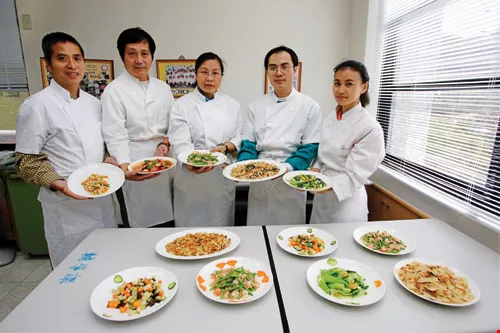
The Taipei City vocational training center offers all sorts of classes, from dressmaking to cooking and catering to auto repair. Acquiring a marketable skill is the best way to avoid falling into poverty.
Freeing the mind from poverty
Besides putting away monthly savings for three years, participating families were also required to attend classes twice a month, totaling more than 100 hours. The wide-ranging curriculum included confidence building, developing the students' latent potential, asset-management strategies, how to get into higher education, parenting training, introduction to home-buying, starting a business, and other topics.
Hsieh I-jung, a Taipei DOSW social worker involved in carrying out the TFDA project, points out that initially some of the families felt that attending classes was a big hassle, but after three years they found that they had benefited a great deal from them.
For example, Wu Hsiu-chu asked her son to take the "Starting a Business with Limited Capital" class and to share what he had learned with the rest of the family. The teacher often told the class that piling up things they couldn't bear to part with but for which they had absolutely no use in a cramped apartment was a typical example of "thinking like poor people." This prompted Ms. Wu to give up her old habit of never throwing anything away. She immediately felt like she had taken a big load of her mind.
One of the main conditions of the TFDA program was that in addition to making fixed deposits into their account and attending classes, participants must also work continuously. Those who lost their job must find another one within three months or withdraw from the TFDA program. This requirement encouraged everyone to work throughout the three years of the program.
The initial phase of the TFDA program ended in June 2003 and was completed by 69 of the 100 families that took part.
Over three years, the 69 participating households saved a total of more than NT$15 million and attracted more than NT$14 million in matched savings from the private sector.
Of the 13 families that set themselves the goal of buying their own home, ten are already proud homeowners. Of the 31 families that chose higher education as their investment goal, 26 have enabled their children to study abroad, go to graduate school, or attend a university or college. And all of the 25 families that aimed to start a small business have reached their goal.
Even more praiseworthy is that fact that 40% of participating families have left the ranks of low-income households and no longer receive welfare cash benefits.
Cheng Li-chen points out that escaping poverty is best defined in the broad sense of economic and psychological empowerment and greater participation in society, rather than in the narrow sense of no longer having low-income household status. Only then can a family truly say that it has escaped poverty.
Cheng says, "In the old days, these low-income families felt isolated and dishonored. But thanks to the assistance from the HDEP program and the experience of doing battle and overcoming poverty as part of a group of people working together, they have gained self-confidence and determination and have started using their brains. They no longer live hand to mouth, from one day to the next."
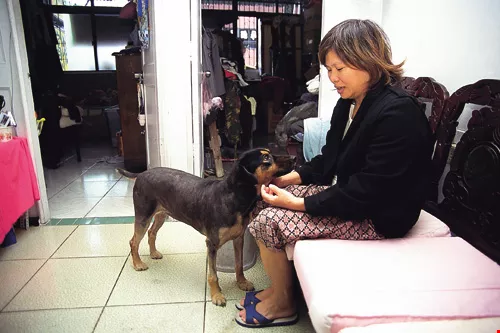
The new home has given the family a better quality of life and a much more positive outlook.
Hope in adversity
Cheng insists, "Eliminating poverty is not a matter of humanitarianism or social justice. Poverty is a flaw in a country's economic development and a waste of valuable human resources. It is a loss that neither individual citizens nor the nation as a whole ought to have to endure." In Taiwan, the problem of poverty is not caused by income disparity but rather by a disparity in families' ability to accumulate wealth. Wealth accumulated over a long period of time acts as a buffer in times of crisis and helps families avoid poverty.
The Taipei City Government's HDEP program has pointed the way. Other cities, including Keelung and Kaohsiung, intend to launch similar programs. A South Korean delegation also came to Taipei at the end of November to study and learn from the Taiwanese experience.
The Taipei City DOSW has taken advantage of the success of its HDEP program to pursue its battle against poverty. In July 2003, it launched a "Success Development Account" program aimed at second-generation low-income households. In May 2004, the "Realize Your Dream by Starting Your Own Business" program was launched for the middle-aged and senior unemployed. At the beginning of this year, phase two of the HDEP program was initiated. A series of programs to replace remedial welfare with proactive assistance and welfare dependency with rights and obligations are set to be launched in the future. The war against poverty is being joined all over Taiwan. Victory will require greater concern and participation from all of society.
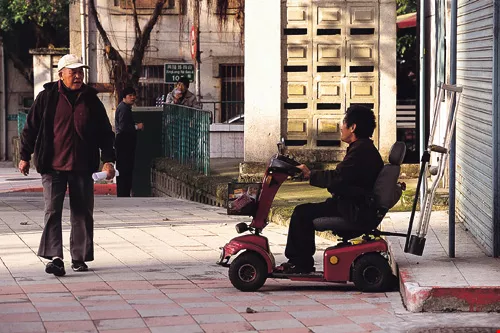
Poverty is not always caused by personal factors, but the old, the weak, and the disabled are especially vulnerable to it and it is particularly difficult for them to escape it. Escaping poverty requires other people's help but above all standing on one's own two feet. The photos show a low-income subsidized apartment in Taipei.


@List.jpg?w=522&h=410&mode=crop&format=webp&quality=80)
@List.jpg?w=522&h=410&mode=crop&format=webp&quality=80)
