The Ultimate Elixir
Managing Water Resources in a New Era
Coral Lee / photos Chuang Kung-ju / tr. by Jonathan Barnard
January 2005


Some say that if the 20th century was the century of oil, the 21st century will be the century of water. Experts predict that wars will erupt over water resources before the century is out.
Although war has yet to break out between nations over water, within Taiwan there have already been some battles over the precious substance. Two years ago, a severe water shortage in Hsinchu sparked a struggle between the Science-Based Industrial Park and agricultural users. And not long ago, when Taoyuan was without its water supply for 17 days, the stoppage enraged local residents and nearly caused a major political crisis.
For the past half century, Taiwan has used its water resources in the service of economic growth. Development has been the goal, and building infrastructure the method. Due to global climate change, droughts and floods have become more and more common in recent years, but it's hard to find suitable sites for reservoirs and dams. At the same time that water shortages are growing in frequency, efforts such as enlarging dams and building stormwater drainage systems have not been enough to stem the rising frequency of floods. Now people in the know are calling for non-engineering methods to address these water resource problems. What methods will this new approach engender? Will they really help Taiwan avoid water shortages and flooding?
Traveling around the island of Taiwan by train, one sees scenery of lush fields stretching between country villages. In the eyes of the urbanite, they appear as a vision of Mother Nature's generous bounty, but to farmers, these fertile fields are the fruits of hard labor. In particular, the irrigation channels-large and small-that run through them bear witness to years of toil by Taiwan's agricultural pioneers.
Taiwan's Han Chinese settlers who came from the mainland dug numerous irrigation channels to bring river water to their fields. The farmers would flood the fields in the early spring, and nourish their seedlings amid the wet fields. Then they would adjust the level of water, apply manure and root out weeds, tending to the stalks until they had flowered and matured. The final result was a harvest of golden rice.
With the amount of land under cultivation increasing from generation to generation, now, more than three centuries later, there are more than 60,000 irrigation channels in use, stretching over 40,000 kilometers all told.
"If you connected all these irrigation channels end to end, the resulting waterway would be longer than the equator," notes Chang Wen-liang, a professor of environmental systems engineering at National Taiwan University. Chang describes this network of channels as a marvel of engineering. Without these 40,000 kilometers of "irrigation ditches," Taiwan wouldn't have enough water for the paddy fields on the broad plains of Chiayi, Tainan, Kaohsiung and Pingtung.
Yet these irrigation channels scattered around the island hold only 10% of the island's rainfall. All the rest flows into the sea.
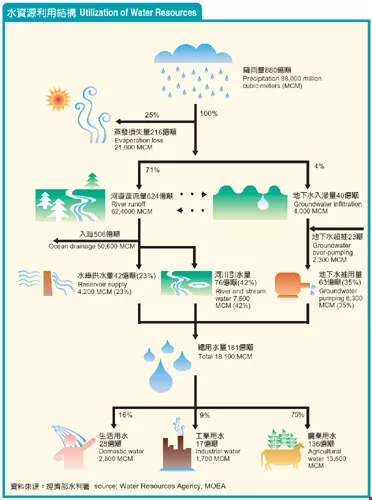
Utilization of Water Resources source: Water Resources Agency, MOEA
Downpours and dry taps
Taiwan's climate and topography make it hard to retain stormwater.
Taiwan is long and narrow, and the high peaks of its Central Range, which run along the island's spine from north to south, cause the western coastal areas to have little rain. What's more, the effects of the northeast monsoon and typhoons make rainfall uneven over the course of a year. 78% of the year's total rainfall falls between May and October, leaving only 22% for the remaining half year. Moreover, there is great regional variation. The ratio of precipitation in the rainy season to that in the rest of the year is 6:4 in the north, 8:2 in central Taiwan, and 9:1 in the south. This unevenness means that even though Taiwan has high average rainfall of 2500 millimeters a year, it's water that's hard to make use of.
Shiau Jeng-tzong, professor of water resources and environmental engineering at Tamkang University, notes that you can trace the sources of most of Taiwan's rivers to the steep slopes of the Central Range. This geography makes for short and rapid runs. Of the more than 100 rivers in Taiwan, only six extend for more than 100 kilometers, and their river basins are small in area. Since river water here reaches the sea so fast, it is hard to retain. Hence, although Taiwan's water resources may seem abundant, harnessing them requires a lot of infrastructure to meet the needs of a growing population with demand for water steadily rising.
Taiwan first began to build large irrigation channels to divert river water in the Qing Dynasty. At that time they built more than 500 spread throughout Taiwan. During the era of Japanese rule, the Japanese government adopted a policy of "agriculture in Taiwan, industry in Japan." In Taiwan it stressed infrastructure to help agriculture, and it introduced Western technology. Among these infrastructure projects, the Wushantou Reservoir and the Chianan Irrigation Channel took more than a decade to build. Providing irrigation to 150,000 hectares, they freed farming on the Chianan Plain from the whims of the weather. Later, Taiwan moved into an era of diversified aims for water projects, including projects aimed at flood prevention, producing hydroelectricity and supplying drinking water.

Taiwan's numerous paddy fields bear witness to the toil of Taiwan's agricultural pioneers, who built up its impressive irrigation system. More than merely scenic, these wet fields help to support a delicate ecological balance.
In step with a growing economy
In 1945, after Taiwan returned to Chinese rule, much lay in ruins and much needed urgent attention. Bolstering agriculture was a primary policy goal, and water infrastructure projects were given top priority. Their scale grew ever larger. The Shihmen Reservoir, which has a storage capacity of 230 million cubic meters (MCM), started operating in 1964. It provided northern Taiwan with a stable supply of water for agriculture and public consumption. In the 70s, with the economy taking off and demand from city dwellers rising steadily, one large reservoir after another was constructed. These served to support the era's tremendous economic growth. Over the past 50 years, Taiwan has built more than 40 reservoirs with a storage capacity of 2300 MCM and an annual yield of over 4000 MCM.
According to Water Resources Agency statistics, Taiwan has annual rainfall of about 88,000 MCM. Over 25% of this evaporates and some 4% seeps into the ground, leaving around 70% to enter the oceans. Because of the steep lay of the land, most river water flows very quickly. Only some 12,000 MCM is retained in reservoirs to be used for irrigation.
But in Taiwan, when taking account consumption by agriculture, manufacturing and residential/commercial users, there is demand for 18,000 MCM. The remaining 5-6000 MCM must be drawn from underground. Since the drawing of groundwater far exceeds the amount that seeps into the ground every year, the result is subsidence in the southwestern plain, sewage line breaks, growing salinity of the soil, and other problems. Many rural areas are now flooded whenever it rains.
The insufficiency of water resources and steady growth of demand is an old problem. But the recent trend of global warming and unusual weather is posing even greater challenges to those managing Taiwan's water resources.
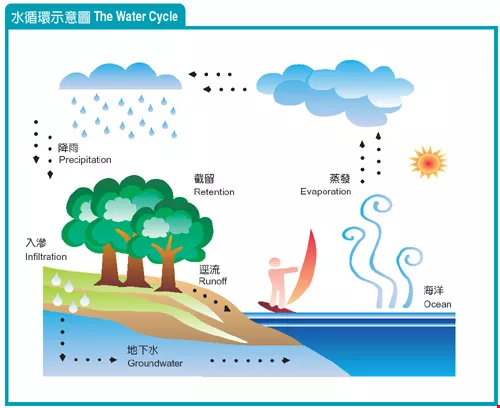
The Water Cycle
Droughts and floods the norm
Over the past few years, climate change has caused natural disasters in every area of the world. There have been extreme hot spells in Europe, glaciers melting in Canada, and flooding in the desert near Las Vegas. According to research by the European Commission's Environment Directorate-General, three-fourths of the Alps' glaciers will have melted by 2050. New records for daily rainfall in Taiwan have been set one after another. Rainfall of 1000 millimeters in a single day is no longer a rarity.
"Climate change has already made a big impact on the water environment here," says Chen Shen-hsien, director-general of the Water Resources Agency of the Ministry of Economic Affairs. One big effect has been on the typical amount of rainfall. According to Taipei weather station statistics, over the past two years the annual number of days with rain has fallen by nearly 30, but the average amount of precipitation when it does rain has increased by 250 millimeters. "This shows that rainfall is becoming more concentrated, which increases the probability of both droughts and floods."
What's more, rising temperatures are increasing the amount of water lost to evaporation and thus decreasing the amount that can be used for agriculture. Rising oceans are flooding coastal plains, and saltwater is polluting groundwater supplies. The increased hydrological instability has pushed water users of various kinds to fight over water from reservoirs, which they are depending on more than ever before.
Taiwan's steep slopes and fast-moving rivers do not favor reservoirs. Taichung's Techi Reservoir, for instance, has a dam 180 meters high and a capacity of 230 MCM. In the United States a reservoir with a dam of the same height could hold 5500 MCM. And as a result of poor maintenance, the loss of forest watersheds, river pollution, and sedimentation, the storage capacities of these reservoirs have decreased. After great deterioration of the water environment, the inability of these reservoirs to be adapted to changing circumstances further highlights the danger of insufficient supply.
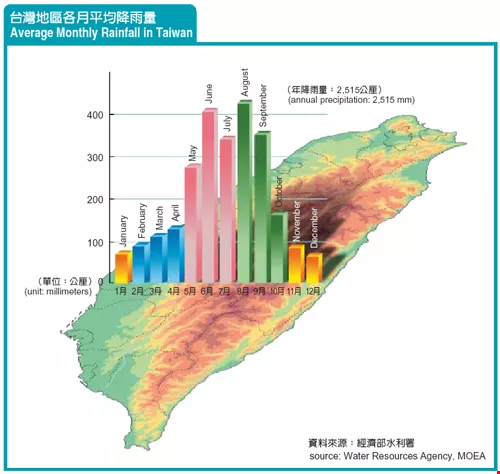
Average Monthly Rainfall in Taiwan source: Water Resources Agency, MOEA
Reservoirs in the plains?
In order to lessen the risks of insufficient water supply, the Executive Yuan has designated the construction of "manmade lakes" (lowland reservoirs) in Taoyuan, Yunlin, Tainan and Pingtung as one of ten new major infrastructure projects. But as of yet only the Chiyang "lake" has gone through even the first phase of environmental impact assessment. It will cover an area of 700 hectares. The plan is for water from the Laonung River to fill it during the rainy season. According to estimates, it will supply more than 100 MCM a year and will serve other functions too-tourism and leisure, as well as providing a source of sand.
The project, however, is a source of concern for environmentalists, who worry that groundwater will flood into the lakebed once it is dug out to a depth of 12 meters. The originally pristine groundwater will become polluted as it mixes with the surface water. They argue the project would damage the geological "natural filter" that has taken tens of millions of years to create and that it wouldn't really provide much benefit in supplying water: During the rainy season both surface water and groundwater can be accessed directly without needing to be stored, they argue, and during the dry season, as the groundwater level dropped, the stored water in the reservoir would quickly seep underground. In other words, they say that it would be little more than a large well.
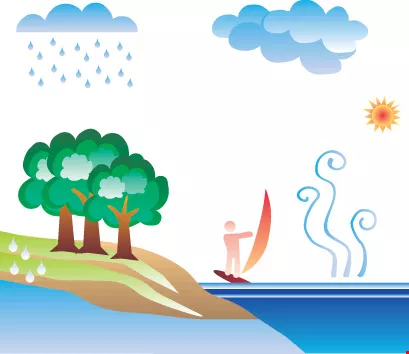
The Water Cycle
Non-engineering methods
Reservoirs in the mountains and reservoirs on the plains are both controversial. With pressure from local residents and environmental activists, numerous restrictions have been placed on building reservoirs in recent years, so that reservoir projects are hard to put into motion. In which case, where is the water to come from?
Still, a crisis can also represent a turning point. In recent years people have found wisdom in traditional methods of collecting water. For instance, ponds have been built in communities to store rainwater and farmers are encouraged to expand their irrigation ponds. Some people are working to find new sources of water with the aid of new technologies. For instance, they are developing technology for desalinating seawater, or researching methods to recycle wastewater.... Various small steps can replace major water engineering projects as the mainstream in the search for new water.
At the same time as working on various fronts to find new sources of water, taking steps to better manage current water resources is also one of the pillars of recent thinking about water resources.
"Taiwan is going to have to rely on non-engineering methods to resolve the problem of water shortages," says Lee Hong-yuan, former director of the Water Conservation Bureau in the old Taiwan Provincial Government. Lee points out that water resources in Taiwan pose huge challenges, since water engineering projects often cannot resolve the serious problems of flooding and water shortages. Take, for instance, subsidence in the Changhua-Yunlin-Chiayi area. Even if you spent tens of billions of NT dollars on storm drains it wouldn't tackle the root problem. To do that would require changing government policies on agriculture, outlawing freshwater fish farming, and then converting fish ponds to manmade wetlands and freshwater lakes, which, apart from helping to treat wastewater and serving as flood detention ponds, could serve as substitute water sources and be designated as ecological and recreation areas. They could thus serve in many ways simultaneously.
Furthermore, effective non-engineering methods-such as imposing reasonable charges for water and adopting water conservation measures, stormwater retention, and wastewater recycling-could be employed to increase the efficiency of how water resources are used.
Of the 18,000 MCM that Taiwan uses in a year, 20% is consumed as tap water by residential and commercial users, 10% by industry, and 70% by agriculture.
The average person in Taiwan uses about 300 liters of water a day, which is considerably more than the world average of 250 liters. If everyone could conserve that extra 50 liters, Taiwan would have an extra 400 MCM a year, equal to the capacity of the Feitsui Reservoir. Yet water consumption habits can't be changed overnight. In 1994 the government began promoting a policy of water conservation. But after ten years the total amount conserved each year amounts to only 120 MCM.
"That 120 MCM is neither a lot nor inconsequential," says Yu Guo-hsing, the director of the Center for Water Resources Management and Policy Research at Tamkang University. A large reservoir in Taiwan only holds about 200-300 MCM, and costs at least NT$10 billion to build. Meanwhile, the amount spent on promoting water conservation has only run to NT$1 billion all told. As far as return on investment is concerned, that counts as doing rather well. And that money is saved forever, as opposed to money spent on a reservoir, which would require regular spending on maintenance.
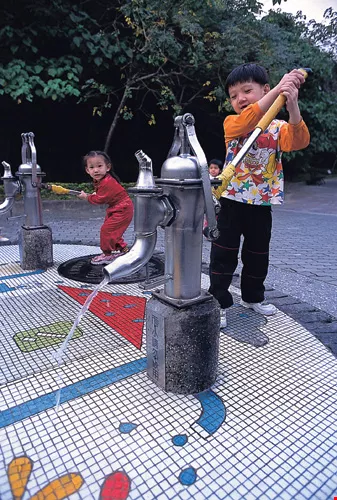
Retaining rainwater involves both ancient and modern techniques. Whether using it to flush toilets, water plants or clean houses, or storing it in ponds for irrigation, making use of it is a good way to conserve water resources. The photo shows an underground rainwater collection tank and pumps at the Taipei Zoo.
Super-low price
The fact that Taiwanese are habituated to wasting water and using it inefficiently is largely due to the low price of water here.
One cubic meter (about a ton) of water costs about NT$8-9. This is far lower than the NT$24 it would cost in Singapore, or NT$30 on average in Australia or NT$40 in Japan. Most small households have water bills that run to NT$200-300 each month. Since this doesn't cause much discomfort, it's only natural that it doesn't lead to a habit of water conservation-or that there is little economic incentive for installing water-efficient appliances. In recent years there have been loud calls to raise the price of water, but for fear of a price hike creating inflationary pressure nothing has changed.
The low efficiency of water usage also results from the high rate of leakage-some 25% for tap water. Ouyang Chaio-fuei, a professor emeritus of environmental engineering at National Central University and the chairman of the Taiwan Water Environmental Association, points out that due to leaking pipes, inaccurate meters, and water theft, when the Taiwan Water Corporation supplies 1000 tons of drinking water, it can only bill for 680. Hence, about 30% goes unpaid for. It's a situation that is certainly bad for the company's bottom line, but it also represents a serious loss of water supply for an island prone to frequent shortages.
For many years the leaks in Taiwan's water supply system have been roundly criticized, but for Taiwan Water, the price of water isn't enough to meet their costs. The corporation has long been in debt and is only replacing water lines at a rate of 0.5% a year. If the government were to pay to replace pipes, it would be viewed as unfairly subsidizing major users. Hence, the problem of leaks continues to be a hard one to resolve.
As for recycling wastewater, there is a low rate of sewer hookups in Taiwan (only about 10.8% islandwide). Currently, only the cities of Taipei, Taichung, and Tainan have water treatment plants that can take water through a level two treatment process and then reuse it. Moreover, this water has limited uses, including cleaning streets and watering plants in parks.
Ouyang explains that even after several years of water conservation campaigns there is room for more efforts in this regard. He suggests that the government first focus on promoting the installation of water-efficient bathroom fixtures in homes. They shouldn't be only pushed for government institutions and schools, because private citizens use twice as much water as industrial users. There is a lot of room for savings.
With regard to recycling water, Ouyang has been sparing no effort advocating wastewater treatment and reuse for irrigation and then again for other purposes. "That would resolve most of Taiwan's water shortage!" Ouyang says. The standards for irrigation water are lower, and nitrates and phosphates in wastewater can serve as nutrients for paddy-field rice. The United States, Japan and other nations have long been using it thus. Yet, because Taiwanese farmers regard treated wastewater skeptically and because no associated legal framework has yet been established, there is still a long way to go before it is used here.

The new trend is developing an assortment of small-scale water resources. Helping to treat wastewater or serving as catchment areas or even as substitute water sources, manmade wetlands have been growing in popularity. The photo shows the Hsinhai wetlands in Hsinchuang.
Industry lags behind
Of the 120 MCM of water saved each year in Taiwan, 32 million are saved by industry. The focus of their efforts is on recycling water.
Because water is typically less than even 1% of a company's total costs, many factories are stuck in the conception that "water is cheap" and put little emphasis on raising efficiency. In order to push water conservation, the Ministry of Economic Affairs hired the Energy and Resources Lab of the Industrial Technology Research Institute to create a "water conservation service team," which has promoted water conservation in various industries and provided technical consulting services. It focuses its efforts on major electronics, petrochemical, textile and paper manufacturers and areas where there are serious water shortages or subsidence of land.
Because of their production processes (which include the use of acids as cleansers), high-tech industries are major water users, and for them conserving water lowers costs. Therefore, these factories happily buy into conservation campaigns. For example, newer semiconductor plants in the Hsinchu Science-Based Industrial Park recycle about 95% of their water, whereas the older ones recycle about 60-70%. But other industries, with different patterns of water usage, use water much less efficiently. Taiwanese industry as a whole recycles about 43% of its water, as compared to about 80% in Japan-which shows that there is still much room for improvement.

Average Monthly Rainfall in Taiwan source: Water Resources Agency, MOEA
Make the most of river water
And how efficient is agriculture, which uses the lion's share of Taiwan's water? What about promoting conservation for it?
"Compared to water usage by residential and industrial users, there's a whole different conception when it comes to agriculture," says Lin Wei-tao, a section chief in the Council of Agriculture's irrigation department. With regard to the 80% of irrigation water that comes from rivers, if the farmers don't use it, it will just flow down rivers to the ocean. It can't be diverted to residential or industrial use. Moreover, wet-field irrigation also helps to replenish groundwater and protect the ecosystem. Consequently, not only is there no need to stress conservation for agriculture's use of river water, but the use of that water in farming should be encouraged.
Yet it's important to increase the efficiency of how farmers use groundwater and reservoir water. Because Taiwan has uneven rainfall over the course of a year, with a wet season and a dry season, government agencies with responsibility for agriculture have long mandated rationing measures during dry spells, including rotating irrigation water by district or enforcing an on-off day schedule for the supply of irrigation water. The government has also been pushing the use of water conservation technology for dry-field agriculture (see "Master Managers of Water"). Only by adopting such measures has it been possible to transfer some of the water previously consumed by agriculture during the dry seasons to household and industrial users.
"Most people are under the misconception that because agriculture uses about 70% of all water-some 12,000 MCM-it shouldn't be a problem for it to make adjustments and transfer some of that water to other users," says Lin. In fact, for various geographical and seasonal reasons, the water actually available for other users is only the irrigation water coming from the Shihmen, Tsengwen and Wushantou reservoirs. This comprises only about 11 MCM per year. If you exclude the water that agriculture draws from those reservoirs during the wet season-when there is plenty to go around-that leaves only 3 MCM per year. Lin points out that in the second half of 1994, when there was a drought throughout Taiwan, an area of nearly 100,000 hectares of fields in western Taiwan went without irrigation water, which was transferred to industrial and residential users. But the amount transferred only totaled 1.5 MCM.
How to go about sharing water during the dry season, is a multifaceted topic. Apart from debates about water consumption, it also involves issues of social fairness and industrial development.

Although large rivers were the cradles of civilization, people haven't treated them with the respect they deserve. To resolve the water crisis, perhaps it is necessary for humanity to rediscover its relationship to water.
Water wars
In the 2002, when Hsinchu was suffering from a major water shortage, factories in the science park protested to the Ministry of Economic Affairs. As a result, the government forced farmers to stop irrigating. It caused quite a controversy.
"Why should farmers give up their water to the science park?" Some people believe the notion that "the technology park is the goose that lays the golden eggs" not only unfairly slights farmers but also seriously disrupts the rhythms of agricultural production. What's more, the government, rather than the factories, provided the compensation money, which struck many as unfair. Incidents of the park discharging polluted water that damaged land downstream have also highlighted the issue of inequitable use of resources.
Facing ever more serious short-term water shortages, Taiwan is a lot like the rest of the world: it has nowhere left to hide. Because most of the world's water resources that haven't been polluted have already been developed, the planning, development and management of water resources will be more complicated in the coming era than ever before. Finding a way through these problems, so that water continues to flow, is not simply a responsibility of the government and experts, but something of concern to everyone in Taiwan.
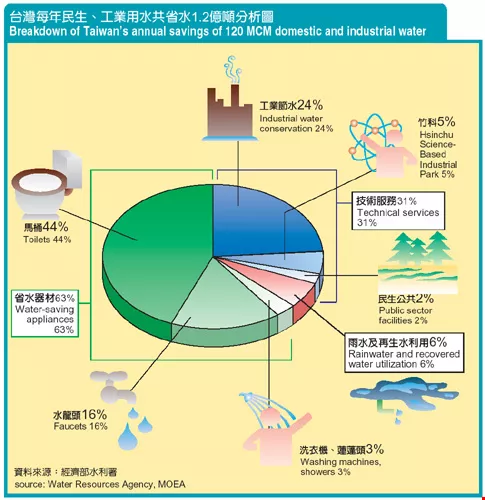
source: Water Resources Agency, MOEA

@List.jpg?w=522&h=410&mode=crop&format=webp&quality=80)


@List.jpg?w=522&h=410&mode=crop&format=webp&quality=80)
@List.jpg?w=522&h=410&mode=crop&format=webp&quality=80)
