A Homegrown Treat for the Tastebuds--Taiwan Golden Chicken
Chang Chiung-fang / photos Yang Wen-ching / tr. by Geof Aberhart
September 2006


In the four years since Taiwan's accession to the World Trade Organization, the domestic market for agricultural products has gradually opened up to imports. Having lost its former protection, the local industry is now facing an onslaught of imported goods, and is naturally concerned. The "Taiwan Golden Chicken" brand is one way they are taking up arms against this threat.
To tackle the foreign challenge, domestic chicken producers have dedicated themselves to building a strong brand through improving quality and marketing, fighting to win the hearts and stomachs of Taiwanese consumers and successfully hold on to their territory.
So, how is Taiwan Golden Chicken's battle progressing?
"Chinese cooking, Western cooking, it's perfect for either; Taiwan Golden Chicken, no other one tastes better. Taiwan Golden Chicken--Taiwan's own." Featuring the brand's three mascots--Chin-go, Paopao, and Chichi--singing and dancing, this commercial has been a regular feature on Taiwanese TV for a year, with adults and children alike so familiar with it they can recite the jingle from memory.
But there are still many people who don't know what "Taiwan Golden Chicken" actually is, or where they can buy it. Still more are even unaware they've actually already eaten it! Sharp-eyed shoppers, though, will have noticed the Taiwan Golden Chicken stickers on fresh chicken in supermarkets and other stores, and fast-food restaurants like KFC, Burger King, Mos Burger, TKK Chicken, and Napoli Pizza, along with boxed lunch stores like Wutao, Chihshang, and Chiayi all sport signs indicating their use of CAS-certified Taiwan Golden Chicken.
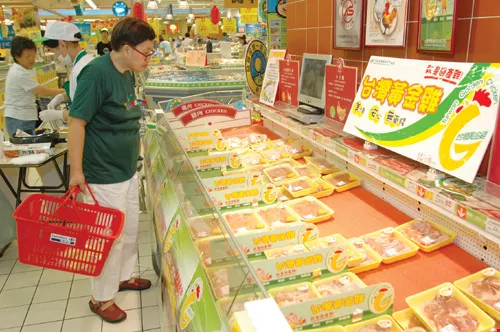
The Council of Agriculture, in cooperation with 12 major retailers including Carrefour and RT Mart, has set up counters in 65 locations in an effort to promote domestically produced poultry and promote Taiwan Golden Chicken.
Quality assured
Some people may wonder, is this "Taiwan Golden Chicken" a new breed? And what makes it different from frozen, imported chicken and freshly slaughtered chicken from wet markets?
The brand name "Taiwan Golden Chicken" doesn't actually refer to a specific breed, but rather a range of chicken products slaughtered by members of the Taiwan Poultry Processing Association (TPAA), and then CAS certified. The brand accounts for 90% of the battery-farmed chicken in Taiwan and 10% of the free-range chicken.
Backed by the Council of Agriculture (COA), the TPAA and retailers issued a joint statement, outlining their commitment to keeping the chicken "tasty, safe, and chemical free." This has led to Taiwan Golden Chicken becoming synonymous with Taiwan's best chicken.
Despite the looming threat of bird flu, in the year the brand has been promoted sales have grown over 30%, and the fact that counterfeits have already appeared is proof that Taiwan Golden Chicken is becoming a major player.
In Taiwan, people who don't eat red meat are fairly common, but people who don't eat chicken are as rare as hen's teeth. This is because chicken is virtually omnipresent--whole chickens are used in religious festivals; pieces are used in traditional medicines; roast, fried, and salted chicken are common snacks from street vendors; and the average dinner table frequently plays host to chicken, including sesame oil chicken, chicken with pineapple and bitter melon, three-cup chicken, and chopped cold chicken.
According to COA estimates, domestic sales of battery-farmed and free-range chicken stand at 350 million units annually, or just over 30 kilograms of chicken per person a year.
With chicken already a staple of the national diet, why do we need a new brand? The answer, in short, is to more clearly differentiate local and imported chicken.
Since Taiwan joined the WTO in 2002, the agricultural produce market has opened up to imports, and with no quotas in place, domestic produce has been under attack--particularly chicken.
According to Hwang Ing-haur, director of the COA's Animal Industry Department, American and European poultry exports are small and unlikely to affect most foreign markets. At the same time, Taiwanese consumers are used to buying fresh-killed pork, so the relatively tougher, stronger-smelling imported pork is no threat, and only 6% of Taiwan's beef consumption has been locally produced with the rest imported, so there's unlikely to be much change there. The exception to all this is chicken, in particular electrically slaughtered chicken, which accounts for 90% of the pre-packed chicken market (free-range chicken tends to be killed on-site at traditional wet markets).
Prior to WTO accession, Taiwan had placed a series of controls on chicken imports. Not only were there annual volume quotas, there was also a 40% duty rate, aiming to control quantity through high tariffs. Chicken legs and wings, which are in surplus internationally and thus sold cheaply in global markets, were entirely prohibited from importation because, like pig offal and pork bellies, there would be too much of a price difference between them and their local competition.

With the door open to imports, the chicken market has become a battleground, with domestic chicken producers hoping to continue to dominate the market through ensuring high quality product.
A pitched battle
As of 2005, protective measures including tariffs and quotas came to an end, and the market was opened to all kinds of imports. Import duties were gradually reduced to 20%, setting the scene for a pitched battle between local and imported chicken. The "Taiwan Golden Chicken" brand is one of the COA's primary weapons in this war.
The name "Taiwan Golden Chicken" comes from the so-called "golden period" in which chicken is at its best, and the three mascots represent the smooth texture of the meat, the health of the chickens, and the moistness of the meat.
As Hwang explains, chicken is best enjoyed within 72 hours of slaughter, before the meat begins to toughen up, and while the adenosine triphosphate in the meat has just begun to react, giving the chicken a more distinctive flavor. These 72 hours are the "golden period," and only locally produced chicken is capable of reaching consumers with that kind of speed. Foreign chicken is generally slaughtered, frozen, transported to ports, and then shipped out, taking an average of three months to reach Taiwan--well and truly past its best.
With the time to market so short, local chicken only needs to be refrigerated (to around 1 oC) rather than deep frozen (to below -18 oC), maintaining the suppleness and smoothness of the skin and ensuring the meat is still tender. Imported chicken, however, has skin that looks broken, pale, and dull, and the meat is less tender.
Freezing chicken not only affects its appearance, but also the quality of the meat. As Hwang explains, when the water molecules between the cells in the meat freeze, they crystallize, and these ice crystals can damage the cells, leading to a loss of cellular fluid. This gives imported chicken its stringiness and changes its flavor and texture.
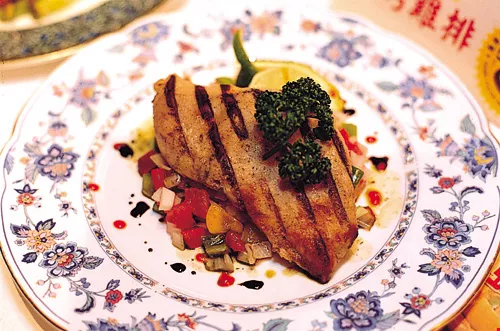
Chicken is an excellent source of protein, and when cooked skillfully, it can become a mouthwatering meal.
Tracing their steps
As well as these advantages, the Taiwan Golden Chicken brand also guarantees the "heritage" of its goods; each chicken has a comprehensive "resume" that traces its life back to hatching, including where it was slaughtered, and what farm it was raised on. This way, if a problem should arise, the trail can be followed back and the problem immediately handled.
Many Taiwanese electrical slaughterhouses have contracts with farms, and the biggest is the slaughterhouse section of the DaChan Greatwall Group, which has recently passed ISO 22000 accreditation and has signed contracts with approximately 200 farms Taiwan-wide.
DaChan Greatwall's slaughterhouse in Tayuan, Taoyuan County, electrocutes an average of 65,000 chickens a day at a rate of 5,000 an hour. Throughout the process, from bleeding the chickens through plucking, post-slaughter veterinary inspections, refrigeration, grading, sorting according to the rules of various areas, packaging, and shipping, everything is mechanized. A live chicken can enter in the morning and be sitting in a fast-food restaurant or market by the same evening.
Every slaughterhouse has an inspector stationed there by the Bureau of Animal and Plant Health Inspection and Quarantine, part of the Council of Agriculture. Each chicken that goes through the slaughterhouse is inspected, and if any appear unhealthy or not up to standard, they are removed from the process.
Hung Tien-tai, the bureau's veterinarian for DaChan's slaughterhouse, says that chickens with a fever can be spotted by appearance--their limbs have a slight red tinge, or their skin will have light purple blisters. All it takes is a single inspection, after which infected chickens are immediately discarded. According to estimates by Chen Chi-fang, chairman of the Taiwan Poultry Processing Association, Taiwanese slaughterhouses discard up to NT$100 million worth of chicken in this way.
.jpg?w=1080&mode=crop&format=webp&quality=80)
With the door open to imports, the chicken market has become a battleground, with domestic chicken producers hoping to continue to dominate the market through ensuring high quality product.
Tasty, safe, and chemical-free
In this war for the marketplace, locally produced chicken has time on its side, and the slaughterhouses have strict quality control measures in place. The only possible black mark against it could be the problem of the use of chemicals in chicken farming.
The head of DaChan's production department, Li Ching-chuan, says that the quality of chicken farming in Taiwan is high, and non-free-range chicken has reached up to 95% success in quality checks. Their methods have become the standard farming model, and today chickens can be grown to about two kilograms in just 40 days.
But due to Taiwan's narrow geography and high population density, most chicken farms have chosen to run large-scale operations. To avoid cross-infection leading to avian cholera and large-scale deaths of chickens, most feed is combined with antibiotics and sulfanilamide--an antiviral agent--to protect the birds' health.
Hwang Ing-haur says that it is difficult to avoid chickens ingesting chemicals at some point during their rearing, but that as long as the chemicals can be processed and eliminated by their metabolism this is not a problem. The concern is that in the rush to get chicken to the market, some may be killed too soon and that people who eat a lot of chicken may be at risk of adverse reactions.
While some suspect chicken farmers of being after quick bucks and feeding their chickens growth hormone, Li Ching-chuen says this is unlikely, as commercially farmed chickens have already gone through selective breeding for genetic improvement, meaning the amount of time needed to raise them has been dramatically reduced. As a result, there's no need to waste energy or money injecting chickens with growth hormone.
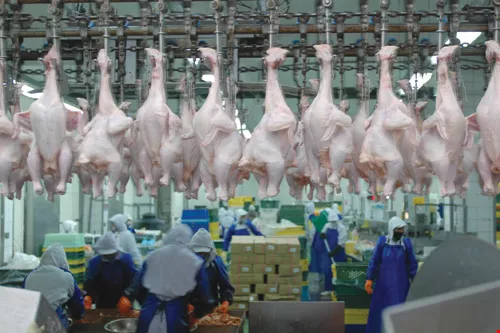
All steps of the slaughtering process, from bleeding and plucking through to grading and slicing, are mechanized in the low-temperature environment of the modern electrical slaughterhouse. Pictured here is the poultry slaughterhouse of the DaChan Greatwall Group in Tayuan, Taoyuan County.
Protecting their claim
To ensure their chickens are chemical-free, and thus letting consumers dig in without concerns, slaughterhouses have developed a special set of tests.
Li Ching-chuan explains that any antibiotics or sulfanilomide in a chicken need seven to 15 days to be metabolized, and so starting from the 25th day of rearing DaChan Greatwall provides farmers with chemical-free feed for their chickens, ensuring that by the 40th day and their slaughter, all chemicals will be gone from the chicken's system.
In the three days leading up to slaughter, the slaughterhouse sends someone out to get a sample from the flock, taking two birds for every 10,000. This sample is used to determine that there are no remaining chemicals in the birds' systems before they're sent for slaughter.
In their constant pursuit of quality, Taiwanese farmers have also begun raising "organic" chickens, with which no chemicals are used at all. These chickens are grouped in a sub-brand under the Taiwan Golden Chicken label called "Luye Free-Range," and all chickens are 100% natural, free-range chickens. These chickens require a large area for rearing, and as such not every farm can raise this kind of chicken.
Last year was the first round in this international chicken war, and so far Taiwanese chicken has managed to successfully keep hold of its territory; over 64,000 tonnes of chicken was imported last year, accounting for about 20% of the market, and 90% of that was American chicken legs and wings.
However, this battle is only beginning, and Taiwan Golden Chicken is on the front lines. Their promise of "tasty, fresh, and chemical-free" chicken is the first shot fired, and there is still a fierce fight ahead if Taiwanese chicken is to remain sustainable.

With the door open to imports, the chicken market has become a battleground, with domestic chicken producers hoping to continue to dominate the market through ensuring high quality product.
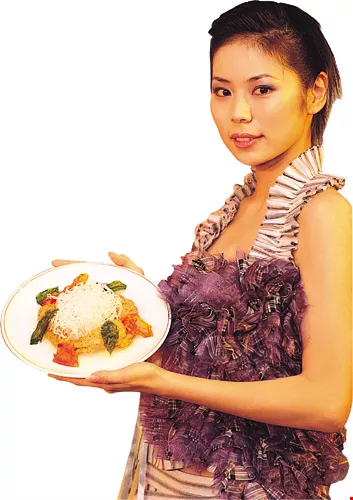
Having fresh ingredients is a fundamental requirement of cuisine, and as such Taiwan Golden Chicken emphasizes the fact that no imported chicken can reach consumers within the "golden period," when chicken is freshest. This photo shows a presentation of Taiwan Golden Chicken.

With the door open to imports, the chicken market has become a battleground, with domestic chicken producers hoping to continue to dominate the market through ensuring high quality product.
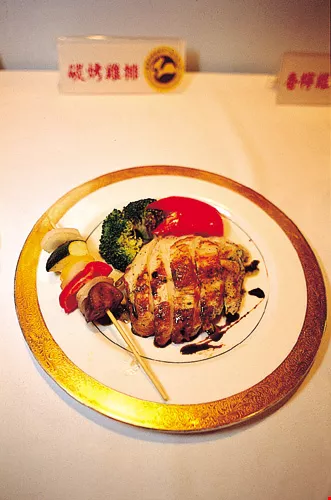
Chicken is an excellent source of protein, and when cooked skillfully, it can become a mouthwatering meal.
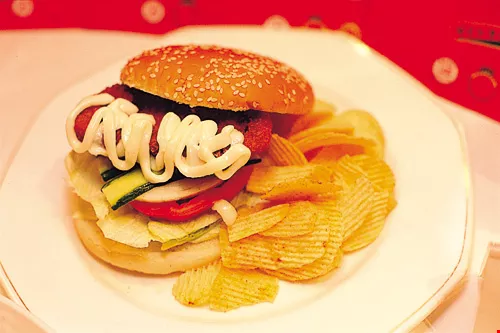
Chicken is an excellent source of protein, and when cooked skillfully, it can become a mouthwatering meal.

@List.jpg?w=522&h=410&mode=crop&format=webp&quality=80)


