A Long Road to Walk--Rebuilding Namasiya
Coral Lee / photos Chuang Kung-ju / tr. by Jonathan Barnard
October 2009


Located along the upper stretches of the Nanzixian River, deep within the Yushan Range, Namasiya Township is a place where the polyphonic harmonies of Bunun choirs have long resounded amid the verdant hillsides. Among a total population of 3500, 70% are Bunun and 18% are Southern Tsou. There are also smaller numbers of Paiwan, Atayal, and Amis. Passing their days in a slow-paced manner that lacks the hectic pressures of modern urban life, Namasiya's residents have long planted millet and bamboo shoots, picked jelly figs, and hunted wild boar and flying squirrels.
After Typhoon Morakot the formerly beautiful township became a giant mud-covered graveyard. The mudslides and flooding caused by Marokot killed 26 of Namasiya's residents and left the township with other serious problems. Of its three villages, Minzu, the farthest downstream, was almost entirely destroyed. On the other hand, Minquan, which is upstream from Minzu, was only partially destroyed, and Minsheng Village, which is still farther upstream, was largely unscathed. Although the residents of the three villages are closely related by blood and cooperated closely before Morakot, they have grown more isolated since the typhoon with road and communication links cut, and they have gone their separate ways on the question of whether to move their villages. The resulting resentments and grudges worry village elders and outside observers alike, and certainly won't help in making future plans.
The dilemmas posed by the reconstruction of Namasiya epitomize the issues faced by more than 10 Aboriginal villages that were seriously damaged by the typhoon. Several tribal villages in southern Taiwan have been left uninhabitable: In Kaoshiung County there is Xiaolin Village in Jiaxian Township; in Pingtung County there are the villages of Jiamu and Haocha in Wutai and the village of Dashe in Shandimen; and in Chiayi County there is Pnguu Village in Alishan Township. The residents of these villages are all facing the question of whether they should relocate. And many more villages where the casualties were fewer-but where dangers nonetheless still lurk everywhere-are also facing major decisions.
The challenges posed in rebuilding these villages lie not just in building residences but also in taking account of traditional lifestyles, livelihoods and relations among neighbors. These are subtle and thorny problems that can't be solved simply by passing the Post-Typhoon Morakot Reconstruction Special Act, argue many scholars and private citizens. The people in charge must listen to the victims, as well as communicate openly, plan prudently, and on no account rush into things-lest the weary victims of the typhoon suffer grave harm a second time.
Three weeks after the typhoon struck, Taiwan Panorama reporters boarded a helicopter to Namasiya Township, which had become a lonely island with impassable roads. From Minsheng Village (at an altitude of 800 meters) we rode in a four-wheel-drive vehicle, enduring more than an hour of rugged travel, before finally reaching Minzu Village. Sitting at an altitude of 500 meters, Minzu was the village in Namasiya that suffered the most damage from the typhoon. The scenes there resemble the ruins of war: battered and badly damaged homes; twisted rebar, corrugated metal and strips of aluminum; cars filled with rocks and earth or half-buried in mounds of gravel; and various objects pulled from homes by flooding and mudslides, such as quilts, clothes and furniture, lying by the side of the road. Under misty skies, the only living beings that remain are eight or nine homeless dogs that scurry back and forth across the rock-strewn road. Through the village their barks echo near and far. It's hard for people to bear looking at the village in such a forlorn state.
When you reach the site of Minzu Elementary School, all that can be seen is a vast expanse of mud. People from neighboring villages say that this is where mudslides created a "quake lake" 70 meters deep that quickly formed and then burst. A classroom building and dormitory were completely destroyed and washed into the Nanzixian River.
Deng Tianshou, 70, lived downstream from the village. As he describes it, at sometime after 4 p.m. on August 9, he was sitting in the verandah of his home, watching the violent rainfall with alarm, when he suddenly heard a loud bang. As soon as he looked up, he saw four large camphor trees-uphill 200 meters at the school-being pushed into the air by mud. He had never seen a mudslide before. He stood up and prepared to call out to his family, but he was immediately swept out of the house and buried by earth and rock with only his head exposed to the air. He was extremely fortunate that he wasn't hit by a big rock. He struggled with all his might to extricate himself from the mud and found his son, who then broke down the front door to save his three granddaughters in the living room, as well as other family members who were on the second floor.
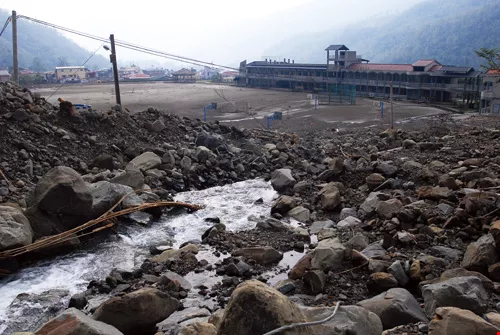
Located in Minquan village, Sanmin Junior High School next to Provincial Highway 21 has been buried in rocks, and the base of the road has risen 2-3 meters. Because large machinery cannot pass, the area is still a mess one month after the disaster.
Panic in the dark night
Located at the downstream end of Namasiya, Minzu Village had 160 households. Three-fourths of them suffered serious damage from Morakot's mudslides. Deng Tianshou lived in Neighborhood 3 of the village, which was at the edge of the mudslides' destruction. There they still had time to flee, but some residents in Neighborhoods 1 and 2 were immediately pushed into the Nanzixian River, and others were buried in the rubble of buildings that collapsed. Altogether 26 village residents died in the disaster, and more than 10 bodies, buried deep under mudslides, still haven't been recovered.
After the mudslides, terrified Minzu residents were scared that disaster would strike for a second time. With the road to Minquan impassible, and the electric and telephone lines down, the entire village-some 200 residents-gathered and decided to withdraw to higher ground, seeking refuge on the "Minzu Plateau."
The mountain road to the plateau having also been destroyed by the mudslides, the young people of village had to quickly slash a path up the 70° slope. "Thinking about it now, I have no idea how the old and the infirm, the women and the children climbed that two-kilometer trail!" says Lin Qingzhang, a professional marine who comes from the village.
Although some tarps had been set up to provide cover from the rain, the wind and rain were so heavy that some people began to lose body temperature that night. Hence, the villagers arranged themselves shoulder to shoulder in circles, with the children in the very middle, the elderly in the next ring out, and hale and hardy young adults in the outer ring, creating a barrier of flesh to keep out the rain. They survived by eating the taro and sweet potatoes that they had planted on the plateau and by drinking rainwater. It wasn't until noon on the third day that they finally saw the helicopters that would gradually evacuate them.
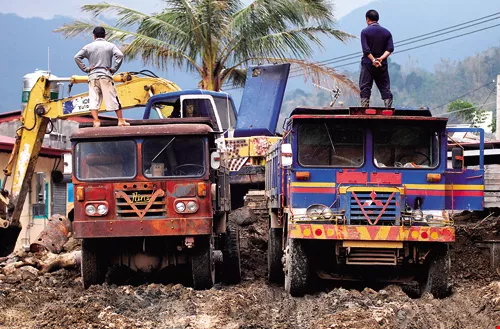
Rescue and relief teams from many organizations and agencies have come to the affected areas; the road back will be long and tortuous.
Decision to move the village
After coming off the mountain, some dozen members of the village, including the village head, elected political representatives and elders, formed a self-help society. Because of the great courage he showed during the escape, and because of his articulateness, Lin Qingzhang, though only in his 30s, was chosen as executive director. "We held a residents' meeting up on the plateau, and the elders reached the conclusion that with the village having shifted westward 250 meters toward the Nanzixian River [see the picture on p.30], we had no choice but to move."
With sites the government selected and several options of their own, the village elders first considered the very Minzu Plateau that had provided them with safe shelter through the storm and that was adjacent to the village. Apart from its proximity to the original village, some of the elders remembered that the plateau was in fact where the village had been originally been located. But it is less than three kilometers wide, and on two sides is bordered by rivers, which might continue to eat away at its base. Furthermore, there had already been some landslides in its higher sections. So eventually, with many regrets, they decided instead on the site the government offered that was closest (about a 50 minute drive) to their old village: land in Shanlin Village that had belonged to Taiwan Sugar Corporation.
Occupying 58 hectares (about seven football fields), the site is next to Kaohsiung County's Shanlin Junior High School and was formerly Taiwan Sugar's Yuemei Farm. In conjunction with the government's plan to move Minzu residents there, the Tzu Chi Foundation and Foxconn Technology Group have promised to fund construction of 700 permanent residences in Shanlin.
The plan for relocating Minzu Village there, which has a distinctly experimental flavor to it, calls for the use of light steel structures for the residences, which are designed to withstand Magnitude 8 earthquakes and Force 17 winds. The homes, which range in size from 500 to 1225 square feet and are being allotted based on the number of members of a household, have been guaranteed to last 50 years. Village facilities are comprehensive and will include a nursery school, an Aboriginal handicrafts workshop, a community center, and a medical clinic. Out of respect for Aboriginal religious beliefs, a church and ancestral shrines for various tribes are also provided. And with cutting-edge solar panels, a bicycle lane, and a recharging station for electric scooters, it is a model of environmentally minded planning.
"We were quite moved by reading Tzu Chi's report," says Li Yuzhang, a resident of the village and a former county legislator. He was surprised to find that the foundation had clearly done its homework on traditional Bunun culture. Their plans even included a weaving workshop, as well as a traditional "calling platform," which young villagers had never even seen before!
Lin Qingzhang, on the other hand, says that the choice of Shanlin was undesirable in several ways but unavoidable-for they wanted to find somewhere they could safely put down roots for the long term. The tribal people made two requests, however: First, they hoped that the government wouldn't repossess their reservation in the mountains, so that they could go back to visit and to plant crops. "Without agricultural lands in the mountains, we'd lose our roots, and we'd starve to death in the flatlands!" Their second request was a guarantee that they could live in their new village forever, thus preventing the government from taking back the land for a public infrastructure project. Lin Qingzhang stresses that President Ma Ying-jeou and former Premier Liu Chao-shiuan (who has just stepped down from that position) both orally agreed to the villagers' requests.
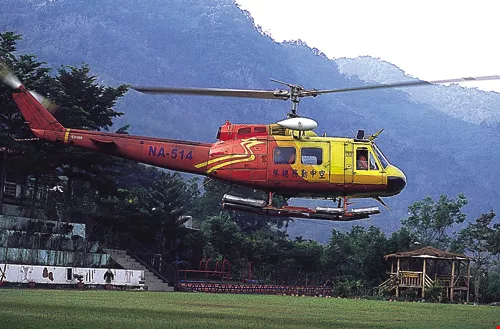
Rescue and relief teams from many organizations and agencies have come to the affected areas; the road back will be long and tortuous.
Lowland suburbs?
By the end of August, the entire village had been evacuated to an army engineering school in Yanchao in the lowlands, where they reached a "village consensus" to pursue relocation. When news of that decision, via television, reached the many residents of Minquan Village and Minsheng Village who were still up on the mountain cleaning up their villages, many found it hard to understand.
"As far as we are concerned, Shanlin is just "a lowland suburb," says Zhou Yongtai, a Tsou youth who lives in Minsheng Village. He wonders if the villagers of Minzu "over-reacted." Otherwise, he can't fathom how they could reach such an unreasonable decision. Although Tzu Chi's donation of 1000-plus-square-foot buildings is enticing, he wonders if the commute up and down the mountain is really workable, Even if Provincial Highway 21 reopens, driving from Shanlin to Minzu and then to one's own plot of land will mean that a farmer is going to be spending two to three hours a day commuting and who knows how much on gasoline. And one can't farm sporadically. Commuting, he argues, can't solve this problem!
Some wonder if perhaps a small number of young people who worked outside the village forcefully advocated the move and pressured their elders not to protest. Namasiya Township mayor Husong Istanda, who had remained on the mountain, directing efforts to clear the roads, says that he had no inkling that Minzu Village was planning on moving before the decision was made. Of course, the impassable roads factored into this, but, he exclaims, they could have called him on the phone! And the county even directly got the residents to sign agreement letters and receive relocation money (NT$30,000 per person, with a limit of five persons per household) without informing the mayor or going through the town government. By the time some residents came to him with grave doubts about accepting the money, it was already too late.
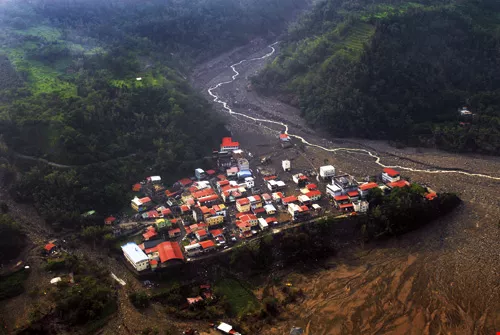
The photo shows a small creek (A) to the right side of Minzu village where a lake (B) formed when the path of the creek was blocked by a mudslide. When the banks holding back the lake broke, the water instantly crashed into the village causing deaths and great damage. The Nanzixian River (C) was entirely filled in with mud where it passes in front of the village.
Love or victimization
"Each time the president came, he expressed the hope that we would consider moving the village down off the mountain. He would always say that the government would take responsibility for protecting the people and their livelihoods. But even if proposed government measures to broaden employment opportunities are adopted, when they expire in two years, then what?" Husong says that if the villagers of Minzu want to move, then that's fine for them, but he would never move! The government has promised to give each household that moves 21,600 square feet of land to plant, but he notes that each family had two to three hectares in the mountains-or more than 20 times as much. And by planting and living in the mountains one enjoys a low cost of living. Down in the lowlands there are all kinds of extra costs. Why go through all that hardship?
As for what the relocated villagers will be doing, Tzu Chi plans for the villagers to plant Taiwan jewel orchids and other high-value cash crops, and Da'ai Village has offered some excellent agricultural land and a promotion center. Foxconn president Terry Guo says that they will help the residents plant organic crops there. Apart from providing training about agricultural techniques, the company will also provide purchasing guarantees for the crops. And for villagers that don't want to work in agriculture, so long as young people are willing to stay in the village, he will be willing to establish a factory there and provide 100% employment.
Through these "purchasing guarantees" and "employment guarantees," the government, Tzu Chi and corporations have shown great consideration for the refugees, but in the eyes of those who understand Aboriginal culture, the plans are not entirely a good thing. Lin Yiren, a professor of ecology at Providence University who has conducted fieldwork on and surveys of Taiwanese Aborigines, argues that those who want to help should consider what the refugees themselves want and need, instead of helping to construct a paradise that rises out of the benefactors' own imaginations. Moving the village is not simply a major change for the villagers; it is also a form of social engineering. It is important to listen carefully to what the refugees of this disaster are saying. The outside world has quickly planned a model of life for the villagers-but is it really what these Aborigines themselves want?
Apart from a few who work as government employees in the town hall or as policemen, almost all of the villagers were farmers. The crops they grew varied, from "rough crops" such as bamboo shoots, plums, taro and ginger to high-priced persimmons and peaches. Each family picks different crops to grow in different seasons. Typically, each farming family brings home NT$300-500,000 per year. Because they eat the crops they grow themselves and the poultry that they've raised themselves, and because the government provides tuition assistance for their children, their earnings as farmers are enough to support them.
For many generations they've been planting diverse crops and using natural methods of farming, but now the idea is to turn them quickly toward "quality agriculture" and "technological farming." Their acceptance of this shift remains to be seen, but this reporter most frequently heard residents of Namasiya say that they hoped to find work "planting forests."
"If you really want to force the village to move, then we would be willing to 'rent' our land back to the government, which could then pay us to reforest and maintain it," says Jiang Minde, a representative of Namasiya. He argues that the villagers care more about their homeland than anyone else. If the government really wants to protect the mountain forests and conserve the water and soil, then they should pursue reforestation. If Aborigines could receive a reasonable wage for taking care of the forests, then they would be willing to leave farming. But currently, the stipend for reforesting is not enough to cover the costs. And they can't understand why the stipend for reforesting in the lowlands is five times as high.
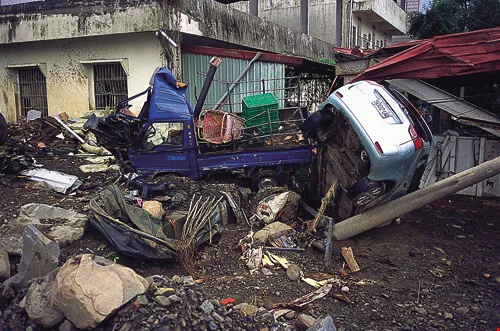
Three weeks after the disaster, the village still appeared as a broken wasteland, like some vision from the end of the world. With their masters having fled in haste, abandoned dogs search amid the ruins for food.
So much still to do
In contrast to the many collapsed buildings and deaths experienced in Minzu village, in Minquan Village farther up the Nanzixian River at over 600 meters above sea level, although 80% of its more than 200 households experienced flooding and encroachment by mudslides, only four homes completely collapsed and only 16 partially collapsed. And Minsheng Village, which is still farther upstream, escaped with even lighter damage: only two homes fully collapsed and three partially collapsed. Because both of the villages were evacuated early during the typhoon, there were no deaths.
"On the afternoon of August 7, there was widespread flooding, and villagers fled to the higher ground of Minquan Elementary School," explains village mayor Ke Zhenghan. "That night we saw a mudslide beginning on the opposite hillside. The road was blocked but we decided it was necessary to evacuate to somewhere else, so braving the wind and the rain we walked to a community activity center that was farther from the steep slopes." The next morning at dawn, they discovered that the elementary school was covered in mud to the height of a person, and the 60-some vehicles that had been parked at the school's track oval had all been completely destroyed. They were left speechless.
Although Minquan and Minsheng villages are not under pressure to immediately move, because so much of the infrastructure supporting life in the villages has been destroyed, the situation is still quite dire there.
The village hall, health center and police station in Minzu were all destroyed, and reconstruction of them is a long way off. Currently, government departments have borrowed space in churches and residences to set up their offices. And in the middle of September, apart from mudslide debris that had been cleared from residences, the other areas that need clearing-Provincial Highway 21, Minquan Elementary School, Sanmin Junior High School and the Namasiya Visitor Center-are all still full of debris and a complete mess.
"Large machines can't come in and there still isn't electricity, so for two months now we have been clearing the community using our own hands," Ke says.
"All of the crops within 50-100 meters of the riverbed have been destroyed!" How do they apply for agricultural disaster compensation? Even he, as village head, isn't clear on that. And what about crops that weren't completely destroyed but suffered serious cumulative damage? Can they apply for assistance based on those? "With too much rain, the leaves of the peach trees have been badly eaten by pests, and the ground is loose. I simply don't dare imagine what the harvest will be like next year." He makes a special call for the outside world to provide agricultural technical assistance and aid.
The roads are impassable, and the school, because it has no electricity or water, can't open. Currently, many families are split up and living in different places. Since the children have to enroll in school, most of the mothers have taken their children off the mountain, and many of the elderly have also left, because the impassable roads make seeking medical treatment so difficult. Some of them live with relatives or friends, and some of them live in the shelter at the Renmei Camp. And up on the mountain, there are still more than 400 people living in the two villages combined. Most are hale and hardy men in the prime of their lives, who must suffer the loneliness of separation from their wives and children while working hard to reconstruct their hometown. Consequently, many residents hope that the road will soon be cleared and electric service restored, so that Sanmin Junior High and the Minsheng Elementary School will reopen and they can be reunited with their families.
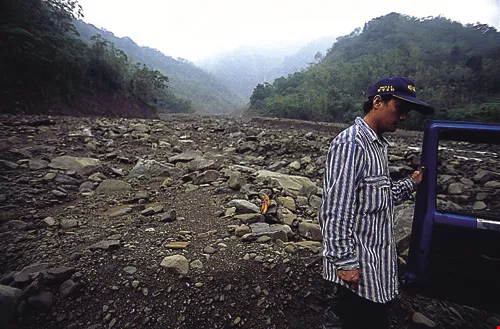
Rescue and relief teams from many organizations and agencies have come to the affected areas; the road back will be long and tortuous.
The land is still our hope
Many people can't help but ask: After such a major disaster, don't villagers fear for their safety up in the mountains? Why are they so determined to find a way back up? "We are of course scared, but we have no other choice. Before we find a suitable place to move to, we've just got to be prepared to survive a big rain," says Ke. He says that the government has already sent experts to investigate. If they determine that the village is truly not suitable for people to live in, then most of them are leaning toward returning to their original tribal lands on the 40-hectare Minquan Plateau, which escaped all damage this time. The plateau is only two kilometers from the current village, and there is a preexisting township road there. They can keep to their farming ways, and the change to their lives would be smallest. Most villagers say they simply wouldn't accept moving off the mountain as Minzu Village chose to.
As for Minsheng Village, if the experts assess that they should move the village, the villagers also hope to move to the Liangquan Plateau, where elders say they have never seen any landslides. Apart from their being able to live their lives in the manner they are accustomed to, the maintenance of cultural traditions is also key.
"Minsheng Village now has nearly 300 members of the Southern Tsou, a tribe that only numbers 400 worldwide," says Zhou Yongtai, a young intellectual whose mother is a southern Tsou and whose father is a Bunun. If they move to the flatlands, their culture will have no way to continue!
Zhou Yongtai was educated away from the village from a very young age. When he was young, he did not understand the elders in the tribe and couldn't see the point in staying in the mountains to farm, where they earned so little, labored so hard, and were exploited by middlemen. But after returning to the village for more than a decade, he came to the deep realization that "the land is the Aborigines' only hope," and he has decided to raise his own children there, so they can learn the courage of hunters and the loving wisdom of the tribe. In recent years, he has been active in the movement to revive traditional Southern Tsou culture, building a tribal kuba (a lodge for its men) and constructing emo no pe isia ancestral shrines, as well as carrying out cultural and linguistic fieldwork. He has also helped to revive the kanakanavu ceremony, which hadn't been held for nearly 50 years.
He is very much opposed to Tzu Chi's proposal that the tribe live in the lowlands and return to the mountains to put on their festivals and ceremonies. That's because Southern Tsou festivals include the mikong and kaisisi cakulan ceremonies, which revolve around a way of life in which people in the tribe plant and hunt. Once they leave the mountains, how could you still hold these ceremonies? And what meaning would they have if you did?
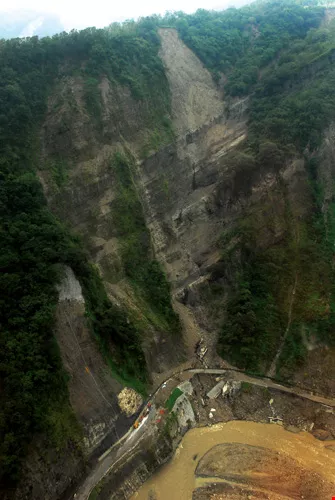
From a helicopter above Provincial Highway 21 in Namasiya, we can see the damage wreaked by landslides.
"We've been cheated!"
As the villages of Minquan and Minsheng were working hard looking for a way forward, people from Minzu Village, who had originally seemed to be settled on moving as a whole, did a 180° turn.
In accordance with its "Outline of Reconstruction after the August 8 Typhoon Disaster," the Council for Economic Planning and Development has divided the entire affected area into 15 different reconstruction zones. For each zone, an assessment report divides all the land into one of three classifications: "development prohibited," "restricted development" and "other." Class I land, in which development is prohibited, includes water resource areas, botanical preserves, and flood zones. Class II land, where only limited development is allowed, includes areas where there is a relatively high chance of flooding, landslides and mudslides but where the government hasn't currently outlawed all development. Under current law, the victims of this disaster are only permitted to rebuild on Class III land.
When news got out that the land in the disaster zones would be designated as Class II land with restricted development, it greatly alarmed the villagers who, even if they had agreed to relocate their homes elsewhere, still hoped to farm and otherwise use their old land to the extent practicable, in order to maintain economic and cultural continuity. "We felt as if we had been cheated once again!" angrily says Lin Qingzhang, executive director of the Minzu Village self-help association. From the very start they had emphasized that they wanted to keep access to and use of their land, and the president had agreed. Now the government was showing that its "check would bounce." Although the government was saying it would communicate with the villagers to achieve "consensus" before any restrictions were imposed, those assurances have not put villagers at ease. What's more, guarantees about perpetual rights have yet to come down. Since it seems that neither of the promised "checks" can be "cashed," the villagers are planning to renege on the agreement and return to their tribal lands.
The villagers say that their minds are made up-no matter that they've accepted the relocation money, and in spite of the fact that their land in the mountains is now under development restrictions. They are going to go back to their tribal lands, even if they can't plant and are simply stuck there with nowhere else to go. But if the residents do decide to go back to find a safe haven, how will that play out, given that the township mayor has a grudge with them over the way he was left out of the loop earlier? There are all kinds of uncertainties.
With regard to the residents of the villages of Minsheng and Minquan, both of which are eyeing tablelands above their villages as safe places to build, would the Tzu Chi Foundation, seeking to realize its original intention of conveying benevolence, be likely to go up into the mountains to build houses for them? In light of one of the foundation's core principles of "letting mountain forests rest," it isn't likely. The worst outcome would be if development was restricted throughout the two villages. In that case, where would their 2,500 residents go? Although the world is vast, they would seem to lack a safe place in it.
The gods have proven not to be benevolent. Nature's mudslides destroyed the hometowns of these Aboriginal Taiwanese, but let us hope that mankind's reconstruction efforts will not be the final blow to uproot these Aborigines!
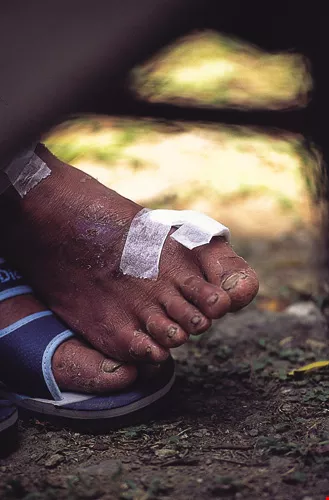
We will not be defeated! Aboriginal villagers who escaped from the jaws of death still face a long road to reconstruction. They are saddened, but determined.
Afterword
A preliminary evaluation of safety conditions in the disaster area came out in late September. There are concerns about safety in all of Minzu and Minquan Villages and parts of Minsheng Village, making them unsuitable for reconstruction. Of the two plateaus that villagers have their hearts set on, although Minquan Plateau is itself structurally sound, the surrounding land is very fragile, and the plateau could be cut off by future disasters. As for Liangquan and Minzu Plateaus, the land is soft and loose, and the mountains behind the plateaus are steep and the plateaus themselves have been shrunk by the landslides, so they have been deemed unsuitable. The government is still inclined to move all residents of Namasiya Township to Shanlin Village. The government has scheduled talks with Namasiya residents for the end of September, but there is obviously a large gap in the starting points and aspirations of the two sides.
There has been an unsettled situation with regard to the willingness of Minzu villagers to move. Originally they accepted moving to Shanlin, then apparently resolved to move back home instead. But in late September, saying that they "acknowledged the government's sincerity," 80% of the villagers expressed the desire to relocate to Shanlin, while 20% opted for going back to Minzu. There is obviously still further discussion to be done.
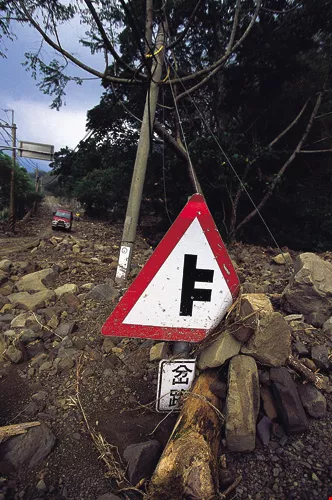
(facing page) Buried road markers are like Taiwan's soil and water conservation policy: already at the breaking point.
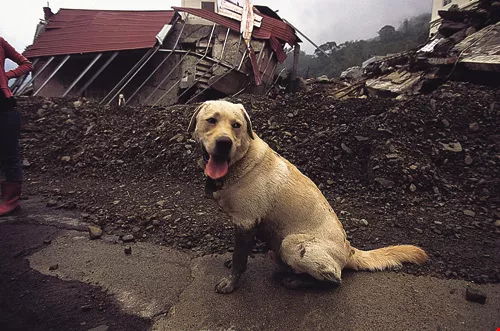
Three weeks after the disaster, the village still appeared as a broken wasteland, like some vision from the end of the world. With their masters having fled in haste, abandoned dogs search amid the ruins for food.
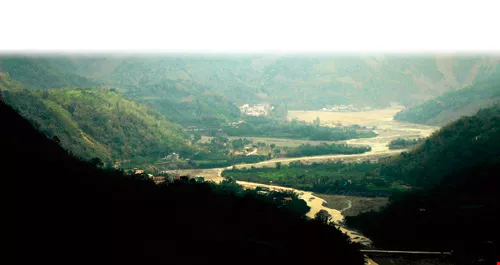
During the Japanese era, as a result of forced removals mandated by the government, the villages of Minzu and Minquan moved from locations in the Central Mountain Range to plateaus in the high mountains and then to the banks of the Nanzixian River. Is a return to those high plateaus, which is what the villagers themselves hope for, in the cards? It will depend upon a number of variables. The photo shows the three plateaus of Minzu, Minquan and Liangquan (moving progressively upstream) on the left side of the Nanzixian River.
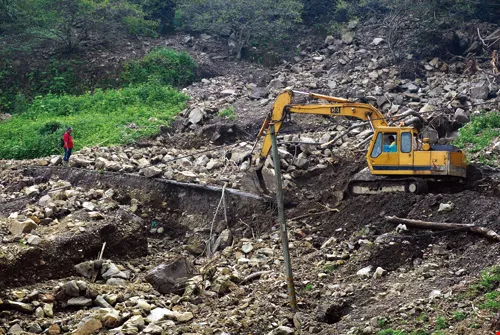
Although Minsheng and Minquan villages escaped with relatively light damage, roads to the outside world are impassible, meaning that life in the villages has been totally disrupted. The photo shows ROC military personnel opening up an old forestry road connecting Minquan to the Nanhua Reservoir as a substitute for Provincial Highway 21. The township mayor (in red) has come to check progress.
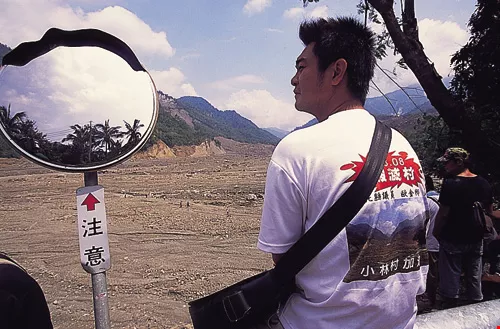
Rescue and relief teams from many organizations and agencies have come to the affected areas; the road back will be long and tortuous.
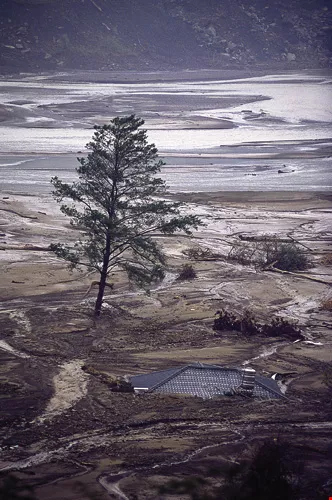
Namasiya, originally a scenic township in the mountains, was so pummeled by Typhoon Morakot that it is entirely unrecognizable. The mudslides created by collapsing cliffs have raised the water level of the Nanzixian River by several meters. From time to time one can catch glimpses of submerged houses from the banks of the river.
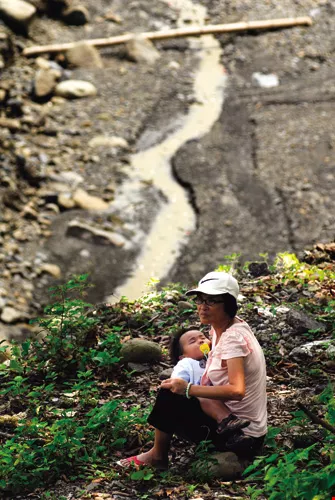
(facing page) A woman from Xiaolin Village, holding an infant, gazes over what was once their hometown.

@List.jpg?w=522&h=410&mode=crop&format=webp&quality=80)


