Independent Travelers From Mainland China Change the Tourism Landscape
Lavai Yang and Teng Sue-feng / photos Hsueh Chi-kuang / tr. by Phil Newell
September 2011


Taiwan first began to allow tourists from mainland China to visit in 2008. In that year there were a total of 200,000 visits, and the number rose fast, reaching almost 1.7 million in 2010. In that year mainland China even surpassed Japan as the number one source of tourists to Taiwan. More recently, in June of this year, the government-rescinding the previous policy of only allowing mainland tourists to come to Taiwan in tour groups-began to permit independent Chinese travelers.
Virtually everyone interviewed for this article has the impression that tourists from mainland China visiting Taiwan in these few years have had two sharply different types of reactions. Many of the tourists have absolutely fallen in love with our island, but others have had a much less pleasant time, and don't care if they ever return. What's wrong?
One problem has been that, because of price competition, the quality of the tour group experience has been degraded. For another thing, safety concerns have been raised by serious accidents at high-profile tourist sites. A third problem has been that the main tourist spots are overcrowded. And a lot of visitors, especially elderly ones, just don't like being rushed around on tour buses from place to place like sheep, able to get only the most superficial understanding of Taiwan.
Not all these problems can be solved in the same way, but independent travel will provide a new option for enjoying Taiwan. Independent travelers can take their time strolling about, getting to know what life is really like in Taiwan.
In this article we will explore a number of possible solutions to the problems experiences by mainland Chinese who have come to Taiwan in group tours. And we will also compare the tour group model to the independent travel model: What is so great about independent traveling? And what kinds of commercial opportunities can be expected from independent travelers?
The following stories, which appeared in an article by the writer Yang Chao, are completely true. "One Taiwan guide brought his mainland Chinese tour group to a shopping center and shouted to them, 'Use your Renminbi to liberate Taiwan!' On another occasion a Taiwan tour guide, whose group of mainland Chinese was waiting to buy tickets at the entrance to the National Palace Museum, told them: 'Please be patient and line up. After the two sides are reunified, we'll return all of this stuff to you then!'"
Any citizen of Taiwan hearing a tour guide talk this way would be nonplussed and would certainly object, for the guides would be patently misleading their mainland Chinese tourists and giving them the wrong impression about Taiwan.
Perhaps the guides considered their comments to be funny, and these guides may be extreme examples that aren't representative, says Yang, but the fact is that group tours cannot possibly show people what is really beautiful about Taiwan, so that our mainland friends can come in contact with and understand the real Taiwan. They get a grossly distorted impression of the values of, and life-choices made by, people in Taiwan's society.
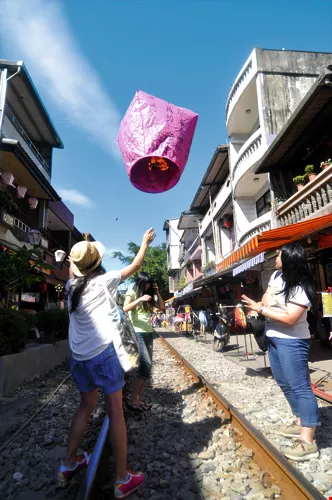
The Pingxi Line railroad passes through a hillside coal mining town, where homes and shops line both sides of the tracks.
Lin Ku-fang, vice-president of the General Association of Chinese Culture, who has been to mainland China more than 200 times, argues that you certainly cannot get a real impression of the other side from politics. Political interactions are molded by the cross-strait situation and by the influence of history, and will always to some extent be posturing.
"The biggest problem in interactions between the two sides is an asymmetry in information. Mainland China is enormous, and Taiwan is quite small. We see only a small part of mainland China, and assume we see the whole. People in the mainland, on the other hand, can only understand Taiwan through reports in the media, and there's far too much delusion and deliberate obfuscation in these, so that people have a lot of misunderstandings."
Lin Ku-fang says that people from mainland China may only look at surface things that the Taiwanese media delivers, and these by no means illustrate what Taiwan is really like. For example, if they just watch the political commentators and politicians boasting and exaggerating, they would get exactly the opposite impression of the real "hidden Taiwan," characterized by modesty and straightforwardness. The hidden Taiwan consists of people who, without fanfare, do their jobs, are settled in their lives, and take care of their responsibilities. They keep a low profile, make no noise, seek no attention, and no matter what they do, they do it with calm, confidence, and modesty.
"It is only by traveling independently and freely, able to get into the corners and alleyways where the people really live, that you can see Taiwan's most attractive aspect, that attitude of living quiet and steady lives," says Lin.
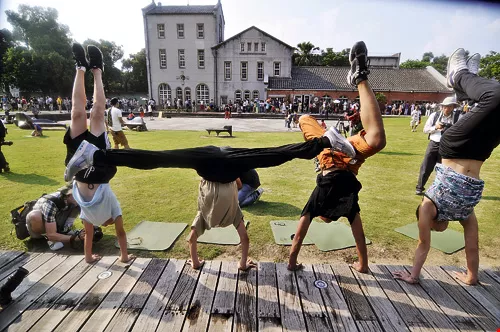
Taipei is filled with youthful energy. A glimpse of this can be seen from the teens practicing street dancing at Huashan 1914 Creative Park.
Cultural activists speak as one in emphasizing that the significance of independent travel is certainly not to be found only in commercial opportunities. This does not stop many people from having considerable expectations. After all, travelers from mainland China have been called "the largest migrating population on the face of the earth."
Statistics tell us that by 2010 China had already become the fourth largest source of outgoing tourists in the world, with 57.39 million trips abroad. Driven by economic growth, the number of travelers has been rising steadily since 1998 at an average annual growth rate of 20%.
Fan Shih-ping, an associate professor in the Graduate Institute of Political Science at National Taiwan Normal University, who has long been following mainland Chinese travel policy, points out that in 2007 Chinese travelers spent US$29.8 billion around the world. Their money is not only of great help to the economies in host countries, it has become a diplomatic bargaining chip. "This kind of 'travel diplomacy,' which can also be considered promoting political ends through economic means, is a comfortable fit with China's current strategy of extending its influence while avoiding open confrontations, having a clear-cut effect in terms of promoting partnership between mainland China and host countries."
The greatest beneficiary so far has been Hong Kong. In the wake of the SARS epidemic of 2003, heavy shadows hung over Hong Kong's economy. Beijing and Hong Kong then signed a "Closer Economic Partnership Agreement," under which Hong Kong immediately was opened to "individual travel" by mainland Chinese. In the first year more than 10 million Chinese poured into Hong Kong (which itself has a population of only 7.8 million) and over seven years the total number of visits has surpassed 100 million. Mainland visitors have thus far spent HK$600 billion (equal to about NT$2.1 trillion) and created 100,000 jobs.

Backpackers and other independent travelers make their way about on their own, eschewing tour buses, having more chances to get off the beaten track and fully enjoy the freedom of travel in Taiwan. This photo was taken in front of the National Palace Museum.
Many people have suggested that if Hong Kong, little more than a speck of land, can attract more than 10 million mainland visitors per year, there is no reason why Taiwan cannot do so as well.
However, looked at objectively, one of the main reasons so many mainland Chinese tourists have poured into Hong Kong is simple proximity. It is only a short trip from Guangdong Province to Hong Kong, and many people stay only one or two days or even return home on the same day, making it a cheap trip. (So cheap, in fact, that it is not at all unusual to see people from Guangdong crossing over to Hong Kong just to shop for daily necessities!) On the other hand, Fujian, the closest mainland Chinese province to Taiwan, is 200 kilometers away, and if each mainland traveler were to spend an average of seven days in Taiwan, they would need between RMB10,000 and RMB20,000, which ain't exactly chicken feed. In this light, it is already quite impressive that last year 1.63 million mainland Chinese came to Taiwan.
So, Taiwan can't be Hong Kong, and its tourism industry cannot rely nearly so heavily on mainland Chinese. Nonetheless, there has been a very real impact from the influx of mainland visitors over the last three years, prompting both qualitative and quantitative changes in Taiwan's travel market.
First, before mainland Chinese were allowed to come, Taiwan was getting about 3 million or so foreign tourists per year, and the number had been more or less steady for some time. However, in 2010, the second full year after the government decided to allow mainland Chinese to come, the total number of visitors hit 5,567,000! And there is no question that it is the Chinese who have made the biggest difference, as mainland China has surpassed Japan to become the largest source country, accounting for 30% of all visitors to Taiwan in 2010.
Even counting only Chinese who have come on tourist visas, as of the end of May of 2011, there had been a total of roughly 2.35 million visits, generating nearly NT$120 billion in foreign currency.
Secondly, according to the ROC Tourism Bureau, in the last two years about 1500 hotels in Taiwan have launched renovation and redecoration projects, investing a total of close on NT$5.5 billion; 1200 new tour buses have been acquired; and the Taipei 101 building, one of Taiwan's core tourist attractions, finally began turning a profit last year, five years after it was first opened. It is obvious that the influx of mainland tourists has stimulated Taiwan's economy and prompted new investment.
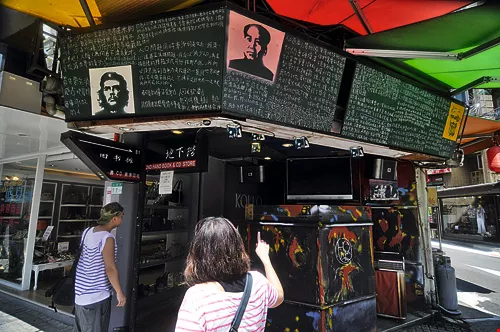
The eclectic shops of bustling Yongkang Street house used CDs, old music videos, movie posters and more. Young people love to hunt for treasures among them.
However, the tourism industry has already noted with alarm that in the first seven months of 2011 only 698,000 mainland tourists came to Taiwan, a decline of 31,000 over the same period in 2010.
Why has the number of tourists fallen? What problems does this reveal?
"Given market conditions in mainland China, most people can only go abroad if they join a tour group, which means that both prices and quality are controlled by the tour agencies. In the past, as mainland Chinese tour groups went to Japan and Southeast Asia, there started to be vicious price competition. Eventually it got to the point where tour agencies were charging nothing for their services, recouping their money by getting kickbacks on what the tourists spend while abroad," explains Wayne Liu, deputy director general of the Tourism Bureau. Unfortunately, he says, it is impossible to maintain the quality of the travel experience under these conditions.
This is why right from the start the Tourism Bureau created a legal requirement that domestic tour agencies keep the tour-group charge at a minimum of US$60 per day. Taiwan is in fact the only country in the world to make such a rigorous demand. Nonetheless, it is by no means easy to ensure that all the players follow the rules of the game.
The possible fallout from ruthless price competition is well illustrated in this example from Hong Kong: Someone put on the Internet a video of a Hong Kong tour guide harshly criticizing her mainland Chinese tour group members for failing to spend enough money shopping, telling them, "You owe me!" A situation like this would certainly take a lot of the fun out of visiting the "shopping paradise" of Hong Kong. And it was the relentless competition to drive down tour group fees that lay behind it all.
Lee Yee, a senior journalist in Hong Kong, says that the vast majority of low-priced tour groups to that city require that their members do some shopping, with some even stipulating openly that each member of the tour group must spend at least HK$3000. Therefore, before condemning that female tour guide, you have to consider the structural problems under which she is working.
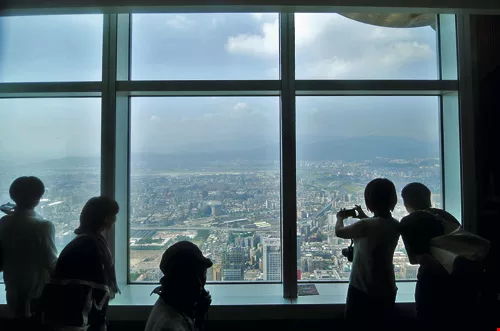
From the Taipei 101 Building you can see the whole Taipei Basin. This has become one of the most visited locations and popular vistas in all of Taiwan.
Steps are already being taken by Taiwan to enforce standards of quality in the mainland visitor industry and prevent destructive "zero tour-group fees" competition, so that the market for tourists from mainland China does not burst like a bubble after only three years. In fact, even those tour agencies that adamantly opposed the government's initial standard of US$60 per day per person are concerned.
The first step is that tourism operators in Taiwan have launched a new wave of self regulation. Yao Ta-kuang, chairman of the Travel Agent Association, explains, "If we can get everyone to agree to charging a fixed minimum and deliver authentic high-quality product, with tour agencies no longer skimming large amounts off the top in fees, the number of mainland tourists and the amounts the tour operators earn for their services will start to grow again." Already 169 members of his Association, who collectively handle roughly 90% of tour group travel from mainland China to Taiwan, have signed an agreement on minimum tour-agency fees.
Yao says that his association will organize a committee to monitor the agreement. The committee will refer any violators to the Tourism Bureau, with the maximum possible penalty being that the bureau will cancel the offending agency's permit to handle tour groups from mainland China.
This alone cannot solve the problem, however. Wayne Liu notes that, according to many professionals in Taiwan, tour agencies in mainland China, who recruit the clients, only pass on a fraction of the minimum tour-group charge to the operators of the tours here in Taiwan. Not surprisingly, Taiwan tour operators complain endlessly that it is their mainland counterparts who are forcing them to pinch pennies and degrade tour quality.
In response, through its office in Beijing, the Tourism Bureau has begun examining advertisements and other information in the mainland, comparing pricing data against promised itineraries. If, for example, the itinerary calls for staying in a five-star hotel, but the mainland agency only delivers enough money to the Taiwan tour operator to pay for a four-star or three-star hotel, an automatic warning system will be activated, and the evidence will be sent to the Cross-Strait Tourism Exchange Association in the mainland to investigate and deal with the matter on their side.
In addition to ensuring that tour quality remains high, another task is guaranteeing visitors' safety.
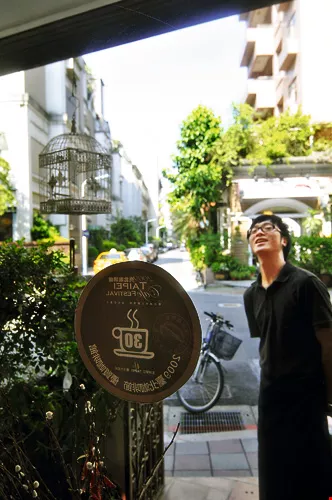
The area around Yongkang Street is filled with amenities for living, commerce and culture. Coffee shops abound in the back alleys, luring people in to stop and savor.
There have been a number of accidents and incidents at well-known tourist locations in Taiwan in recent years. Wayne Liu observes, "Given incidents like the derailment of the forest railway on Alishan, and the recent scandal about plasticizers in soft drinks, people in the mainland are taking a wait-and-see attitude. But this might be a good thing for us, because we can pause for a moment and think carefully about our next step."
During a roundtable discussion on cross-strait tourism held in mainland China in July of this year, the director-general of the Tourism Bureau, Janice Lai, declared that Taiwan has already taken measures to ensure the safety of travelers. For example monitoring systems have been set up on some of the most frequently traveled scenic routes to keep tabs on road conditions and warn of potential landslides. Also, standard operating procedures have been created for surveying and dealing with the problem of rotting trees on the verge of collapse all along the Alishan Forest Railway.
The Directorate-General of Highways also has installed an early warning system for road conditions. As soon as the information system of the Central Weather Bureau indicates excessive rainfall, text messages will be automatically sent out to tour bus companies and drivers warning that they must take particular care on affected stretches of the roads. Immediate notification will also be sent out if rain gets so heavy that the roads must be closed altogether.
While the direct cause of the accident at the Alishan Forest Railway in April of this year was the collapse of rotting trees, the fact is that the train was also overloaded, making its center of gravity unstable on the narrow-gauge mountain tracks. In short, the tourism experience is also threatened by overcrowding.
Too much of a good thing?
According to the Chiayi Forest Office of the Forestry Bureau, Council of Agriculture, given current facilities, hotels, and shops, the capacity of Alishan is about 4000 tourists per day. To ensure that the number is managed effectively, when the number of people admitted to the area reaches 3500, the Forestry Bureau will inform the Highway Bureau, and a notice will go up on electronic billboards along the road encouraging tourists to go to other destinations.
Liu says that the government must give consideration to the "capacity" of the most popular tourist destinations, and take appropriate actions to protect them, such as putting a limit on the number of people who can go to Guishan Island in the Northeast and Yilan Coast National Scenic Area, or requiring people to make reservations to take the small mountain railway. This will be the only way to ensure a balance between tourism and the ecology.
At the National Palace Museum, Taiwan's leading storehouse of cultural treasures, to take another example, last year there were 3.44 million visits. In order to ease the crush of people, beginning in July 2010 the museum extended its hours, and in July of this year began cutting admission to half price on a trial basis during off-peak hours (16:30 - 18:30 on weekdays).
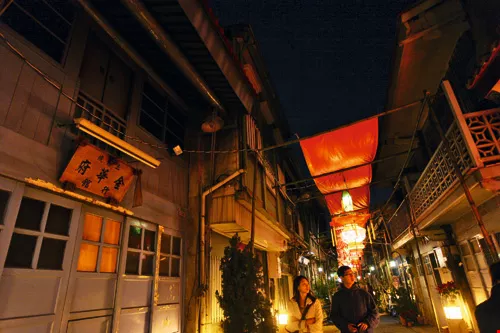
Old streets and buildings abound in the wonderful former capital city of Tainan.
How can group tours be improved? Will independent travel prove to be a better alternative?
Liu says that the government has been nagging and begging tour operators to stop laying out itineraries that go right around the island, but the travel agencies say that there is market demand for these tours. Perhaps because people from mainland China have been looking forward to a chance to visit Taiwan for such a long time, they don't want to miss any of the main attractions, including Taipei 101 and the National Palace Museum in the north, Sun Moon Lake and Alishan in the center, and Kenting in the south.
Fast-paced "hitting the highlights" travel may be especially problematic for mainland tourists to Taiwan because, as statistics from the Tourism Bureau show, the average age of tourists from mainland China is 52. This contrasts with Korea, where the average age of the Chinese tourists they get is only 41. Given that mainland tourists to Taiwan tend to be middle-aged or even elderly, it is important that the special needs of older people be taken into account.
At the heart of tourist economics is the "experience." As Janice Lai puts it, "We would prefer that travel agencies observe the principles of 'food that is a little softer, lodging that is a little more comfortable, itineraries that go a little slower, and journeys that don't try to cover so much territory in one go.' In short, we would like to see them design high-quality itineraries that include health-food specialties, nature appreciation, and a slower pace, things older people might enjoy more."
Even so, group tours are still preplanned, insulated activities. And yet the real beauty of Taiwan lies in its daily life, in its small but highly refined local culture. In the city, there are great restaurants tucked away in small alleys, creative and artistic coffee shops, and tea emporiums for connoisseurs, which can be found while enjoying a leisurely afternoon stroll. Or, in the countryside, you can visit recreational farms or get in touch with Aboriginal culture. And this is where independent travel comes into its own.
Because the arrival of mainland Chinese tour groups over the last two or three years has indeed injected a lot of energy into Taiwan's economy, many people have similarly high expectations for independent travel. However, observes political science professor Fan Shih-ping, for the initial phase, mainland China is only allowing residents of three large metropolises-Beijing, Shanghai, and Xiamen-to apply, with a limit of 500 persons per day. Even if the maximum limit is reached every day, that would only be an average of 20-something tourists per city and county in Taiwan per day. Obviously the economic impact will not be that immediate.
However, certain specific groups may benefit appreciably. In group travel, the main industries to profit are big hotels, major tourist attractions, and certain on-the-beaten-track restaurants. But now with independent travel, travelers can follow their own personal fancies, and put more depth and breadth into the experience of visiting Taiwan. Indubitably, more small eateries, out-of-the-way retailers, and transportation providers will benefit from the new policy opening.
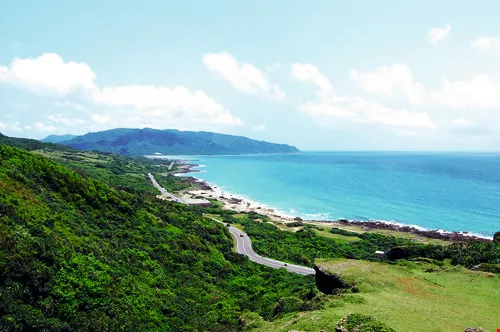
Standing in the verdant grasslands of Kending's Longpan Park, you enjoy a commanding view of boundless azure skies above the Pacific Ocean. The stunning vistas are truly intoxicating.
Whether group tours or independent travelers, however, we should realize that there is a lot more going on here than just making money and providing services.
"When people from different locations undertake tourism and travel activities, there is an important process of mutual learning and mutual influence," says cultural critic Nanfang Shuo. Those who work in the tourism industry must treat their clients like friends. And yet these are people that they will spend only a short time with and will likely never see again. The job thus requires enormous self-discipline. And if Taiwan wants to develop in the direction of even more upmarket tourism, the quality of services will have to become much better.
One of the biggest challenges for the tourism industry in Taiwan at the current stage is to break out of the model of having tourists come and see all the must-see sites in one trip, never to return, and instead create an experience so that travelers will want to return again and again, and the industry can enjoy long-term growth.
"Taiwan's real attraction lies in the places where the lives of ordinary people play out," says Shan Fang-cheng, CEO of the Hotel Royal Group. In Taipei, for example, try this simple walk: Go from the Confucius Temple in Dalongdong to the Xiahai Chenghuang Temple to the Shuanglian Market, then to the concentration of cultural salons around the Zhongshan MRT Station, and from there walk to Ximending. Anyone taking this stroll will get an insightful glimpse into how Taipei City has developed and its hundreds of years of history. There is enormous variety-buildings high and low, venerable old sites and sparkling new ones, places where the pace of life is pedal-to-the-metal and others where it seems unaltered from the past, all demonstrating various aspects of the enormous variety in Chinese culture.
"If you want culture to be rich and vital, you need to attract tourists to the audience for it. Tourism, on the other hand, also needs culture in order to put some real depth and substantive content into the experience. If you go someplace and only end up eating and shopping, there is little real value in tourism like that, and people will not leave feeling genuinely touched, much less inspired to come back again," points out Stanley Yen, known in Taiwan as the "godfather of tourism," in his book The Future as I See It.
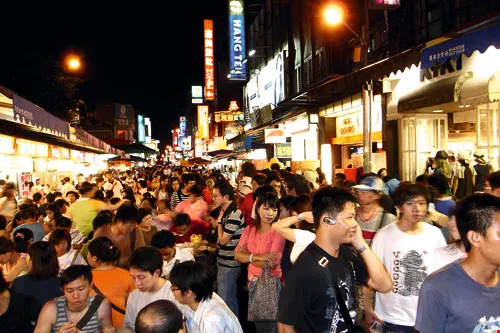
One must-see for international visitors to Taiwan is the night markets, where cuisine with roots all over China showcases the diversity of Taiwan's food culture. Pictured here is Luodong Night Market in Yilan.
There is even more significance in the fact that mainland tourists, in addition to learning about culture in Taiwan, will carry their experiences back home. In this way, people on both sides can correct the wrong impressions that they have been misled to have, alleviating the possibility of conflict and misjudgment.
Fan Shih-ping says that since mainland China launched its policy of reform and opening, its economy has developed rapidly and people's standard of living has sharply improved, but most people still view the world in a harsh dog-eat-dog manner. They are unsympathetic to the weak and disadvantaged, and lack empathy, concern, or pity. If visitors from mainland China could only see the Tzu Chi Buddhist Foundation and other charitable groups in Taiwan who are active around the world with their compassion, they will understand the warmth and kindness that characterizes Taiwan, and when they return home they can concretely put into practice the construction of a harmonious society. This more than anything else would be enormously positive for both sides.
Take for example Taiwan's comprehensive ban on smoking in public places. It was through the efforts of nonprofit public interest organizations, who overcame many obstacles, that this was achieved, and could be considered unique in the world. Some mainland Chinese tourists have even said, if you want to quit smoking, come on over to Taiwan for a trip and you'll definitely succeed!
The mainland writer Xu Zhiyuan has been to Taiwan three times, searching for threads of the May 4 Movement of 1919, a liberal tradition that has been marginalized in mainland China, as well as to learn about Taiwan's transformation in the 1970s. He says, "Taiwan's greatest value is that it offers China a kind of experimental sample, a possibility."
In a tea shop in an alleyway off of Shida Road, a few mainland Chinese intellectuals take shelter from a downpour and sit around chatting. But as soon as they hear that the former residence of Yin Hai-kuang, a pioneer of liberalism in Taiwan in the 1960s, is right nearby, they head out, disregarding the dark of night and the driving rain, to see how this intellectual progenitor lived.
As Taiwan's tourism industry takes another large step forward, we should all be sure we understand that tourism is in fact a kind of cultural industry. What is it Taiwan should point to that will be most appealing and most moving for foreign visitors? The answer may be in independent tourism, where individuals can come and go as they please, directly feel the unique cultural ambience, and experience the warmth of the people.
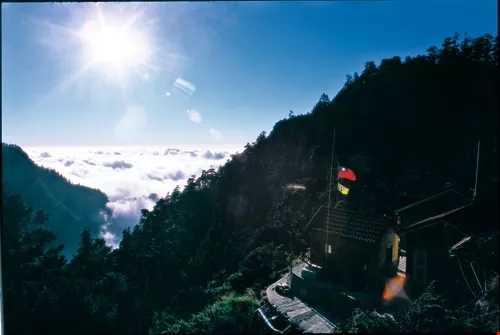
Taiwan may be small, but it's packed with rich natural scenery, such as "seas of clouds" visible from the high mountains. Shown here is Yushan National Park, which draws large numbers of international tourists.
Longpan Park, Kending
(Ken Wu, community development director at Lion Travel) Tourists from mainland China are impressed with Kending's scenery. And no wonder: the lush green grasslands of Kending's Longpan Park, the azure skies, the Pacific Ocean and Bashi Channel before the eye, and the expansive bosom of earth and sky leave one transfixed.
Heading north along the coastal highway from Eluanbi, there's an expansive grassy plateau. In the summertime, you can stroll across the matted green grass, the song of the oriental skylark in your ears. Gaze at steep seaside cliffs and the vast ocean, as you quietly watch a splendid sunrise, a gorgeous sunset, or a dazzling starry sky: you'll forget all your cares.
Yilan's Cuifeng Lake
(travel blogger Cheng Chao-hsiang) Cuifeng Lake, 1,840 meters above sea level, is the largest alpine lake in Taiwan. Located within the Taipingshan National Forest Recreation Area, it's shrouded in mist year round. Its partly obscured surface, its appearance difficult to discern like that of a young woman veiled in gossamer, gives it the nickname "lake of the 19-year-old maiden."
From the Cuifeng Lake Loop Trail, which follows an old logging railway line, you can enjoy the lake's beauty from a different perspective, and watch migratory birds and mandarin ducks frolicking in the water. It takes about two hours to complete the 3.95-km circuit. After walking a comfy stretch of boardwalk, you reach a gravel path. On the way, the lake views intermesh with dense primeval forest, giving you a sense that no matter how forbidding the forest may seem, sanctuary is within reach.
Surrounded by Formosan cypress, Cuifeng Lake shows a different face with each season: new greenery in the springtime, rains and mist in the summer, ruddy foliage in the autumn and white snows in the winter. The lake's changing appearances, embellished with gorgeous sunrises, seas of mist and rosy sunsets, each have their uniqueness. And it's easy to get to: you can make a day trip from Yilan.
Yongkang Street
(Lulu Han, author and director-general of South Village) The area around Taipei's Yongkang, Qingtian and Longquan streets forms a community rich with cultural and literary erudition.
Coffee shops, teahouses, independent bookshops, international restaurants, zakka stores and other colorful establishments line the streets and alleys here. And concealed behind luxuriant greenery are Japanese-style residences, which in the 1950s and 60s were bastions of the modern Chinese liberal tradition. These include the former residences of Yin Hai-kuang and Liang Shih-chiu, as well as the Wisteria Tea House, a meeting house for literati that has been designated a historic site: these are all cultural symbols of Taiwan's legacy from the May Fourth Movement.
Local life in Taipei
(Wayne Liu, deputy director-general of the Tourism Bureau) If you're staying, say, four nights in Taipei, you can take the MRT or local trains to numerous destinations around the city.
Take the MRT to Danshui to sample local treats like iron eggs (a kind of stewed egg) and agei (vermicelli in a tofu shell); then take a ferry to Bali and go for a bike ride. Or else go on a north coast day trip to Fisherman's Wharf, the grave of Teresa Teng, and Juming Museum; don't forget to enjoy the ocean vistas. The next day, go to Sanxia to visit the Cha Shan Fang soap factory or head off to Yingge, a famous ceramics center.
By the way, Liu adds, if you have time, the Aboriginal village cultures of Hualien and Taitung are not to be missed.
The Pingxi Line
(railway expert/author Liu Ka-shiang) Completed in 1921 by the Tai-yang Mining Company, the Pingxi Line was built to transport coal. The line stretches 12.9 kilometers from Sandiaoling Station to Jingtong Station.
Its attraction lies in all the sights along the route. After the coalmines shut down in the 1980s and populations in the area aged and declined, the railroad faced abandonment. But more recently, visitors have been drawn here on nostalgia trips by a wealth of cultural assets, such as quaint old streets, sky lanterns, coalmining history, little train rides, and a Japanese-style station house.
Traveling on the Pingxi Line, you can think of each station as a center point, and just roam about, exploring the area around it on foot. You'll find marvelous experiences just viewing the rustic scenery (trees, waterfalls, rock formations and villages), or strolling on the old streets browsing through hardware stores, farming supply shops and bakeries.
.jpg?w=1080&mode=crop&format=webp&quality=80)


_DSC2938@List.jpg?w=522&h=410&mode=crop&format=webp&quality=80)


@List.jpg?w=522&h=410&mode=crop&format=webp&quality=80)
