Liuligongfang: Two Decades of Cross-Strait Experience
Coral Lee / photos Chuang Kung-ju / tr. by Scott Williams
November 2011


Loretta Yang has said: "Life is like a peony, exploding into bloom." Yang, one of the founders of glassmaker Liuligongfang, is referring to a legend in which Empress Wu Zetian is enjoying plum blossoms on a winter day and decides she'd like to see all the various flowers in bloom at once. She orders the god of flowers to make them all blossom early, but the peony, alone among the flowers, refuses to cooperate. When Wu orders the peonies banished from Chang'an or burned to ash, they take root in Luoyang and prosper there. Liuligongfang has chosen the peony as its emblem to suggest its commitment to that same spirit.
Founded 25 years ago in Tamsui, Liuligongfang began establishing itself in mainland China in 1996. Ignoring early warnings that its mainland venture would come to a bad end, the studio has instead prospered there. It now operates 49 mainland galleries, has diversified into food, beverages, and other businesses, employs 1,100 people worldwide, and has annual revenues of roughly NT$1.1 billion. Liuli's capabilities have blossomed as vigorously as the peony, turning it into Asia's premier creative-cultural venture.
Across from Tianzifang on the arty stretch of Shanghai's Taikang Road stands a large glass structure. Brilliant and eye-catching, the building houses the Liuli China Museum. Two giant steel peony blossoms decorate its glass exterior. Sculpted ducks sit in running water outside its French windows, craning their necks in welcome. At night, light plays on the peonies to fantastic effect.
The first floor of the main hall contains a restaurant and a gift shop whose shelves are filled with sparkling, translucent glass animals in lifelike poses. Ele-gantly depicted flowers, insects and fish are accompanied by poetic descriptions. An arrangement of pink glass lilies in a hollow, colorless glass sphere is "an early spring flower in the mountains, standing next to a cliff, erect, deeply rooted, petals extended." A blue-green imperial dragon seal "approaches like billows striking a steep cliff, soars over the land, and rides the wind across vast seas, pacifying all under heaven." Company CEO Chang Yi pens all of the descriptions himself.
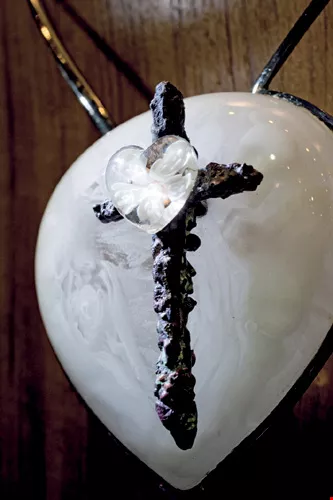
The conceptual decorative pieces of Yang's In Brilliant Bloom series honor seven exceptional women. The piece representing Mother Theresa is the pure white of compassion, with a roughened cross against its smooth lines. "Without shoes for her feet, she has reached around the world; though lacking a single material object, she is brimming with love."
In early fall, a travel-worn Chang and Yang were preparing for the opening of the Liuli Taipei restaurant in Taipei's Songshan Cultural and Creative Park. After 15 years of shuttling back and forth between Taipei and Shanghai, the two have "come home." Chang's feelings run particularly deep as he revisits his memories of leaving Taipei, a city that had everything, for the unfamiliar and at that time undeveloped Shanghai.
Chang says it took Liuligongfang three years to develop its lost-wax casting techniques. (Liuli, a term originally used for a semiprecious stone and for a lead-barium glass produced in ancient China, is the term the studio has adopted for its contemporary lead-crystal works; gongfang means "workshop.") Once it had done so, it had to go to work on building its brand through major exhibitions. Once the brand had a name, the company bought a second factory site in Tamsui. They didn't realize that their site had been zoned for the residential Danhai New Township, restricting their ability to build. Burdened with heavy debts, Liuli didn't have the money to seek another location and found itself stuck even after explaining the situation to both the president and the premier.
Just as their Taiwan expansion plans ground to a halt, mainland China opened its arms to them. But there were objections to the move. Who would buy art in the cultural wasteland of the mainland? Chang thought to himself, "In the Eastern Han Dynasty, Mancheng County, Hebei Province produced the double-handled liuli cups of Emperor Liu Sheng. Why can't we return to the historical source?" Chang, who as a teenager had wondered whether China would become "good," realized that there would be no turning back for the mainland now that it had decided to open up to the rest of the world. He reasoned further that if he wanted to work in the cultural sphere, he needed to quit complaining and get on with it.
How did Liuli crack the vast mainland market? "We define ourselves as being in the business of transmitting culture," says Alice Wang, general manager of Chinese operations and one of the company's seven founders. "Taking good faith as our core value, we use glass works to spread life values."
But what values, exactly? Wang notes that the sutras say: "I vow that in the future, when I achieve enlightenment, my body will be like liuli, transparent inside and out." In her own life, Yang longs for the unity of interior and exterior that glass represents. But human life and liuli are also fleeting. As the poet Bai Juyi put it: "Like scattered clouds, the fragility of liuli." With these thoughts in mind, Yang hopes that through her creative work she can learn to live in the moment.
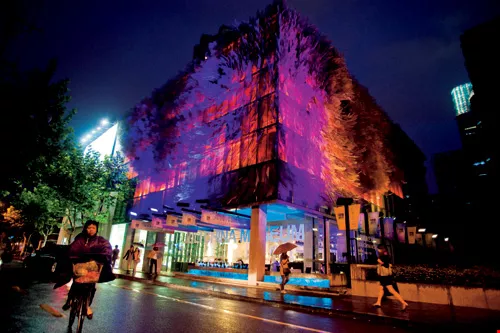
The exterior of Liuligongfang's Liuli China Museum in Shanghai is remarkable, featuring two huge peonies suspended from a glass curtain wall. At night, light plays on the peonies to fantastic effect.
Liuli holds an average of one major exhibition every year without regard to the cost, using the exhibition and media exposure to increase its name recognition. Reports on the company often speak of how two movie-industry figures threw their entire fortunes into reviving China's liuli glass arts. With the studio producing amazing new works on a regular basis, there's always new material for an article.
Intrigued by what he'd heard, Tang Sifu, a senior Beijing-based reporter for Shanghai's Wen Wei Po, became a regular at the studio. "Mr. Tang thought that Liuli's story provided an inspirational counterexample in that 'make a quick buck' period in the mainland." Wang adds that the influential Tang has been with them from the beginning, and helped the company out in 1995 when it was preparing for its first major exhibition in Shanghai. With ROC president Lee Teng-hui in the US and cross-strait tensions running high on the eve of the show, important Taiwanese guests were canceling their appearances. Tang nonetheless urged Liuli to go ahead with its scheduled press conference, and arranged for the Wen Wei Po's supportive president and editor-in-chief to attend.
In addition to working on media strategy, Liuli had to develop commercial distribution channels. Wang says that it was very difficult to open a gallery when the company first set up in the mainland. Even though Liuli already had a bit of a name, Wang found her visits to Beijing department stores to be exercises in frustration. "They didn't know what Liuli was about and were concerned that we wouldn't have enough sales to stay afloat." Wang finally persuaded a department store to permit Liuli to hold an exhibition. Once the store had seen their cultural products and how well they sold, it agreed to lease them space. The tactic eventually allowed them to establish beachheads in cities all over the mainland.
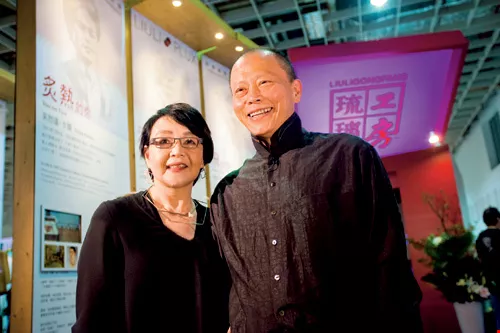
In addition to the challenges they faced developing their market, the company also struggled to manage its employees. The scars of the Cultural Revolution had left mainlanders estranged from one another, which is deadly to a service-oriented business. For the culturally oriented Liuli, managing employees was a real issue.
"We called each other 'partner,' not 'colleague," says Wang, "and treated our partners like family and friends." Wang says that to cultivate employee relations and foster good mental and physical health, everybody cleaned up the store and did Taiji together before work. The practice is now a 20-year tradition with the company. Another company hallmark is respecting and trusting its partners. Wang remembers how tough the Korean firms operating in the mainland used to be on their employees, forcing those caught taking company toilet paper or forgetting to flush the toilet to kneel in punishment. Liuli encountered the same problems, but dealt with them in a more humane fashion: it had employees sign a toilet contract and take turns conducting inspections until matters improved.
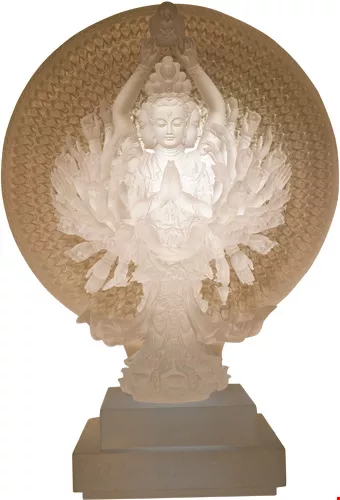
This liuli Guanyin of the Thousand Hands and Eyes in the collection of the Liuli China Museum echoes the paintings at Dunhuang. Yang plans to make one comparable in size to the Dunhuang Guanyin, but will first have to overcome the limitations of contemporary kilns.
Five years after Liuli set up shop in the mainland, it opened the TMSK Restaurant in Shanghai's Xintiandi commercial district. The idea was to use food and beverages to promote liuli glass arts and propel the studio forward.
Chang says that the concept originated with a trip he made to Japan when in his 20s. In those days, he was still just a poor student learning to shoot movies. Sent by a teacher to study in the US, he visited Kyoto on his return trip, and experienced Japan's reverence for its culture for the first time. He was awed by the way in which kaiseki meals incorporated traditional handicrafts into everyday life. "Our ceramics were brilliant in the Song Dynasty," says Chang. "What happened to our craftsmanship and aesthetics? How do we incorporate our traditions into modern life?" He wondered why Chinese people so often opened restaurants that were so vulgar.
This seed of an idea blossomed into a magnificent flower some 30 years later in Shanghai. Every feature of TMSK, down to even the restroom sinks and faucets-modeled on lotus leaves and seedpods-highlights some aspect of Chinese handicrafts. Perhaps most interesting are the liuli bar and stools, which reflect the light in a magnificently mysterious fashion. Yang says that they were inspired by the painting The Night Revels of Han Xizai, and use light and liuli in layers to recreate the splendor of the Southern Tang Dynasty of more than 1,000 years ago.
The second-floor hall's liuli dome sparkles and its tabletop candles flicker. The atmosphere is wonderful, the music excellent, and the food delicious. All five senses bask in the beauty as you enjoy your meal. The music of film composer Peter Chang, performed on Chinese strings and woodwinds with MIDI effects and jazz rhythms, is particularly memorable. The seamless blending of traditional and modern, the melodies' changes of mood, are unimaginably lovely. A meal here isn't cheap-roughly RMB600 per person-but it's certainly worth it.
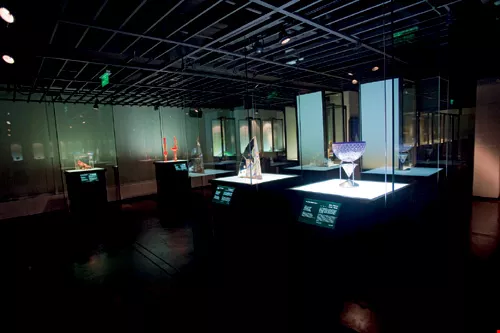
The Liuli China Museum's collection includes ancient pieces of liuli as well as works by Loretta Yang and other masters from around the world.
Yang's own works have long been the studio's biggest calling card. Her depictions of Buddhist images, flowers, and women have been internationally renowned for years. Her work can be found in the collections of the National Museum of Women in the Arts in Washington and the Bowers Museum in the Greater Los Angeles area, which feature pieces such as A Great Wish, which depicts a sweet child fast asleep atop a hand, and The Proof of Awareness, a transparent 76-centimeter-tall peony.
Her most recent series, entitled In Brilliant Bloom-My Individuality and Beauty, interprets the lives and experiences of seven exceptional women-including Mexican painter Frida Kahlo, mother of modern dance Isadora Duncan, and Catholic nun Mother Theresa-in conceptual decorative pieces.
Says Yang. "The Buddha spoke of suffering, but also of love and mercy. These seven women all suffered, but each exhibited incredible dedication and value in her life." Yang says that these works-which also come in pendant versions-are informed by a unifying spirit, each piece depicting life and value. "When you encounter frustration in your life, clasp the pendant at your breast and recall how these women soldiered bravely on. I hope these pendants will give people the inspiration to keep going."
In addition to its cultural underpinnings, Yang's work shows remarkable technical prowess. Wang says that the reason The Proof of Awareness became part of the authoritative Corning Museum of Glass's collection is that the museum was impressed with Yang's ability to create pieces far larger than the typical palm-sized liuli. Yang's inclusion in the Corning collection is indicative of her position at the forefront of contemporary liuli glass working.
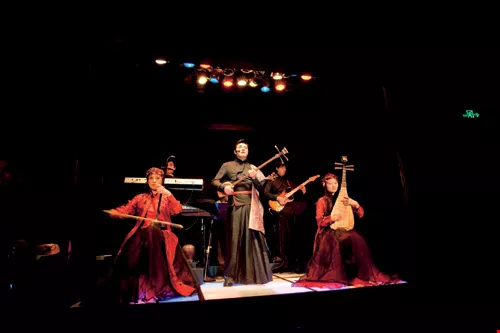
In recent years, Yang has expanded into other fields, including designing TMSK's interior, furniture, and flatware, and its house band's outfits. When she was invited to show TMSK's bar and lantern stools at the Victoria and Albert Museum's "Creating China" exhibition in 2008, she became a representative of the fashions and lifestyles of contemporary Shanghai.
In the era preceding the rise of the "creative-cultural industry," Liuli used its storytelling skills to build itself an oasis in a cultural desert. How can Taiwan's younger generation of creative-cultural talent build on Liuli's experience?
"Culture is primary. Innovation follows that, before finally an industry develops," says Chang. Drawing on the work of corporate strategist Michael Porter, he says that culture is an attitude, a perspective on core values, and a kind of conviction.
"Liuligongfang is small," says Yang, "but we constantly strive to use innovative means to expand on values we believe in." She argues that working in the creative-cultural field is an adventure in and of itself. If you set out to do something commercial, you're just doing business, not creating culture.
Once you do get involved in the field, you have to stick to your principles. There are things that are appropriate and things that are not. "If you're determined to do something you have to give it at least 10 years," says Yang. She adds that Liuli releases its pieces in only limited numbers, forcing Yang and the design team to think and innovate constantly.
In recent years, the big eight luxury brands have spent enormous amounts of money fighting for market share, and Taiwanese brands have won almost no space in mainland department stores. According to Yang, the reason that Liuli has managed to stand out in the crowded high-end market is because, "We're not looking to walk the red carpet. Instead, we're pursuing life values, and that resonates with people."
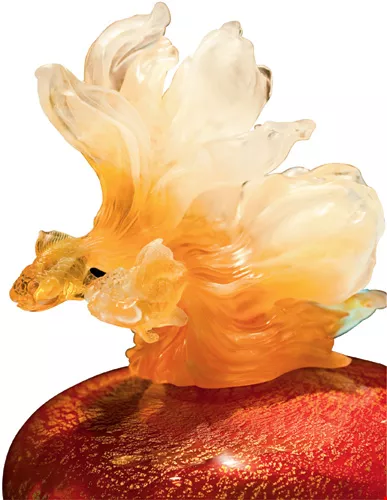
Loretta Yang often uses flowers and fish as subjects for her work, rendering them with exquisite clarity.
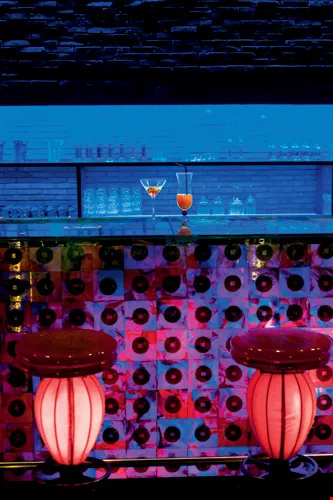
Located in Shanghai's Xintiandi district, the TMSK restaurant combines liuli and life aesthetics. Its liuli bar and stools exude an air of profound mystery.
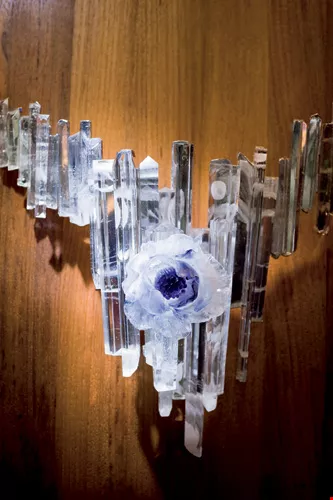
Limpid You interprets the life of American painter Georgia O'Keeffe, who continued to paint in her later years, even as her eyesight deteriorated. "The desert, flowers, and desiccated bones, the purity of a life in dialogue with itself."

_DSC2938@List.jpg?w=522&h=410&mode=crop&format=webp&quality=80)

@List.jpg?w=522&h=410&mode=crop&format=webp&quality=80)


