Summer’s Net Worth:
The Keelung Squid Festival
Esther Tseng / photos by Jimmy Lin / tr. by Phil Newell
August 2025
This “stick-held dip net” fishing boat uses lights to lure neritic squid.
The neritic squid caught in the seas off Northeastern Taiwan account for more than 70% of Taiwan’s total catch. The Keelung Squid Festival, now in its 21st year, has become a well-known brand among summertime fishing-related events. Fishing at night amid cool ocean breezes, eating fresh seafood, and exploring the scenery in more than ten fishing harbors, one can really enjoy the richness of this part of Taiwan.
“When you catch your first ocean fish, what’s the next thing you want to do?” Ryron Chen, skipper of the Hualun fishing vessel, poses this question to visitors who have come to experience night fishing. “Of course,” he continues, “you take a picture!”
June to September each year is peak fishing season for neritic squid around Taiwan. While some are caught off Penghu and Nanfang’ao, over 70% of the total catch comes from the seas off Northeastern Taiwan.
The Keelung City Government initiated the Keelung Squid Festival in 2005, responding to the central government’s policy of promoting domestic tourism by encouraging each township to showcase a distinctive local product or industry. Having been held 20 times, the festival has driven waves of enthusiasm for dining and recreation themed around neritic squid.
What are neritic squid?
Liao Cheng-hsin, dean of the College of Ocean Science and Resource at National Taiwan Ocean University, has been studying neritic squid for over 27 years. He notes that Taiwan accounts for only 0.0277% of the world’s land surface, but boasts 10% of the globe’s marine biodiversity. Neritic squid are an example of this: among some 49 species worldwide, Taiwan is home to ten species across three genera.
The academic community divides neritic squid into species such as swordtip squid (Uroteuthis edulis) and Indian squid (U. duvaucelii), but Taiwan’s fishmongers take a different approach. They have adopted names to distinguish the sizes and prices of these cephalopods. The largest (over 40 centimeters in length) are known as paoguan (cannon barrels), while those of 20–40 cm are known as touchou, those of 15–20 cm zhongjuan (medium rolls), and those below 15 cm xiaojuan (little rolls). The smallest, roughly 2–7 cm in length, are called mimijuan (mini-rolls), and are mainly processed into XO sauce (a spicy seafood sauce).

The period from June to September each year is peak production season for neritic squid in Taiwan; the photo shows all sizes of neritic squid on sale at Zhuwei Fishing Harbor in Taoyuan’s Dayuan District.

Liao Cheng-hsin says you can use your hand and forearm to distinguish different sizes of neritic squid. The smallest, mimijuan, are about the size of a pinky finger; the next smallest, xiaojuan, are about as large as the span from the tip of the thumb to the tip of the index finger; and zhongjuan are about the length of a hand with fingers extended. Touchou are about the length of a forearm, and paoguan are as long as the forearm plus the palm of the hand.

Mimijuan, the smallest neritic squid, are mostly used to make XO seafood sauce.
Cyclical production
The lights of fishing boats can often be seen at night in the waters off Northeastern Taiwan. They are fishing for neritic squid, which are attracted to the lights.
Liao Cheng-hsin mentions that fishing industry data reveal cyclical highs and lows in annual catches of neritic squid. However, the periods of low catches have been getting longer and longer.
There was a major downturn that lasted from 1997 to 2003. The main reason was a Super El Niño event in 1997–1998 that caused the waters in the East Pacific Ocean to reach unusually high temperatures.
But another major reason for the extended low ebbs in neritic squid catches is competition from China. Following its economic takeoff, China began harvesting huge quantities of neritic squid in the East China Sea, affecting Taiwan’s catch. In 2003 only two boats were fishing for neritic squid off the Chinese coast using lure lights and lift nets, but by 2007 that number had risen to over 130.
In 2018, Taiwan’s total catch of neritic squid fell to less than 5,000 metric tons.
There have been suggestions that the government should adopt a quota system to limit neritic squid catches, as it has done for sakura shrimp, but Liao has reservations. He points out that cephalopods grow rapidly after hatching, and live for only about a year, dying after their first spawning. “If you don’t harvest them, they will die anyway.” He advises that the real solution is to protect their spawning grounds.
In 2019 the Fisheries Agency adopted the “Regulations on the Management of Torch Light Net Neritic Squid Fishery,” banning fishing for these creatures around three small islands off the Northeast Coast for one month each spring and autumn during spawning seasons. Statistics show that subsequently the decline in catches halted in 2019 and there has since been some upward trajectory.


Ryron Chen, skipper of the Hualun, offers fishing instruction to novices. He stresses that recreational fishing is not just for experts, but is open to families and to women and girls.


Tsai Fu-ning, director general of the Keelung City Department of Economic Affairs, suggests that the Keelung Squid Festival has already become a brand name representing Keelung’s fishing industry culture.
Innovations for the festival
Tsai Fu-ning, director general of the Keelung City Department of Economic Affairs, who transferred back to the city government from the Fisheries Agency in 2011, has been in charge of organizing the Keelung Squid Festival each year since its inception. Over the last 15 years, she has also witnessed the most rapid decline in the neritic squid catch in history.
Tsai points out that improvements in fishing technology have increased the “catch per unit of effort” (CPUE). But more impactful has been the effect of Chinese fishing boats crossing into Taiwanese waters to fish. They use bottom trawling to catch shrimp and crabs, but this damages the habitats and breeding grounds of other sea creatures. In particular, it virtually wipes out bottom-dwelling juvenile neritic squid, preventing them from maturing.
This has meant that visitors taking nighttime recreational boat trips to see neritic squid or to experience catching them have been left disappointed. To minimize the impact on festivalgoers, the organizers of the Keelung Squid Festival have successively promoted events such as visits to fishing villages and sea fishing instruction sessions to enable people to better understand things like fishing village lifestyles and the construction of the fishing boats that catch neritic squid using “stick-held dip nets.” If visitors don’t catch any neritic squid themselves, they can still enjoy a meal of squid with rice noodles laid on by their boat’s captain.

The scenery of Keelung Islet can be admired during night fishing tours.
Fisheries transformation
One of the highlights of the Keelung Squid Festival is the “fishing for beginners” experience. People don’t even need to bring their own fishing gear, they just have to show up. The boat crews will provide bait, tackle, and even ice.
Amendments to the Fisheries Act made in 1991 first enabled fishing boat operators to also offer recreational fishing. Tsai Fu-ning says that the earliest motivation was to help fishing vessels transition away from pure fishing. The second generation of recreational fishing operators began building new boats with a focus on improving comfort for sea anglers. The third generation has combined deep-sea fishing with cruise voyages and developed new activities to attract tourists including fishing, diving, trips to Keelung Islet, and group hires for overnight fishing parties.
Ryron Chen, skipper of the fishing vessel Hualun, is a prime example of a second-generation participant in the transformation of the fisheries industry. His father began fishing at age seven, but with the decline of fisheries resources, Ryron urged him to switch to offering itineraries for novice fishermen. With the veteran captain piloting the boat, Chen uses fishfinder technology to locate schools of fish for customers to catch.
Chen says that in summer the waves off Northeastern Taiwan are smaller, making it an ideal time for visitors to experience night fishing. Recreational fishing is especially fun for children, many of whom have eaten seafood without ever seeing a live sea creature. He adds that there are different fish in different seasons. For instance, from April to June there are mackerel, Japanese scad, flying fish, and sharpfin barracuda; next up are neritic squid, from June to September; then hairtail, from July to October; and in August and September three-spotted swimming crabs, which trustingly come right to the surface at the first sight of light.
An experienced Japanese fisherman who joined a boat tour for novice fishermen tells us that he caught more than ten fish in one night, including sharpfin barracuda, bonito, and Japanese scad. He says that in Japan the only night fishing is for squid, whereas in Taiwan it targets many marine species.
Tsai Fu-ning relates that in 2018, when the finals of the international Young Chefs Competition (Jeunes Chefs Rôtisseurs) were held in Keelung, arrangements were made for young champion chefs from 26 countries to go on a night fishing trip, followed by an early morning visit to the Kanzaiding Fish Market. The young chefs were amazed because in other countries fishing is done mostly by day, and because there was so much activity on the sea at night.
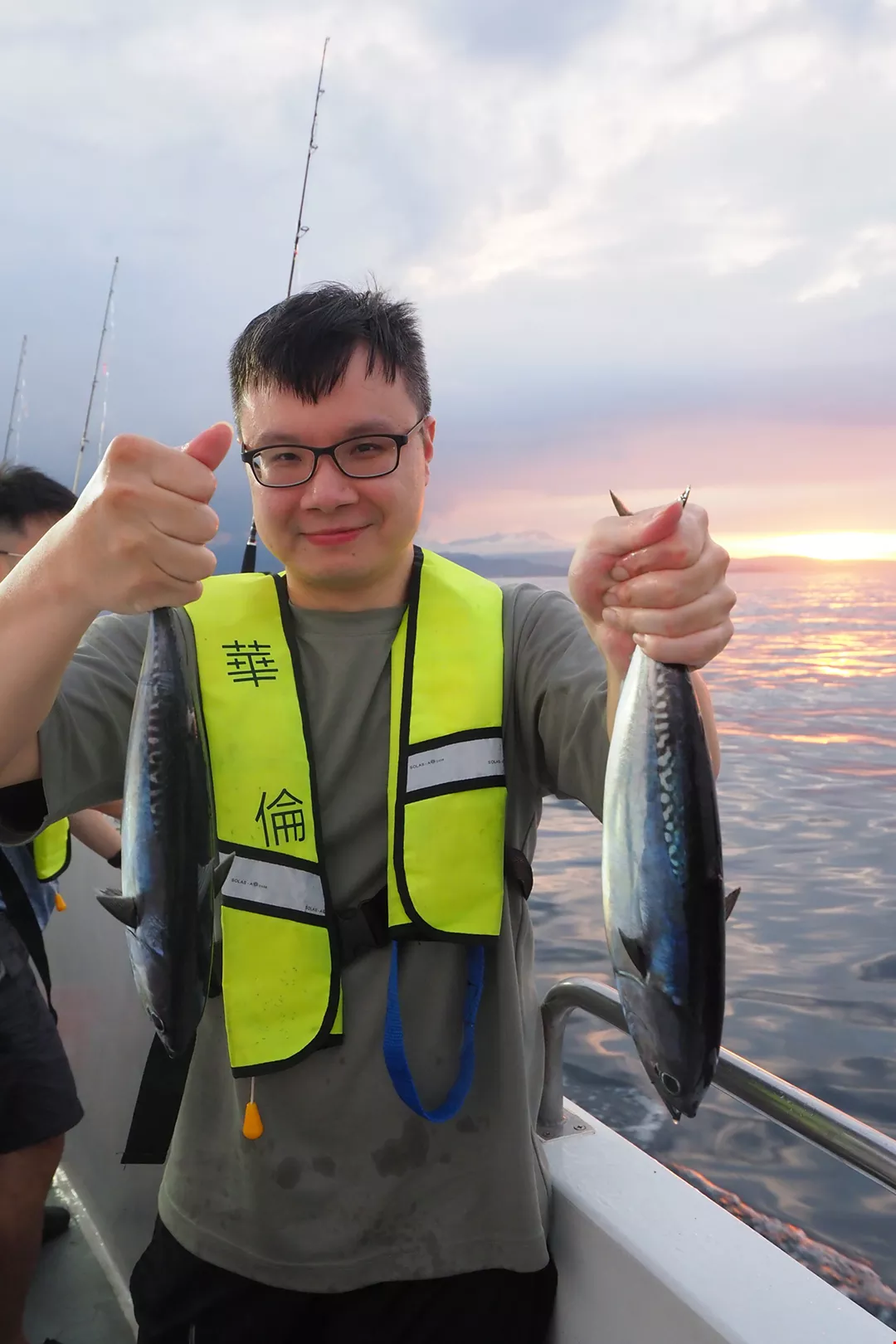
The first thing most people do after catching their first ocean fish is to take a commemorative photo.

The impact of brightness
For a time there was a vicious circle of competition among the operators of boats fishing with stick-held dip nets to see who could have the brightest lights. In particular, following the granting of permission for fishing vessels to offer recreational fishing services, boat owners at the time wanted their customers to be able to catch as many neritic squid as possible, so they boosted the power of their lighting. But this tended to overload the vessels’ electrical systems, sometimes causing boats to catch fire.
Data collected by Liao Cheng-hsin shows that stick-held dip net fishing boats operating off Taiwan’s Northeast Coast have on average 36 lamps each, whereas those working off Penghu or Southern Taiwan average only 17. This shows the intensity of competition off the Northeast Coast.

Squid fishing boats use lamps to lure neritic squid into their “stick-held dip nets” before lifting them out of the water. (courtesy of Keelung City Dept. of Economic Affairs)
Sustainable fishing
In fact, there is a way to deal with the excessive brightness of fish lure lights.
Before getting into the details, Liao tells us a story. One night a student of his went out to do an experiment on a squid fishing boat that used lure lights, and when he returned his skin was burned. His parents thought he was lying to them, wondering how he could have got a “sunburn” during night fishing. It turned out that the halogen lamps on the boat emitted ultraviolet (UV) light.
It would be preferable to control the wavelength of the light by using LED lamps that do not emit UV rays. In addition, LED lights use only one-fiftieth of the power used by halogen lamps. Therefore, academics have been working on how to use LED lights instead.
Importantly, fishing boats that use lure lights do not mistakenly catch non-target species. Moreover, unlike trawlers, they do not destroy marine habitats. So long as the problem of high energy usage by lure lights can be solved, stick-held dip net fishing is not only environmentally friendly, it is the most sustainable fishing method.
Neritic squid are located in the middle of their ecosystem’s food chain and play an important role in energy transfer. Liao recalls that when he once went out to sea on a fishing vessel to do research, he got hungry at night, so the captain cooked up some freshly caught (and still transparent) neritic squid to eat. “Wow, that squid was sweet and delicious.” We must be sure to utilize this gift from nature prudently.

There are often beautiful sunsets to be seen during night fishing activities.
