Taiwan’s One-Person Publishing Houses Court Niche Readership
Eric Lin / photos Chin Hung-hao / tr. by Josh Aguiar
February 2013


Over the past few years, what began as a subtle shakeup in Taiwan’s publishing industry has swelled into a veritable revolution.
Today’s burgeoning one-person publishing firms combine small-scale budgets with novel marketing, focusing on books that companies in the past would have dismissed as overspecialized or unpalatable to mainstream tastes. These newer firms are like missing pieces in the larger publishing puzzle, filling in neglected niches within Taiwan’s literary landscape, and in the process smashing the old paradigm of mass appeal.
The new publishers know which books to select and make sure they enter the hands of the right market segment, work which requires the ability to move fluidly between the roles of editor, salesperson, and planner. And their success derives from how they have tapped into the current digital generation’s penchant for sharing and linking online to generate consumer loyalty.
Since the phenomenon began to take off in 2010, the number of one-person publishers has mushroomed to 10 distinct enterprises. Now that these firms have had three years to ferment, perhaps this year will yield a bumper crop of good books.
Every year after New Year’s, all of Taiwan’s major booksellers announce their “best books of the previous year” as a promotional gambit. This year, the book most prominently displayed at Eslite bookstores in Taipei is a volume titled Publishing the (Not So) Easy Way.
The author of the title, Sharky Chen, is editor-in-chief of CommaBooks Publishing House, and on its pages he relates in a disarmingly self-deprecating tone the ups and downs and strange encounters of his more than two years at the helm of his enterprise. The book was voted by Eslite’s employees as the book they were “most eager to sell.”
On the day of the awards ceremony, Chen wrote on Facebook: “My eyes were rimmed with tears; my heart was racing. I started to speak, but couldn’t remember what I wanted to say.”
For Taiwan’s publishing industry, this marks the arrival of a new trend, the rise of a third wave of independent publishing. Moreover, it highlights the polarization within the industry, on the one hand towards conglomeration, and towards small-scale individual publishing on the other.
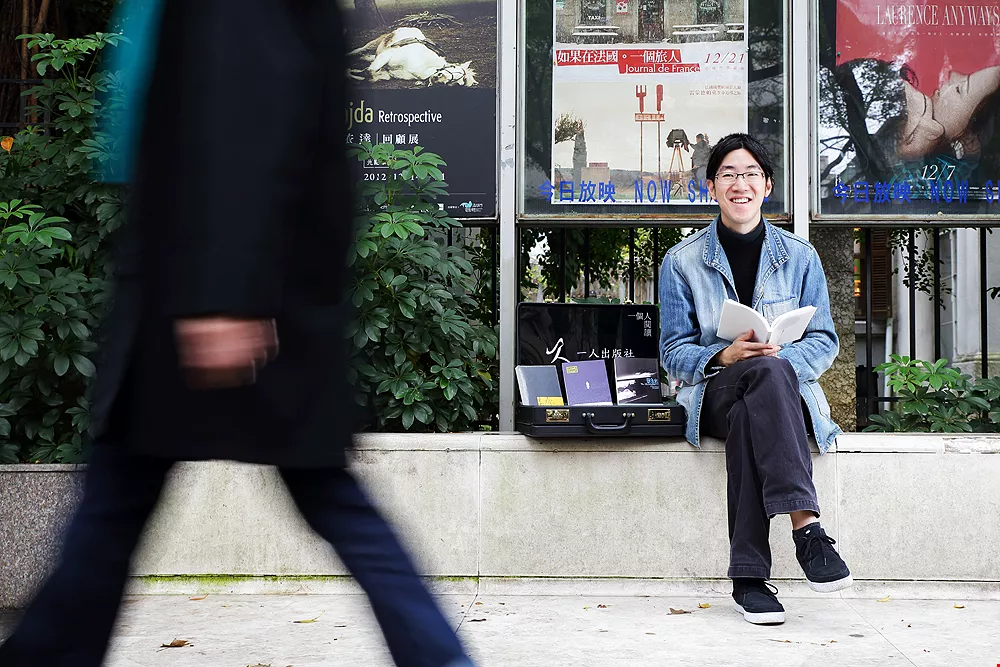
Alone Publishing founder Liu Gi is fond of choosing a spot by the side of the road to read and sell books, interjecting a blithe studiousness into the urban chaos.
Looking at the history of Taiwanese publishing we can discern three separate waves of independent publishing.
The first wave materialized in the 1960s, a period during which many Taiwanese authors, in addition to their own creative work, also scoured the landscape for emerging voices in domestic literature. They also imported foreign classics to introduce to local readership. Examples include elder statesmen Lin Haiyin’s Chunwenxue and Yindi’s Erya. Both enterprises were run out of their respective founders’ residences, a page directly from the home-as-factory mode of production in vogue during that era, the living room serving both as office and as a meeting space for literati. It was a moment that left an indelible imprint on Taiwanese cultural history.
The second wave came into being around 2000, fast on the heels of the trend in industrial outsourcing. A few editors in Taiwan realized the potential in starting their own businesses. So long as they could pick the right books, get their production chain set, and properly gauge the market, they could compete on an even footing with the industry behemoths.
At Ars Longa Press, Joyce Yen achieved market success by publishing translations of foreign bestsellers like The World is Flat and Justice: A Reader. And at Revolution-Star Publishing and Creation, Ray Huang struck gold by converting the online creations of bloggers Wanwan and Jhai Nyu Siao Hong into the print medium, easily selling over 10,000 copies each, which opened up additional sources of revenue through sales of peripheral merchandise like stationery products and imaged material.
The success of these two provided plenty of food for thought for younger entrepreneurs: could the same one-person modus operandi be applied to the publication of marginalized books? Could limited capital be used to publish only those books that the publisher personally favored and still develop a reliable readership?
And thus the third wave was born. Starting in 2010, CommaBooks appeared, followed by Alone Publishing, VS Press and a host of other individually run outfits all the way up to the present total of more than 10. They bubbled up from the crevices within the industry in which they are ensconced by coming up with a number of novel and creative ideas.
Firstly, instead of importing popular foreign books to Taiwan, the latest wave of independent publishers has focused on new material. Working with established bloggers with large fan bases holds less appeal for these publishers than does seeking talent that has yet to appear on the cultural radar. Another area of interest is obscure works of Western literature, even modern poetry, which the industry has largely left for dead.
Secondly, they have invented creative business strategies that disprove the canard that only a large company has the necessary weight to persuade the public. These individuals relish doing things on such a small scale, because, disburdened of the typical competitive ethos, they are free to apply synergistic approaches like publishing books that can combine with books published by a different firm to form a kind of companion set.
Finally, their work is emblematic of a broader life philosophy emphasizing freedom and joie de vivre that has been embraced by the younger generation.

For the past three years, some of Taiwan’s one-person publishing houses have jointly maintained a booth at the Taipei International Book Exposition as a kind of platform from which to promulgate their publishing ideals.
Since its inception in 2010, CommaBooks has published more than 30 titles. Moreover, it has sparked a new passion for poetry amongst Taiwan’s young.
Comma’s founder, Sharky Chen, was born in 1980. After completing his master’s degree at the Institute of Creative Writing and English Literature at National Dong Hwa University he worked as an editor for two years at Bookman Books, which deals primarily with academic literature. Several times Chen proposed publishing experimental literature, but his efforts met with rejection each time. This experience coupled with the added pressure he felt to forge a career in the wake of his 30th birthday goaded him to leave his job and seek his fortune on his own.
Very early on, he made a point of selecting only the most obscure materials so as to draw sharp distinctions between his fledgling enterprise and the rest of the pack. In his first burst of activity he published three volumes of poetry by three different unheralded individuals, none of whom had ever put out a book.
“Everyone’s always saying that modern poetry is dead in the water, but I say it’s still teeming with vitality,” avers Chen. In his thoughts on poetry he has gone against the grain of convention. Whereas in the past the publishing industry’s standard for evaluating poetry was purely aesthetic, Chen’s tack is to try to view things from a reader’s perspective, to determine whether a need exists for the work in question. “As long as I feel the writing is on the level and that people will like it, it’s worth putting out.”
He set aside NT$400,000 to launch his business. Assuming a cost of more than NT$100,000 for a single book, he had enough capital for three volumes. He put himself on a compressed schedule of one new release a month, printing limited quantities of each book to keep inventory to a minimum. The strategy of “letting one book pay for the next” expedited turnover and allowed him to recoup quickly, and also allowed him to rapidly build up a publishing catalog and market presence. That initial three-volume set was limited to 800 copies per book, with 500 being the magic number needed for him to break even and move on to another book.
The poetry collections gave Comma visibility and in short order made it the darling of young literature buffs. Sales showed marked improvement, giving Chen cause to expand the scope of his ambitions. In the span of six months he released another eight books, amongst which Egoyen Zheng’s You Are the Light that Illuminates My Eyes and Lin Dayang’s The Paper Airplane that Arrived Late sold more than 2000 copies each. It seemed that the curse that had crippled modern poetry for so long had been lifted.
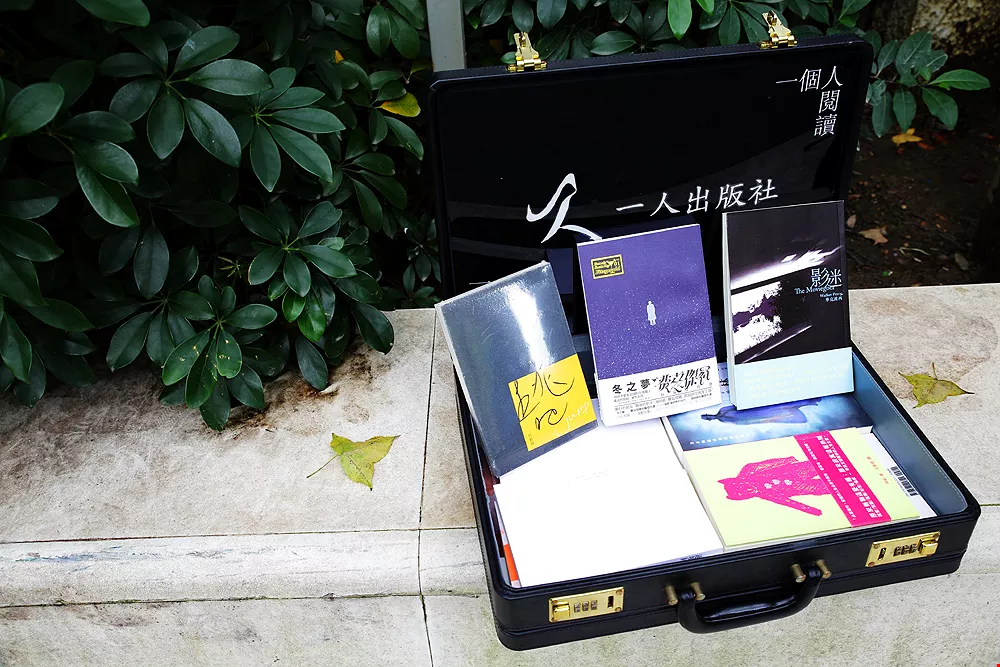
Liu Gi isn’t just selling books: he’s promoting a whole literary ethos.
Every weekend over at Spot-Taipei Theater, there is a young man who sits by the side of the road reading insouciantly. Next to him is a suitcase full of books that he has published himself, and atop the suitcase the inscription reads “Read alone, publish alone.”
His presence interjects a note of surreal calm into the urban throng that makes many individuals slow their footsteps to catch a second glimpse. The man is Alone Publishing’s proprietor Liu Gi, whose street-vendor tactics are a reflection of his ideal of making reading integral to life.
Liu was born in 1978 and graduated from National Tsing Hua University’s Chinese Department. He also holds a master’s degree in film and literature from Essex University in England. Returning to Taiwan in 2005, he balanced working as a translator with co-founding and operating Longstone Publishing, a firm specializing in how-to books in business and finance, with some college friends. He accumulated enough capital in four years to launch his own enterprise. He’s averaged two to three books per year, sticking to things that he himself likes. To date he’s put out nine volumes.
“I am by nature a free spirit,” he says. “My motives were very pure in all this: I just wanted a regular outlet for all this translation, reading, and writing—all this stuff that’s part of my life.” As a result, his business approach is somewhat unconventional. For one, he gives his translators the freedom to choose material for publication; so long as they find a book interesting enough, he’s willing to entertain their proposal. He then negotiates with the foreign publisher over local publishing rights. Both he and the translator put up the cash to fund the project, and they split royalties right down the middle.
The most successful venture thus far has been a book titled Eeeee Eee Eeeee. Taiwanese-American author Tao Lin is an author of some fame in New York literary circles and has been described as the “Kafka of the iPhone generation.” Translator Coco Shen chanced upon the semi-autobiographical work in 2010 and found it so refreshing that she quickly got in touch with Liu about a Chinese-language edition.
Shen’s level of involvement was extremely high throughout. Not only did she oversee the book’s visual presentation, but she also maintained a Facebook fan page in which she posted pictures and other relevant material. The number of online fans shot up to 2600 with unit sales proceeding apace.

For single-handed publishers, the whole city of Taipei is their office. They can perch anywhere in the city and start brainstorming with a business partner.
VS Press also specializes in foreign translations. Proprietor Chiu Kuang maintains a small, one-man office near Guting MRT station in Taipei. On one of the walls hangs a raggedy map of Moscow, a souvenir from Chiu’s days as a student in Russia.
Born in 1969, Chiu is one of very few translators in Taiwan specializing in Russian literature, and this highly specialized background sets him apart from the less initiated one-person publishers. As a former editor-in-chief, he has a bit of a reputation in the field. In starting his own publishing house, he was motivated by a desire to reintroduce the treasures of Russian literature to the Taiwanese public. The 150th anniversary of Russian realist author Anton Chekhov’s birth in 2010 provided an auspicious moment for his dream, so he resolutely left his old job and embarked on a translation of one of Chekhov’s famous works, The Lady with the Lapdog and Other Stories.
The impeccable timing of the release, the attractive modern book cover, not to mention the special reading by renowned author Huang Chunming, all were factors in The Lady with the Lapdog and Other Stories’ spectacular sales. More than 5000 copies were sold, a new record in the annals of translated classic fiction in Taiwan.
“All of the translations of Russian literature that were undertaken by Taiwanese were done back in the 1970s;
from the 1980s on, publishers found it cheaper simply to use mainland Chinese editions. But both of these sources reflect the influence of different eras and/or cultural milieus, all of which pose barriers to the modern Taiwanese reader,” he comments. The language of classic literature needs to be updated. His firm’s new edition takes care to include the slogan “Newly Translated” on the cover, letting readers distinguish between this new edition and previous editions on the market.
Chiu believes that every book has its own life energy and power to influence, which is why he eschews the model of using the proceeds of one book to fund the next one. His recent translations of Ivan Turgenev’s novellas First Love/Asya and Mikhail Lermontov’s A Hero of Our Time were not delayed while waiting to recoup from previous efforts. Luckily for him, he has an indispensible ally in his wife, Hsiung Tsung-huei, an assistant professor of Russian literature at National Taiwan University—her writing the prefaces to his translations provides a seal of quality beyond reproach.
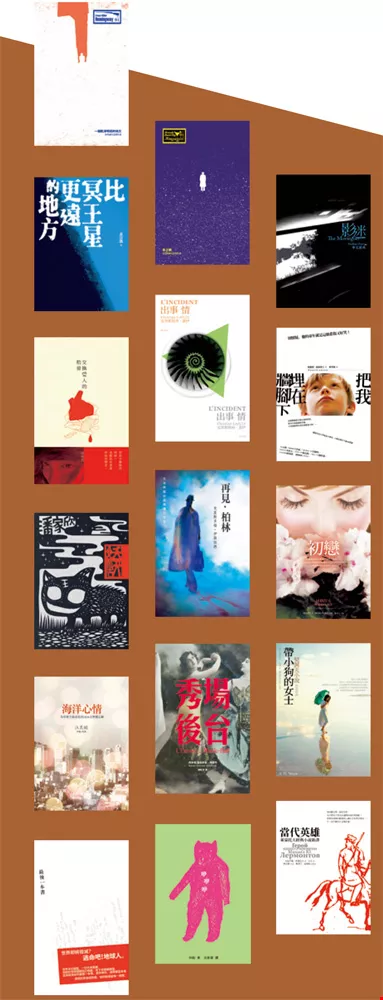
That creativity is paramount for one-person publishers is self-evident in the flamboyance of the designs. Their books are frequently in the running for the annual Golden Butterfly Awards held at the Taipei International Book Exposition.
For the past three years, some of the one-person publishers have manned a booth together at the Taipei International Book Exposition, an act that displays both their solidarity and their originality.
Sharky Chen, Liu Gi and the other new publishers symbolize a prosperous society that values individual aspirations. Growing up comfortably middle class gave these individuals a sense of security and the freedom to pursue early on their visions and be captains of their own ships. Their success gives new possibilities and renewed potency to all those who strive to achieve unique destinies on their own terms.
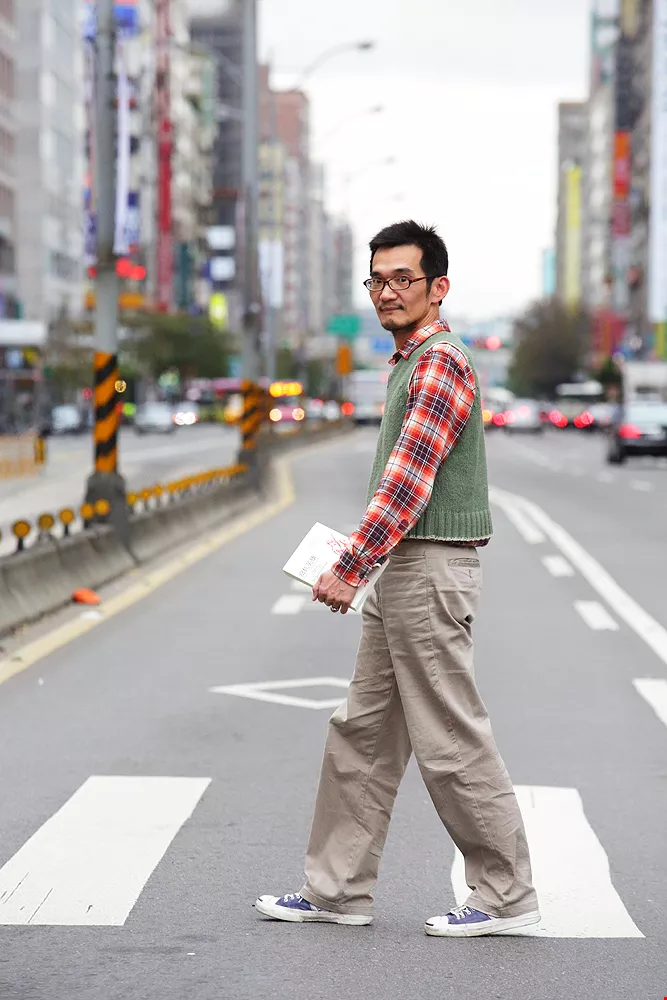
Guided by a desire to reintroduce the greatness of the Russian canon to Taiwanese readers, veteran publisher Chiu Kuang quit his job to start his own enterprise, VS Press.
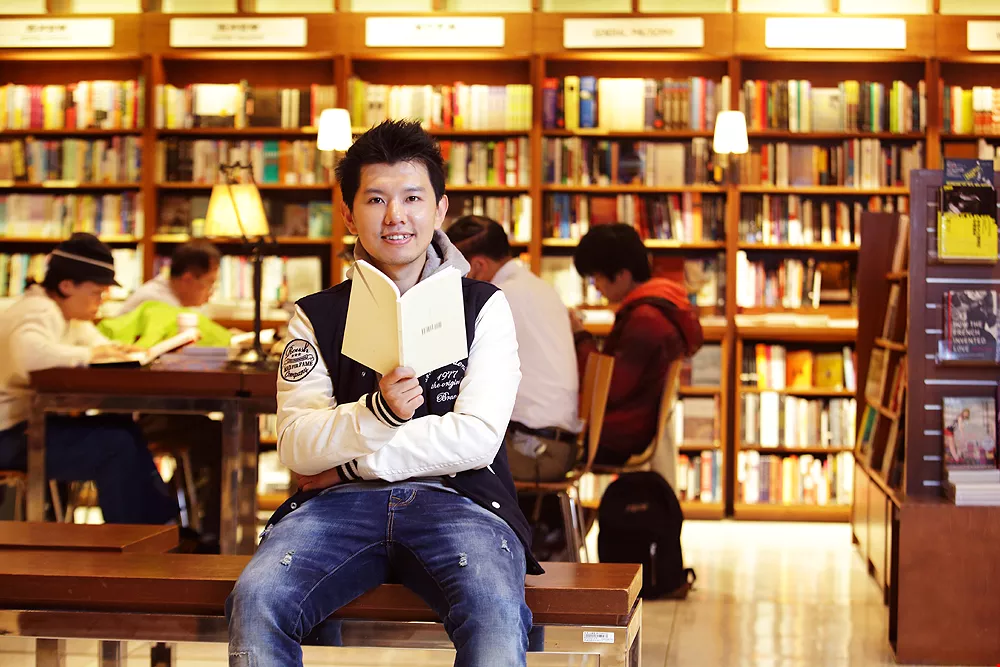
When Sharky Chen founded CommaBooks at age 30, it helped reignite interest in modern poetry. His account of the founding of his enterprise, released at the end of 2012, resonated well with readers and was specially recommended by Eslite Books (facing page).

Dostoyevsky’s Notes from the Underground is the latest translation to come from VS Press.

@List.jpg?w=522&h=410&mode=crop&format=webp&quality=80)


@List.jpg?w=522&h=410&mode=crop&format=webp&quality=80)
@List.jpg?w=522&h=410&mode=crop&format=webp&quality=80)
