The Remaking of Linpien Home of the Black Pearl Wax Apple
Teng Sue-feng / photos Jimmy Lin / tr. by Christopher MacDonald
February 2001


Even if the township of Linpien doesn't have a monopoly on the cultivation of "black pearl" wax apples, it was orchards in the Linpien locality that earned black pearls their national renown. A little town formerly notorious for its ground subsidence problem, Linpien is now turning itself into one of Southern Taiwan's premier tourist attractions. The impetus for this change has come chiefly from local historians, along with various voluntary groups.
Just before Christmas break, the rural township of Linpien, on the Pingtung Plain at the mouth of the Linpien river, held its first ever Wax Apple Festival. The festival, in the town's riverside park, was held to promote black pearl wax apples and celebrate the local volunteer spirit. It was a scorching hot day, and heavily perspiring visitors were to be seen wandering among the stalls, lugging bags of wax apples and commenting on their remarkable sweetness.
"There's a lot more than you'd think to growing wax apples," says local farmer Chen Sheng-tzung. "How you take care of the orchards, which equipment you use-it all has an affect on the shape and texture of the fruit." Prices for wax apples range widely, from around 3 pounds for NT$100 to NT$150 a pound. Fruit that shows a hint of black through the red color of the skin fetches the best price.
Huang Wan-fu, whose family farms two hectares of orchard with more than 700 wax apple trees, and who has over 30 years' experience as a fruit grower, says that while other parts of Pingtung County also grow wax apples, "Linpien stands out for its growing techniques, developed through trial and error by the growers themselves, and for vernalization rates of up to 90%."
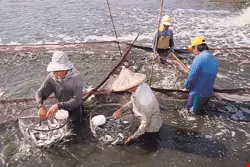
Aquaculture provides for full nets and full bellies, but it is also the culprit behind Linpien's severe subsidence problem. The acreage of fish farms has halved in recent years, due to the combination of falling profits and environmental degradation.
Ugly duckling no more
The wax apple is a tropical fruit originating from the Malay peninsula. The Dutch brought it to Taiwan from Java, in the 17th century, and it became commonly grown as a shade-giving tree.
Old folk in the South remember when wax apples were "just something to munch on"-the kind of fruit that grew freely and that you could help yourself to. But wax apples have increased in value during the past 30 years, thanks to advances in the way that they are grown. For example, the "bag-wrap" method was originally a way of protecting budding fruit from birds, but once it was introduced to Linpien, in around 1994, farmers found it enabled them to grow more lustrous, shiny-looking wax apples, with less pesticide on the skin. The method soon caught on throughout the district.
Another popular technique involves covering the trees with black mosquito nets to improve yields. This reduces the amount of sunlight reaching the trees, causing nutrients from the leaves and branches to be diverted into producing fruit. The net-covered trees blossom earlier and produce more fruit. As a result of this technique, black pearl wax apples are now available throughout most of the year.
The "black pearl" tag didn't originate in Linpien, but it was Linpien wax apples that made the variety famous and prompted the dramatic growth of its market. In 1983 the then-provincial governor Lee Teng-hui visited the town and praised the quality of its black pearl wax apples, so assuring the renown of the fruit. Subsequently, as president, Lee Teng-hui often gave gifts of black pearl wax apples to foreign dignitaries.

The river is blessed with fine scenery, and is good for fishing and birdwatching. Linpien residents see this as an important asset for attracting tourism.
Green hills
The success of black pearl wax apples gave Linpien a much-needed boost, bringing some of the younger generation back to the area to grow the fruit. The credit for putting wax apples at the heart of the town's revival and for mounting the Wax Apple Festival belongs with a group of volunteer workers-local people committed to the town's regeneration.
How does a small town like Linpien come to be home to such a well-organized volunteer effort, and just how did the volunteers set about giving their town a make-over? The story begins with the town's riverside park.
The road linking the town's main street with the riverside park, where locals like to stroll and chat at the beginning and end of the day, used to be overgrown and lined with trash. Now, however, thanks to a coordinated effort involving volunteers, residents and landlords, the verges are planted with sunflowers and lantana, while a former mud patch, donated rent-free by its owner, has been converted into a carp-filled lotus pool.
The revamping of Linpien started eight or nine years ago, when schoolteacher Tsao Chi-hung-now a DPP deputy in the national legislature-along with fellow members of the Linpien Residents' Democracy Association launched a program to sweep the streets and keep the riverbank clean.
Wu Wu-ta, a plumber who runs the Democracy Association, says: "People were already doing their bit for the community over ten years ago, but not openly. They swept the streets before dawn because they didn't want people to see them and call them crazy." It was only three years ago, with the founding of the non-political Linpien Natural History Conservation Association, that residents began to publicly support the project.
The flood-prone Linpien River has been dyked and dredged since the Japanese colonial era, but the bare concrete embankments never did much for the scenery. In 1999 Tsao Chi-hung learned that the Water Conservancy Bureau was planning to renovate the flood defenses, and he proposed a scheme for "greenification" of the riverside area. Objections were raised, however, with some pointing out that the site, if left untended, could easily get overgrown and become a breeding ground for snakes and vermin. The issue was discussed and finally the Bureau agreed to let volunteers maintain the riverside area for two years. If the scheme didn't work out then the Bureau would concrete over the site as originally planned.
Following the lead of the conservation association and the Democracy Association, various volunteer groups in the district-including the senior citizens' club, members of Tzu Chi Buddhist Foundation, the Presbyterian Church, and followers of the I-Kuan Tao sect-signed up to share responsibility for the riverside park, which was divided into 90-meter-long plots for the purpose. Turf was laid, flower beds appeared, and the embankment soon became a 1.2 km-long "green Great Wall."
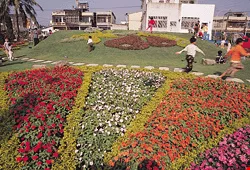
The gardens of the riverside park, laid out and maintained by local volunteers, cover land that used to be overgrown and strewn with rubbish. The people of the town now come here to stroll and enjoy their free time.
Dreaming by the river
"You can't go about community work in a standoffish way, and you certainly can't operate effectively from behind the scenes-you have to be out there at the front of things. When local people see teachers and doctors coming out to collect trash, they feel encouraged to join in," says Chen Chin-chao, a dentist who chairs the Linpien Natural History Conservation Association. Chen frets about the way the media has focused the spotlight on him alone, when numerous other individuals are also involved, all chipping in what they can.
"The biggest achievement is that the flowers haven't been stolen," says Tsao Chi-hung. "As more people volunteer to help, disruptive behavior becomes less and less likely." The riverside area used to be a teenage hangout, known for its drinking and fighting, but since greenification the town's residents have been coming here to stroll and enjoy the scenery: green hills to the East, the sunset in the West, and the dreamy river alongside the park.
"The more that people get involved the greater their sense of accomplishment," says Tsao. "It's not just about tidying up the environment. We also hope to foster the commercial interests of the community so as to bring practical benefits for people's lives." This was the thinking behind Tsao's gathering together of various groups for the Wax Apple Festival.
According to the archives, 400 years ago Linpien was a plains-aborigine settlement called "Fang-suo-she." In the middle of the 17th century the Ming dynasty loyalist Zheng Chenggong (also known as Koxinga) brought an influx of settlers to Taiwan from the Fujian and Guangdong regions of China. Some of the Fang-suo-she aborigines stayed and intermarried with Chinese, while others moved away. The oldest recorded use of the name "Linpien" is on a stele, erected in 1762, next to the town's Sanshan King Temple. The name, which means "beside the forest," indicates that the early settlers must have had a tough time clearing land for their crops.
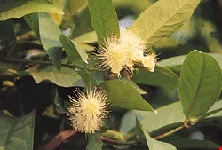
Using special growing techniques, the farmers of Linpien control the quantity of blossoms on the trees so as to optimize the production of their treasured black pearl wax apples.
Moving to center-stage
In the past half century or more Linpien has concentrated on a series of different forms of produce, from rice, to bananas, to prawn and eel farming, to wax apples-today's main crop. With Taiwan's imminent accession to the WTO, the next big change could be just around the corner. For example, will wax apples lose their market to imported fruit? And what does Linpien have to offer that other districts in the county can't easily duplicate?
Yang Hung-jen, a PhD student at National Taiwan University's Graduate Institute of Sociology, came to Linpien a year ago to research his thesis on the renewal of the local community. "I had come to what was said to be the worst county in Taiwan for factionalism and corruption," says Yang, "a place where the ground had sunk as much as three meters due to subsidence. But the contrast between that image and what I actually found here was quite something." For Yang, the way that those most active in the renewal effort routinely pass the credit to others is itself impressive.
Linpien rose to prominence on the strength of its celebrated wax apples. But can it now push its way to center-stage as a tourist attraction?
Says Chen Chin-chao: "We can't yet say how things will turn out for Linpien. But that's not to be pessimistic about the town's prospects; it's simply a case of not building castles in the air."
Development of the long-promised Tapeng Bay Scenic Area is due to begin, and in 2003 the 2nd Southern Freeway will open. Will this bring more prosperity to the area? Construction of a bypass around the town has already boosted property values, but what other benefits may it bring? A golf course is mooted, but will that mean the loss of birdwatching zones and the mangrove woods? Can the wax apple orchards be adapted to serve as a setting for family outings? And can fish farms in the locality be converted to provide housing and accommodation, and a recreation alternative for visitors? Can this little town make an asset of its scenic location and historical roots to attract more visitors?
Linpien used to be little more than a brief stop for travelers on their way to the seaside resort of Kenting, but now its residents are wondering if they can turn the town into a destination in its own right.

Subsidence has been caused by the over-extraction of ground-water for aquaculture. Some of the houses on the Linpien-Chiatung coastal strip have sunk to the degree that their windows are level with the street and their rooves are within easy reach.
Linpien Facts and Figures
Linpien Rural Township is in Pingtung County, located on the Pingtung Plain at the mouth of the Linpien River. It is adjacent to the planned Tapeng Bay Scenic Area, and marks the point where the 2nd Southern Freeway will terminate. At 15.6 sq. km in area, it is the second smallest of Pingtung County's 33 townships, and has a population of around 23,000. Wax apples and aquaculture products are the main commodities, with betel nut and coconut also grown. One-third of the township's land is below sea level. Visitors are recommended to try the local seafood and also not to miss the opportunity for bird-watching among the nearby estuaries, wetlands and mangrove woods. There are also cultural relics including traces of the original plains-aborigine inhabitants. Linpien can be reached along Provincial Highway 17. The town has a railway station and can also be accessed by public and private bus services. For more information check out: www.taconet.com.tw/cstudio/


@List.jpg?w=522&h=410&mode=crop&format=webp&quality=80)


