

Taiwan is home to one-twelfth of the world's species of plants and animals, many of them native to no other place on earth. This month our series on "The Rare Plants and Animals of Taiwan" presents Lophura Swinhoii, or Swinhoe's blue pheasant.
If you want to see Swinhoe's blue pheasant in the wild you have to exercise a little patience, because it has a quiet, refined, and intelligent character.
It won't reveal its whereabouts like many smaller birds which chatter away all day as if afraid people otherwise would overlook their existence.
Swinhoe's blue pheasant hides in the depths of primitive broad-leaved forests 2,000 to 2,500 meters high during the day and searches for food along paths in the deep woods only at dawn or dusk. When it finds tender grass or insects in the underbrush, instead of pecking about and gobbling them down, it spreads open the overgrowth with careful and practiced footwork, elegantly bends over, and enjoys its fine cuisine in style.
Its refined movements make it almost soundless when pacing through the forest. "Even if it goes over dried branches or fallen leaves it doesn't make a sound," says Hsieh Hsiao-t'ung, an ornithologist who recalls how he almost missed his chance to see one walking through the forest.
The reason why Swinhoe's blue pheasant is so good at protecting itself is related to its belonging to the Phasianus or pheasant genus. The greatest difference between pheasants and other birds is that they live on the ground.
In order to deal with the dangers that lurk all about them on the ground, pheasants have evolved a "high level of vigilance and are accustomed to concealing themselves," explains Wild Birds, a book published by the U.S. Audubon Society.
"In contradiction, although they like to hide themselves, their body colors are extraordinarily bright and attention getting," the book goes on, pointing out that the males are especially colorful. The male peacock is an example.
And Swinhoe's blue pheasant is no exception.
The male measures about two meters from head to tail and stands about thirty centimeters high. It has a black body that looks like a velvet overcoat with a beautiful border that flashes a rainbow of colors. Its face and legs are bright red, and its white crown adds even more distinction. A pair of white tail feathers about forty centimeters long were once a prized trophy for many aboriginal hunters who used to use them as head ornaments.
The female is smaller than the male and far inferior in color. Except for its head and feet, which are red, its whole body is brown and covered with hazel colored "V" markings.
That the female is not as colorful as the male is a common characteristic of nearly all pheasants. The reason for the difference, an ornithologist says, is "that showing off to the female is an important duty for the male." He explains that pheasants are generally polygamous in nature, and so the males must be rather outstanding in appearance to compete in attracting a harem.
The mating season for Swinhoe's blue pheasant runs from March to July. The male will first dig out a shallow hole in the ground and make a nest in it with twigs and dry leaves. After mating, the female returns at once to the nest to wait and lay her eggs, while the male runs off to attract another mate. The chicks hatch in about 25 days and are cared for entirely by the mother.
Taiwan has around 400 recorded species of birds, sixteen of them unique to the island. The largest in size and the most spectacular are Swinhoe's blue pheasant and the mikado pheasant.
Swinhoe's blue pheasant lives at lower altitudes than the mikado pheasant and was first spotted by Robert Swinhoe when he came to Taiwan in the mid-nineteenth century. Astonished at its beauty, he brought a specimen back to England, where this large and lovely pheasant became the first species of wildlife unique to Taiwan to become known to Westerners.
Owing in part to its international renown, Swinhoe's blue pheasant was listed in 1962 as an endangered species deserving special protection by the International Union for Conservation of Nature and Natural Resources. Nonetheless, the pheasant's ability to survive is very strong. Because it walks more than it flies, its legs are more highly developed than those of other birds, and it can run away quickly when it meets up with an enemy. Nor has it entirely lost its ability to fly. Yao Chung-chih, head of the ornithological division at the Taipei Municipal Zoo, says that Swinhoe's blue pheasant, in a pinch, can fly from one hilltop to another at one go.
In fact, Swinhoe's blue pheasant is one of the wild animals most often subject to artificial propagation in the R.O.C. and a popular feature in zoos. But Hsieh Hsiao-t'ung has another concern. Animals bred in captivity are inferior to those born in the wild, he has pointed out, and if people hope to propagate the birds artificially and then release them in the wild, they will only harm the quality of the wild breeds and further spoil the environment.
Another conservationist believes that Hsieh's experience of spending a whole day trudging through the mountains and forest wilds to sight a single bird and then not daring to move for fear of frightening it away is a good lesson for modern man in how to get along with nature and treasure our wilderness.
What's more, raising an animal in a cage at home or going to see one at the zoo "can't compare with the education you get when you make yourself a part of nature like the birds themselves," she says.
[Picture Caption]
(illustration by Lin Yu-shan/courtesy of CCPD)
The colorful Swinhoe's blue pheasant: shown is a male.
The female is covered with "V" markings.
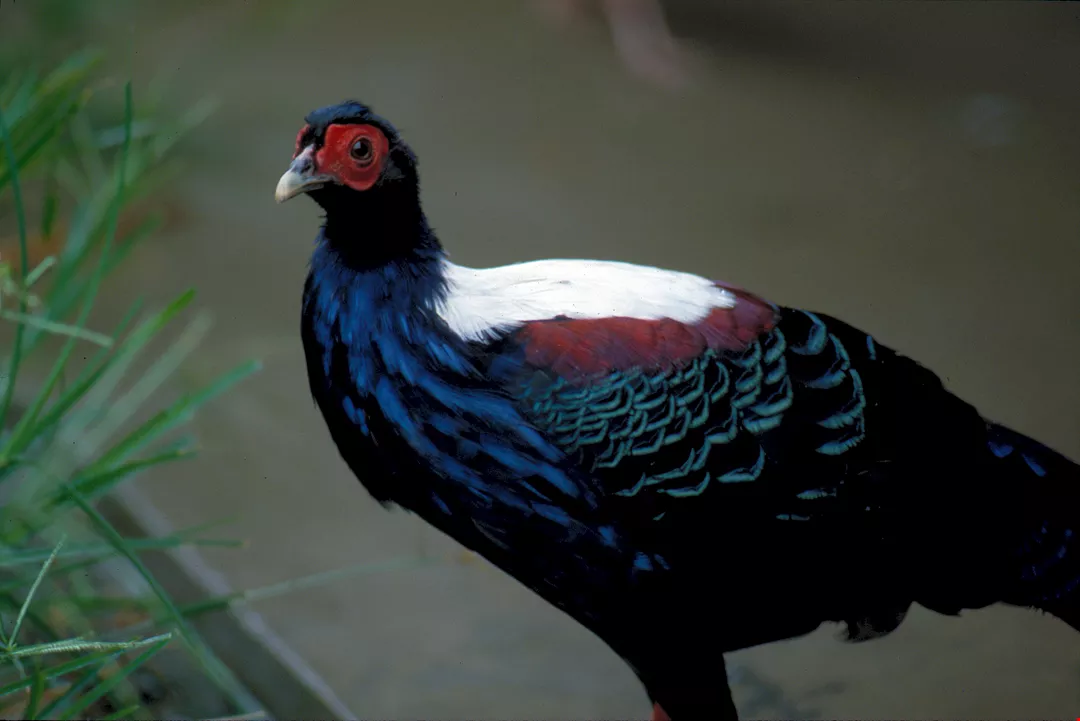
The colorful Swinhoe's blue pheasant: shown is a male.
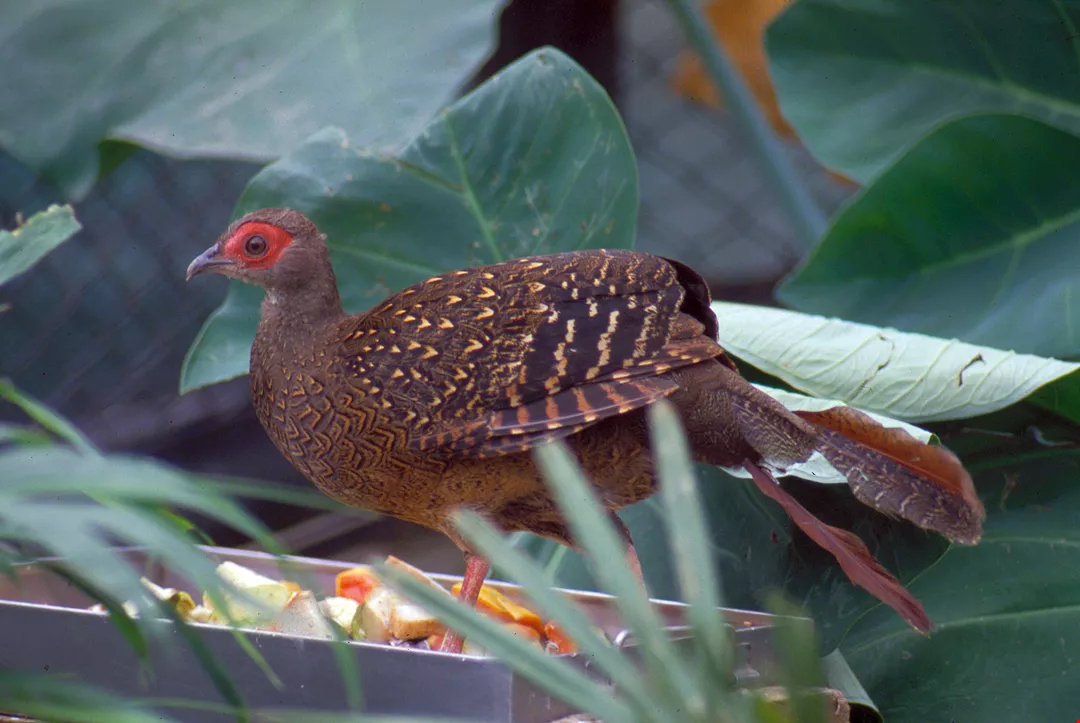
The female is covered with "V" markings.


@List.jpg?w=522&h=410&mode=crop&format=webp&quality=80)


