Clean and Green: Housekeeping for Profit and Social Good
Chen Hsin-yi / photos Chuang Kung-ju / tr. by Phil Newell
May 2011


In the past, people whose job was to go to strangers' homes and help clean house probably preferred not to mention it, or were seen as too incompetent to get any better job, and there was certainly no kind of overarching organization or management. But 11 years ago the Peng Wan-Ru Foundation took the lead in systematizing the business of housekeeping services, and the result today is that they not only have the -lion's share of the market, but have made it so that "home management" has become a profession protected by labor laws and enjoying a reasonable wage (NT$250 per hour). The foundation's definitions of types of housekeeping work-such as sweeping and cleaning, washing and ironing, putting things into storage, food preparation, shopping, childcare, companionship for the elderly, and so on-have been widely adopted in the industry.
How did the Peng Wan-Ru Foundation, a non-profit organization dedicated to supporting the independence of women, get started with this program that incorporates employment services, welfare benefits, and poverty relief? What kinds of connections have been built up, and how have people's lives been touched, through this program?
It is Sunday evening, and 46-year-old Fan Hehua is, as always, punctually heading out just before 9:00 to put the garbage bags that she carries-with the trash and recyclables in separate bags-into the dumpsters. Then she returns to the house for a final check: Have all traces of water been wiped out of the sinks in the kitchen and bathroom? Have all the cleaned items been returned to their proper locations? Have the plants and flowers in the window planters been watered? Only then does she take the NT$1000 bill the home owner has left on the tea caddy and put it into her oversized bag (with an apron, cleaning tools, and the music player that she loves to listen to whenever she works alone). Finally she turns out the lights, locks the door, and says a smiling goodnight to the apartment building doorman at the front desk before she walks off into the night.
Fan, who has a bright smile and a quick mind, used to run a hardware store with her husband. When her two girls entered primary school, she started to go out of the home to work. Eight years ago, looking for higher-paying employment, she came from southern Taiwan to Taipei to work as a 24-hour live-in caregiver. Although the salary was indeed higher than what she had been making before, she still had to rely on money borrowed from a mutual lending association to cover her daughters' education expenses, and she had to sacrifice the chance to spend time with her girls as they grew up. On top of that, several years ago her husband was compelled to stop working for a while because of a spinal injury.
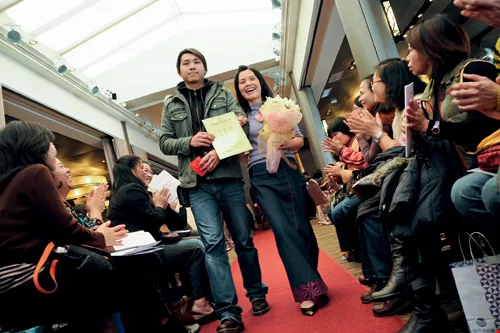
Every year there is a touching awards ceremony for the best housekeepers, at which winners receive congratulations and accolades from friends and family.
Around that time, she just happened to see an article in the paper about how the Peng Wan-Ru Foundation was training "home managers." She signed up and attended the introductory meeting, and decided that this kind of job, with a stable income, flexible hours, and the chance to stay home with her family, was a better option for her. With confidence and determination, she sailed though the interview, the training, and the match-up and contract signing process. Since then, thanks to word-of-mouth among employers, she has become one of the "super-housekeepers" whose schedules are constantly filled.
Fan, who this year finally cleared her debts and began to save money, is happily planning to take the whole family on a vacation to Bali next year when her eldest daughter graduates from university. She also plans to cut back on the number of hours she works to avoid damaging her health through overwork.
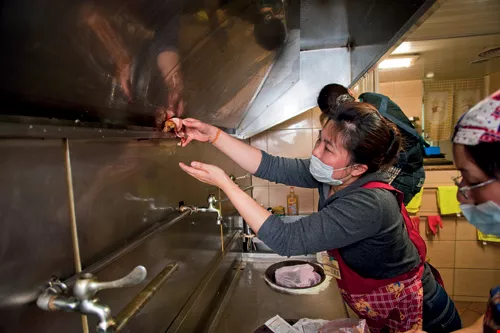
In training class, the supervisor (first at left in the picture on the left) requires each student to repeatedly do each task with attention to detail; strict training methods are the key to a reputable brand name. The training site was borrowed from a church in Taipei City.
Unlike for-profit cleaning firms, which focus their attention on the market for office buildings or moving house, the Peng Wan-Ru Foundation has always put home services front and center. This is connected to the foundation's ideals and practices of "making home responsibilities a public concern" and organizing collective solutions to contemporary home problems.
Since its creation in 1997, the foundation has devised a number of community-based welfare and service programs, including community baby-sitting systems, self-governing community preschools, after-school care for primary-school children, home management services, and home care support networks. Of these, the home management services program has grown the fastest and provides the largest number of jobs, and is now the core around which the whole community care system revolves. It has not only helped many women find work, it has allowed the foundation to develop a model to become financially self-supporting.
The number of people within the foundation's support system for housekeepers has reached about 2000 per year. (Half of these are in northern Taiwan.) Total wages and salaries have surpassed NT$900 million, for average monthly earnings of NT$28,000 per person. (The average for northern Taiwan, where the cost of living is higher, is NT$32,000.) The average age of these housekeepers is between 40 and 50, and most have at most a high-school education. Even more importantly, nearly half are either single mothers or the main source of income for their households.
Faced with this group of "disadvantaged women," the foundation's selection process and training methods are "famous for their strictness."
Wang Huei-chu, the executive director of the Peng Wan-Ru Foundation, states that the main objective in the training for housekeepers is to help women become independent, but clients are most interested in the quality of the services they receive, so the foundation won't pull any punches just because the women are disadvantaged. On the contrary, right from the start the foundation forces everyone to look reality right in the face and evaluate their own job skills and employment possibilities, in order to minimize unrealistic expectations. Only in this way can the foundation "use the limited resources we have on the right people."
But how do you pick out the "right" people?
First, during introductory meetings for the program, the lecturers will explain how the courses are arranged and the rules governing future employment, while emphasizing: Today more and more clients are requesting that their housekeeper be able to prepare dinner; therefore cooking is an essential skill, and at the very least you have to be able to stay on the job until 7 or 8 p.m. During training, arriving late or leaving early are prohibited, because this behavior reflects on a person's ability to be punctual and keep promises. For people who have weak constitutions or are suffering from an illness, the foundation suggests that they see a physician and look after their health first, and only rejoin the program after they have fully recovered.
Following statements of this kind, people who can sense that they are not going to fit in will leave of their own accord. For those who remain, besides filling out a form disclosing basic information, the most important thing is the one-on-one interview. Some people burst into tears as soon as they open their mouths, pouring out their painful pasts and their feelings of uncertainty about the future; some want to work but wonder whether they can put their pride aside and "lower themselves" to housekeeping; others can't understand the rules and want to ask a lot of questions. At times like these the interviewer will do whatever she can to clarify issues, and will provide encouragement and support when necessary.
The emphasis in training is not -merely to teach technical skills, but also to allow the foundation to observe people's personalities under real-life kinds of circumstances. "Housekeeping involves entering another person's private space, so the most important thing is integrity, followed by attention to detail," notes senior supervisor Zhao Cuijun.

Women should step up and help other women! With the help of the Peng Wan-Ru Foundation, 2000 women in Taiwan have lifted themselves out of poverty to become professional home managers, while 7000 households requiring efficient housekeepers with integrity have found just what they need. The photo shows customer service personnel at the foundation.
In contrast to government training programs, the Peng Wan-Ru Foundation authentically combines training and employment, and takes the burden of "sustainable employment" on its shoulders. Not only does a representative of the foundation accompany each house-keeper to the client's home for the signing of the standardized contract in order to protect the rights and interests of both parties, but the foundation also offers free "advanced courses," on-the-job training, and organizational supervision, so that the quality of service constantly rises. For clients' benefit the foundation has also established a client service center and a mechanism for surveying how satisfied clients are with their house-keepers, in order to make sure that the organization stays aware of and meets the needs of customers.
Moreover, recognizing that the employment model for home management is one in which the worker has no single employer, since 2004 the foundation has required all those who want to work within its system to participate in the "Community Care Service Workers Employment Association," set up through the foundation, so that the housekeepers can enjoy labor insurance and health insurance.
How is the foundation able to provide such stellar service to both housekeepers and clients? Besides the high motivation to help society that underlies the very existence of this organization, the foundation also benefits from a self-supporting "mutual-aid contribution system."
On one hand, housekeepers have to deliver a mutual-aid contribution of NT$3500-4000 per year, which goes toward on-the-job training, employment matchmaking services, and supervision. This money also covers the premiums for the accident insurance that the foundation has taken out to protect both clients (who will be reimbursed if the housekeeper does any damage) and housekeepers (who would be financially devastated by having to pay for damage themselves).
On the other hand, when signing the contract, employers must agree to donate a certain amount of money to the foundation each month, calculated according to a sliding scale that takes into account how many hours of service and what kinds of service are provided (for example, a client who gets four hours of home cleaning each week would pay NT$400 per month). This money goes toward the foundation's operations and allows it to sustainably engage in social research and come up with new ideas to help people.
Some voices have been heard, how-ever, accusing the foundation of "fattening itself" off the housekeepers. Wang Huei-chu responds that the training alone, for which the foundation charges tuition of NT$3,500-3,800, would cost NT$20,000 at market prices. As far as the clients are concerned, they are able to get well-trained and well-screened housekeepers only because of the donations made to the foundation by others in the past. Secondly, the overall community care system involves not only housekeeping, but training for and management of other programs such as care for the elderly or babysitting for women who have re-cently given birth. Such activities have to be completely written off as losses, but the foundation believes they are still worth doing, especially when you keep in mind that today's home management clients may well become these programs' future beneficiaries.
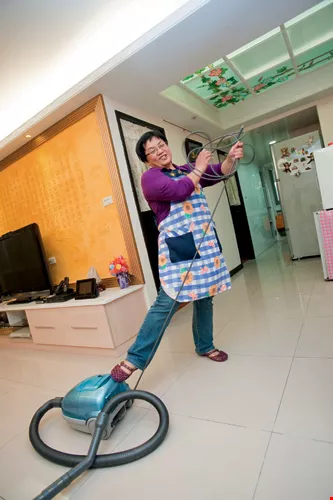
Home manager Fan Hehua says, "Housekeeping requires attention to detail, physical endurance, punctuality, time management, and self-discipline, and gives a real sense of satisfaction for a job well done."
One can't help but feel curious about one question: Housekeepers go deep into other people's private space, and are themselves marked as a "disadvantaged group." Have they run into any "employers from hell"?
Fan Hehua, who has been in this line of work for six years now, doesn't hide the fact that when chatting with her colleagues, it is certainly the case that some will air complaints about how picky the clients are. For example, one person was annoyed when, on her first day, her employer insisted that "the bathroom is only really clean if you scrub it three times." Fan herself once worked for a husband and wife, retired from the civil service, of whom the husband would sit on a stool next to her the whole time to "supervise" her work. That's not what really bothered her though. What really was hard for her to take was the fact that they prohibited her from using any hot water and insisted she "get down on my knees to wipe the floor."
Fan explains that greasy dirt can only be cleaned away with hot water, while frequent kneeling leads to orthopedic problems (the foundation recommends that housekeepers squat rather than get on their hands and knees). Nonetheless, thinking to herself that "it is not that easy for the foundation to get clients," she gritted her teeth through the discomfort until finally, four months later, she got a sharp warning signal from her knees. It turned out to be a case of bone spurs, and she had to take medications and time off from work. Only then did she pour out her troubles to her case supervisor, and the foundation, after careful consideration, decided to stop assigning her to that client.
Wang Huei-chu explains that the principle followed by the foundation for dealing with customer complaints is that the employer, provider, and foundation should all be of equal status, rather than "the customer is always right." For example, if the client is dissatisfied with the service, the supervisor will go to the workplace in person to adjudicate. If the housekeeper has been "way out of line," the supervisor will give her both a good talking to and an opportunity to improve. If the amount of work assigned by the client exceeds the ability or working hours of the housekeeper, then the supervisor will communicate this directly to the client.
Fortunately, the vast majority of the foundation's clients appreciate and are touched by the effort and attention to detail shown by their housekeepers. A school counselor and teacher named Cai -Shuli relates that her housekeeper was even able to apply at Cai's house what she had learned about home appliance maintenance in her advanced courses, and the two seem to have an innate understanding of what the other needs. Although during the global financial crisis a few years ago Cai thought for a time about "cutting out this expense," that thought was invariably defeated by the sense of pleasure and relaxation she got every time she arrived home to a place that was "just like new." Many employers even go so far as to give their housekeepers a duplicate set of keys to the home, or offer generous year-end bonuses. Actions like these are real morale boosters.

Women should step up and help other women! With the help of the Peng Wan-Ru Foundation, 2000 women in Taiwan have lifted themselves out of poverty to become professional home managers, while 7000 households requiring efficient housekeepers with integrity have found just what they need. The photo shows customer service personnel at the foundation.
The Peng Wan-Ru Foundation also differs from commercial profit-oriented cleaning firms in another crucial way: The women who meet at the foundation develop close mutual attachments, like sisters. There is nothing the home managers look forward to more each year than the chance to catch up with their colleagues at the foundation's annual award and year-end parties.
"The personal connections they make here are social resources for these women from the lower strata of society, and women who have been damaged find the mutual support and concern very therapeutic," explains Wang Huei-chu.
These "sisters" even develop their own spirit of sharing and obligation to help others. Many of the housekeepers feel so grateful for the foundation's help in finding work that they tell themselves, "I have to work hard and be self-disciplined. I mustn't ruin the reputation of the foundation, otherwise the women who come after me won't be able to keep on finding work."
Lucia Lu, executive director of the Begonia Foundation, who is considered the capo de tutti capi of social practice in Taiwan, lauds the Peng Wan-Ru Foundation for creating a situation in which everybody wins. They not only give strength to the weak, but solve the headache of home management for clients, and most importantly have built up a precious sense of public trust and interconnectedness. Even more rare is that, starting from the precondition of achieving a social objective, they have also generated economic value, becoming a prime example of an authentic "social enterprise."

Women should step up and help other women! With the help of the Peng Wan-Ru Foundation, 2000 women in Taiwan have lifted themselves out of poverty to become professional home managers, while 7000 households requiring efficient housekeepers with integrity have found just what they need. The photo shows customer service personnel at the foundation.
Some people think, dismissively, that the Peng Wan-Ru Foundation is "just a lot of women doing women's stuff." That's not the case here! Re-cently, two men have entered the ranks of the foundation's regular housekeepers. This earth-shattering innovation can be traced back to clients who have immobile elderly who need to be cared for, a job that requires more physical strength, so these clients specifically asked for male housekeepers. After considering what to do, the foundation decided to recruit some men from among the husbands, brothers, or sons of the women home managers. After the first group "comes online," considering that the pay is not bad at all (NT$48-52,000 for a 24-hour live-in caregiver, with six days off per month), it is expected that more men will come forward to join.
Why limit themselves to relatives of women housekeepers? "While we are still in the process of figuring out how best to manage and communicate with male housekeepers, the women-already part of the system-can encourage and support their husbands, although I have to admit that five men walked out of the introductory meeting because they thought housekeeping work was 'too humiliating'! Moreover, the men who are going through training are discovering that housework is by no means as simple as they thought, so when they go home they can ask their 'in-house tutor' to get them up to speed!"
So it turns out that a home management services system can also change gender relations back home! As the husband of one award-winning housekeeper said on the stage at the presentation ceremony, "My wife now specializes in looking after others, so my job is to specialize in looking after her!"
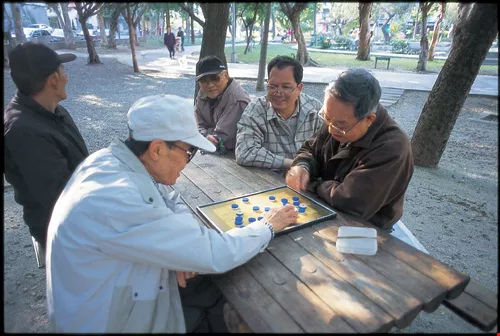
Facing the trends of a declining birth rate and a rapidly aging society, the Peng Wan-Ru Foundation has come up with proposals for community-based home care that could allow everyone the chance to work, have a family, and grow old with peace of mind. The left photo (courtesy of the Peng Wan-Ru Foundation) shows an after-school childcare class at Wanfang Elementary School in Taipei City.
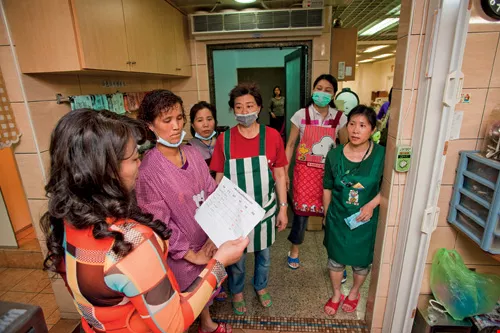
In training class, the supervisor (first at left in the picture on the left) requires each student to repeatedly do each task with attention to detail; strict training methods are the key to a reputable brand name. The training site was borrowed from a church in Taipei City.

Women should step up and help other women! With the help of the Peng Wan-Ru Foundation, 2000 women in Taiwan have lifted themselves out of poverty to become professional home managers, while 7000 households requiring efficient housekeepers with integrity have found just what they need. The photo shows customer service personnel at the foundation.
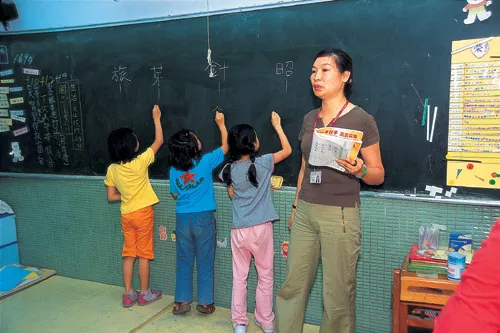
Facing the trends of a declining birth rate and a rapidly aging society, the Peng Wan-Ru Foundation has come up with proposals for community-based home care that could allow everyone the chance to work, have a family, and grow old with peace of mind. The left photo (courtesy of the Peng Wan-Ru Foundation) shows an after-school childcare class at Wanfang Elementary School in Taipei City.
@List.JPG?w=522&h=410&mode=crop&format=webp&quality=80)


