

Autumn 2014 is nearing its end in the town of Chishang. Paradise Road in its rural splendor sets the scene for the Autumn Harvest Concert.
It is November 1, and pop diva Chang Hui-mei, better known as “A-Mei,” has returned to her native Taitung County to perform in the “Songs of A-Mei’s Homeland” concert. The stage is set up in the middle of rice paddies, with a spectacular backdrop provided by the Central Mountain Range. A-Mei takes to the stage in the traditional garb of her Puyuma tribe, including a floral headdress that her own mother has made by hand, and belts out 15 songs in sweltering 35ºC heat. She calls out to the 2,000-strong crowd: “Thanks for this land. Thanks for this beautiful sky. And thank you all for coming here to be out in the sun!”
The land and sky of Taitung re-energize A-Mei, who has once again found the pure love of singing that she started out with. Meanwhile, seated on the grass listening to A-Mei is Hsu Lu, who recently left her post as chief executive of the Lovely Taiwan Foundation, and now stays on as an advisor. This moment brings her an odd sensation—A-Mei will soon head back to Taipei, but Hsu will not have far to go at all, for her home is right here in Taitung. Their life paths have crossed in opposite directions.
Taitung is not actually all that far away from Taipei, just three and a half hours by Puyuma Express, but when Hsu announced her intention to “emigrate” to Taitung while coming back to Taipei two days a week to look after her 90-year-old mother, friends in Taipei threw her one sendoff party after another as the moving date approached. There were some weeks when she had four farewell gatherings to go to. She came to realize that Taitung was quite far from Taipei after all. For most Taipei residents, trips down to Taitung come years apart. Places like Wulu Gorge, the Coastal Mountain Range, and the Puyuma Archaeological Site sound more exotic to Taipei denizens than a lot of overseas destinations.
Five years passed before Hsu’s first impulse to head south crystallized into a firm intention. Then another five years went by and a lot of careful thought took place before the dream became a reality.
In 1981, as a recent graduate of Tamkang University’s Department of English, Hsu joined with some friends in founding The Mother Earth magazine. It was her first job, and a considerable departure from the career path she originally had planned. Going abroad to get a degree in something like cultural studies or comparative literature had been on the horizon. Never the shrinking violet, however, she became acquainted as an undergraduate with several present and future notables, including Lee Yuan-chen (her teacher, and a veteran women’s rights activist who has recently published a memoir on her career as a feminist) and Wang Jin-ping (a noted social and political activist). And the campus folk musician Lee Shuang-tze also affected Hsu’s thinking with his famous call in the 1970s for everyone to “beat the drums loudly and make your voices heard.” All these factors steered Hsu toward the dangwai movement despite the fact that her parents were mainlanders, which was rather “ethnically incorrect” at that time. She was especially involved in the movement where it touched upon cultural and social issues.
And so she decided to stay in Taiwan and start up a magazine. Over the next couple of years, she and her cohorts turned out ten issues at irregular intervals. She descended into debt, and at age 24 had to accept a rescue by Antonio Chiang, who offered her a job as an editor at The Eighties, a magazine published by the dangwai movement. It was during her time at The Eighties that she spoke for the first time at a political rally. While everyone else on stage spoke in Taiwanese, she stood out as the lone person speaking Mandarin as she asked: “Why can’t our parents go back to their hometowns to see friends and family members they’ve been separated from for 40 years?”
1986 saw the official establishment of the Democratic Progressive Party. The following year, martial law came to an end. When the ban on new mass media publications was lifted, The Journalist weekly hit the scene with a huge splash, and Hsu was brought on board as general manager. To meet the challenge, she learned how to write a business plan, and how to read a balance sheet.
But Hsu left The Journalist after just three issues. Buried under a mountain of administrivia, she felt like she was just wasting her time, and longed to return to the front lines to focus and report on cultural and social issues. Friends arranged a job interview for her with the Independence Evening Post. During the interview, publisher Wu Feng-shan asked why she hadn’t stayed at The Journalist. She replied: “I want to find myself.”
The Post hired her, and on the long road to “find herself,” she and co-worker Lee Yung-te became the first two journalists from Taiwan to report from mainland China before the ROC government officially announced that citizens would be allowed to travel to the mainland to visit relatives. All of a sudden, she was being asked for interviews, and eventually the newspaper sent her at its expense to do nine months of research at Columbia University in New York as a visiting fellow. The idea was to brush up her skills enough to work as an overseas correspondent.
When the government issued its first batch of new broadcasting licenses in 1993, Hsu’s venturesome spirit got the best of her once again as she and several friends established Hit FM radio station. The new station was breaking even after just three months in business, and by the end of its first year had already earned back its NT$50 million in capital.
In 2000, the year when Taiwan experienced its first ever orderly handover of ruling power between political parties, “friend of the Democratic Progressive Party” Hsu Lu joined the Chinese Television System (CTS) as its vice president. Two years later she took over as company president. But why do such a thing? Was it to fight for the goal of reforming the media? Was it for the satisfaction of being a company president? Or did she simply need to work to fill the void left in her life by a year of voluntary unemployment after leaving Hit FM? Was she trying to get back her lost mojo? Hsu asked herself those very questions, and decided it was probably mostly the latter.
Four years later, upon resigning as president of CTS and walking out of the CTS headquarters building, she knew for sure that she was leaving the media and politics for good. This was her goodbye to time-wasting meetings, endless social commitments, annoying structural reforms, and mind-numbing financial statements. Goodbye, also, to high heels and the fancy designer labels in the armoire.
Indeed, the designer labels and high-powered job title inspired only melancholy, for Hsu couldn’t help thinking that the “self” she had once set out in search of, and the mojo she had been meaning to rebuild, had only gotten more and more distant over the years.
The day she left her job, good friend and renowned dancer Lo Man-fei picked her up by car, and the two went for a coffee.
Hsu suddenly announced: “I want to leave Taipei.” But she was only half certain about it. Lo simply nodded and said, “Okay!” She knew her friend well, and believed her. Two years later, Lo left the world peacefully after lung cancer spread to her brain.
Life is short, and can change in an instant. Hsu recalled the words that the veteran newsman Adam Chang had said to her from his sickbed: “Listen, kid, you’re not the iron lady type. Go do your own thing, and live for yourself.”
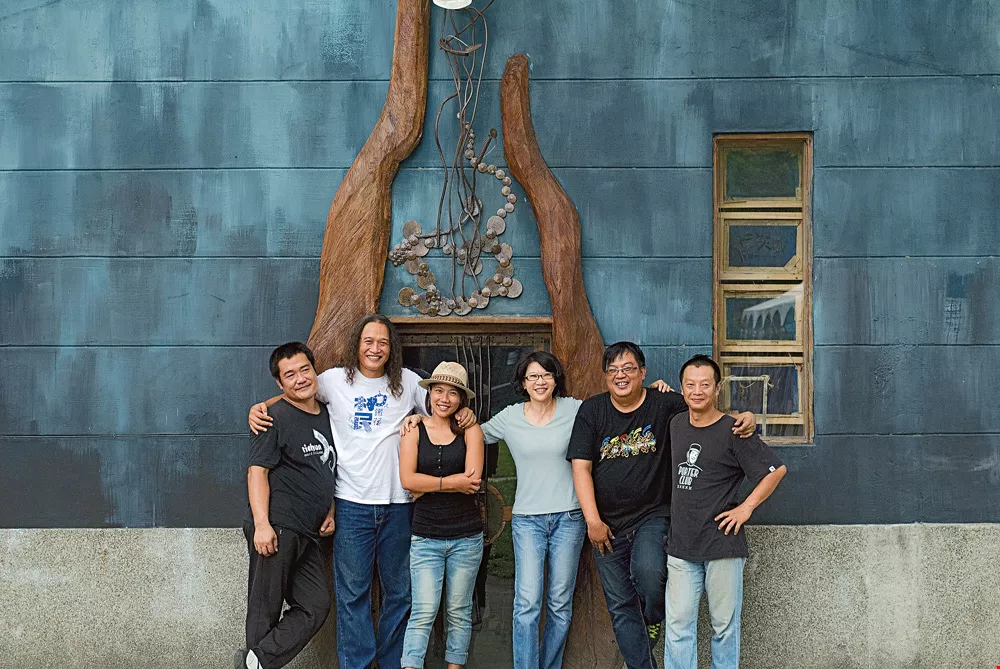
Hsu Lu took the post of chief executive of the Lovely Taiwan Foundation in order to use Taitung as a starting point for showcasing the beauty of Taiwan’s culture. Shown here is Hsu (center) and some of the high-spirited staffers at Tiehua Music Village.
Hsu has had to stare death in the face. Late one winter’s evening when she was 34, an intruder broke into her apartment, tied up her hands and feet, blindfolded and gagged her, took her money, and then kicked, stabbed, and raped her. At daybreak, she opened her eyes to blood all over the floor. In her addled state, however, she didn’t even feel the pain.
For the next six years, Hsu suppressed memory of the event. And for six years she tormented herself, attempting to bury the trauma by keeping herself twice as busy as ever. Fear still hit as darkness fell, but she toughed things out. Then one day a publisher asked her to write a book. She decided to write about her experience, and to look back more generally on the course of her life, including the men she had loved and the deaths of dearly beloved family members. Writing Survivor of the Dark Night was like opening up old scars to thoroughly clean the wounds. The book sent shock waves through Taiwanese society. But it would be more than 15 years before the publication of her second book, My Taitung Dream, in 2014.
She had been “up in the air” for a long time, but was soon to come down at last in a land of waving rice.
After leaving CTS television but before deciding what her next job would be, Hsu did a lot of traveling, punctuated by periods spent keeping company with her friend Lo Man-fei, who by that time was battling cancer. It was the first time she had ever traveled just for the fun of it, rather than for study or work. Because of her travels, she read up on European history. And because of her travels, she sought out literary works from the countries where she went. In Portugal she read The Book of Disquiet and The History of the Siege of Lisbon, in Turkey she tackled My Name Is Red, and so on. Suddenly, literature was making its way back into her life. Her long-dormant cultural ideals and concern for the land were rekindled. So when Ho-Chen Tan asked her to come aboard at Chunghwa Telecom and help with the launch of the company’s multimedia-on-demand (MOD) service, she made a bold counteroffer: “How about I help you set up a foundation and do cultural things, instead?”
And just like that, Hsu became CEO of the Chunghwa Telecom Foundation in 2006. After she had been there three years working in support of cultural activities, Wen C. Ko, Taiwan’s “godfather of venture capital,” looked her up and briefed her on his plans to establish the Lovely Taiwan Foundation. As Hsu listened, a big smile broke across her face. What a strange thing life can be, she thought to herself—like a circle that, once started on the page, must eventually come back to where it began, or a boomerang that, once thrown, must return to the hand that threw it. She had started out 30 years before at The Mother Earth magazine combing through urban neighborhoods and rural villages to report on cultural and social issues, and here she was again, 30 years later, a key mover and shaker at the Lovely Taiwan Foundation, where the mission was, in the words of its chairman, Wen C. Ko, to “build a beautiful rural culture in Taiwan, so that residents and visitors alike can comfortably share in the life of rural communities and deeply feel the goodness of Taiwan.”
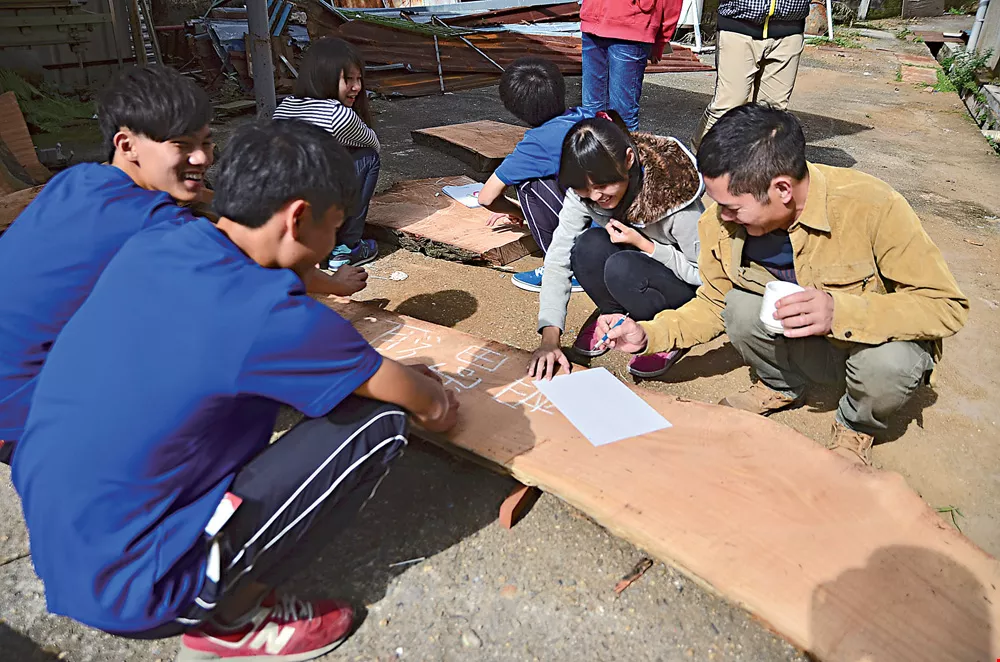
The Lovely Taiwan Foundation uses local talent, resources, and characteristics to create unlimited opportunities. Here, teacher Rahic Talif leads students from Kung-Tung Technical Senior High School leads students in designing driftwood furniture, which is displayed for sale at Tiehua Music Village.
It was the Lovely Taiwan Foundation that took Hsu to Taitung.
One morning in 2009, as she and some co-workers were tromping across Taiwan in search of beauty, they arrived in Chishang Township and gasped at a verdant landscape where the eye found nary a utility pole to mar the scene. Rice fields spread silently across the rift valley: “My god, it’s so incredibly beautiful!”
Beautiful, to be sure, but the inhabitants of Chishang lamented to the visitors that cultural assets never make it as far as Chishang, and the locals certainly don’t want their children to grow up in rural villages that have nothing but rice.
As she listened, Hsu mentally calculated the resources at her disposal, and decided to join forces with local residents and launch a joint undertaking of some sort. Over the past five years, this has turned into the standard modus operandi for the Lovely Taiwan Foundation, and they will continue to do things this way in the future. Now that the Taitung venture is up and running, each of the four seasons brings something new—the Spring Picnic Festival, the Summer Rice Banquet, the Autumn Harvest Concert, and finally the Winter Lectures Series. These activities bring the people of Chishang the benefits of cultural community development, while the cultural luminaries who take part—such as Xi Murong, Summer Lei, Lin Hwai-min, and Chiang Hsun—get their batteries recharged in Chishang, and fall in love with the place. Indeed, Lin Hwai-min was inspired to choreograph Cloud Gate Dance Theatre’s Rice, which premiered in Chishang. Also, the Lovely Taiwan Foundation helped put the people in touch who would go on to establish Tiehua Music Village, a very successful venue for musicians and artists housed in a former employees’ dormitory of the Taiwan Railways Administration.
Kaaluwan Village is another interesting story. For one thing, it is the hometown of Ara Kimbo, known as “the father of Taiwanese folk music,” and Bulareyaung Pagarlava, a world-renowned choreographer. After the village was devastated by Typhoon Morakot in 2009, the Lovely Taiwan Foundation held a musical fundraiser and a charity auction, and donated the entire NT$9 million in proceeds to the village. After that, volunteers came in for the long haul. They helped make bead ware for Bayi Workshop, and opened a local carpentry shop. And everyone in the entire village pitched in to break ground on a project to build a village square. Meanwhile, the foundation established the Lovely Taiwan Shop on a lane off Zhongshan North Road in Taipei to provide a retail outlet for goods from Taitung, be they culture-laden knick-knacks or handicraft items with a distinctly local character.
To be near her work, Hsu rented a little studio apartment in Taitung and spent her time traveling back and forth between there and Taipei. Life had become simpler. For clothes, jeans and a white button-down shirt were sufficient. For cosmetics, inexpensive off-the-shelf items did the trick. At the apartment, a bed and a desk took care of her needs. She began to dream of settling down for good in Taitung; all she would need was a car and a rental apartment with a kitchen. This “Taitung dream” was not a whimsical flight of fancy or a sudden dramatic shift in the direction of her life; to the contrary, it had emerged slowly out of her work and existing lifestyle. After a process of five years, one day she clearly realized that she could settle down in Taitung. So she set about writing My Taitung Dream.
What she most dreaded was that the media would oversimplify her move to Taitung as “leaving behind” her previous life. While it is true that some things were being left behind, it was not a total departure. At age 56, she decided to do something for Taitung, and for herself. But it was all a process, not a denouement. Life, after all, is not a movie.
Everyone goes through times of self-searching. Everyone has his or her own “Taitung dream.” Hsu has a theory: No matter how brilliantly a woman may shine by day, when night falls and the makeup comes off, the moment when she steps out of the shower alone is the moment when she knows herself best. This is when she understands, better than ever, whether she is happy or unhappy.
Hsu sees off A-Mei, and returns to her apartment. As the sun slowly sinks, indescribable feelings of satisfaction and peace of mind come over her. Never in her life has she liked herself so much, or been so close to herself.
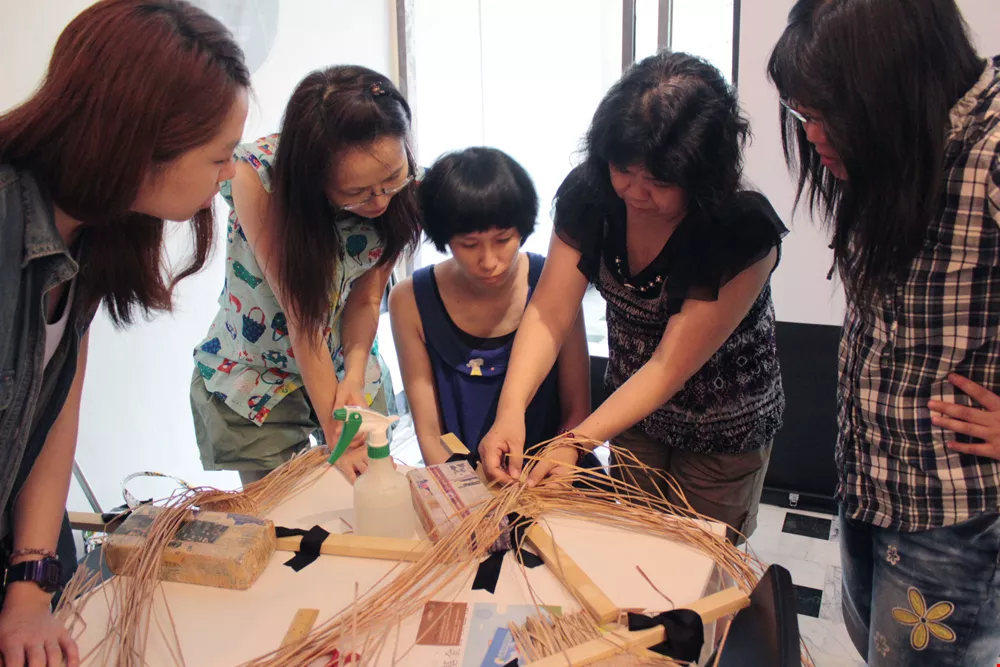
To save traditional handicraft skills that are in danger of passing into oblivion, the Lovely Taiwan Shop in Taipei holds an activity in which rush grass basketry is made using the traditional techniques of Miaoli County. The event gives city dwellers a chance to appreciate an amazing handicraft.
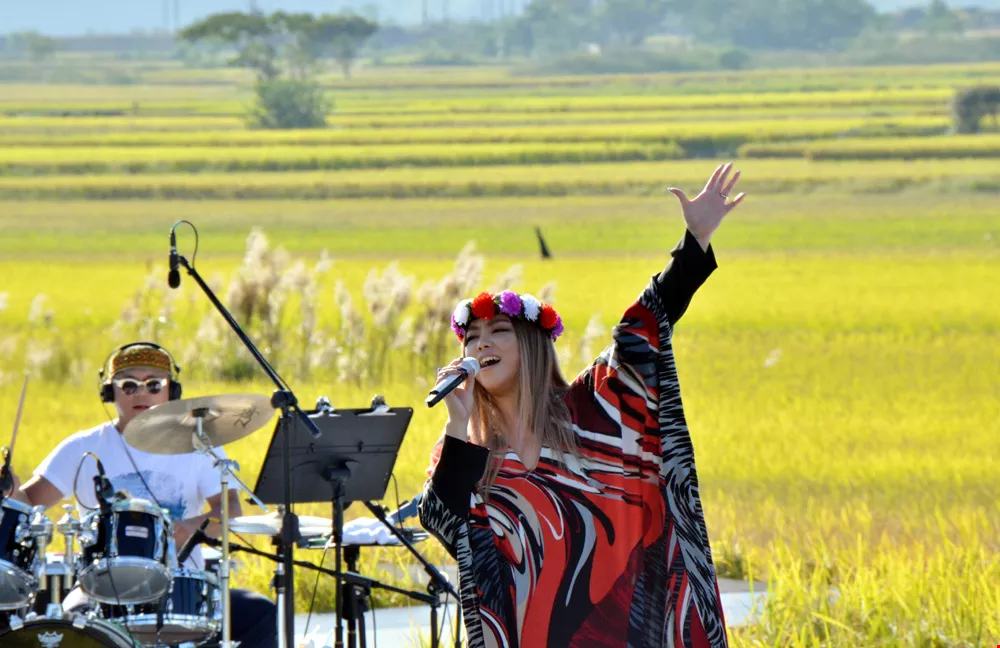
In a green valley at the foot of the seemingly endless Central Mountain Range, pop superstar A-Mei takes to the stage and rocks the crowd at her “Songs of A-Mei’s Homeland” concert.
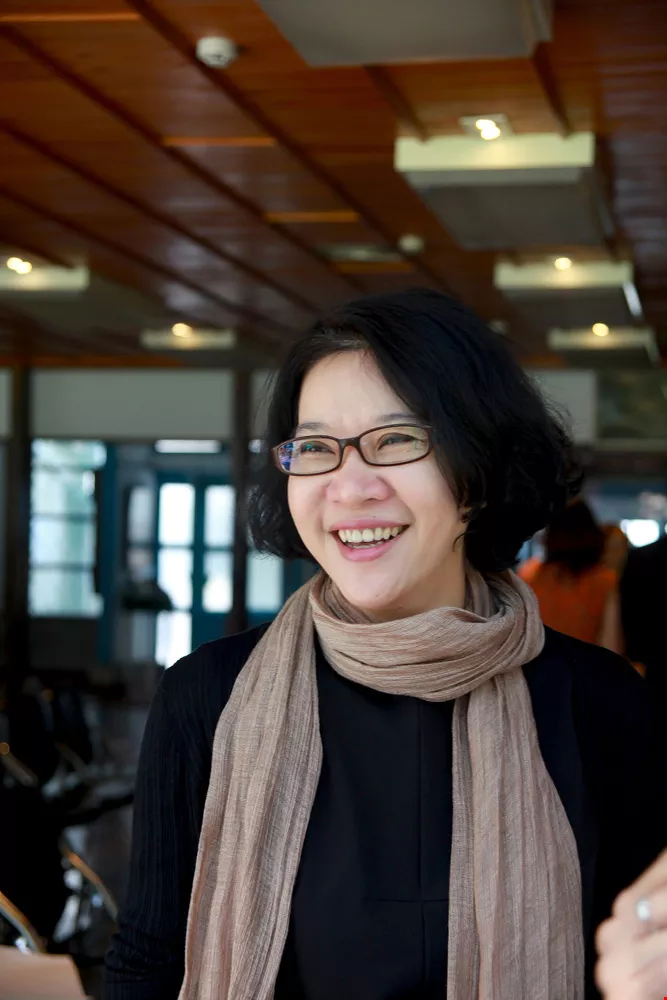
Throughout her career in the mass media, Hsu Lu was always tough yet gentle. She likes the life she has now, and likes her current self even more.


@List.jpg?w=522&h=410&mode=crop&format=webp&quality=80)


