Bringing Ships Safely to Shore—The Maritime Pilot
Kobe Chen / photos Chuang Kung-ju / tr. by Scott Gregory
August 2012


All motorists know how hard it is to squeeze a big car into a tiny parking spot in the city. Just imagine what it’s like trying to navigate a 100-meter, 10,000-ton ship through a busy port to dock. Complicating things further is the fact that every port’s layout is different. When ships from all over the world enter, one tiny mistake could lead to a disaster.
Maritime pilots are the indispensable mariners who guide ships through ports. What skills do they need to be able to fill this critical role?
A small boat cuts through the waves toward a ship 1.5 nautical miles outside Keelung Port in order to guide it to dock. This arriving “guest” is a cargo ship 224 meters in length and more than 60,000 tons in weight.
“Vessel Chaiming, please maintain your present course at 15 knots. This is Pilot Zheng, preparing to board.” By radio, Zheng Jiangshan begins guiding the ship even before he boards.
From such a small craft, the larger ship looks like a skyscraper rising up from the sea. Its wake rocks the pilot boat such that one can hardly stand up aboard it. After quite a while of jostling, the boat finally makes it to the ship’s side, and the ship’s crew let down a rope ladder 10 meters long. Zheng stands upon the gunwale, timing the motion of the waves. Then he leaps up and grabs hold of the ladder. In an instant, he is aboard the larger ship. The 60-year-old is in fine shape and could rival many younger men.

The entrance to Keelung Port looks narrow from the bridge of a container ship, and the line of sight is obstructed by stacked shipping containers. These factors test a pilot’s skills.
This is the most dangerous part of a maritime pilot’s job. When boarding a ship, one has to wait until the waves are at their highest and climb up in one go. A moment too slow and the smaller boat will ride up the top of the wave, catching the pilot between the two vessels. He’ll end up either with broken bones or, at worst, in the ocean.
A pilot earns his living through his experience, and most of them are not young. Taiwan’s maritime pilot law stipulates that potential pilots must have at least three years’ experience as captain of a 3,000-ton-class ship, or larger, before taking the licensing exam. That means that even a rookie pilot is an experienced sea captain.
Fang Xinxiong, head of the Keelung Port Maritime Pilots’ Office, says that experience as a captain not only proves a pilot’s ability in operating a ship. It also earns the respect of the boarded ships’ captains, which keeps the process of entering the port running smoothly.

A maritime pilot’s job is around the clock, and there are no holidays. Whenever a ship arrives or leaves port, it’s the pilot’s responsibility, and a typical pilot works more than a hundred times a year. A pilot encounters every kind of captain and crew, so issuing the right orders is a big challenge.
Fang says that, for the most part, the controls are the same for any ship. Whether the ship is a hundred years old or features the latest high tech, it comes down to controlling the speed and the direction. As long as you’ve mastered the basics, everything will go smoothly.
As an example of the differences, newer ships can usually move sideways under their own power, which allows for greater precision in maneuvering. This saves a lot of time when entering a port. If the side propulsion system is out of order, a tugboat must be called in to assist.
Older ships are more difficult. One example is the Sōya, a Japanese ship that has been used on adventurous trips to the Antarctic and has made a port call in Keelung Port. “You only see ships like this in books,” Fang says. “When you dock something like that, you get a real sense of accomplishment.” Modern ships have radar and GPS systems, he says, but an older ship like the Sōya has to be navigated by sight. The pilot has to rely on his memory to avoid hidden obstacles. He also has to interpret the direction of the tides in order to maintain the correct angle of approach and at the same time keep in contact with the tugboat so as to adjust the ship’s direction.
No matter whether the ship has to head forwards or backwards into the dock or whether it has to dock to the left or the right, an experienced pilot can offer up many ways to meet the demands of the shipping company, the captain, or the port. “Our goal is very simple,” Zheng says. “It’s to dock the ship safely in the shortest time possible.”
A pilot has to be ready for whatever the situation requires. In addition to learning from his own experience, at the very beginning he has to call a master pilot in. After passing the licensing exam, he has to apprentice at the port for three months, learning the tricks of the trade from an experienced pilot.
It’s not a one-to-one student-teacher relationship, though; a new pilot can learn under any experienced one.
The job of bringing ships into port demands precision and each tiny detail can have an effect, so a pilot must be very cautious and have several tricks on hand in order to meet any situation.
In a critical situation, a pilot needs to rely on his own knowledge and experience and also be able to cooperate with the ship’s crew. Some captains hold pilots in high regard and will accept any suggestions they make. In such cases, the work is much easier. But other captains have bigger egos. They believe their own skills are better than the pilot’s, and that the pilot should be subordinate to the captain.
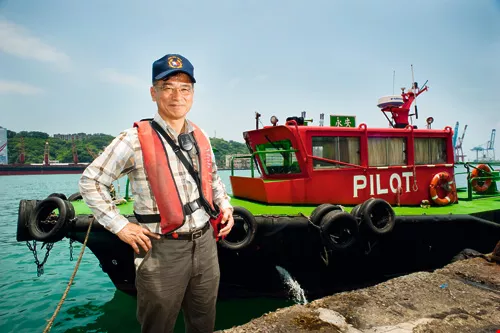
With the self-confidence that comes from experience, seasoned maritime pilot Zheng Jiangshan is ready to face any challenge at any time.
Maritime piloting is a rare occupation. They are paid roughly similarly to lawyers, on a case-by-case basis. The difference is that lawyers can choose their clients, but pilots do not have the right to refuse a case.
No matter whether there is bad weather or crashing waves, a pilot has to go fulfill his duty. Though it is forbidden to enter or exit the port during a typhoon, in the case of an accident a pilot still has to accompany the rescue team to bring in the damaged ship.
Farmers depend on nature for their livelihood. Pilots, on the other hand, battle nature for theirs. The direction and strength of the wind affects a ship’s speed and course, and in the case of Keelung Port, the winter brings strong northeasterly winds. Once these winds blew a docking ship away from the shore, and three tugboats could not pull it back. It ended up hitting another dock and being damaged.
On top of this, thick fog or heavy rain can affect visibility and make the job even more difficult. Wind and rain on a starless, moonless night is a pilot’s nightmare. Even an experienced pilot like Zheng has been knocked into the sea by waves while climbing the rope ladder to board a ship.
“When you fall into the ocean, the ship is moving forward so the flow of the water will pull you toward it,” Zheng says, a note of urgency in his voice. “If you don’t get away quickly, you’ll be mincemeat.” He’s a strong swimmer and very comfortable in the water, but a fall of many meters from the pilot’s ladder would have left him unconscious when he hit the water.
Pilots are needed when a ship leaves the port as well, and going down from the big ship to the pilot’s boat can be even more dangerous than boarding. This is especially the case at night, when visibility is low. It’s easy to slip and fall on the deck or into the ocean.

From a small boat, ships look like skyscrapers above the water. To board them, a pilot has to get his speed and timing just right.
A pilot’s pay is better than a captain’s, and because a pilot doesn’t have to go to sea, he can spend more time at home. That is why many captains have their sights set on the job.
However, the pilot’s exam is only held once every two years. The entry requirements are high, and the test is difficult. The competition consists of experienced captains, so it is not easy to shine out. There are currently 87 maritime pilots in Taiwan, enough to meet the demand of its ports. That means that even if you pass the test, you won’t necessarily find a position right away.
Moreover, since the hydrology and geography of each port is different, the pilot exam is localized and examinees have to choose a particular one. If they pass, they are only licensed for that individual port.
There is another reason for the localized exams: The payment system for pilots is very unique in that it is averaged across all of the pilots of the port. If the exam weren’t localized, everyone would choose the largest ports. Not only would that lower everyone’s income, it would also leave the smaller ports without pilots.
Also, each port’s pilot’s income is calculated according to the total cargo volume of the ships that have come in. For the most part, it is calculated at NT$1 for every ton the ship carries, so a 60,000-ton cargo ship would bring in NT$60,000 in pilot fees.
In recent years, the average volume of traffic at Taiwan’s ports has dropped, and that has affected the pilots’ income. The average monthly salary for the 16 pilots at Keelung Port, for example, works out to NT$200–300,000 after pooling. However, this is still far more than the average person’s salary.
Those interested in becoming maritime pilots are recommended to start as ordinary crew members, whose salary is on average NT$50–60,000 a month. The pay is good, and on top of that you can see the world.
“Life in the city is tough, and you hardly ever get to see a shooting star. At sea, you can see them every night—sometimes so many that you lose count,” says Zheng, encouraging young people to think out of the box and live a more adventurous life.
The maritime pilot’s job is an essential part of the world shipping system, and any mistake that led to a vessel being delayed could have ripple effects across the whole industry. Fang says, “Every job we get is a challenge that demands our complete attention. It’s hard work, but once the job is over and the captain shakes our hand and says thanks, we have a great sense of accomplishment.”
No matter how dark the night, or how strong the wind, a veteran maritime pilot is at the port, ready to take on whatever challenge may come.

@List.jpg?w=522&h=410&mode=crop&format=webp&quality=80)


@List.jpg?w=522&h=410&mode=crop&format=webp&quality=80)
@List.jpg?w=522&h=410&mode=crop&format=webp&quality=80)
