BOT Blues:Getting the Forest Railway Back on Track
Chang Chiung-fang / tr. by Phil Newell
August 2009


"The mountains are all BOT, the sea is all BOT. So what's left that really is ours?" This complaint from a character in the film Cape No. 7 is exactly the question that the people of Alishan would like to ask.
The contract for the "Alishan three-in-one BOT Project" was signed back in June of 2006, under the Chen Shui-bian administration. Management of the Alishan Forest Railway was formally transferred in June of 2008.
The management transferee, Hungtu Alishan, is a newcomer, and there have been all kinds of problems. Some say that Alishan has been "sold on the cheap," while some members of the Control Yuan think that the whole process has been slipshod. But the important questions are: Has the BOT idea been a boon for Alishan? Or a disaster? And what will happen now?
In March of 2003, as a result of human error, there was a derailment on the Alishan Forest Railway, causing 17 deaths and over 100 injuries. This lit the fuse for privatization of this railway, which was losing hundreds of millions of NT dollars per year for the Chiayi Forest District Office (a division of the Forestry Bureau of the Council of Agriculture in the central government).
However, the remote forest railway by itself found few suitors willing to invest. But after a suitably rich "dowry" was attached, it became a different story.
In June of 2006, the government held open bidding for a three-in-one BOT (build-operate-transfer) proposal. Only one company-Hungtu Alishan-bid, and they received the contract. The proposal covered development and operating rights for the 85 kilometers of the railway, 0.9 hectares of land where the Beimen Station in Chiayi originally stood, and 2.2 hectares of land across from the Zhaoping Station on Alishan itself. The land and railway have been "leased" to Hungtu Alishan for 34 years (until 2042) in exchange for NT$900 million.
Hungtu's plan calls for construction at the Beimen site of a "multi-functional transport and logistics center" with two stories underground and six above. Besides a hotel, theme restaurants, and a banquet hall, there will also be a museum of artifacts from Alishan and an exhibition hall featuring the culture of the Tsou, the local indigenous people. Meanwhile, there is to be a 220-room luxury hotel built on Alishan which, if completed, will be the largest wooden structure in East Asia.
Rookie errors
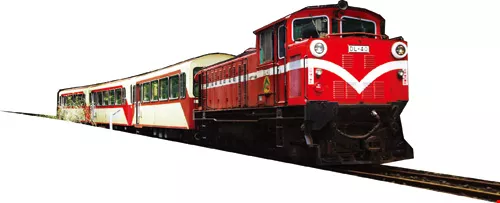
Though the hotels and related facilities, which have to be built from scratch, require time to design, the forest railway, which has already been in operation for nearly a century, was transferred virtually immediately-in the year following the signing of the contract. The Forestry Bureau formally handed over operating rights over the railroad to Hungtu in June of 2008, making it, after the Taiwan High Speed Railway, only Taiwan's second privately operated rail line.
In only the third month after transfer to private hands, the rail line was cut at the 23-kilometer mark after the roadbed collapsed following typhoons Sinlaku and Jangmi.
There's nothing unusual about parts of the railway roadbed getting washed away or collapsing. In the past, the Forestry Bureau would repair the damage immediately to get the trains running again ASAP. But under private management, the line was out of service for three whole months, though the collapsed area was only 60 meters long. Only in January of 2009 did the operators arrange for one train to take people up to the nearest station to the break point and another to carry them after the break point. But that meant people had to walk 500 meters, dragging their luggage, along narrow-gauge tracks. The sight of travelers huffing and puffing their way along not only drew the ire of the media, the premier even sent his personal secretary to take photos and find out what was going on.
The break in the rail line also revealed other problems beneath the surface.
According to the contract, the government is to bear 80% of the costs for repairs of damage caused by "acts of nature," while Hungtu is to bear 20%. But after the event, Hungtu was unwilling to come up with money for repairs. Instead, they kept asking, "How can we be sure that collapse was caused by the natural disaster?"
Without Hungtu's contribution, the Forestry Bureau was unable on its own to open the process of bidding for the repair work. "The land up to five meters on each side of the line is within Hungtu's operational scope, so naturally the problem was their responsibility. If the Forestry Bureau just started taking bids for repairs, wouldn't that have been using public money for the profit of a private enterprise?!" asks a frustrated Yang Hung-chih, director of the Chiayi Forest District Office.
In response to Hungtu's objections to paying, the Forestry Bureau argued that since the collapse happened after the typhoons, it must have been the result of "an act of nature." But Hungtu claimed that the landslide that carried away the roadbed would never have happened if the riverbank just downhill from the rail line had been properly managed to block the uphill land from sliding in the first place, so that it was human negligence that was really to blame.
After several attempts to negotiate a solution failed, a neutral third party-the Taiwan Professional Geotechnical Engineers Association-was called upon to arbitrate. The TPGEA's conclusion was that the cause of the landslide was "natural disaster." Once responsibility had been established, the Forestry Bureau opened bidding for repairs, with the intention of claiming compensation from Hungtu in the future.
Off the rails?
In fact, since privatization, in addition to the break in the line, the number of daily trains has been reduced, and there have been many cases of trains being delayed or cancelled, with corresponding criticisms from riders. "If there are not enough people, the train won't run; if the weather is bad, the train won't run." This is the complaint from a Miss Guo, a travel agent who has had the company change departure times on her tour groups from mainland China.
A former forestry railway employee opines that the new operators don't really care at all about the railroad, and have forced out a number of older employees transferred from the Forestry Bureau with such tactics as transfers, pay reductions, and compulsory unpaid "vacation." Since the transfer of control, staff has been slashed from 200 to 146.
"Hungtu has not really taken railroad operations seriously, and is mainly concerned with the two new hotels that go along with the package," says Su Chao-hsu, director of the Railway Cultural Society of Taiwan, who formerly worked as an advisor to Hungtu but was fired after the commotion over the halt in service. In fact, Su has come in for his share of criticism that he "never should have toed the company line for those guys" in the first place. He replies: "I don't care about Hungtu, I only care about Alishan," and he says he has nothing to feel guilty about.
Teng Hsin-fu, vice general manager at Hungtu Alishan, responds to the criticism. He says that right from the beginning they expected to lose money on the railway, and it has always been the company's plan to use revenues from the two hotels to cover the costs of operating the railway.
Nonetheless, he says, "Hungtu has not only not abandoned the railway, we have innovated and marketed aggressively." The best example, he says, is that, besides having two journeys from Beimen up to Alishan each day (there were three before privatization), they have added trains that run from Chiayi to Fenqihu and from Fenqihu to Alishan, so that passengers have more flexibility in choosing their itineraries. Also, in order to allow riders to gain a deeper understanding of mountain forests along the route, Hungtu plans to install a digital-screen "guide" in each train car.
Win or lose?
Losses on the railway were expected, but Hungtu has been caught out by a delay in hotel construction.
The 131-room hotel at Beimen, where there are no environmental obstacles, held the traditional ceremony of the placement of the first crossbeam in May of this year. They expect to open the hotel for business in March of 2010. But the Alishan hotel, which was supposed to proceed on the same schedule, is stymied because it has not passed the environmental impact review.
It is not without reason that the Alishan hotel has become the main center of controversy. A draft bill proposed by the Council for Economic Planning and Development in 2005 would have in principle banned development, without exception, on all land above 1500 meters in core soil conservation areas. But the location of the planned hotel is at 2216 meters above sea level, a clear contradiction with the intent of the law proposed by the very same administration.
This February, the Control Yuan, citing "casual and careless decision-making," reprimanded four government agencies. Frank Wu, the Control Yuan member responsible for investigating the case, says that the Council for Agriculture handled the railway privatization and hotel construction under the designation "agricultural facilities," and the Public Construction Commission agreed to adopt this categorization as well. "It's absolutely ridiculous!"
"Alishan was already overdeveloped as it was!" says Zeng Jincheng, director of the Fenqihu Station, who has 33 years experience on Alishan. In the past Alishan was covered in forest, and it was able to retain soil and water, so that after heavy rains it was a week before flooding would hit the plains. Now almost as soon as it rains on the mountain, you get water gushing down into the bottom, carrying the soil with it.
"The whole re-forestation thing is a fraud," says one Alishan resident. Although farmers are required by law to engage in reforestation side-by-side with their high-altitude tea plantations or fruit orchards, they often deliberately stick the tree seedlings in tin cans just to get past the inspection count by the government, with their goal being to make sure that the seedlings can't grow and eventually die out.
In building a large hotel in an already overdeveloped mountain region, the biggest environmental issue is access to water.
Last August, after the environmental impact assessment (EIA) failed to get approval, Hungtu came up with a new water-use plan which calls for the construction, in the long run, of a holding tank with a capacity of 67,000 cubic meters of water, in order to cope with the shortage of water during the winter dry season (November to April). In the short run the plan calls for deliveries of water by train, and a more water-efficient design of the hotel.
It is still unknown whether the Alishan hotel EIA will get approved, but there are already calls for the government to retake control of the railway.
"The Alishan Forest Railway is a symbol of the whole country, so it should never have been subject to BOT," says Su Chao-hsu, who contends that the new government should bravely face up to the situation and fix the mistakes that have been made in the past.
However, if the government were to renege on the Alishan BOT project, it would have to pay Hungtu NT$1.4 billion in compensation. Moreover, as early as March 2008, Hungtu borrowed NT$1.3 billion from seven banks by using as collateral their land rights and the structures and auxiliary facilities they will put up. If the BOT project is cancelled, these banks would end up suffering severe "collateral damage."
Since going the BOT route, the problem-ridden forest railway and recreation area are now at a critical crossroads. We can only watch and wait to see what happens, and hope that the relevant agencies will get the best advice they can to get this project back on the right track, so the government, the company, and the people all come up winners!


@List.jpg?w=522&h=410&mode=crop&format=webp&quality=80)


