

In spring, when flowers bloom and cre- ation comes to life, the delicately beautiful black-winged stilts seek mates and build their nests, preparing to incubate their eggs and rear their young. Meanwhile, some ten species of migratory water birds including teal and little ringed plover stop over to feed and frolic, while various species of fiddler crab busy themselves in the mud.... Having a swamp nearby allows people to behold the great vitality of wetlands. Have you thought of picking a weekend to take the kids to a nearby coastal marshland so that they can experience its teeming vitality?
Throughout history, swamps were long regarded as good-for-nothing wastelands and places of pestilence, while those who lived nearby eagerly awaited their removal. But in recent years, with calls to preserve wetland ecologies, environmental groups have begun scrutinizing swamplands for environmental change and establishing preserves for wetland plants. Thus the wetlands' decline has finally begun to be alleviated. Here in Taiwan, deserted agricultural land in Fuhsing Rural Township, Changhua County, has been turned into a wetland paradise for migratory birds. The Taiwan Ecotourism Association hails this as "an excellent example of revitalizing a withered ecology with the incentive of ecotourism."
"The Fupao Wetlands in Fuhsing are a new eco-paradise in which a liability has been turned into asset," says Tsai Chia-yang, a PhD student in environmental science at Tunghai University who works as a volunteer with the Changhua County Environmental Protection League. This is a story that starts with the rise of fish farming along the west coast of Taiwan in the 1960s. Back then the principal industries in Fupao Village-like much of the mid-to-southern coasts of western Taiwan-were aquaculture and traditional agriculture. After many years of pumping groundwater to feed the fish ponds, subsidence and excess alkalinity grew increasingly severe. From the 1970s, much of the farmland shifted from sugarcane production to pastureland, and agriculture generally shifted toward dairy farming. In recent years, subsidence has worsened as a result of coastal landfill at the nearby Changpin Industrial District and the effects of the September 21 earthquake of 1999.
"The soil is too alkaline to grow crops," says Huang Chien-tsai, the Fupao Village mayor. The soil has become so alkaline that even sesbania, which is often used to increase fertility in inhospitable sites, won't grow there. As a result, farmers cannot obtain government subsidies for crop rotation. Tens of hectares of land have simply been deserted. So when the mayor read a newspaper report about an environmental group renting abandoned fields in neighboring Hanpao Village to create a habitat for water birds, he contacted the group in the hope that Fupao could also rent out some fields.
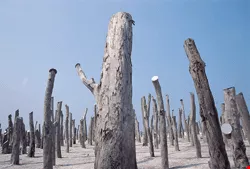
A work of landscape art in a river delta near Fupao is made of mirrors and designed to be seen from the air. Although beautiful, it occupies space that would otherwise be inhabited by more than 1000 seabirds during the rising tide.
A new lease on life
"We hoped that with ecological management we could turn idle fields into a habitat with ample ecological functions," says Tsai Chia-yang. "We also hoped to foster community development and give residents jobs in habitat management or conservation-helping Fupao Village attain economic benefits from ecotourism and environmental education." The basic concept initially met with the approval of only 20-30% of village residents, but with the strong support of the mayor the Changhua Environmental League in 2000 applied for funding from the Council of Agriculture. It quickly was able to rent some 20 hectares of idle farmland, and started with the planning for habitat management.
"We manage the land according to specific goals that suit the individual plots." Tsai cities the example of a "feeding habitat." Migratory birds that winter in Taiwan don't need much space. A single riverbank or a pond is enough for several thousand birds. But they need an ample food supply. Hence, ensuring there is enough benthos (crabs, clams, shrimp and so forth) is one of the key points of this eco-management program.
The benthos supply largely depends on water quality. With high levels of salinity in areas near fishponds, algae grow in abundance. They use up the oxygen in the water and soil, killing the benthos. It is therefore necessary to remove the algae and then get to the root of the problem by improving water quality and reviving the hydrologic cycle. Soil that has experienced severe oxygen starvation requires turning to expose it to the air. The water level must be controlled too, for if it is too high, smaller birds like sandpipers and plovers won't be able to reach their food.
After three years of ecological revival efforts, more than 160 bird species have visited and fed at the Fupao Wetlands and more than ten species have bred here.
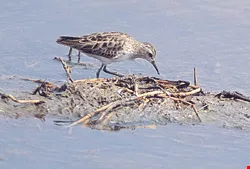
After three years of efforts to revive them, the Fupao Wetlands have attracted more than 160 different bird species to roost and feed here. Our pictures show (1) a sharp-tailed sandpiper, (2) some fiddler crabs, and (3) a moorhen.
Community mover
"Throughout the process of habitat management," says Tsai, "we worked with the mayor and local residents." With the efforts gradually bearing fruit, residents' recognition of the group's accomplishments has increased. In recent years, they've had much success in training guides, with more than 20 obtaining credentials. A guide can make NT$2000 a day leading tours.
Apart from offering birdwatching and wetland ecology tours, the Fupao community has also been working hard with the oyster and dairy industries to develop tourism based around ecological diversity. On some tours, as well as birdwatching and learning about coastal plants, tourists also ride out to the tidal zones to see how oysters are raised and collected. At low tide, they enjoy the sight of crabs digging their holes, and visit ponds where hard clams are grown. Later, as the tide rises, they return to the shore to enjoy magnificent views of the sea over the now-submerged oyster beds.
Since the Fupao Ecological District opened in 2002, it has received more than 30 school groups and more than 2000 visitors for its ecological education programs.
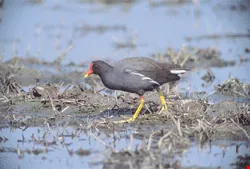
After three years of efforts to revive them, the Fupao Wetlands have attracted more than 160 different bird species to roost and feed here. Our pictures show (1) a sharp-tailed sandpiper, (2) some fiddler crabs, and (3) a moorhen.
Starting young
In the courtyard of the red-brick traditional compound that now serves as a visitor center, a guide plays a game with children about water birds that make long migrations. Markers on the ground represent birds from Siberia, Japan, and the Yellow and Yangtze River deltas that pass through Taiwan on their way to the Philippines, Indonesia, and Australia. "For every 100 kilometers they travel they consume huge amounts of energy, and need a resting place with benthos to revive." If the environment in the next resting place were damaged, the guide asks, wouldn't the birds starve to death? Wouldn't they fail to reach their warm breeding grounds to propagate their young?
In Sweden, where environmental education is well developed, outdoor education in elementary and secondary schools goes something like this: Students select a lakeside for long-term observation of changes to its plants, insects, water and shoreline, and try to find the causes for environmental ills. Some schools go to nearby islands for fieldwork, and teachers lead students to sit on the cliffs, experience the ocean and write poetry to express their feelings.
Swedes put a lot of emphasis on environmental education because they realize that when the environment has problems it concerns everyone, not just scientists.
Although Taiwan's environmental education has a short history, it has at least had a good start-thanks to the efforts of many who have been working at it from different angles. Ecotourism, like the tours to Fupao that give children a chance to get close to nature and become friends with the beasts, bugs and fish is one of the best approaches to take. To get children to care about the environment, start providing them with some happy ecotourism!
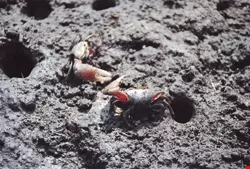
After three years of efforts to revive them, the Fupao Wetlands have attracted more than 160 different bird species to roost and feed here. Our pictures show (1) a sharp-tailed sandpiper, (2) some fiddler crabs, and (3) a moorhen.


@List.jpg?w=522&h=410&mode=crop&format=webp&quality=80)


