

Diplomacy is an extension of national power. On the eve of the ROC's 100th anniversary, the Ministry of Foreign Affairs has given the nation's citizens a big present: visa-free travel (or its equivalent, visas on arrival) to 100 nations. More precisely, there are 117 nations and territories that welcome ROC citizens on their passports alone.
"Visa-free travel is like the 'Anywhere Door' used by the cartoon character Doraemon," says travel writer Danny Wen. "So long as you have a passport, you can just get up and go, leaving the nation on a moment's notice. It saves time and money, and even more importantly allows more people to go abroad and experience different cultures." Wen characterizes visa-free travel privileges as a major accomplishment of the current government.
Members of the business community, meanwhile, describe it as the "car wheel" (referring to the rotary-shaped sun on the ROC passport) turning into a top-speed "flywheel."

Malaysia (above) was the 100th country to offer the convenience of visa-free travel to ROC citizens. The 35 nations of the European Union, meanwhile, had already granted those privileges. The photos show the windmills of Holland and the picture-book scenery of Vienna.
If you look carefully at these 117 nations and territories, the largest numbers of them-43-are found in Europe. Next comes Asia with 33, and then the Americas with 25. Currently, with the exception of the United States, the ranks of those 117 places include almost all of the world's important developed nations.
"Because foreign affairs work involves classified information, much of it can't be publicized, which leads to a lack of clear understanding about what diplomats are doing," explains Minister of Foreign Affairs Timothy Yang. "But visa-free travel directly impacts citizens' lives. ROC citizens ought to know about this three-year effort."
In the two years of negotiations that led to visa-free travel to Canada, trade was a key factor. Taiwan is Canada's fourth largest trading partner in Asia and 12th largest overall. In 2010 trade between the two nations totaled C$5.2 billion (about NT$156 billion). Major Canadian exports to Taiwan included minerals, wood and leather. According to estimates, more than 60,000 ROC citizens travel to Canada every year to see the sights, visit relatives or study. The people of these two nations have close dealings with each other.
"Canada has long wanted to sell us their beef, and they brought up visa-free travel and beef sales together," says Yang. "But we were successful in separating the two issues." Many in the ROC don't realize that trade and foreign affairs fall under the same department in Canada (like in Australia and Korea), Yang explains. Consequently, its diplomats are also responsible for promoting trade. But allowing beef imports from Canada could have negative impacts on the ROC, so the Ministry of Foreign Affairs continually lobbied Canadian MPs and Canada's immigration department and also focused the power of Taiwanese businesses and the Taiwanese community in Canada. Eventually Canada agreed to deal with the issues separately.
According to Tourism Bureau statistics, from January to July of this year, 41,000 ROC citizens flew from Taiwan to Canada. That represents growth of 11% over last year, demonstrating the impact of visa-free travel.
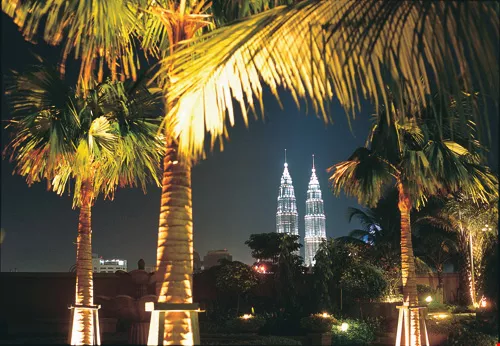
Malaysia (above) was the 100th country to offer the convenience of visa-free travel to ROC citizens. The 35 nations of the European Union, meanwhile, had already granted those privileges. The photos show the windmills of Holland and the picture-book scenery of Vienna.
Negotiating for visa-free travel to the 35 nations of the European Union proved to be even more complicated. Many years previously, the Ministry of Foreign Affairs had approached the EU about achieving visa-free travel to its Schengen Area. Back then the EU bureaucrats all believed that this was "a mission impossible."
"After President Ma Ying-jeou took office, he adopted a policy of 'flexible diplomacy,'" explains Yang. "President Ma actively constructed a mainland policy and worked to achieve a virtuous cycle in foreign relations, so that the cross-strait relationship, rather than being characterized by tensions and clouds of war, would serve instead as an important conduit for developing Asia-Pacific trade. From being a troublemaker shunned by international society, Taiwan became a model student welcomed by all." Yang says that neither the cross-strait relationship nor foreign affairs takes precedence over the other. Rather, the two are tightly intertwined. The warming of cross-strait relations allowed the ROC to reach a breakthrough in the international arena. Visa-free travel to Europe is just one obvious example.
From the time that visa-free travel for ROC citizens was first proposed by the European Commission, it required separate approvals at 15 different stages. All those hurdles weren't cleared until the end of November 2010, when the news finally came that ROC citizens would no longer need visas for travel to EU nations.
If you include non-EU European nations, such as several in the Western Balkans, as well as territories belonging to EU countries, such as Denmark's Greenland and the Faroe Islands, and France's St. Pierre and Miquelon, the domino effect from the EU decision resulted in visa-free travel to 57 nations and territories.
This isn't just a pretty number. It's made a real difference for Taiwanese businesses abroad.
For instance, before visa-free travel to Europe, Taiwanese business people based in mainland China would have to live there for a full 183 days before they could apply for visas to European nations, which would then take an average of two or three weeks to obtain. Those who hadn't resided on the mainland long enough would have to return to Taiwan to make a visa application. It was all very time consuming.
"But business opportunities are fleeting, and competing Korean firms could just hop on a plane and go to Europe," notes Yang. "At least now there's a level playing field."

The US Capitol in Washington D.C. The ROC expects to become a candidate for visa-free travel to the United States by the end of 2011 and to formally be granted those privileges in 2012.
When you take a close look, you realize there was a high degree of difficulty involved in attaining visa-free status in every instance.
Take, for instance, Malaysia, the 100th country to offer visa-free travel to ROC citizens. Back in 2002, the ROC gave Malaysian citizens visa-free travel in Taiwan, so for many years there wasn't reciprocal treatment.
"As a reason for refusing visa-free travel, some nations offered the 'one-China' policy." Yang recalls. "That's not a valid reason in my opinion." As minister of foreign affairs, Yang would say: Apart from the 19 nations that recognize the Republic of China, there are many other nations with "one-China" policies that nevertheless grant ROC citizens visa-free travel. If they can, why can't you? "International relations are a two-way street," he'd say. "I hope you will seriously consider this matter and earnestly look at our request in a positive light, because the ROC today has a right to receive serious and positive treatment in the international community."
Eventually, Malaysia granted ROC citizens 15 days of visa-free travel. Nevertheless, the Ministry of Foreign Affairs is still pushing for even better treatment.
All told, in the three years since ROC President Ma Ying-jeou took office, the number of nations giving ROC citizens visa-free or visa on arrival travel privileges has risen from 54 to 117. That's a substantial accomplishment.
US hopesThere's no destination where ROC citizens would more like to travel without visas than the United States. Achieving that goal has been a focus of recent ROC diplomatic efforts.
Yang points out that the United States has been focused on national security since the 9/11 terrorist attacks. Among the conditions that the US has set for granting visa-free travel, the first involves a nation's past record: the visa rejection rate for a nation must be below 3%. Last year the rejection rate for ROC citizens applying for US visas was 2.2%. The next requirement is that the nation must issue biometric passports. The ROC began to issue them at the end of 2008. Finally, there's the matter of sharing data, such as information about lost or stolen passports. The ROC meets almost all of these criteria.
It used to be that when ROC citizens applied to replace lost passports, they could continue to use the old ones if they found them within 48 hours. But the United States had misgivings about the policy, believing that the 48-hour window gave criminals the chance to alter passports and enter the United States illegally. The Ministry of Foreign Affairs changed the policy accordingly. Now, as soon as passports are reported missing, they are voided, even if found.
Many on the outside believe that the unresolved issue of American beef imports could impact the US decision on visas.
But Yang stresses that the Ministry of Foreign Affairs has consistently taken the position that visa-free travel should not be entangled with any other issues, and the US side has likewise maintained that they are making their decision entirely based on national security issues. Yang is confident that the ROC will be listed as a candidate for visa-free travel to the United States by the end of this year and will formally obtain that status next year.
"Taiwan has a good reputation with regard to its government, economy, international assistance efforts, and high-tech products. This breakthrough of visa-free travel to 100 nations further demonstrates how we have touched people and earned their respect as a nation," Yang says. "I hope that ROC citizens will treasure this gift from the international community."

_DSC2938@List.jpg?w=522&h=410&mode=crop&format=webp&quality=80)

@List.jpg?w=522&h=410&mode=crop&format=webp&quality=80)


定稿-1@List.jpg?w=522&h=410&mode=crop&format=webp&quality=80)
