A Farewell to Childhood: Qiniangma
Tsai Wen-ting / photos Pu Hua-chih / tr. by Julius Tsai
November 2001


On the seventh day of the seventh lu-nar month, the Oxherd and the Weaving Maiden meet each other on the bridge of magpies, making for a bittersweet love story that has been passed down for thousands of years. Subsequently, qixi, the "night of the seventh," has become the well-known Chinese Lover's Day (similar to St. Valentine's Day in the West). In many places, moreover, qixi also marks the time to celebrate the momentous occasion of the coming-of-age rite. Droves of 16-year-olds offer thanks to the Weaving Maiden, known among the Taiwanese people as Qiniangma for her many years of watching over them. Shedding the protective talismans they have worn over the years, they pass under the miniature Qiniangma Pagoda and in doing so wave goodbye to their childhood years.
Once seen as being on par with the wedding ceremony in importance, today the ancient coming-of-age rite has been all but lost. In Taiwan, the only place that the rite can still be seen is in the historic city of Tainan. Parents from all over the island still come here, attracted by its lavish yearly performance.
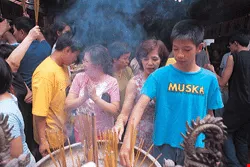
Qixi, the seventh evening of the seventh lunar month, marks the romantic Chinese Lover's Day. The scene is exceedingly lively at Tainan's Kailung Temple, located near the Tainan main railway station. It is an extraordinary evening in the cramped confines of the temple. More than 300 youngsters, in the bloom of their youth, follow their parents and grandparents in raising high their smoldering incense sticks, worshipping from the front to the back of the temple.
"Oh, is this your son? He's 16 already? Why, he's taller than you!" Groups of worshippers meeting by chance chat with each other, barely able to contain the joy that they feel inside.
The young man being referred to, the center of attention today, is clad in T-shirt and sneakers and continuously toys with his cell phone. Other youngsters are wearing large golden placards, looking quite nervous and ill at ease.
Growing up
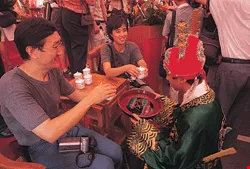
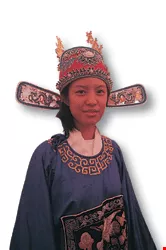
The youngsters attending the temple's coming-of-age rite find it a fresh and interesting experience to be clad in the ancient garb of the zhuangyuan (top graduate in the imperial examinations), and cast about meaningful glances. However, at the moment that the youngsters kneel before their parents and perform the offering of tea, a number of parents and children secretly wipe away the tears they are unable to contain.
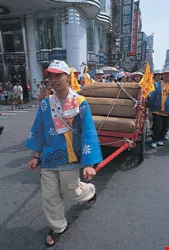
After paying respects to their parents through the offering of tea, the youngsters are given carrying poles and pushcarts furnished by the temple. This is to symbolize that the child is ready to take up the burden of responsibility hitherto carried by the parents. Upon taking up the carrying poles, however, these modern-day youngsters have a difficult time finding their balance. Their careening to and fro makes for quite a spectacle.
The goddess known as Qiniangma is precisely the Weaving Maiden. According to folk tradition, seven fairy women reside in the seven stars of the Big Dipper. Their weaving skills were such that they were able to weave celestial garb with the appearance of tinged clouds. Anyone that put on this celestial garb would be able to soar through the heavens and the human world. Back on earth, there lived an Oxherd who had suffered his fill of cruel mistreatment by his brother and sister-in-law. His only companion was an old ox. One day, acting upon the advice of his ox, the Oxherd retrieved and hid an article of celestial garb he had come upon by the riverside. The Weaving Maid, unable to return to heaven because she no longer possessed her celestial garb, agreed to marry the earnest and straightforward Oxherd. With the husband tilling the fields and the wife weaving her cloth, the couple set about raising two sons.
They did not reckon on the fact that the Heavenly Sovereign would disapprove of their union and proceed to take the Weaving Maid back up to the heavens. The broken-hearted Oxherd put on the hide of the old cow, carried his sons in two bamboo baskets and chased up to the heavens after his wife. He was just within reach of the Weaving Maid when the Queen Mother of the West plucked out a golden hairpin and with it drew out the Silver River (Milky Way), giving rise to those words of eternal longing, "So full, the distance o'er these waters, / So silent, between the lovers no words may pass." Fortunately for the couple, once a year a flock of magpies form a bridge over the Silver River (which in astronomical terms corresponds to the approach of the stars Altair and Vega on opposite sides of the Milky Way) so that the pair can meet, and this is the origin of Lover's Day.
The romantic, enduring love story aside, the Oxherd found it difficult to raise two sons on his own. The Weaving Maiden's six sisters thereupon took it upon themselves, aided by a group of mother birds, to watch over the children. In missing her own children, the Weaving Maiden became the protecting deity of all the children of the world, watching over myriad young ones so that they would grow up safely into adulthood.
Protecting and nurturing
In contrast to the Matsu and Wangyeh cults of the Southern Min (Fujian) region of China, Qiniangma, a deity whose worship originated in Zhejiang and was brought over to Taiwan, is rarely honored with a temple of her own. Instead, she is usually found in temples dedicated to other deities. Tainan's Kailung Temple is the only temple in all of Taiwan devoted to the worship of Qiniangma.
The chairman of the board of Kailung Temple, Wang Hsu-li explains, "This temple was built in 1732, and has an almost 270-year history of devotion to Qiniangma. Aside from Qiniangma, Zhusheng Niangniang (the goddess of fertility and childbirth), who grants children, as well as Linshui Furen (the Lady who Overlooks the Water), who protects pregnant women and assures them a safe childbirth, are also worshipped here. These three great life-cycle deities see a person through marriage, pregnancy, and childbirth."
In the past, when medicine was not advanced, child mortality rates were high. Apart from the domestic worship of Chuangmu (the Lady of the Bed), mothers would also bring their sons and daughters on their first birthday to be dedicated as the adopted children of Qiniangma. They would take old coins, silver pieces, or talismans folded into the shape of the Eight Trigrams of the Yijing and place them in a red cloth pouch, which would be hung round the child's neck. This practice was called jiajuan ("applying the thread" also a pun for "protecting"). On the evening of the seventh day of the seventh lunar month of each year, they would return to the temple and pass the juan through incense smoke. The children would continue wearing these articles until their sixteenth year.
The coming-of-age rite, which was called the "capping rite" or the "hairpin rite" in ancient times, can be traced back to the Xia (2100-1700 BCE) and Shang Dynasties (1700-1100 BCE). Along with birth, marriage, and funerals, it is considered one of the four major rites. From this one can appreciate the high status accorded to the coming-of-age rite.
The ancients practiced the coming-of-age rite for boys at 20, and for girls at 15. Three days before the rite, the parents would select from among those who were to attend the rite one person who was an elder and of good moral character. This person would be specially invited to place the cap on the child's head. To be qualified to serve in this capacity, it was necessary to obtain the ancestors' approval through divination. On the day of the ceremony, the child who had come of age would have to change into three different sets of clothing and accompanying headgear. Through the changing into progressively finer and grander garments and with each round of congratulations and exhortation, the child would attain an inner transformation through an outer change of clothing.
A 16-year-old's load
Why is it that, in the Tainan area, the sixteenth year should be singled out as the age at which one crosses over into adulthood?
The Anping area of Tainan has long been a flourishing commercial port. The Wutiao Port around Yule Street was a bustling area where many of the residents worked hauling loads at the docks, especially those belonging to the five large surname lineages-Lu, Kuo, Huang, Tsai, and Hsu. Back then, salaries at the dock were calculated based on one's age. When one turned 16 one would be able to join one's father and brothers in receiving full pay, before then only receiving half-pay as a child worker. Thus, when children reached the age of 16, they were considered adults in the eyes of society and could help their parents take up the burden of supporting the family. This was why the age of sixteen was seen as being significant. Nowadays, even though children do not have to make a living at such an early age, the custom of the coming-of-age rite at 16 is still carried on in this ancient city.
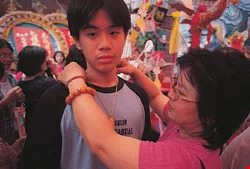
When a child is about to turn 16, the maternal grandmother will make a set of attire, complete "from head to toe." This includes new clothes and shoes, as well as gold pieces. To meet the needs of today's youngsters, some grandmothers also give watches, bicycles or cell phones to mark the day. Well-off families will furthermore put on a large banquet, inviting friends, relatives and even prominent community members to witness the coming-of-age rite of a boy or girl.
Kuo Ching-tu, a father who has brought his son to the coming-of-age rite says, "In the past my grandfather lived here in Wutiao Port. When my father turned 16 he also had the coming-of-age rite performed. But when it came to me, I did not have the rite performed because of my family's financial situation. As long as household finances allow, most families will opt to perform the rite for their children."
Last year, in fact, Kai-lung Temple performed a remedial coming-of-age ritual for 20-some elderly folks who had been unable to perform the rite when they had turned 16. By holding this special coming-of-age rite, these men and women were able to redress one of the regrets of their youth.
Making Qiniangma pretty
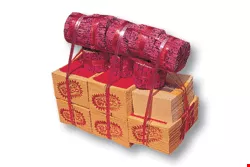
In today's coming-of-age ritual there are quite a lot of ritual customs. To thank Qiniangma for 16 years of protection, aside from the usual sacrificial offerings, worshippers also offer up sesame-chicken wine and thin noodles; bachelors button (Centaurea cyanus) and cockscomb (Celosia cristata) flowers to promote togetherness and harmony in one's career; and five-colored offering paper called niaomu yi (mother bird garments), which is similar to gold and silver offering paper. One also makes "reluctance" rice balls, which are glutinous rice balls in which one makes an indentation with one's fingers, which according to tradition is to contain Qiniangma's tears.
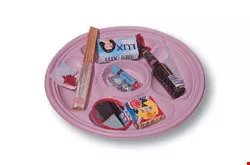
Most notable are the women's goods which people offer, such as cosmetic powder, lipstick, mirrors, and plates of fragrant flowers. A street vendor selling sets of make-up kits in front of the table remarks: "Qiniangma is a female deity, and so it's natural to offer her items that women like. Oil of Olay or SK-II will do just fine."
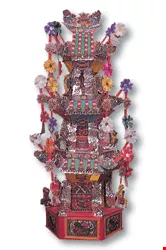
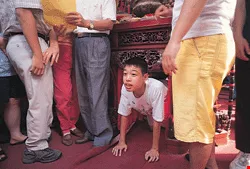
Moreover, an even more unique sight is that of the "Qiniangma Pagoda," finely handcrafted out of bamboo pieces and paper strips. Each Qiniangma Pagoda sells for around NT$1,200, and stands about 120 centimeters tall. They come with two or three layers, with Qiniangma residing above, her six sisters residing in the middle, and throughout attached with images of the Eight Immortals or the mother birds who help Qi-niangma to watch over children. At the conclusion of the sacrifice, the parents lift up the Qiniangma Pagoda to allow the children to pass under it. Wang Hsu-li says, "While passing underneath the pagoda, boys should circle it counterclockwise three times, while girls should circle it clockwise three times. The boys and girls should not look back but look forward, showing that they are bravely walking into the future. This is called 'leaving the mother birds' nest.'"
A graduation ceremony
Chou He of National Taiwan Normal University remarks: "Calling it a 'coming-of-age rite' does not mean that, having undergone it, a child becomes an adult overnight." Rather, it means that in the days leading up to that day, the elders in the family should gradually instruct the child in how to behave, and when added to the child's own personal trials and life experience, the day of the coming-of-age rite marks the end of the child's education into becoming an adult. "You can say that it is like a graduation ceremony for home education," says Chou.
Even with the performance of the coming-of-age rite, however, most kids today are still under the close protection of their parents. Li Mei-yen, who had the rite performed for her daughter Wang I-ting just last year, says: "She's a high school kid who's busy every day with her schoolwork. She needs to be dropped off and picked up by her father every day. So even though she's performed the coming-of-age rite marking her sixteenth year, letting her go to dance parties and come home late is completely out of the question."
Of course, while parents set their policies, the children are busy with their own plans. One young man, who stood over 180 cm tall, admitted that he had indeed come to the temple during the day with his mother and grandmother to mark his sixteenth year in the traditional way. He also confided, however, that that very evening he would be going behind his mother's back to attend a concert at the Tainan Canal with his girlfriend. He made a mischievous face as he said, "Since Qiniangma is the Weaving Maiden, I think she would help me succeed in this scheme."
At dusk on this qixi evening it rained, confirming traditions regarding the tears that Qiniangma sheds from heaven. Were these tears of pining for her husband, or of lament over how difficult it is to be a mother these days?
p.098
On the birthday of Qiniangma (left), worshippers offer rice noodles and women's cosmetics such as powder, lipstick and facial cleanser (pictured below). These offerings show the warm, human side of popular religion.
p.099
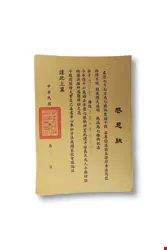
Wearing a gold necklace, a present from grandmother, this youngster has received a "graduation" certificate given by the temple (pictured below). The coming-of-age rite represents the end of a child's home upbringing and entry into adulthood.
p.100
Parents receive the offering of tea from their children's hands. Having watched their children grow from infants to young adults, the mothers and fathers feel a swirl of emotions on this important day.
p.100
Coming-of-age ceremony
Time: Seventh day of the seventh lunar month
Place: Kailung Temple, Tainan
p.100
Passing through the zhuangyuan (top graduate) pagoda without looking back represents one's bold steps toward the future.
p.101
Pulling a cart gives this youngster a taste of the responsibilities of caring for a family. In the past, in the Anping area of Tainan, young people would be able to start receiving an adult's wages upon turning 16.
p.102
The handcrafted paper Qiniangma pagoda (above) and the five-colored niaomu yi (below) are special offering goods used in the coming-of-age rite.
p.103
aIt's a rare sight to see so many young people in the temple. These 16-year-olds are already taller than their parents!


@List.jpg?w=522&h=410&mode=crop&format=webp&quality=80)


