Private Kitchens: Blending Haute Cuisine with Personal Service
Chen Hsin-yi / photos Chuang Kung-ju / tr. by Jonathan Barnard
November 2014


“Private kitchens” in Taiwan are what “pop-up restaurants” are in the West—establishments often run out of people’s homes that require a reservation. Typically, there is no set menu, and the proprietor serves both as chef and waiter. Usually they don’t actively solicit customers, but instead provide a personal service by appointment only.
These private kitchens have been around for over a decade, and a new generation of foodies have especially embraced them in recent years. They are injecting some unusual color and flavor into Taiwan’s culinary culture.
At seven in the evening, on the third floor of an apartment building on Taipei’s Wenzhou Street, the clinking of cutlery and china mixes with the sound of laughter. Four friends are having a long-anticipated dinner at a private kitchen.
The young chef, wearing snow-white kitchen garb, also serves as waiter and provides sparkling commentary on every dish: “The pork in this dish was stewed with wheat beer. The beer both tenderizes the meat and leaves a hoppy aroma.” True to form, the large chunk of streaky pork on the plate is tender and aromatic, and the hog maw tastes fresh and pleasantly chewy. They really hit the spot. With his customers gorging on the delicious food, the chef quickly turns to work on the next dish, but just then someone calls out: “It’s awesome. I’d love a little more.” The chef scoops up what’s left of the dish to accommodate his customers’ wishes. Half way through the meal, he presents some litchi and grape beers that he brewed himself, to the delight of the diners.
Running a private kitchen is the ideal way to work as a chef in the eyes of Stalu Shen, 34: “I love fine cuisine and love using my own two hands to make it. And I love even more sharing carefully thought out and cooked food with other people.”
When Shen, who holds a master’s in Internet technology from National Central University, was a student, he frequently treated his friends to meals he prepared. Two years ago, he figured out that cooking was his true love and quit his information engineering job, forsaking its steady salary. With partners he founded a business that merges culture, coffee and a pop-up restaurant. Last year, he left that business to work on his own as a caterer and cooking teacher. His dream is to open his own private kitchen where he can handle every step from the planning to the cooking.
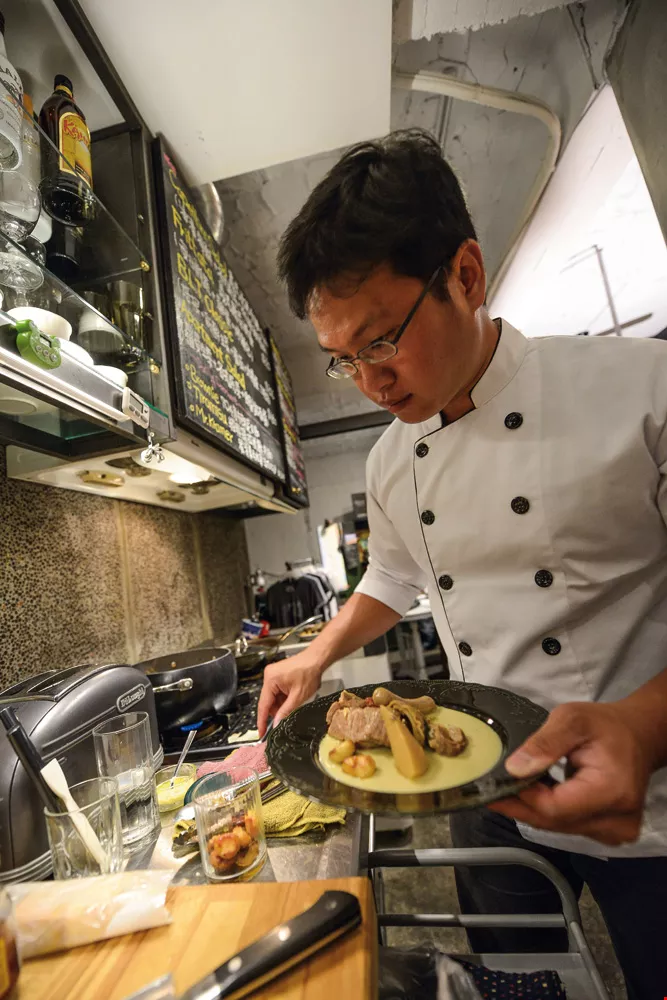
Stalu Shen is an entirely self-taught cook. He excels at creative fusions of Western and Chinese cuisine. Here he holds his signature dish: streaky pork stewed in beer.
Favorites of industry insiders
Private kitchens are small restaurants that are generally located in residential buildings. They take reservations and usually don’t actively look for business from strangers or passersby. Instead they focus on serving regulars and building a clientele via word of mouth. They won’t take reservations below a certain number of diners.
Typically they don’t have a set menu. Instead, the dishes are determined by what the chef purchases himself at markets. The meals are thus a blend of the chef’s ingenuity and what’s fresh that day. Some pop-up restaurant chefs will also work as private cooks at customers’ residences. They take preliminary trips to survey the equipment and tableware, before discussing in detail the character of the dishes.
As far as the chefs are concerned, the chief advantages of going the pop-up route are the reduction in costs and the low barriers to entry. Hong Kong writer Shi Yingying points out that after the handover of Hong Kong in 1997, there was an economic downturn there, and many restaurants went out of business. To make ends meet, unemployed chefs began working privately out of their own kitchens. That approach offered some advantages: One no longer needed to pay rent, and it was easy to control costs. A mysterious secret location even proved to have a certain allure for many customers.
Private kitchens that required reservations began appearing in Taiwan as early as 1998. Back then, Bagel Bagel, a French restaurant located in an old house, attained quite a following among government bureaucrats and businessmen thanks to its concealed location, its retro-style decor and its excellent food prepared by an experienced chef.
In recent years, with the slow food movement and the growing foodie culture, an increasing number of private kitchens have opened. Most of the 30-plus private kitchens in Taiwan are found in the Taipei and Taichung metropolitan areas. Their cuisines vary—from Taiwanese to Japanese to Western to Aboriginal. They also demonstrate a variety of operating methods—from sole proprietor, to family business, to dinner club. Because these professional chefs are picky about ingredients and meticulous in their preparations, prices range from NT$1200 to NT$2500 per person. Target customers are well-heeled epicures that treasure privacy as well as middle-income consumers splurging on something fresh and new.
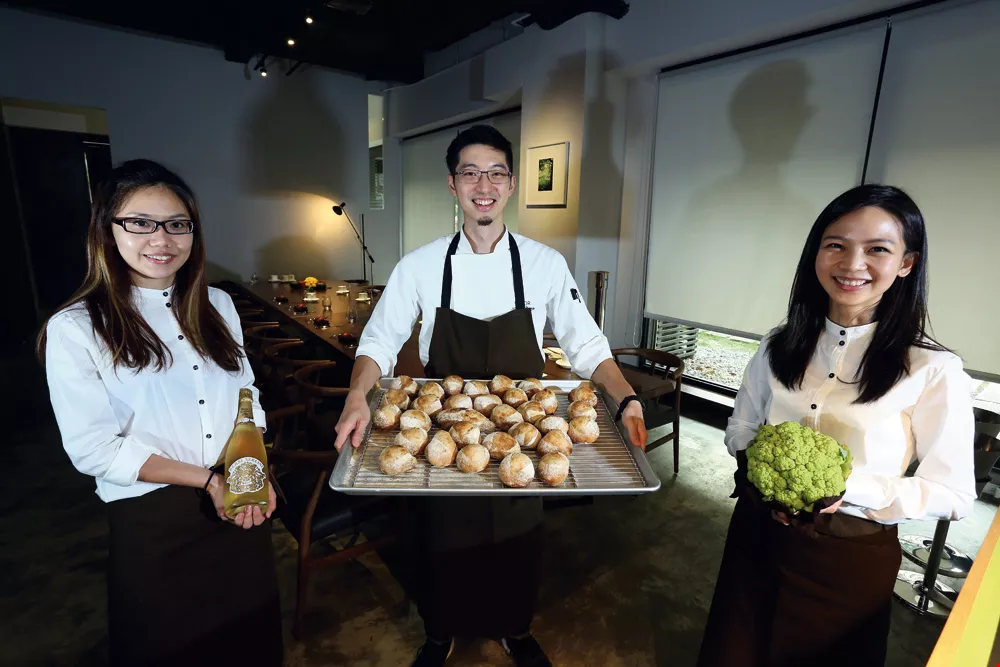
The young staff at the private kitchen Savor are full of enthusiasm, and head chef Zhang Lige (center) makes the entire full-course French meal—including the bread and the dessert—himself.
French cuisine reinterpreted
Interestingly, private kitchens have also become a model for young entrepreneurs. Out of disdain for commercialized restaurants, many young chefs have established their own workspace at home and found a clientele from people that fate has led them to meet. Zhang Lige is but one example.
When Zhang, now 30, was 22, he felt “If I don’t do it now, I’ll regret it.” So he forsook his acceptance to a US master’s program in hotel management and enrolled instead in the famous Ecole Supérieure de Cuisine Française in Paris for a year’s training as a chef and a subsequent internship. After he returned to Taiwan, he experimented with cuisine, using his own home as a pop-up restaurant. With two stoves and a small oven, he produced exquisite, labor-intensive French cuisine.
Take, for instance, his signature appetizer “hot-cold eggs,” which he learned while interning at a three-star Michelin restaurant, L’Arpège. First he coddles eggs in 65°C water, and then he removes one-third of the shell. Through that opening, he removes the egg white but leaves the half-cooked yolk. Then he adds mousse made from sherry vinegar and a powder of cloves, nutmeg, pepper and Chinese cinnamon. Finally, he puts maple-sugar pearls on top of the egg. It’s like a work of art.
Fortunately, after six months or so, his kitchen began getting rave reviews, which attracted quite a few business owners and gourmands. They quickly became regulars, providing momentum.
This year, he and his fiancée worked together to create a space that includes a professional kitchen and wine cellar. They chose the name Savor. Despite hiring another chef and two waiters, they still only take one group per night. The bright well-appointed dining space is decorated simply and tastefully. With nothing but a work island dividing the kitchen from the dining room, customers can enjoy the whole show of scent and color.
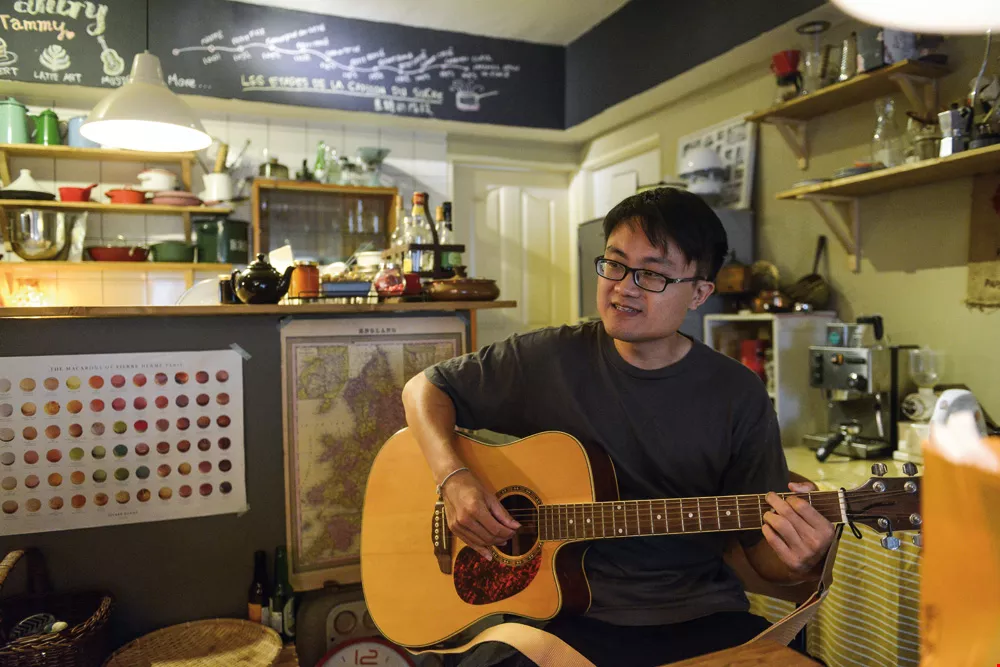
Private kitchen chef Lin Junkuan likes old things, old friends and old songs. Confident that a meal can provide beautiful memories, he sees his role as providing an inspiring experience, complete with fragrances and mood, on which those memories will be based. His old private kitchen has closed, with a new, better-equipped space scheduled to open in November.
Three-star Michelin training
With experience cooking at a five-star hotel in Taipei and the three-Michelin-star L’Arpège in Paris, Zhang had been given the rare opportunity to work his way up the ranks in the kitchens of major hotels. What caused him to passionately embrace the role of pop-up restaurant chef?
“I had no interest in supervising other people,” he says, “and major hotels have standardized operations, so you lack all creative freedom. It’s so stifling.” What’s more, in pursuit of profit and efficiency, Taiwan’s restaurant industry tends to skimp on some steps and ingredients, often replacing them with cheaper substitutes. These concessions are painful for someone like Zhang who cares deeply about food.
Although the internship at the Michelin-starred restaurant was arduous, it opened his eyes and shaped his ambitions to become a private chef.
Because his French was weak at the beginning of his internship, Zhang says that he would misunderstand the sous chef’s directions. For the first three weeks, while he performed menial tasks such as sweeping floors, he felt depressed and considered giving up. Then he memorized by heart the French for each ingredient and utensil and took the initiative to offer his help. Gradually he began to get opportunities to do more. As he toiled at 16-hour work days, he began to grasp why the restaurant had earned Michelin stars for eight years running. He dedicated himself to knowing the special qualities of each ingredient and the methods of preparation, and he came to understand that only through complete attention to detail at every step of the process can one produce cuisine of the highest quality.
A more abstract lesson was drawn from the words and actions of the restaurant chef Alain Passard, who had three gardens where he grew more than 400 different vegetables. The great chef would always say, “The garden determines tonight’s menu.” Passard gave vegetables a leading role. Mother Earth was responsible for both the taste and look of the ingredients.
At the heart of the charm of pop-up restaurants is the way they allow for an atmosphere that is relaxed yet thoroughly dignified. “Chefs needn’t isolate themselves in their kitchens,” says Zhang. “Instead they can connect deeply with their diners!” In this sense, a private kitchen is like the “chef’s table” found in some prestigious restaurants. “Personal guests of the head chef enjoy the right to sit in the kitchen and watch the entire fast-paced process of putting together a meal. Customers can feast royally while watching the chefs work and listening to them gossip.”
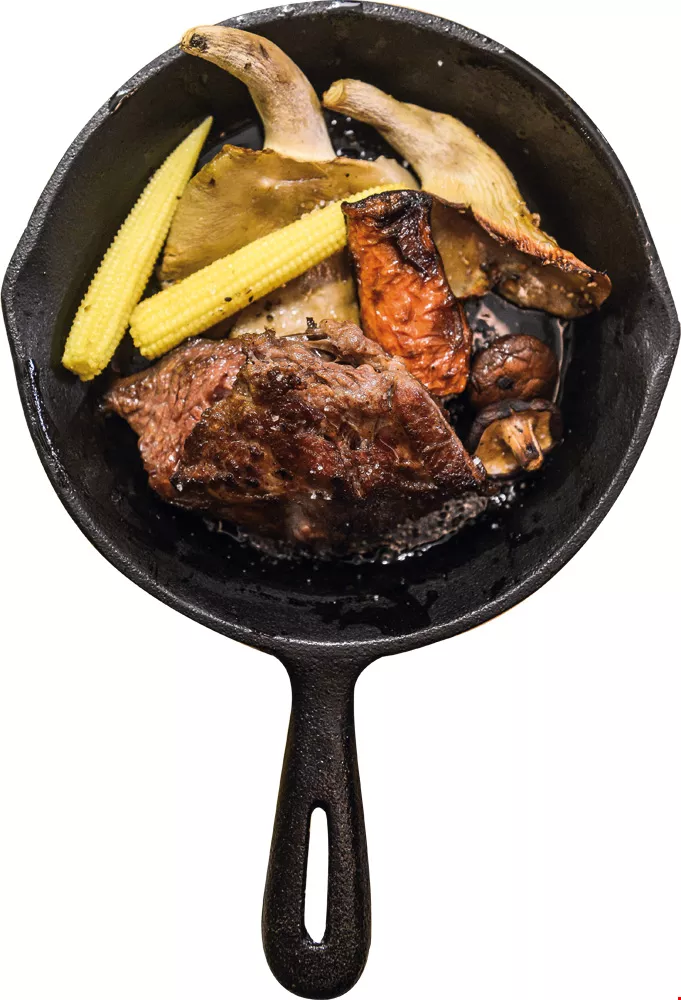
Stalu Shen is a carnivore by persuasion. His main course always includes a choice cut of beef.
A scientist’s mind, an artist’s passion
Many private-kitchen chefs gather inspiration from their own lives and draw from self-taught techniques. And the lack of set menus in private kitchens gives their chefs even more opportunity to show off their skills.
Stalu Shen loves to mix and match and think outside of the box. His cooking methods draw on a wealth of sources: cookbooks he reads, culinary manga, TV cooking shows and so forth. He also saves up money to splurge at prestigious restaurants. If he likes what he eats, he goes home and tries to put his own spin on it.
As he describes in a regular magazine food column, he often uses seasonal fruit in his cooking. Take, for instance, his dish “guava ham and sparerib soup.” Jinhua ham and dried oysters serve as a base, to which are added fresh “pearl” guava and dried red guava. The soup is milky white with a hint of green. Its flavor is rich and sweet.
Last summer he took the long trip to Taitung to study Aboriginal food. For the first lesson, he went to the Aboriginal refrigerator: the sea. He and some Aboriginal friends went diving to catch octopus, and they gathered shellfish along the shoreline. He also learned how to spot various wild herbs and to understand how various ingredients are used. It was inspiring.
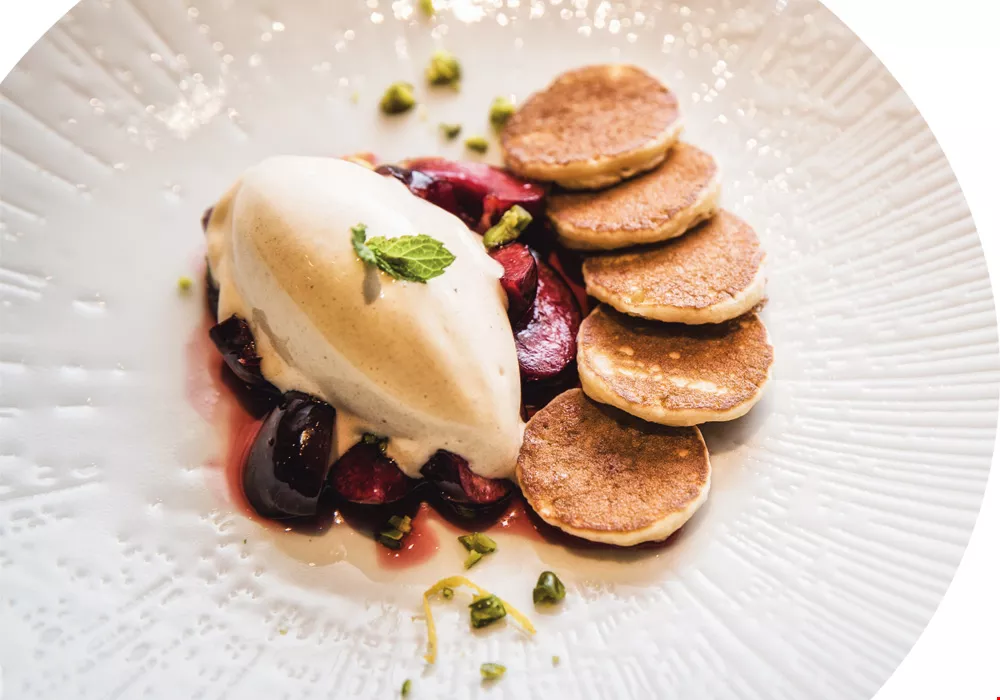
Caramelized banana ice-cream with buckwheat pancake and berries compote.
Toasting to a flavorful life!
Yet the most unique advantage in being a pop-up restaurant chef lies in the relationship with clients, who become almost like family or friends.
Now 37, Lin Junkuan has a doctorate in computer science from National Tsing Hua University. Last year he left behind his decade-plus career as an engineer in Hsinchu. Several years ago he felt exhausted from stress and the demands of his job. At one point he even came down with an anxiety disorder that left him asking himself questions about the meaning of life. It became increasingly clear to him that his previous existence within his professional comfort zone was a kind of self-imposed imprisonment. In throwing himself into work as a pop-up restaurant chef, he had instead to rely entirely on his own drive and the encouragement of his girlfriend. “Yet as soon as I tried it, I was hooked—and there was no turning back.”
As far as Lin is concerned, cooking is both a science and an art, and totally suits his personality. As a multitalented showoff, Lin is obsessed with turning a meal into an aesthetic experience that surprises and delights.
In the dining space he appropriated from his apartment, the chandelier, wooden furniture and bar were all his own creations. He invited his guests to explore every nook and corner and peruse the antiques, curios and china that he and his girlfriend had collected over many years. Once the dessert was served, he would often take off his apron and bang out a rhythm on a box drum or pick up a guitar and start to sing. The result was almost inevitably that the guests would start singing too and wouldn’t want to stop.
Of course, running a pop-up restaurant is not all smooth sailing. Once, when water started to gush out of the drain in his kitchen floor, he used one foot to plug it, while one arm continued to tend to the pots on the stove. All the while he kept his cool to prevent his guests from discovering that anything was amiss. (Nevertheless, one of them said afterwards that his expression had been “stony-faced” and it had affected the meal’s atmosphere.) On another occasion, after trying to cope with 12 guests, he was so exhausted and his back so sore that he thenceforth set a limit of eight diners. Nevertheless, the use of their private space for the business and the demands on his time led to conflicts between him and his girlfriend, and they ended up parting ways.
Still, no matter life’s ups and downs, Lin always treasures the experience of meeting strangers at his dining table. “One role of a private kitchen is to add fragrance and brightness to people’s recollections,” he says. “I find meaning in witnessing and participating in happy moments in other people’s lives.”
Are you tired of the unchanging menus of ordinary restaurants and their systemized service? Do you want a romantic and secluded dinner with people of special importance to you? Whether it’s for the atmosphere, the food, or the friendliness of the host, why not add spice to your life by trying a meal at a private kitchen?
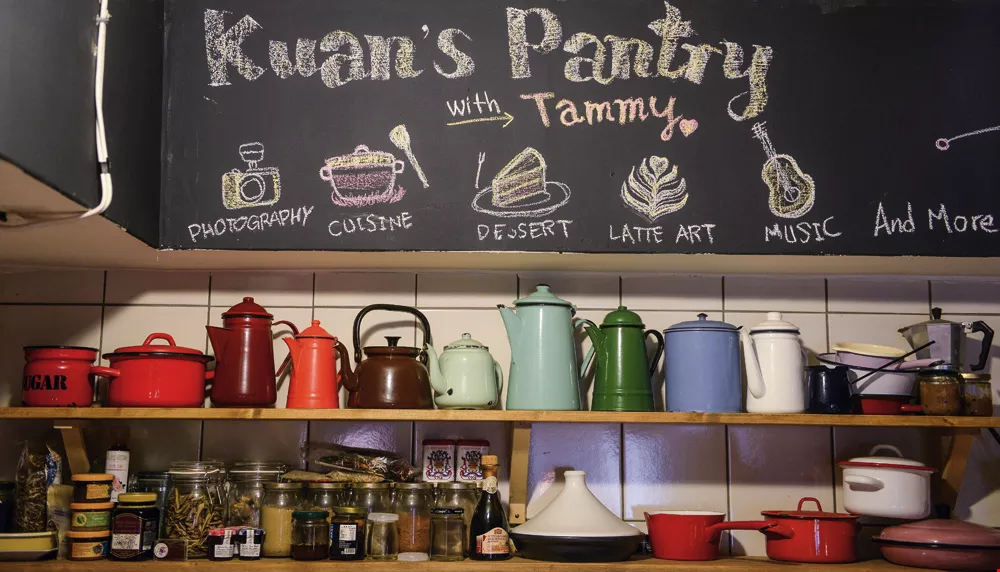
Private kitchen chef Lin Junkuan likes old things, old friends and old songs. Confident that a meal can provide beautiful memories, he sees his role as providing an inspiring experience, complete with fragrances and mood, on which those memories will be based. His old private kitchen has closed, with a new, better-equipped space scheduled to open in November.

@List.jpg?w=522&h=410&mode=crop&format=webp&quality=80)


@List.jpg?w=522&h=410&mode=crop&format=webp&quality=80)
@List.jpg?w=522&h=410&mode=crop&format=webp&quality=80)
