Living with the Earth Bull-The 921 Earthquake Museum
Teng Sue-feng / photos Chuang Kung-ju / tr. by Jonathan Barnard
June 2008


At 2:28 p.m. on May 14 an earthquake measuring 8 on the Richter scale struck in the mountains of Sichuan Province's Wenchuan County, 90 kilometers west of Chengdu. Eleven times greater in force than the 921 quake that struck Taiwan eight years ago, the quake could be felt as far off as Shanghai and Bangkok. The disaster area, which also spanned much of Gansu and Yunnan, encompassed 100,000 square kilometers in Sichuan alone.
Because the quake occurred in the afternoon, it resulted in horrifying scenes of students buried in the rubble of collapsed schools. Many towns and villages were left in total ruins. With roads impassable, the mainland authorities had to use helicopters to bring in food and drinking water and to rescue victims of the disaster. Although the ultimate death toll is still unknown, it is expected to surpass 80,000. Direct victims of the quake number more than 10 million.
Wang Chien-ying, a professor of earth sciences at National Central University, notes that this earthquake was the result of movement along the Longmenshan Fault. Over the previous 100 years, Sichuan had experienced many earthquakes large and small, but only a few had been related to activity along the Longmenshan Fault, and those were small in magnitude. It seemed that virtually all of the area's seismic energy was being released by the Xianshuihe Fault, which also runs through Sichuan. Seismologists considered the Longmenshan Fault basically inactive, and no one expected it to suddenly come back to life. The quake caused the surrounding area to rise by about nine meters, and it also pushed the Himalayas, the world's highest mountain range, substantially higher.
Among many Taiwanese who were visiting Sichuan at the time, the first thought was: "Who would have guessed that Sichuan would experience its own 921 Earthquake?" Nightmarish memories of the earth shaking on a night eight years previously came flooding back.
At 1:47 a.m. on September 21, 1999, the earth bull had turned under Taiwan. Centered in Nantou, an earthquake measuring 7.3 on the Richter scale had wrought a 108-kilometer path of destruction north-south along the Chelungpu Fault. There was devastation everywhere. Mt. Chiouchiou had lost its trees and turned from green to white. Fault ruptures had created a new waterfall in the Ta-an River and an earthen swell of two meters on the track at Kuangfu Junior High School in Wufeng, Taichung County. More than 20,000 homes had collapsed. All told, 2415 people died, and damage to property exceeded NT$300 billion.
Earthquakes are notoriously hard to predict, and for the survivors the scars are everlasting. To commemorate the 1999 disaster, Taiwan's government selected the former Kuangfu Junior High as the site of the 921 Earthquake Museum. To the tune of NT$600 million and eight years of work, the facility was finally completed and fully opened to the public in September of 2007.
As the world's first museum devoted to "preserving earthquake ruins," it adopted a design goal of creating an architectural space that would symbolize "mending the earth's wounds." Critically acclaimed, the museum is a reminder of the geological truth that "the island of Taiwan coexists with earthquakes." As we report on the process of transformation and rebirth by which the museum came into being, we also pray that the survivors of the Sichuan earthquake may quickly leave their pain and terrror behind them and begin to rebuild their lives.
"A once-in-a-century disaster focused the hearts and minds of 23 million people. The geological fault that symbolizes this vast destruction cuts through the 400-meter running track of Kuangfu Junior High School, and a fault rupture left a remarkable rise in the earth there." The earthquake damage and the topography of the site shaped the architectural space of the 921 Earthquake Museum. For architect Jay W. Chiu, the guiding principle of the design was "to allow the space to connect the visible scars with the invisible memories."
For successfully integrating the old ruins with new architecture, Chiu was awarded the 2007 Far Eastern Architectural Award. He earned great praise from the international panel of judges, who hailed from the United States, Japan, Taiwan, and China.
Panel member Mohsen Mostafavi, dean of the Graduate School of Design at Harvard University, praises the quality of construction, citing the vibrant "conversation" between the new architecture and the earthquake damage on the site. China Architecture Design and Research Group vice president Cui Kai notes that it is easy to imagine the engineering difficulties posed by the desire to preserve the tottering ruins. "The design details were deftly rendered, and the result very much achieves an international standard."
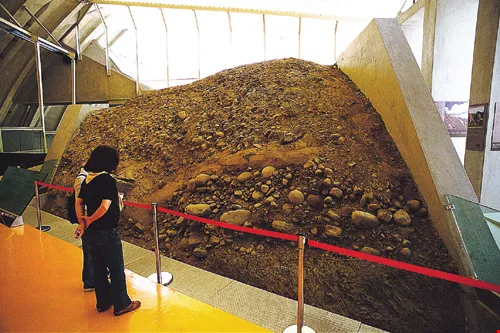
The ground rupture caused by the quake has been preserved in its entirety in Fault Preservation Hall. Like a cake sliced open, the earth revealed its various layers of sand, gravel and Chinshui shale. Chinshui shale is usually found much deeper, typically some ten to 12 meters under the surface. But here it is only two meters from the surface. Perhaps the nearby river has washed away what would normally cover it.
Integrating the historical damage
With its dramatic fault rupture, the track quickly became a symbol of the 921 quake, and the five-hectare Kuangfu Junior High School campus also met the four conditions required by the 921 Earthquake Post-Disaster Recovery Commission for the museum: its appearance amply demonstrated the devastation of the earthquake, its use as a museum had the support of local residents, there was a plan for sustainable development, and there was good access. Architects Jay W. Chiu and H. N. Chuang of A+B Design Group then won a professional design competition, garnering the commission to design the museum.
But grass grows back on the bare ground of fault ruptures, earthen rises crumble and collapse, and PU composite tracks weather under the constant assault of the sun and the wind. How to go about preserving the living grass slope and the gradually weathering track as a memorial site that would symbolize rebirth posed great challenges both in the design and construction of the museum.
From the parking lot on Wufeng's Chungcheng Road, a principal access road to the town, visitors walk along a viewing bridge that connects to the 921 Earthquake Museum. When you get to the entrance to the museum, it's as if you've entered a time capsule. You are enveloped by peace and quiet, and there is none of the sense of heaviness that one might expect. The first thing one sees is the grass portion of the field not damaged by the quake, which is called "70% Plaza."
Along the only path of entry, one enters the museum's first exhibition space: "Chelungpu Fault Preservation Hall." The building features a geometrical design. The left wall is made of a series of pre-cast concrete panels. V-shaped, like the wing of a giant bird of prey, each panel measures 12 meters long and 2.4 meters wide and weighs 11 metric tons. There are 82 of these panels pieced together like a jigsaw puzzle to form a giant arc-shaped wall that stretches 1000 meters. The long sides of the panels lean overhead to meet the room's right wall, which is made of safety glass supported by a steel framework. The interplay of the arcs rising overhead on one side and the floor-to-ceiling glass on the other suggests a boat or a distorted running track. There are exhibitions about tectonic plates, maps of the world's earthquake zones, models of the earth's interior, and interactive exhibits.
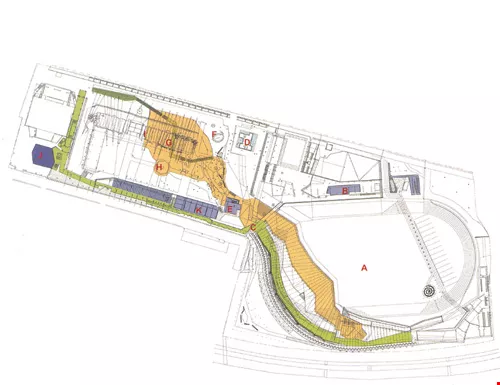
(courtesy of A+B Design Group)
Merging old and new
The juxtaposition of the quiet exhibition space with the views onto fault ruptures on the running track unnerves. Opening the door and walking outside, one sees the wounded earth and recalls the collapses that occurred that night, imagining the plaintive wails from all around... it as if the gulf of time and space were condensed in an instant.
When you raise your head upward, you discover that this indoor-outdoor space has a canopy overhead supported by steel cables running from the top of the concrete panels. Underneath the canopy is a preserved and reconstructed fault zone.
This mix of hard steel cable and soft fabric spans over the fault. There are three different kinds of space here: inside, outside, and half-in, half-out. The interplay between still and moving, hard and soft, results in a visual field of great variation. Jay Chiu used the steel cable to symbolize a needle and the canopy to symbolize a bandage. Together they suggest the idea of the wound on the naked earth (the fault) being treated with sutures and a bandage. To some degree the cables and canopy also suggest the tents that were temporarily thrown up to cope with the crisis.
What's more, the architect cleverly brought one lane of the eight original lanes of the track into the exhibition site as red flooring, which passes through the exhibition space as an extendable organism that helps to direct pedestrian traffic flow. It passes through the ground of the museum, like some being that has acquired an entirely new status after death.
Architect H. N. Chuang explains that there was a high level of difficulty in the construction because the concave panels had to be pre-cast at the factory. A truck could only move one at a time (requiring 82 round trips), and then they were assembled on site. This entire process-from design and manufacture to shipping and assembly-posed great challenges. "In particular because the wall is curved, each of the pre-cast panels had to be cut at different angles. That required precise control and a lot of consideration of how to suspend and stabilize these panels weighing 11 metric tons each. It was very difficult."
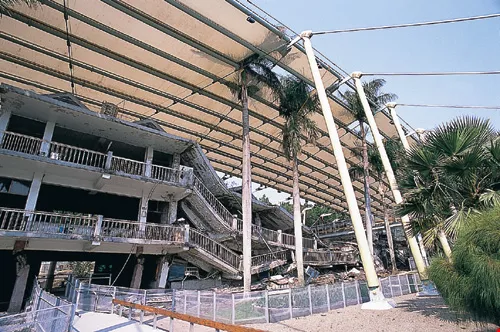
The northern classroom building collapsed from three floors into one. Preserved in their entirety, the remains of the building show clearly the destructive force of earthquakes.
Living proof
The architects' team took the concept of sutures mending a tear in the earth and carried it through the entire museum.
After some structural strengthening, the remains of the three-story northern classroom building, which collapsed as a result of the earthquake, also had a canopy installed over them on cables that were connected to piers installed in front of the ruin. A covered arcade that originally connected the north and south classroom buildings collapsed into a tight, sandwich-like mound of rubble. The architect was inspired to cut into the arcade, creating a little path, so that today tourists can stand in front of the arcade and look right and left to see cross sections of the compressed rubble. These views make it easy to imagine the force of the earthquake.
Museum director Hou Wen-chung remarks that today everyone sees the row of royal palms in front of the north and south classroom buildings and doesn't think twice. In fact, erecting the canopy without damaging these two rows of palms required a lot of work. "There was no reason to wipe out natural life that had been here for 30 years and had witnessed the earthquake," says Hou, who was intent upon preserving the palms.
To allow the tops of the palms to receive the warmth of the sun, so the fronds on top would continue to grow skyward, the architect created one-square-meter openings in the canopies. But how would these openings affect the strength of the canopy in a strong wind? It was an important point to consider during construction.
H. N. Chuang points out that the museum's utility lines and air conditioning systems are all buried underground. He estimates that foundation work accounted for about one-third of all construction time. When building the piers to support the canopy over the southern classroom building, they could not use heavy equipment such as bulldozers, for fear that the buildings would be damaged. "The base of the piers supporting the steel cables went three meters deep. Workers had to dig straight down to avoid damaging the roots of the trees. And while digging the holes, we were trying to prop up retaining walls at the same time." It was a very tense situation, similar to the atmosphere when rescue teams were trying to save people in the rubble right after the disaster struck.
On October 17, 2007 a major typhoon hit, and everyone was worried that either the canopy or the palm trees wouldn't be able to withstand the wind. But it resulted in absolutely no problems: the construction quality had passed a serious test.
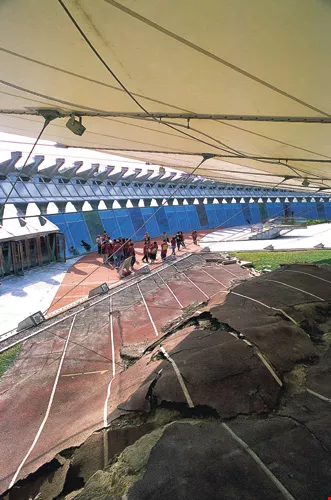
The steel cables symbolize surgical thread and the canopy a bandage that covers a wound on the earth. They remind everyone of the geological truth that people in Taiwan coexist with earthquakes.
Repository of seismic knowledge
Before even taking a full look around, visitors quickly sense that although the 921 Earthquake Museum was the site of a disaster, the mood is not at all heavy, miserable or gloomy. To the contrary, the museum is lively and surprising, with many educational and interactive exhibits that have helped it to attract over 1 million visitors.
Walking from the Fault Preservation Hall to the Earthquake Engineering Education Hall, one passes various hands-on interactive exhibits, where visitors can gain understanding about such concepts as earthquake preparedness and residence safety.
For instance, there is a demonstration of soil liquefaction. In a box of wet soil that resembles a child's toy visitors can place two structures with foundations at different depths. When an earthquake occurs, the sand and water in the soil become remixed and can no longer support the weight of a building. At this point, the depth of the foundation is a key to whether the house will sink into the loose surface when the ground begins to shake. These hands-on exhibits allow visitors to quickly understand why houses that aren't built deep enough may collapse.
What's more, do you know how Taipei 101, the world's tallest building, is able to withstand earthquakes and typhoons? The answer is a NT$130 million "tuned mass damper."
Taipei is located in a basin full of soft sediment, which can amplify the shockwaves of a quake. In combination with the resonance effect, this creates a high potential for damage. Any object, including a building, has a natural resonant frequency. If an external force such as an earthquake acts on a building at that frequency, the structure will sway with increasingly large movements. But if new buildings are designed to avoid resonance within the range of frequencies likely to be generated at their location by earthquakes, based on analysis of the geological conditions at the site, and if they are properly built to the design specification, then the extent of potential damage can be greatly reduced.
Taipei 101 has employed a new type of giant steel frame. At each of the four corners of the building there are two giant pillars, for a total of eight. Each is three meters long and 2.4 meters wide. These pillars were placed from five floors below ground to 62 floors above. High-density concrete was poured into them, and then they were reinforced with steel plates. This created a solid structure that is very resistant to earthquakes.
Many people may not know that Taipei 101, which rises to a height of 508 meters, has less to fear from a powerful earthquake than from strong winds, which are much more common occurrences. Consequently, the designers installed a tuned mass damper weighing 660 metric tons (730 US tons) between the 87th and 92nd floors. When wind causes the building to sway, this suspended damping ball lags behind the movements, counteracting the sway of the building. Complex as the concepts relating to architectural structure, earthquake resistance and wind resistance may be, models at the museum allow adults and children to immediately grasp why the skyscraper doesn't "rock" during an earthquake or in strong winds.
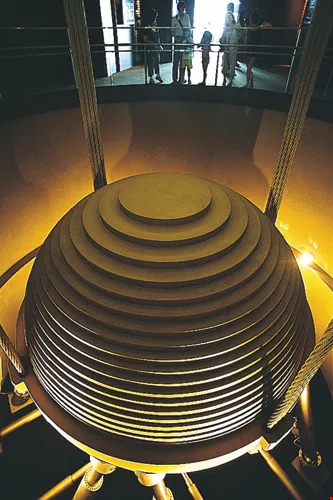
The inertia of Taipei 101's golden-colored 660-metric-ton tuned mass damper counteracts building sway caused by high winds.
Becoming a butterfly
Children are even more enthusiastic about the Hall of Images with its "Earthquake Simulation Area."
The space can hold a maximum of 20 adults with an average weight of about 60 kilos. After sitting inside, you experience ten centimeters of vertical and horizontal movement at the force of an earthquake that measures six on the Richter scale. Even though it is only for a short 30 seconds, it is enough to make children scream and adults to experience the terror of being in an earthquake. The force of the shaking is considerable.
In the Future Disaster Prevention Education Hall there is a "gopher hunt" game that aims to foster one's sensitivity to the environment. Other activities aimed at bolstering your ability to save yourself include "arm strength training" involving sitting in a chair and pulling oneself up using a rope connected to pulleys and gears. There is also a decibel meter that measures the strength of screams to give visitors an idea of how far their cries would carry in the darkness. It's all very practical.
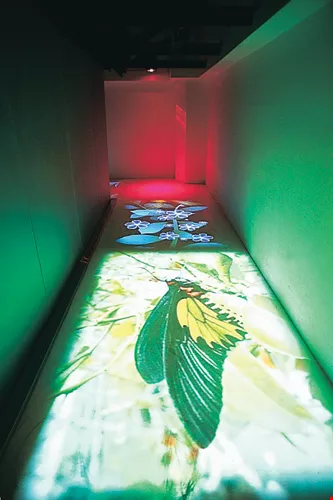
The last stop at the museum is to ascend the Baptismal Tower. Walking along a beautifully landscaped pathway that suggests the transformation from a caterpillar to a butterfly, you reach an elevator. As the elevator smoothly ascends, there comes the sound of water trickling from outside. As you approach the third floor, the skylight suddenly opens and sunlight floods in. One walks out onto the highest spot in the museum, where you can view Mt. Chiuchiu, its slopes once again green with vegetation, covered with grasses and sparse trees.
After three hours it is as if the body and soul have become elevated and better able to face some yet-unknown future natural disaster.
What is here before your eyes, exposed to the sun and the wind-every brick and tile, every tree and clump of grass-are the fruit of work put in collectively over eight years by the museum, architects, construction companies and community. They overcame daunting obstacles.
For instance, the route that was originally the fastest way to reach the museum passed by a nearby housing complex for former employees of the provincial government, and the residents protested, saying that the construction trucks and tour buses that constantly went by were disturbing their peace. But eventually, thanks to the help of the Ministry of Education, the museum acquired one hectare on the opposite side of the Kanhsi River, where it placed its parking lot and the museum's entrance. Although slightly out of the way, the location achieved a balance between the museum's operational needs and the peace of the neighborhood.
Sustainable operations
Fuhsing Elementary School, separated from the museum by only a wall, has also had to bear with eight years of construction noise. During that period, the construction companies also considerately scheduled noisy activities, such as piling work or the entry and exit of cranes, only for the afternoon hours, when only the older grades (and thus fewer students in all) were on campus.
The architect even constructed a footbridge shortcut next to "Fault Preservation Hall." Whenever students and teachers from the school want to enter the museum for a field trip, they can come straight in without having to take the long way around or ask permission from museum authorities. The museum has worked hard to be a good neighbor.
Hou Wen-chung, who recently retired as museum director, is most proud of the museum's landscaping: "When public facilities do a poor job planting their trees, they should definitely get marked down. And you can't rely on architects to plant trees." Hou studied forestry in college, and he says that early on he peppered the architect with questions about the plantings: What should the plants demonstrate? Should they flower? Should they provide shade? Should they have any particular habit? And then Hou himself chose the specific plants.
For instance, next to the bed of the Chiaotou River, they planted lantana and perennial morning glory. "Colloquially, earthquakes are known as 'the earth bull turning' and the Chinese name for morning glory is 'holding-the-bull flower,'" Hou notes. "Hence, planting morning glory has the symbolic meaning of tying down the earth bull, or stifling earthquakes."
"We can't help but feel grateful that the typhoons and floods that occurred during the period of construction didn't do a lot of damage. It shows that God wanted to preserve these ruins." Hou explains that these eight years have been a long series of struggles. If you want to give the 921 Earthquake Museum a definition, it's "concern and transformation." It is symbolic of the Taiwanese spirit.
"The greatest accomplishment of the 921 Earthquake Museum isn't its innovative structure, or the precisely engineered glass wall," argues Wang Chun-hsiung, an associate professor of architecture at Tamkang Univeristy. "Rather, from the standpoint of architecture serving as a treatise on the artistic use of space, the museum not only provides a beautiful conclusion to the new campus architecture movement that rose in the wake of the 921 earthquake, but it also establishes a new benchmark for architectural excellence in Taiwan."
And the visitors themselves are helping to create this new space. Carefully experiencing it is one of the best ways to memorialize the 921 quake.
Address: 46 Chungcheng Road, Kengkou Village, Wufeng
Township, Taichung County
Hours: 09:00-17:00, Tuesday-Sunday. Closed on Mondays.
Admission: Full price NT$50; special rates NT$30.
Tel: (04) 2339-0906, ext. 921
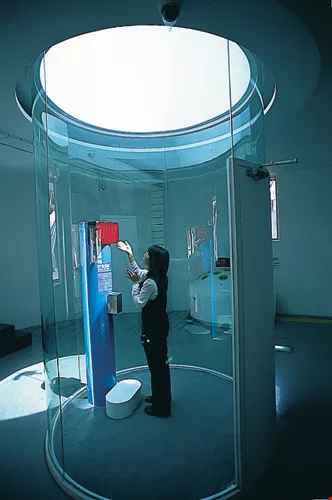
Among the interactive exhibits of Future Disaster Prevention Education Hall is one that measures the decibels of visitors' loudest shouts. It shows whether their calls for help from under rubble would be heard.
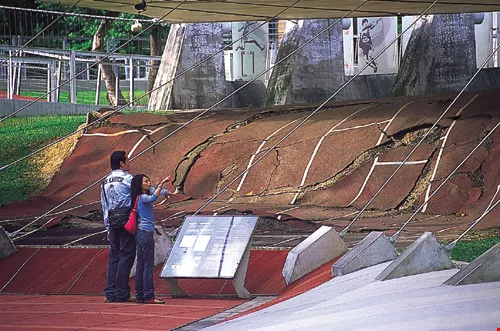
The 921 Earthquake occurred as a result of geological uplifting and movement along the Chelungpu Fault. The ground rupture here extended for 340 meters, from the river embankment, through the school's track oval, classroom buildings and gate, and north across the road. The Fault Preservation Hall (right) preserves the effects of the earthquake and links the present with the memory of the past.
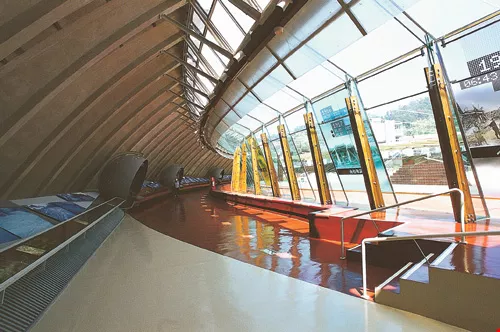
The architects marvelously took one of the lanes of the track and extended it through the 600-meter arc-shaped hallway of Fault Preservation Hall. It was a splendid way of bringing new life to the old track. The wall on the left in the photo is made up of 82 precast concrete panels.
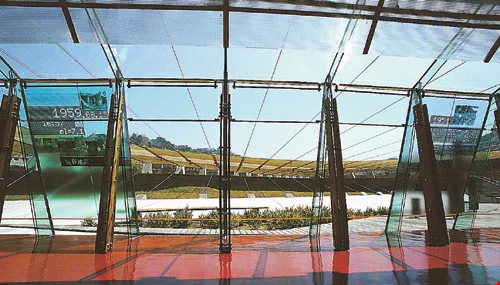
The 921 Earthquake occurred as a result of geological uplifting and movement along the Chelungpu Fault. The ground rupture here extended for 340 meters, from the river embankment, through the school's track oval, classroom buildings and gate, and north across the road. The Fault Preservation Hall (right) preserves the effects of the earthquake and links the present with the memory of the past.
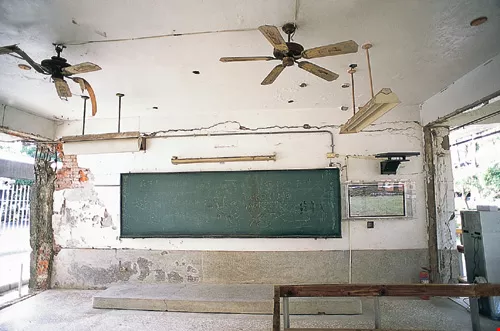
The southern classroom building of Kuangfu Junior High School was structurally reinforced to serve as a real-world exhibit. In conjunction with the various demonstrations about earthquake resistance in the Earthquake Engineering Education Hall next door, it gives visitors a clear understanding of why the school's buildings failed.
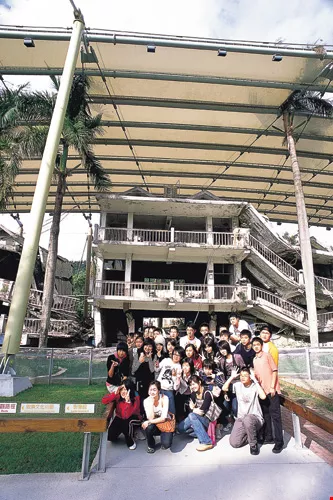
Over a million people have visited the 921 Earthquake Museum since it opened in September 2004. The museum examines how the people of Taiwan cope with the awe-inspiring power of nature.


@List.jpg?w=522&h=410&mode=crop&format=webp&quality=80)


