Investing in the Now: Generation Y’s New Consumerism
Chang Chiung-fang / photos Jimmy Lin / tr. by Josh Aguiar
April 2012


The “me generation,” the “broken generation,” the “debtor generation,” the “foolhardy generation”—these are all epithets that have been used at one time or another to describe the generation born in the 1980s that upon completing its studies has faced the unenviable task of working in a tenuous economy.
The good old days vanished long ago, and those who grew up amidst their affluence must somehow put aside dreams of luxury and steel themselves for lives of cautious frugality. In neighboring Japan the younger generation has adopted an anti-consumerist attitude; what will be the Taiwanese strategy for staying afloat in difficult times?
Of all the recent trends Japanese cultural critic Miya Mora describes in her book Otomen/Ari-jo, published last September, anti-consumerism stands out most.
The “anti-consumerist generation” refers to Japanese under age 30, individuals who entered adulthood amidst a deteriorating economy. That formative experience combined with the increased environmental consciousness of recent years has given rise to a youthful demographic that eschews name brands and expensive overseas trips, that refuses to be encumbered by mortgages or car payments, and that eats its meals with the reusable chopsticks it carries everywhere.

The affluence which surrounded them as children seems to have evaporated only to be replaced by a purgatory of frozen salaries and high unemployment. But today’s youth have found ways to cope with the gloom and angst.
At the helm of popular protest in Japan is veteran activist Hajime Matsumoto, the mastermind behind the artistic and activist collective known as “Amateur Revolt.” “Things have deteriorated to the point that we just have to find a way to live life according to our own rules,” Matsumoto commented.
Amateur Revolt, Matsumoto’s account of his leadership in demonstrations for free rent for the poor and protests against the use of nuclear power, has already swept Japan and Korea and was released this February in Taiwan. The book also instructs the poor in survival skills such as securing affordable housing, eating frugally, and taking advantage of mass transportation.
The Japanese are not alone in their indignation. Over the past few years the global economic quagmire has spawned waves of popular protest. In Britain and Spain, young people took to the street to complain about high unemployment and poor living conditions. In the US “Occupy Wall Street” movement, disenchanted youth camped out near prominent government and financial landmarks to rail against unequal wealth distribution, specifically how 1% of the population was controlling the majority of financial resources, indifferent to the plight of the other 99%.
In an anti-poverty march held on May 1 last year in Taipei, labor activists lay down for five minutes in front of a luxury apartment complex named “The Palace” in a gesture symbolizing the gulf between rich and poor.
No quarter of the globe remains unscathed by economic turmoil. Is it a foregone conclusion, then, that Taiwan’s youth will in time imitate the anti-consumerism of their Japanese counterparts?

Today’s discontented youth lament being “born into the wrong era.”
How bad are things really? What kind of odds does the “broken generation” face?
At present, Japan is contending with a number of thorny problems: an ageing population, government deficit, high taxes, and a young generation who will bear the cost of it all. How do things bode then for Taiwan, which is about 15–20 years behind Japan in its developmental trajectory?
Lin Thung-hong, an assistant research fellow at Academia Sinica’s Institute of Sociology, points out that Taiwan’s society is aging more rapidly than Japan’s. Its Gini coefficient is higher (indicating a higher degree of wealth inequality), as is its rate of unemployment, and its birthrate is lower—virtually every metric lags behind Japan. In the meantime, the problems of an impecunious young generation have already begun to rear up.
“Do you take me for a fool? Have I got nothing better to look forward to than to become a workaday stiff enslaved by a 30-year house mortgage living out a tedious marriage, so stressed out that he takes out his frustration on his kids?” Amateur Revolt author Matsumoto’s battle cry has aroused many sympathetic ears amongst Taiwan’s young.
In the popular idol drama Office Girls, which focuses on the lives of young career women, the central character’s stated aspiration is to be able to afford a home of her own one day.
But in actuality, how many young people these days are willing—or can afford—to pursue such a dream?
According to research compiled by HB Housing, the average age of first-time home buyers in Taiwan is increasing annually by one to 1.5 years. Last year the nationwide average was 36.2 years; in prohibitive Taipei the figure shoots up to 39.4.
One fellow with a master’s degree who had just entered the workforce lamented that his monthly salary of NT$30,000 was barely enough to cover his living expenses, let alone invest into real estate. When it comes for him to assume stewardship of his parents’ property, he’ll be paying for their nursing-home expenses. “There’s just no opportunity to save at all!”
From the time he was in middle school until he completed his master’s program, Xiao Chen, born in the 1980s, has practically never been without one job or another. After he was discharged from compulsory military service, his mother put NT$1.5 million down on a studio apartment. His ticket into the bourgeoisie cost a hefty fee of NT$12,000 in monthly mortgage payments, preventing him from enjoying leisure activities costlier than the occasional meal or karaoke night with his buddies.
Yang Shu-wei has been working for a little more than two years. Amongst his circle of friends, he is a bit of an oddball. He lives and eats his meals at his parents’ residence, seldom purchases new clothes, gets new shoes only when the old ones are falling apart, and only occasionally takes his girlfriend out for dinner. He strives to keep his monthly spending within NT$5000, either saving the rest or investing in various funds or savings insurance. Yet despite his thrift, he still regards home ownership as an unattainable pipe dream.
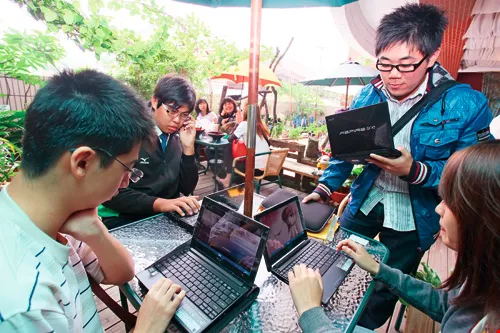
The affluence which surrounded them as children seems to have evaporated only to be replaced by a purgatory of frozen salaries and high unemployment. But today’s youth have found ways to cope with the gloom and angst.
Throughout Taiwan are more than 3.4 million citizens born in the 1980s. They grew up in a newly wealthy nation wanting for none of life’s basic necessities, but the society they’ve inherited as adults has lost some of that earlier vitality.
Hung Ching-shu, director of the Research Center of Working Poor at the Taiwan Labor Front, has labeled them the “debtor generation.” “Before they have a chance to get their finances together they’re already saddled with debt!” From the moment they graduate they encounter a working world fraught with demons: degree inflation, limited work opportunities, frozen salaries, and a widening gap between rich and poor. Their life plans are inevitably put on hold.
Lin Thung-hong of Academia Sinica says that 80% of young Taiwanese about to enter the workplace have bachelor’s degrees, and 26% have both a bachelor’s and a master’s or PhD. “A college degree is now the minimum threshold for employment. It’s degree inflation run amok.”
A Council of Labor Affairs study on first-year salaries of college graduates revealed an average of NT$26,500 per month. For those with master’s degrees the amount was NT$31,000. These numbers have remained unchanged from 10 years ago.
On top of that, employment and business opportunities are shrinking, to boot.
Lin explains that since 2001, the unemployment rate has hovered around 4–5%. For young people, though, the statistic is closer to 10%, and two years ago it even hit a dismal 14%.
Speaking of the entrepreneurial environment, in recent years the “birthrate” of new businesses has slackened while the “death rate” has continued to mount. In the past, the “birthrate” was 14% opposed to a “death rate” of 3–4%. The exodus of businesses overseas from 1999 on eventually brought those two statistics into equivalency. The amount of capital required to start a new enterprise has increased over the last 10 years or so by a factor of four. For Taiwan’s upstart entrepreneurs, it presents a formidable challenge.
These unfavorable circumstances coupled with a shift in values mean that young people are delaying everything from finishing school to marriage to raising families. And when people delay marriage or choose not to marry at all it carries ramifications for birthrates. “Producing offspring used to be a biological behavior; now it’s an economic behavior,” says Hung Ching-shu, who remains single at age 38.

Smart spending is tantamount to smart investment for this generation. Necessity has turned the young generation into slick and savvy consumers.
Even while prospects appear dim, the good news is that Taiwan’s young appear thus far to have staved off the lackluster consumerism crippling Japan. Crystal Lee, deputy marketing director at market research firm Eastern Online, maintains that, though Japanese and Taiwanese societies initially evolved along similar lines, their economic trajectories seem to have diverged around 2000.
Lee explains that after the roaring 1980s, Japan’s economy imploded, and it has remained anemic for 20 years. Young people born in the 1990s who grew up amidst their country’s economic tailspin have never felt anything but pessimistic about the future.
There doesn’t seem to be any exit from Japan’s woes, but in Taiwan, ever since the 1990s there have been two promising developments: the rise of the Internet and the rise of mainland China.
The time when Taiwan’s economy first began to stall, says Lee, coincided with the emergence of mainland China, which provided new opportunities for Taiwanese. The Internet, which really came into prominence in 1995, similarly illuminated new commercial possibilities. The under-40 Y Generation has availed itself of these two resources.
According to a social-change study conducted by Academia Sinica in September of last year, people born after 1970—i.e., people below age 40—go online far more often than their elders. People in their twenties spend an average of 3.5 hours compared to 2.5 hours for people in their thirties and a mere hour for people over 40.
“Going online is like breathing—it’s an appendage of daily life,” Lee says. The Internet has become youth’s main resource for everything from socializing, work, and communication to entertainment and shopping.
According to Institute for Information Industry statistics, last year the Taiwanese online market grew by 20% to a net worth of NT$430 billion, no doubt thanks to the sizeable contribution of the younger generation.
Japanese e-commerce colossus Rakuten’s Taiwan division revealed in market research last year that its two most reliable consumer groups were women aged 26–30 and 31–35.
The “broken generation” hasn’t lost its will to consume and spend, but the reality of reduced wages means that they’ve had to become savvier shoppers.
“For the children of the 1980s, consumerism is a way of life; in their scheme of things, smart consumption is tantamount to investing well,” says Lee.
Professor Lin Long-yi of Aletheia University’s Graduate School of Management Sciences observes in his article “The Six Secrets Influencing Consumer Habits of the New Generation” that isolation is one of the defining characteristics of the new generation of consumers. People can shop from the comfort of their homes—their own personal kingdoms—and receive their purchases through the post.
“This young generation of consumers is skilled at tapping the collective consciousness of the web,” says Lee. By searching the net for those who share their interests, they are able to make group purchases at a discount.
“They may not be especially thrifty, but they’re very clever about getting bargains,” she continues. Young people know how to sweep the net for pertinent information and to compare prices, and “the younger they are, the more adept they are at it.” Statistics culled from Eastern Online’s Integrated Consumer Profile databases indicate that 68.5% of shoppers aged 20–39 first read product reviews and compare prices online before committing to a purchase, a percentage notably higher than the 26.9% among the 40–64 age bracket.
Xiao Xuan is in her fifth and final year of college. Because she has enrolled in night classes, she has actually already spent a number of years in the workforce. Most of her hard-won earnings go into buying clothing and name-brand bags.
Over the course of the past few years, she’s amassed three classic-style Louis Vuitton bags and a wardrobe of clothes and shoes, the majority of which were purchased online. Department stores tend to be expensive, and street vendors’ wares are of unreliable quality; the web is the avenue that best allows her to pursue the haute couture flaunted in popular magazines.

Is today’s youth doomed to a lifetime of hardship and limited opportunities? Plagued by uncertainty, a resentful generation is demanding, “Who robbed us of our future?”
Though they may face diminished economic prospects, the generation born in the 1980s is nonetheless eager to maintain a level of material comfort commensurate with their affluent upbringing.
People were frugal in the past, opines Crystal Lee, because they were investing in their future. Today’s young people face a future so ambiguous that they’re not overly concerned with saving. Instead of setting money aside for purchasing a home or raising a family, they’re more disposed to spending on their personal interests and enriching their lives.
Just as Japan has given rise to “nesting” people for whom no price is too high insofar as their interests are concerned, and fujoshi, women who shun fashion but are obsessed with their hobbies, Taiwan has produced a generation “unwilling to spend the slightest amount to procure something uninteresting, but willing to devote a fortune to that which they desire.”
At the Taipei International Book Exhibition in February this year, one person shelled out NT$160,000 for comic books and other items, a record for the largest sum spent on a single day in the event’s history. Not surprisingly, the fellow was a comic book fanatic under age 30.
Lin Long-yi writes in his article that this generation “is more willing to pamper itself, to splurge as much as it can afford on luxuries such as clubs, name brands, and extravagant hotels.”
Xu Zhiwei, an engineer at Neihu Technology Park, nets more than NT$50,000 a month in salary and overtime, making him a “high roller” in the estimation of his peers.
He puts in extra time at work 20 days out of the month. There are days when he arrives at work at nine in the morning and stays until 11 or 12 at night. In his own words, the grueling work schedule is akin to that of a “high-level day laborer.” Perhaps the stress of his job makes him especially enjoy buying things, which he does freely and unstintingly. And while his schedule exhausts him, the moment he receives a call from a friend inviting him to get a few drinks at a pub, no matter how late the hour, he’ll still head over to let off some steam. “I have to consume a bit just to feel like I’m actually living!” he says.
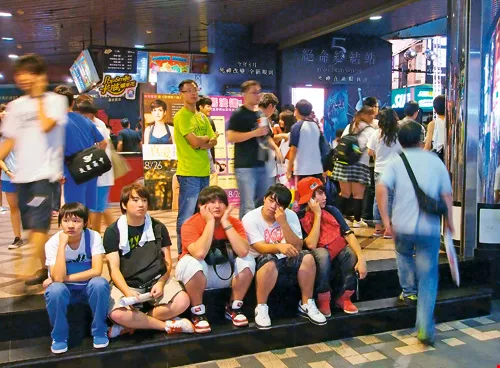
Today’s discontented youth lament being “born into the wrong era.”
“In the end, is consumption a sin or a virtue? I suppose it depends on whom you ask,” comments Hung Ching-shu. Whenever a new product hits the market, it’s always younger consumers whose curiosity is first titillated, and their enthusiasm that eventually infects the older crowd. A prime example is smart phones. Though originally intended for the business set, the games and networking abilities might as well have been tailor-made for younger users. Young people’s attachment opened the floodgates to such broad acceptance that “one wouldn’t glance twice at an older person playing Angry Birds on their phone.”
Taking stock of consumer apathy in Japan, perhaps it is simply a matter of the pendulum swinging away from yesteryear’s excesses. Then again, perhaps it reflects the current generation’s zeitgeist of living in the moment, frugality, and environmentalism.
Crystal Lee mentions how Japanese men are opting to pack a bento box meal to take to work or school instead of eating out. It would be understandable for those in the restaurant business to view this as an anti-consumerist activity, but the trend offers abundant opportunities to bento box makers, cookbook publishers, and manufacturers of small-scale cooking equipment. The economic benefit is there for the taking, so long as people have the acuity to recognize it.
In August 2011, Wealth magazine and 104 Job Bank conducted an intergenerational survey on employment and life attitudes in Taiwan. The report dubbed those born in the 1960s the “contented generation” because they had enjoyed the most economic opportunity. The 1970s generation, the first to contend with a slowing economy, were the “trapped generation.” The “foolhardy generation” of the 1980s, despite facing the bleakest prospects, was nevertheless sanguine about the future.
According to the survey, 76% of the young generation failed to put even NT$10,000 in the bank each month, and many in fact lived beyond their means; yet, 65% of them reported feeling optimistic about the future, the highest percentage of any of the surveyed groups.
Each generation must deal with unique challenges. Based on their experience of life’s long journey, the older generations regard today’s up-and-comers with no little concern.
Hung Ching-shu of Taiwan Labor Front believes that perceived fragility is one of wealth’s inevitable stages. “People seem to forget that even the 1960s generation was once denigrated as ‘strawberries’—pretty on the outside, but soft inside.” Weng Ching-yu of Career Consulting Company coined the term in her book Office Parable to disparage the baby-boomer generation that has since taken its place as the backbone of society.
In understanding the “broken generation,” perhaps inspiration can be drawn from Angry Birds. Just as each bird possesses its own unique power, so each generation has the unique potential to surmount the challenges it must face. So, lighten up, old folks, and quit your worrying—everything will shape up fine!

Smart spending is tantamount to smart investment for this generation. Necessity has turned the young generation into slick and savvy consumers.


@List.jpg?w=522&h=410&mode=crop&format=webp&quality=80)


