Penghu Rocks! Taiwan’s “Most Beautiful Bay” in the Limelight
Liu Yingfeng / photos Jimmy Lin / tr. by Phil Newell
June 2017
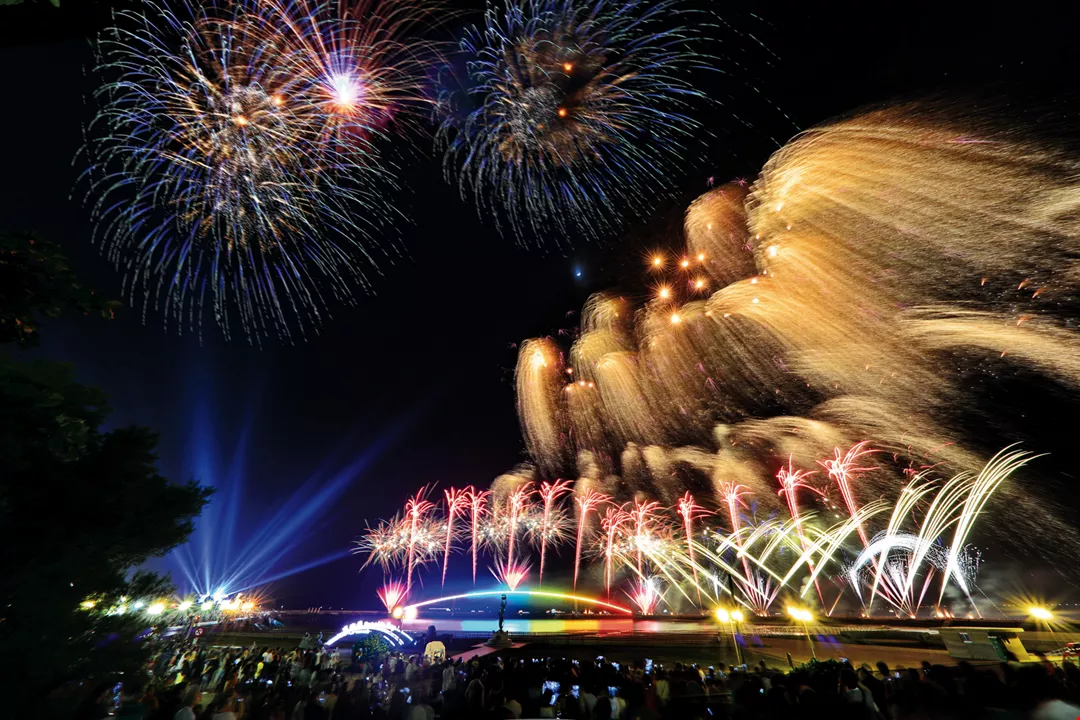
There’s a pop classic in Taiwan called “Grandma’s Penghu Bay.” The lyrics speak of the gentle evening breezes that waft over Penghu Bay, the white-capped breakers and sundrenched beaches, and of course the sea of blue, so blue. The Penghu Islands (also known as the Pescadores) attract tens of thousands of tourists annually, especially during the Ocean Fireworks Festival, and most can’t help but start singing “Grandma’s Penghu Bay” to themselves.
It would be a shame if the beautiful scenery of Penghu were to be enjoyed only by the people of Taiwan, which is why in recent years Penghu has been actively promoting marine tourism for visitors from home and abroad. Not only has Penghu joined the “Most Beautiful Bays in the World Club,” it will be the venue for the club’s 2018 annual meeting, providing a fabulous opportunity for marketing itself to the world.
Walk into the visitors’ room at the office of the Penghu County magistrate, and you will see on the wall a newly hung map showing the 40-plus member sites in 25 countries of the “Most Beautiful Bays in the World Club,” with iconic photos from each. Magistrate Chen Kuang-fu, Penghu born and bred, points to his home island on the map and says with pride: “With our pristine white sand and basalt geological formations, the scenery in Penghu is second to none of any ‘beautiful bay’ anywhere in the world.”
The hexagonal Daguoye Columnar Basalt is one of the hottest tourist attractions in the archipelago.
Wonderfully weir’d
There are six types of basalt formations in the world, and five of these occur in Penghu. Of the 99 islands and islets that make up the archipelago, all but one are composed of volcanic basalt. The one exception is Huayu, the easternmost, which is formed from andesite.
Penghu’s basalt configurations originated when volcanic magma cooled at different times and under different conditions, producing variations that include columns, folds, and faults. For example, the Daguoye Columnar Basalt—perhaps the most popular sight on the islands—comprises a series of hexagonal basalt towers, with sharply defined corners and edges. Then there’s Jingyu (Whale) Cave, located on Xiaomen Islet, where relentless erosion by the ocean has cut out a “sea arch.” Over on Yuanbei Islet, meanwhile, the basalt appears as radiating columns, looking for all the world like a pleated skirt.
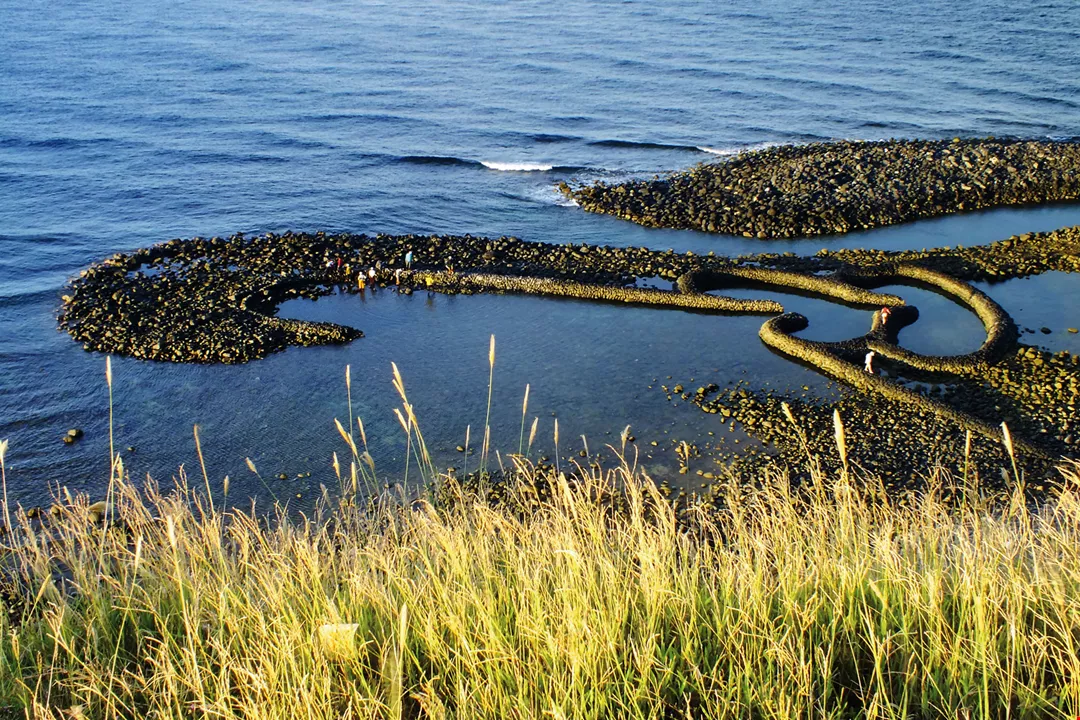
Besides the plethora of interesting basalt vistas, Penghu also boasts more than 500 stone “fish weirs”—tidal fish traps—scattered in the waters on the edges of the islands, revealing the ingenuity of Penghu’s early residents in catching fish.
The most famous of these weirs is the “Twin-Heart Stone Fish Trap” in Qimei, so called because it looks like two intertwined hearts. Some visitors mistakenly assume that the twin hearts were constructed by the county government as part of its coastal works to improve the islands’ appeal for marine tourism, but in fact these weirs date back 300 years. Fishermen came up with the brilliant idea of using coral stone, basalt, or other materials to build round pond-like structures in shallow water that would flood at high tide and then, when the tide went out to below the level of the stone walls, trap fish inside them.
But over time people stopped using this fishing method, and many of the weirs collapsed and disappeared. Given the traps’ wonderful scenic value, in recent years the county government has been investing in their preservation and renovation, for which they hired a team of local residents and craftsmen familiar with traditional weir-building techniques. The team has successfully preserved many of these beautiful structures, including the “Twin Hearts” and Jibei fish traps.

There are more than 500 stone “fish weirs” (tidal fish traps) scattered around the Penghu Islands, showing the ingenuity of early settlers on the archipelago. The photo shows the famous “Twin Hearts” weir in Qimei. (courtesy of the Penghu County Government)
Bay watch: The MBBWC
Tongpan Islet, Erkan Village, the “Moses Parting the Sea” sandbar at Kuibishan… there are interesting sights everywhere you go in Penghu. To encourage travelers to explore more fully all that the islands have to offer, Penghu plans to promote more “island-hopping” tours. Chen Kuang-fu explains that each of Penghu’s 99 isles has its own unique features, so there is great potential for island-hopping itineraries. As part of this effort, this year for the first time the “Ocean Fireworks Festival” will expand beyond the county seat of Magong, with events being held in all five other townships, including Qimei and Wang’an.
Besides continuing to expand land-based tourism, Penghu also plans to develop recreational boating. Penghu has 68 harbors (mostly fishing harbors but also a few military ones) that have been largely left idle by the depletion of coastal fish stocks and the lack of young people who want to work in fishing. Taking advantage of Penghu Bay’s terrific scenery, the county government has decided to transform some of these idle harbors into facilities for pleasure boating.
In June of this year, Penghu’s first yacht marina will open in Magong City, with berths planned for up to 55 craft. In the future similar facilities will be opened in Qimei, Wang’an, Xiyu, and Baisha. People who sail to Penghu will have a variety of options of scenic offshore islands where they can dock.
At the end of June there will be an event entitled “2017 Penghu Yachting Life,” which will serve as the formal ribbon-cutting for recreational boating in Penghu, and plans are in the works for next year’s Taiwan International Boat Show to be held here. Chen Kuang-fu relates that when the boat expo was held in Kaohsiung last year, it generated business worth NT$4 billion in just four days. He has expectations that the results will be similar when the venue is shifted to Penghu.
These events will not only promote development of pleasure boating in Penghu, they will serve as warm-ups for the annual meeting of the “Most Beautiful Bays in the World Club,” to be held in October of 2018.
Penghu launched its bid to join the MBBWC in 2010, and after two years of dedicated effort, succeeded in entering the organization. Membership has allowed representatives from Penghu to meet regularly with experts from other countries to exchange views on managing the marine environment and preserving seaside cultural assets.
In early 2016, at the annual MBBWC meeting in the Philippines, Penghu beat out Barcelona to win the right to host the 2018 annual meeting. Chen Kuang-fu finds this extremely encouraging not only for Penghu, but for Taiwan as a whole.
“Our biggest strong points were ecological conservation and natural scenery,” explains Chen. Despite the archipelago’s unique marine panoramas, Penghu has had few opportunities to advertise itself to the world. The 2018 MBBWC meeting will be a prime occasion for Penghu—and indeed for all of Taiwan—to strut its stuff on an international stage.
In addition to the activities related to pleasure boating, the events that will serve as preludes to the MBBWC meeting will also include an international food festival. Chefs from around the world will be invited to utilize down-home signature Penghu ingredients such as cobbler’s tack (Glossocardia bidens), a medicinal herb, and the cobia fish (Rachycentron canadum) to produce dishes that have that authentic “Penghu zing.” On top of all that, concurrently with the MBBWC conclave, Kaohsiung will host a meeting of the Global Harbor Cities Forum, inviting scholars from many lands to discuss issues of importance to port cities.
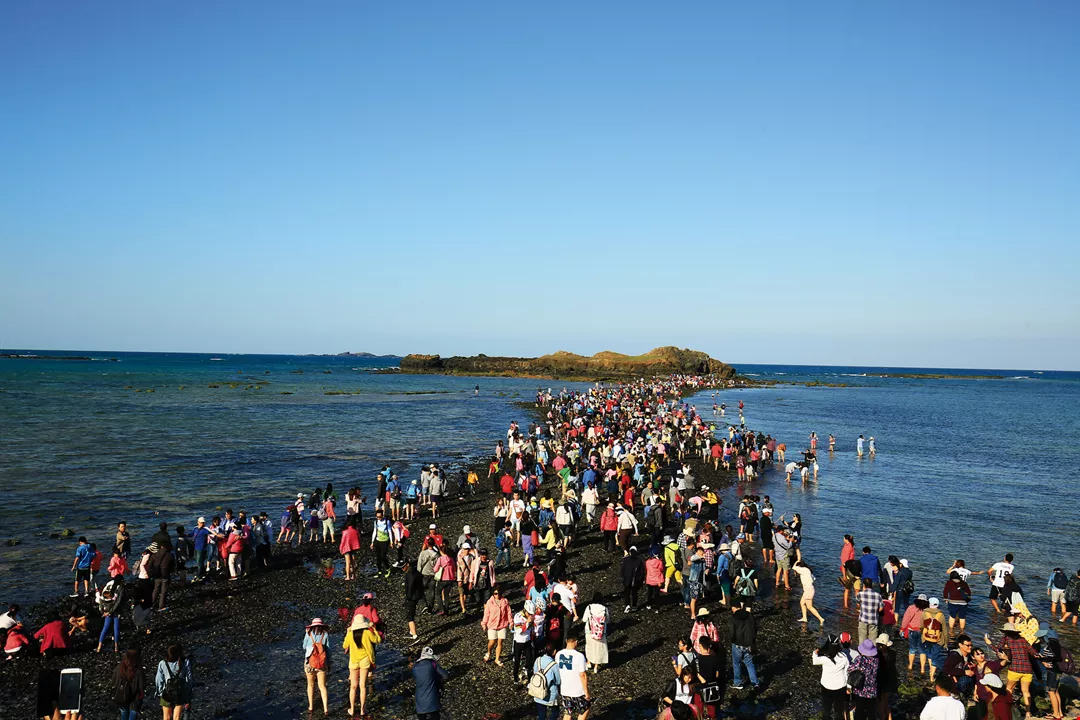
Visitors flock to Penghu in the summer, drawn by the richness of the natural vistas. The photo shows the “Moses Parting the Sea” sandbar in Huxi Township.

Culture and history too!
Penghu’s cultural and historical attractions are no less delightful than its natural ones. For many tourists, the best place in the whole county is the “Seven Streets” area that extends out around Zhongyang Street in Magong City.
Chen Kuang-fu notes that Penghu not only predates Taiwan proper geologically, but its history also boasts a number of “firsts.” For example, not many people know that before the Dutch built Fort Zeelandia in Tainan, they landed in Penghu and built a fortress at Fengguiwei in Magong.
In 1624 the Ming Dynasty responded by sending forces to dislodge the Dutch, who reached a negotiated settlement to withdraw to Taiwan. They dismantled their fort at Fengguiwei and shipped a great deal of the basalt to Anping in Tainan to be used in the construction of Fort Zeelandia. This explains how colonial walls in Tainan came to be built of Penghu basalt!
Another spot rich in historical significance is Magong’s Jinguitou Fortress Cultural Park, which opened in April 2017. Constructed in 1864, this former artillery emplacement was designated a national monument in 2011, and years of meticulous renovation work were completed in January 2017. It now is one of Penghu’s major historic sites.
For the future, plans are in the works to link together Jinguitou and nearby sites of interest, including Guanyinting Recreation Area, Duxing Tenth Village, Tianhou Temple, Magong Port, and several local fishing harbors.
The sun, sea, sand, and style of Penghu attract many travelers from home and abroad, with total visits topping 1 million last year. At peak season, it is hard to even buy an air ticket. But this year there is a new option for getting to and from Penghu. Following the opening of a ferry-boat service from Budai in Chiayi County to Magong, a ferry line from Longmen in Penghu back to Chiayi went into operation in April of this year. Chen Kuang-fu points out that no one had expected Penghu‡Chiayi round-trip services to be up and running for three or four years yet, so having them now is like a miracle! A one-way journey takes less than an hour, and there are seven sailings a day, with capacity of up to 300 passengers per journey. This should take some of the pressure off existing transport capacity.
It should be added that Penghu is more than just about tourism, and is working to develop other industries as well. Since 2011 Penghu has been cultivating the green energy industry, with the ultimate goal of becoming a low-carbon county. Magistrate Chen tells us that the winds are very strong during the winter monsoon season, making Penghu ideal for developing wind power, with generators able to run at full capacity for 3800 hours per year. There is also plenty of sunshine for solar power, and the future possibility to use the tides to generate wattage.
The county government has also been stepping up efforts to promote local fisheries and agriculture by creating Penghu brand names to differentiate their most outstanding products in the market. Chen says that they also intend to set up a traceability system to let consumers track the source of their purchases all the way back to the producers in Penghu, assuring quality and authenticity.
“If you come to Penghu you’ll find great seafood and so many scenic spots that it’s impossible to name them all. In fact, one visit isn’t enough—Penghu is worth visiting again and again!” Chen Kuang-fu strikes his chest as he speaks, signalling his assurance that you will feel the same way.
Penghu has not only natural attractions, but cultural and historical ones as well, such as this traditional settlement at Erkan.

The Penghu Ocean Fireworks Festival, now entering its 15th year, always attracts big crowds. (courtesy of the Penghu County Government)
Since 2011 Penghu has been striving to become a low-carbon county by developing green energy sources.
Penghu is promoting its own brands for its premium fisheries products, creating market differentiation for these items as they make their way into the hands of consumers.

Visitors gather on Guanyin Bridge to admire the sunset.