New Attitudes for an Old Bookstore--Kingstone Looks to the Literary World
Kate Yang / photos Tsai Chih-yang / tr. by Scott Gregory
October 2004


Kingstone has always seemed to be a bookstore for the masses, with most of its branches near train stations or in other busy areas. But the beginning of this year saw the official opening of its literary-themed "My Library" branch on Chienkuo South Road, near the Ta-an Forest Park. It may be a little out of the way, but its relaxed, sophisticated feel shows the new path Kingstone is taking.
Established in 1983, Kingstone is a pioneer in the development and modernization of the local bookstore industry, and with 92 branches, it remains a giant in the nation's bookstore industry today. However, with the rise of Eslite in the 1990s, Kingstone has been feeling the competition. Last year, Kingstone enlisted Neil Peng as its marketing and creative director, hoping to put a finger on the pulse of the cultural world and redefine the scope of its business.
"My Library" is only one step in the process, Peng says. Kingstone hopes to give the store the feel of a literary salon, with the greenery outside complemented by green interior design. "We want to let everybody know that Kingstone can do design, too," he states with confidence.
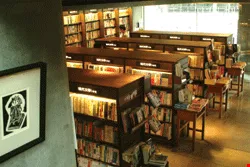
No other bookstore in Taiwan can compare with My Library's enormous space filled with literary works.
A place for literature
"In the 22 years that Kingstone has been in business, it has become strong in its organization. But literature is the foundation of all reading, and being one of the biggest booksellers in the nation, it makes sense for us to open a store devoted to it," says Peng.
There is no comparison in Taiwan for this huge space filled with literature. Even Eslite's literature section only carries around 10,000 titles, as opposed to My Library's 30,000-plus titles. For example, every issue of the literary monthly Unitas is available.
In addition to fiction, other categories are represented, such as nature writing, cooking, art books, feminism, and humor; if it falls under the broad definition of literature, this store's got it. Peng says that while many tourists from Hong Kong come to Taipei and "do" Eslite, My Library would be the best choice for book collectors.
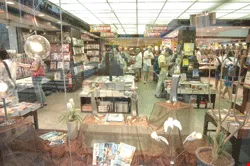
Neil Peng doesn't want to follow in Eslite's footsteps. With so many books out there, he feels certain Kingstone can find some interesting topics to make reading more fun.
A new look for Publishing Report
In addition to My Library, Peng has made another breakthrough at Kingstone-the periodical Publishing Report. This was originally a company publication similar to a catalog, which was simply laid out directly by the printer without any concern for design. Peng had it redesigned, adding some regular columns and allowing the editors to "mess around" with it. It began to draw the interest of customers with such features as covers designed by a different illustrator each month, with reading as a theme.
Peng emphasizes that the new version is produced with resources that were already on hand. Once the editors were provided a direction to go in, he could step aside and let it take its own course, and let the company progress to the next level. Sure enough, Publishing Report presented a threat to Eslite, which responded by transforming its own Eslite Reader from a free newsletter into a for-purchase magazine targeted at serious readers.
Peng says, "Eslite is at the top of the pyramid, having successfully combined reading and Yuppie culture. But it's also fine for Kingstone to take up the middle. In sales, I don't want to go the Eslite route. Since there are so many books out there, surely we can find some interesting topics to make reading more fun, and also lure passersby into our stores." He cites the example of Kingstone's yearly "Most Influential Book" awards. This year, he brought in friends from the theater and design communities, and made the awards ceremony more like that of a film festival. The show was a success, especially among his friends in the arts crowd.
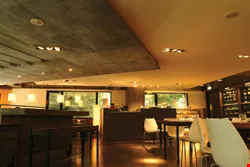
My Library is also a friendly, cozy spot for a leisurely cup of coffee.
Attitudes with books
From an outsider's perspective, Peng admits, while Kingstone may be the nation's oldest and biggest chain bookstore with its own long-term business model, he has long felt it lacked "personality" in its handling of books.
He often tells his co-workers, "Even if we're oriented toward general readers, we've still got to have personality. Then from personality, we'll develop attitude." As such large stores, Kingstone will have most any title, but the process of selecting and promoting recommended books is crucial.
For Mother's Day of last year, he developed a concrete expression of an attitude with books. Of the hundreds of titles suggested for Mother's Day promotion, most were cookbooks. But this list was a reflection of popular taste, and not of Kingstone's attitude. Putting up displays of cookbooks for Father's Day instead of Mother's Day would show attitude.
Peng explains that, despite the equality of the sexes and the division of labor, fathers rarely do the cooking, so it's fathers who ought to take a look at cookbooks in order to get with the times. On the other hand, most mothers can already cook, and might have neglected other areas of interest, so why not suggest for them books on health, finance, or parenting, and help widen their perspectives? This attitude also extends to other topics, such as that of single mothers. They might need information on legal rights, happiness, and self-respect. By offering titles on those topics, Kingstone can help them out, and at the same time bring attention to less-popular books.
For Mother's Day this year, Peng went a step further and stressed mothers' desire for romance-a breakthrough for the traditionally conservative Kingstone. As a result, his planner associates realized that broadening their product line, changing their promotions, and going upmarket with their brand brought growth to the company.
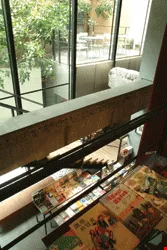
With verdant surroundings and a sophisticated interior, Kingstone's My Library has the atmosphere of a real literary salon.
From widgets to pieces of culture
Perhaps it was due to the parent company's industrial orientation, Peng suggests, that Kingstone used to treat books as widgets to be sold, and didn't think deeply about their relation to the act of reading. He saw that this needed rethinking, and that the presentation and content of books needed attention as well.
"Books are embodiments of culture, channels for spreading new knowledge and ideas, and readers are knowledgeable people." He points to Kingstone's old system of announcing two "strongly recommended books" a month. The books were business books chosen on purely commercial grounds, and didn't represent Kingstone's cultural view or attitude, so Peng changed the system. Now one book is chosen each week in each of three categories, literature, business, and miscellaneous, adding up to more than 150 books each year. This is an effective way to boost the sales of good literary works.
Since February of this year, every Monday afternoon Peng has gathered representatives from all departments of Kingstone to choose the three recommended books. Then, either Peng, new Kingstone team member author Lu Yu-chia, or Peng Shih-chen from public relations writes a brief explanation of why each book is essential reading.
The staff were for the most part habitual readers already but lacked the chance to think about and discuss books in depth, so they felt that these Monday meetings were a great benefit of their jobs rather than just more "work."
Over the year or so Peng has been with the company, it has already seen its fortunes start to turn. It has yet to reap great profits from the change, but it has seen the literature departments of many publishers pleased that Kingstone is selling more than just books about pop idols and finance. Their "new attitude" is turning heads, and this is Neil Peng's biggest contribution.
Neil Peng's New Creative Challenge
Formerly with the China Times, Neil Peng also has ample experience in film, theater, radio and television. He came aboard at Kingstone as marketing and creative director last year at the behest of an old college classmate, who is married to Chou Chuan-fang, general manager of Kingstone's parent company Kaosha Textile. Peng was given carte blanche at Kingstone, and brought it to life.
Neil Peng studied library science at university, and then went to America to study broadcasting in Connecticut. At that time, he also took a position as a translator for the China Times' North American edition. During his ten-plus years in America, he was heavily influenced by American talk shows. He has always believed that humor is a positive influence on a nation, and that parody is an artform.
Upon returning to Taiwan, he took a position as a writer at the China Times, developing a political satire column called "Report to Me." A big hit, it introduced satire to Taiwan as a new form of political commentary.
As for being labeled an "idea man" by the media, Peng feels that it was due to his being at the China Times at the same time as many other "freaks," such as Pu Ta-chung, Chang Ta-chun, and Liu Li-erh.
At that time, founder Yu Chi-chung gave the staff the freedom to use their imaginations and toy around in order to build the paper's name. They got mixed reviews, but Peng feels that in conformist times, only those who dare to go against the grain can create new cultural sensations and gain recognition.
Now the idea man is working for this old-style bookstore. Neil Peng has learned from his past experience. He feels that "creativity" develops after encountering different cultures and experiences, and seeing different sides of the world around us. Store fixtures can be updated overnight, but it takes time for a unique attitude to develop. Kingstone needs only time to find its own.
(Kate Yang/tr. by Scott Gregory)
Authors' Coffee Cups
In My Library's coffeeshop, there is a wall where authors' personal coffee cups are kept. Hoping that the authors will make themselves at home there and stop in from time to time for coffee, Neil Peng had them leave cups there. But it is not complete yet-he hopes that there will be many plaques with authors' names, and stories to go with them. And he hopes to one day hold mugs and wine glasses with writers' "drinking songs," so people can come by for a drink and a chat. He points out that in the West, many literary manifestoes and movements were born in pubs, coffeeshops, and salons. He hopes that he can develop such an atmosphere in Taiwan, a place where artists can interact and find inspiration.
My Library not only makes a cozy place for authors, but is also a friendly, comfortable spot in which all customers can enjoy reading. Peng remembers how he'd keep going back to certain used bookstores while in America. Each had something that got him hooked-a sofa, a chair in a corner, or maybe the impressive selection. As they were used bookstores, there was always something surprising or unexpected to be found. Peng hopes that this new store will provide similar memories for readers here.
@List.JPG?w=522&h=410&mode=crop&format=webp&quality=80)


