St. Mary’s Shouts Out for Retired Emigrant Doctors
Chang Chiung-fang / photos Chuang Kung-ju / tr. by Jonathan Barnard
October 2012


Residents of the Lanyang Plain used to refer to St. Mary’s Hospital Luodong as the “foreigner hospital.” Film director Wu Nien-jen, who has been helping the hospital with its fundraising campaign, explains that most injured miners in the Ruifang area would seek treatment at St. Mary’s. From a young age, he thought of the hospital as “run by foreigners who were good people.”
The story of St. Mary’s encapsulates the historical development of medical services in Taiwan. At first the hospital mostly treated people with tuberculosis and polio. Now it is caring for elderly dementia patients. Likewise, its foreign doctors, including Janez Janež, Davide Luigi Giordan, and Marinello Renato, have aged or passed away. If the hospital is to have a future, more Taiwanese doctors must be willing to take their places.
“Medicine is a field where people care for people,” says hospital superintendent Chen Yong-shing. “Without people, there isn’t medicine.”
Three years ago Chen moved diagonally across Taiwan from Kaohsiung to St. Mary’s Hospital. Now he is only able to return home to Kaohsiung once every two weeks, and the trip takes him nearly four hours. But Chen doesn’t consider that a hardship: “Foreign doctors came from Italy to St. Mary’s, where they spared no effort and even ended up being buried on the Lanyang Plain,” he says. “If they didn’t consider it too far away and never complained about not being able to go home, then where would I come off whining about being far from home?”
Located in Yilan County’s Luodong Township, St. Mary’s was established in 1952. In the six decades since its founding, the hospital has taken on the heavy burden of providing medical services to remote and often mountainous areas, including Datong and Nan’ao.
From 12 beds, the Roman Catholic St. Mary’s has grown to 600 beds.
Currently, Taiwan’s medical environment is changing rapidly, with a tendency toward polarization into hospitals that are either huge or tiny. In the middle, St. Mary’s is having a tough go of it.
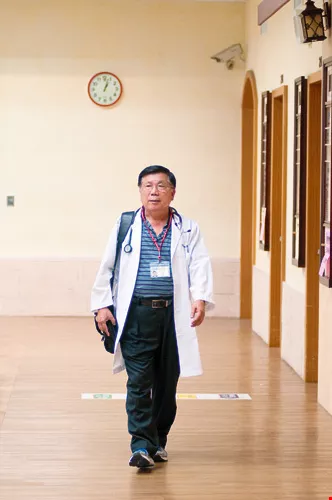
The hope of all of these returning physicians is to make a contribution to their homeland in their golden years. The photo at left shows doctor David C. Yang.
A lack of funds and personnel is the key problem. “The hospital has a staff of 1100, and it offers service 24 hours a day, 365 days a year,” notes Chen with a sigh. “But it doesn’t make a cent!”
When it comes to the financial deficit, donations can temporarily make up the difference. But the shortage of personnel leaves hospital administrators with a sense of hopeless frustration.
“It wasn’t until I had started work here that I realized that the biggest problem is finding doctors,” explains Chen. As Taiwan’s medical centers continually expand, remote hospitals are finding it extremely difficult to attract young doctors.
St. Mary’s is no exception. Its 30-some departments typically serve more than 2000 outpatients per day. But the hospital doesn’t even have 80 doctors in total, meaning that each department typically has only two or three. Consequently, the workload is onerous.
Chen points out that hospitals which are unattached to medical centers lack residents and interns, so that their staff doctors man all shifts. With two doctors, you’ll each have about 15 full days of shifts per month. “It’s best to have four doctors so that each has only about seven days of total shifts.”
By this standard St. Mary’s is short 80 doctors. Chen explains that young people aren’t willing to work hard, and all local hospitals are having trouble finding physicians. Even though doctors in Luodong are offered higher salaries, there is still a shortage of applicants.
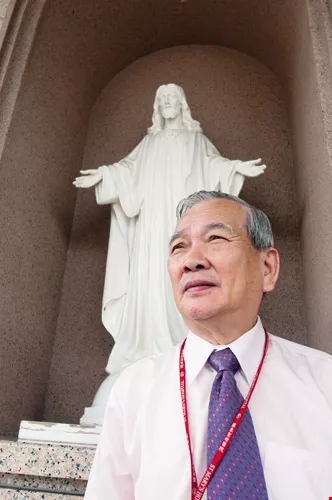
Doctor Swei H. Tsung, who is responsible for assessing biopsy slides at St. Mary’s, loves Taiwan’s night markets. After his retirement, he was happy to come back to serve in Taiwan.
Unsuccessful in its search for doctors in Taiwan, the hospital was forced to look abroad. Pathologist Swei H. Tsung is the first doctor that Chen was able to convince to return from the United States.
Two years ago St. Mary’s was having no luck finding a pathologist, and Chen kept his ears open for any news of one. Word came that Tsung, who had been ahead of Chen at Kaohsiung Medical University, was retiring in the US. Consequently, Chen invited him back to Taiwan to have a look at St. Mary’s. When Tsung agreed to work there, it was the first time the hospital was able to garner a commitment from a returning son.
Tsung had received comprehensive training as a pathologist in the US. After retiring at 60, he returned to Taiwan and worked for the Koo Foundation Sun Yat-Sen Cancer Center for a decade. But the taxing work left him always stressed and tired, so he retired for a second time and went back to America to enjoy the company of his grandchildren.
On a return visit to Taiwan, Tsung paid a visit to St. Mary’s and discovered that the hospital was larger than he had imagined, and that its equipment wasn’t too shabby. What’s more, it had an intensive care unit, a nursing home and a hospice—everything one might need during one’s last years. So he and his wife decided to return to Taiwan.
As for why he returned home once again, Tsung says, “We were able to gain perspective on what we really want out of the rest of our lives!”
“A lot of people in our generation,” he notes, “want to get back to their roots.” Tsung, whose sons and daughters-in-law are likewise physicians, says his children have established their own households and he doesn’t want to bother them. And he is only on a nodding acquaintance with the Americans he frequently encounters. Sometimes his life there felt lonely. But in Taiwan, people “speak the same language” and he can eat at night markets. It makes him feel content.
“After Swei H. Tsung joined, both the surgeons and internists were extremely grateful,” says Chen, “because he is quick with evaluations of biopsy slides, writes excellent reports and serves as a valuable educational resource.” Chen notes that the US has a lot of retired Taiwanese doctors. Taiwan, he argues, should try to “recycle those resources.”
Last August, at the invitation of the Taiwan Medical Association and the alumni association of Kaohsiung Medical University, Chen went to the US to raise money for a geriatrics building at St. Mary’s. Time and again, he made it clear that St. Mary’s needed people even more than it needed money.
“We could have raised the money in Taiwan,” Chen told an audience of retired doctors. “But what about those of you who left Taiwan after receiving your education there and have spent three or four decades in America. If you spend you retirement just playing golf or fishing, what a shame that would be! You ought to come back to Taiwan and make a contribution, even if it’s just for a couple of years.”
Chen’s remarks were like pebbles creating ripples in the minds of many of those doctors, and he successfully secured “donations” from two: pediatrician David C. Yang and emergency medical doctor Li Fangyun.
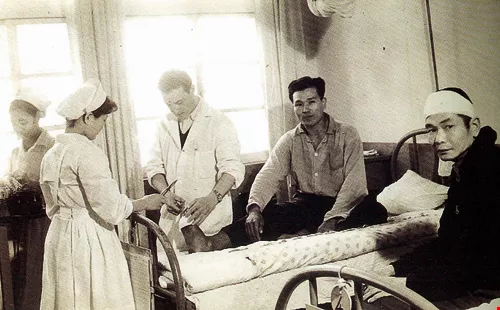
Love and compassion know no national boundaries. Brother Giovanni Petrin, from Italy, was Taiwan’s first male nurse. A winner of Taiwan’s Medical Contribution Award, he cared for the ill in Taiwan for over 50 years.
Yang, a pediatrician who has also received training in anti-aging medicine, graduated from China Medical University in 1969 and then served at the airforce hospital in Chiayi for a year before leaving for the US. In 1977, Yang went to Orange County, California, which enjoys spring-like weather all year long. He worked as a pediatrician there up until he retired four years ago.
“Originally, I thought I’d retire and enjoy a leisurely existence spending time with my grandchildren, playing golf, and going to church,” Yang recalls. “But it turned out I didn’t like that kind of life. I felt as if I’d lost my moorings.” He read an article in Time magazine that said there are two ways to find happiness: one is by following your dreams, and the other is by devoting yourself to a cause.
Consequently, Yang served as a physician in a poor area of northern California for six months, and on the weekends would spend time watching salmon fight their way upstream in rivers near the state capital of Sacramento. He saw hundreds of thousands of salmon pushing together to return to their birthplace and lay eggs and thus complete their life cycle. Their persistence moved Yang, and he began to entertain the notion of returning to Taiwan. When Yang heard Chen Yong-shing make a recruitment speech in Los Angeles, Chen’s call to return and serve Taiwan resonated with Yang.
“I lived in the US for 40 years, and my biggest regret was that I wasn’t providing a service to my homeland. I felt that Taiwan was calling to me.”
In April 2012, Yang returned to Taiwan to attend the 50th anniversary reunion of his class at the Affiliated Senior High School of National Taiwan Normal University, and he paid a visit to St. Mary’s. It was then that he resolved to return and contribute to his homeland. In the middle of July he and his wife came back to Taiwan together. On August 1 he began to see patients.
Moving from Southern California, with its year-round spring-like weather, Yang couldn’t help but feel a little out of sorts in the heat and humidity of Taiwan. And the street food, however delicious, twice upset his stomach, so he’s been forced to forsake that pleasure.
From being able to lavish 15 minutes on an average patient in the US, these returnees now have to change to looking for the best possible diagnosis in the shortest possible time in Taiwan. Moreover, the drugs prescribed in Taiwan are different—and that too requires a period of adjustment. But for doctors who are determined to return, those obstacles aren’t big deals. They’ll adapt.
“What makes me happiest is that I can communicate with patients in my mother tongue,” says Yang. “Just that makes me feel really good!”
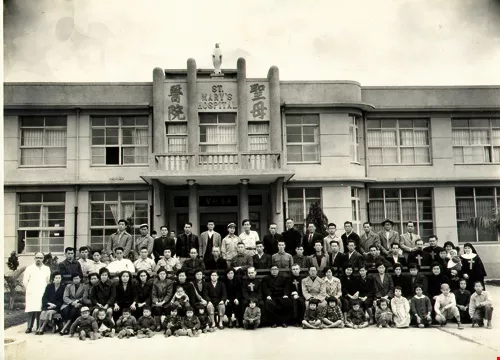
The surgery building at St. Mary’s in 1955, when the hospital had already reached a substantial size.
In the past 30 or 40 years, an estimated 1600 doctors have emigrated to the United States from Taiwan. At least 500–600 are nearing retirement age.
Many are passionate about wanting to return to give something back to their homeland, but there is a practical issue: When they left Taiwan, they lacked specialist certification in their fields and simply had medical licenses. Even if they went on to acquire specialist certification in the US, those credentials wouldn’t be recognized in Taiwan.
Chen points out that Taiwan’s medical specialists aren’t credentialed in a one-size-fits-all manner by the Department of Health. Instead, professional associations grant specialist credentials via rigorous tests that serve to control the number of practitioners. The situation often prompts hesitation among many emigrant doctors who might otherwise return.
In August of last year, after Chen Yong-shing returned to Taiwan from a visit to the US, he made a suggestion to the DOH: Since remote districts were finding it difficult to hire doctors, wouldn’t it make sense to encourage doctors who had gone overseas to come back? “They’re not returning to try to fight for jobs at medical centers, and they’re not here to open a practice. They just want to make a contribution in places where doctors are in short supply. Why can’t we make it more convenient for them?”
The DOH reacted positively. In its subsequently released medical reform plan, which includes four main orientations and 12 strategies, recruiting physicians returning from abroad is listed as a strategy for “providing better medical services to remote areas.” In the future, doctors returning from abroad will be able obtain specialist certification after working in underserved remote areas for at least three years.
Yang, who once served as Southern California chapter head of the North American Taiwanese Medical Association, explains that once the certification issue is settled many more Taiwanese doctors would be willing to return to Taiwan.
“Thank you for your love / Give me a chance to start over / The clouds above will keep me company / And angels will always be by my side….” The song “Boundless Love” captures the spirit of returnees like Yang.
“Right now there are only three, but I hope that 30 more will come back,” Chen says. St. Mary’s in Luodong is just the start. The ultimate goal is to have returnees fan out to underserved locations across the island.
“Remember that we trained these doctors ourselves. If we don’t ‘recycle’ them now, it will be too late in 10 years—because there’s no way the younger generation that was born and raised in the US is coming back to Taiwan.”
St. Mary’s Hospital Luodong, which was founded by foreigners, has contributed so much to Taiwan. As the foreign priests, monks and nuns that originally staffed the hospital grew old, locals gradually took their places. Now, with the lack of medical personnel in remote areas at crisis proportions, emigrant doctors have answered the call to return home. St. Mary’s is still demonstrating the power of boundless love.
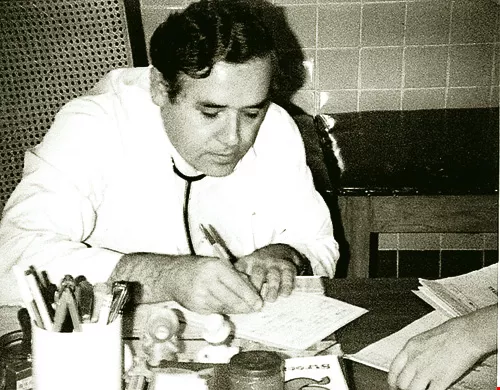
Father Antonio Didone, who once served as the head of St. Mary’s, was a pediatrician. In 1978 he founded an organization aimed at helping premature babies in Taiwan, which has saved countless newborns.
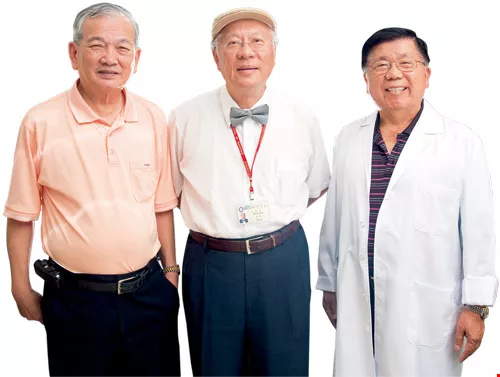
In order to ease the shortage of doctors, hospital superintendent Chen Yong-shing (middle) traveled all the way to the United States to look for retired Taiwanese doctors. He hoped to convince them to come back and serve their homeland.

@List.jpg?w=522&h=410&mode=crop&format=webp&quality=80)


@List.jpg?w=522&h=410&mode=crop&format=webp&quality=80)
@List.jpg?w=522&h=410&mode=crop&format=webp&quality=80)
