Tabalong: Cradle of the Amis Renaissance
Laura Li / photos Hsueh Chi-kuang / tr. by Jonathan Barnard
September 2002


The village of Tabalong is bordered by the Chianung River on one side and Fataan on the other. Far from a provincial road, this community of less than 5,000 seems small and peaceful. Yet it is remarkable for its "holistic community building." Earning the designation a "hotbed of creativity" from the Council for Cultural Affairs, it has obtained a NT$30 million grant over three years. With its accomplishments, it is serving as an index for holistic community building all across Taiwan.
When you speak of Tabalong, the image that floats into many people's minds is Tabalong Elementary School. Among the more than 3000 elementary and junior high schools in Taiwan, it is the only one with three Chinese characters in its name. The changing of its name represents one of the first shots fired in the battles of the 1990s movement to change names from Mandarin Chinese to native Aboriginal languages.
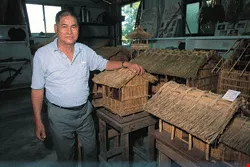
Traditional aboriginal buildings with their bamboo walls and thatched roofs are things of years past. But former chief Chou Kuang-hui has brought them back, one at a time, with his remarkable handiwork. These miniatures form a precious cultural record.
You can trace community development in Tabalong back to eight years ago when the "holistic community building" program had just been announced. Li Lai-wang, who was then serving as the Peifu Elementary School principal, threw himself into fighting for Aboriginal rights and reviving traditional Aboriginal values. When the school was renamed the Tabalong Elementary School, it caused a commotion around the nation. The cultural renaissance in Tabalong had begun.
In Li's view, Aboriginal peoples shouldn't find their values in mainstream Han Chinese culture. Instead, they should try to base them on their own natural gifts and develop their own special characteristics. In the Tabalong School, woodcarvings are everywhere. Li has also collected many legends and vocabulary items from village elders, transcribing them lest they be lost forever.
Collecting folk songs has also been a facet of the Tabalong cultural revival. These folk songs, which virtually no one was singing and which were on the verge of being forgotten entirely, have now been collected as educational materials. Students practice singing them and thus come to value their own culture. The "Old Folk's Chant Group" is still one of the most representative of Tabalong's cultural assets.
Though the school has only about 350 students, it has produced several famous professional baseball players, including Chen Yi-hsin, Wang Kuang-hwei and Wang Kuang-hsi. The Tabalong girls' soccer team has traveled to Europe on several occasions, where they have won international championships for their age group.
With strong cultural self-awareness, holistic community development in Tabalong has gone smoothly from the very beginning. And as in Fataan, wood carving was used as a starting point.
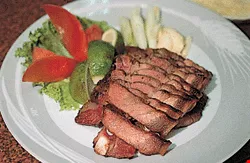
Mouthwatering authentic Aboriginal food: salted wild boar, hearts of vines and okra.
"The Amis had no writing, so they recorded things with images," says Lin Heng-chih (Diluo-an), who runs the Tabalong Humanities Workshop. "They would take admirable figures from legends and tribal history and carve them into tableware and sheaths of swords. They also carved puppets, which were often given to a sweetheart as a token of affection."
Interestingly, in 1995, when the first Tabalong carving class was held, all of the students were women.
Chen Chun-hua, who was one of the students in that first class, recalls that her classmates were all idle housewives, who had heard that the "handsomest man in the village," Wu Hui-ming, was teaching the class. Hearing that they could sit around drinking and chatting, they thought they might as well give it a try. Even though the class was scheduled for 7:00 to 10:00 in the evening, everyone would wait to watch the 8:00 p.m. television serials before ambling over, children in tow.
Chang Cheng-wen, another graduate of the first class, recalls that there were always a bunch of toddlers around. After crying and fighting, they'd settle down-only to say that they wanted to go to bed. Despite everything, that busy group of chatty women showed determination to finish the class. Over the last six years, they have thrown themselves into carving more and more. It has gotten to the point where they can't stop themselves.
The success or failure of holistic community building is tied to the sustainability of local industry. Because wood carving's costs are high and competition intense, Chen Chun-hua and Chang Cheng-wen have turned from leather and ceramic carving to putting traditional totem designs on ceramic tableware and modern designs on leather objects. They've been making a good living at it.
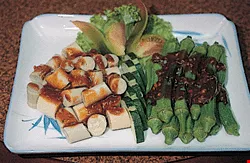
Mouthwatering authentic Aboriginal food: salted wild boar, hearts of vines and okra.
"Tabalong has always been a place famous for ceramic carvings. There was even an area in the village that was called Atomo or 'ceramic jars,'" says Lin Heng-chih. In order to distinguish its products from the ceramic beads for which Fataan is famous, Tabalong reached a communal understanding that it would focus on ceramic tableware. There is a rough, earthy quality to its work, which is quite unlike delicate and elaborately painted Han Chinese ceramics. It conveys an elemental and unadorned Aboriginal style.
"In the future, when the production of millet wine here matures, then we want to supply matching containers, which we will market all across Taiwan," says Lin.
Yet right now the Amis lack a standard process for manufacturing alcohol. Many brew it, but few, if any, do a good job. Frequently it's sour or mildewed, so that most of the villagers themselves imbibe the rice wine produced by the Taiwan Tobacco and Wine Board whenever they hold a party. As for manufacturing the ceramic vessels, because they lack the money to buy kilns and money for technology and for research and development, they are now stuck at the stage of doing things by hand, so they are unable to produce on a large scale.
"I often wonder: how can we get culture to pay for the food on the table?" asks Lin Heng-chih. That's the key question: How to get local industry to modernize as fast as possible, so that Tabalong makes a name for itself but doesn't grow excessively commercialized?
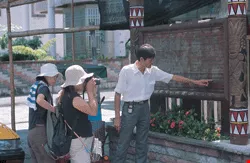
The village of Tabalong is known as one of the Amis' pearls. Its reputation brought these two young Japanese women, who are hunting for photo opportunities.
Apart from manufacturing arts and crafts items, Tabalong, like Fataan, hopes to become a travel destination. In contrast to Fataan's swamps, Tabalong offers a more quiet and peaceful kind of village scenery.
The tourist activity is centered on Chienkuo Road, on either side of which are forests of wooden carvings the height of people that offer visitors a quick introduction to carving in the village. The Tabalong "tribal classroom" at the side of the road is designed inside and out to look like a traditional dwelling. In the afternoon a few elderly women while away their hours here in this familiar space, chatting, their memories flowing.
Chou Kuang-hui, a former tribal chief who fondly recalls the intimacy of communal living, hopes that the younger generations won't forget their ancestors' wisdom. Since he has retired, he's spent every day in the workshop, painstakingly assembling thin pieces of bamboo and arranging straw to construct realistic models of various traditional buildings: typical residences, a chief's house, a village meeting house. Each structure is different. Chou's self-funded workshop and cultural artifacts hall has become another must-see for tourists coming to Tabalong.
Looking toward the future, Lin Heng-chih says that once he gets a sizable chunk of money for renovations, he wants to repair Kakita-an, Tabalong's ancestral shrine. Located at the center of the village, this building was originally where the chief lived, and it was also the lodge where the young adults of the village would gather. As the place where official discussions about inheritance, religious ceremonies, land and property were carried out, it was rife with symbolic significance.
In 1958, when Typhoon Grace ripped through here, the shrine was blown down, and the original structure was taken north and reconstructed for a cultural artifacts exhibition by researchers from the Academia Sinica. At the original site, all that remains is tall grass and a tablet marking where bones have been buried.
Rebuilding the shrine would symbolize that the ancestral spirits were being honored by the village. It's a big project that many are eagerly awaiting. For the people of Tabalong, who have been taking firm and prudent steps on the path of holistic community building these past eight years, completing it would represent another cultural renaissance.

Lin Heng-chih was originally a reporter. Returning home to gather material for an article, he ended up getting involved in "holistic community building" in Tabalong. He's been working on it ever since and now serves as a spokesman for the program here.
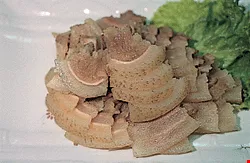
Mouthwatering authentic Aboriginal food: salted wild boar, hearts of vines and okra.

@List.jpg?w=522&h=410&mode=crop&format=webp&quality=80)


