Cultivating Hope for a Lost Generation
Wang Wan-chia / photos Hsueh Chi-kuang / tr. by Geoff Hegarty and Sophia Chen
June 2011


Teenagers going astray, wandering the fringes of school and society, unthinkingly labeled as dropouts. They have mean tempers and have often suffered terrible trauma, and they're learning to grow up. They suffer wounds that must be fully healed before they can be completely accepted by society, so experiencing hard work and gaining self-affirmation from farm work could signal a new beginning.
It's early summer around the mountain areas of Pinglin, New Taipei City, and several young farmers are at work on their farm. Xiao Jie, 15 years old, is rearranging pots of maidenhair fern to make the most of the sunshine and watering. Nearby, colleagues Ah Gou and Xiao Ya are filling small pots with peat soil mixed with perlite ready for planting.
"We specialize in potted plants, and because of our cold, wet climate here, it's especially good for ferns. These are maidenhair and Boston ferns, and that's crab cactus and spider fern," says Bee, a young man aged 20, the most experienced of the farm's young workforce.
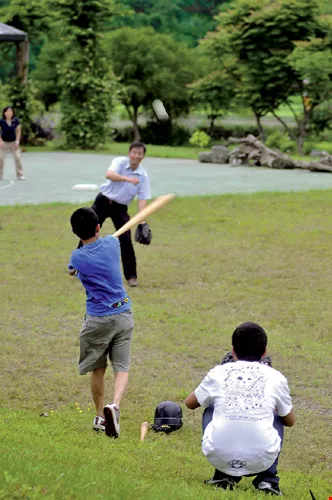
Organic farming, social services and physical activity are all part of De An School's diverse program. The school has developed a curriculum to suit all tastes in a fun learning environment.
The farm of approximately one acre set around a mountain stream was established by social group Elim Young in 2009 as a shelter to provide help and counseling for young people in trouble.
Qiu Mingguo, the farm's initiator and the director of Elim Young, explains that the name comes from the Bible, meaning an oasis in the desert. The Elim Young institution, established in 2004, works with the Taipei City Government, providing transitional education services. Over the past seven years, the institution has helped more than 100 teenagers who are having problems in the mainstream education system. An attempt is made to rediscover their interests in learning and establish peer friendships.
After they complete junior high school with Elim Young, some students choose further study, some continue part-time study and work, and others head directly into the workplace. According to Qiu, finding a job can be a trial for both the youth and their potential employers.
In the eyes of many managers, these 15 to 16 year olds are still basically kids. Once employers discover their backgrounds, all the old negative stereotypes emerge. They worry that if they give them a job, they may cause trouble-like a bomb waiting to explode-so many are simply unwilling to take the chance.
Most of these young people come from dysfunctional families, and suffer from a lack of social skills. Even if they manage to find a position, they are often blamed for their low level of professional skills and poor working attitudes, or are unable to meet the basic requirement of getting to work on time. And if they have disagreements with their employers, they often throw in the job without a second thought.
However, if they are unable to get a job and live independently, they tend to become involved with criminal activities like drugs, selling pirated DVDs, and prostitution. And once they embark on such a lifestyle, it's difficult to escape. It's a very familiar and very sad story, repeated again and again in cities all over the world.
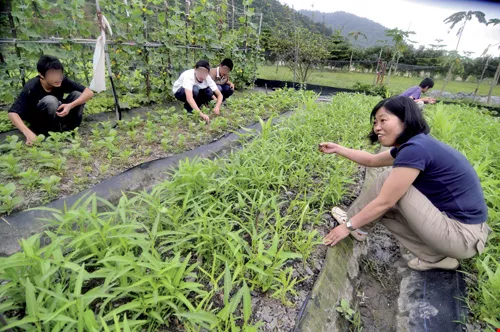
Organic farming, social services and physical activity are all part of De An School's diverse program. The school has developed a curriculum to suit all tastes in a fun learning environment.
In order to make a change, in 2009 Elim Young borrowed money to buy a piece of land and agricultural equipment from a retired farmer, setting up the farm as a first step towards providing help to teenagers in trouble.
Qiu notes that using a farm to help young people experience the life of a workplace community is still an experimental concept in the field of youth counseling. However, compared with the rapid pace of a normal workplace, if they make mistakes on the farm, they are much more likely to be forgiven. And they have the added advantage of learning farming skills and a professional attitude to work. At each planting, they experience the joy of expectation, and harvest time, there is a great sense of accomplishment.
Since the beginning of the project, these young farmers who weren't familiar with farming have all willingly contributed their limited skills to every area of farm work, including repairing a rusted greenhouse framework, building a greenhouse, mixing soil, seeding and fertilizing. However, because of the limited transport to and from the farm and the small number of social workers available, the farm currently takes in only four to six teens a day. So although the farm has been running for more than a year, a great deal of work still needs to be done, and much more support from social services is required.
"I've changed a lot since I came to work on the farm," says Bee shyly. Before the change, he led an idle lifestyle, with no particular goal to pursue. He stayed at home and slept till late almost every day, or went motorbike racing with friends. Bets would be laid, and the gamblers watched from each side of the road. Bee decided to get out of this environment and make new friends. He worked part-time in a restaurant, but quit the job after an argument with his boss.
"The pay's not very good on the farm, but I feel OK and I'm now more careful with money as it all comes from my own hard work. I also need to keep on an even keel and think about what I really want to do," says Bee with a shy smile. He has in fact gained some farming experience, and has chosen farming as his career goal.
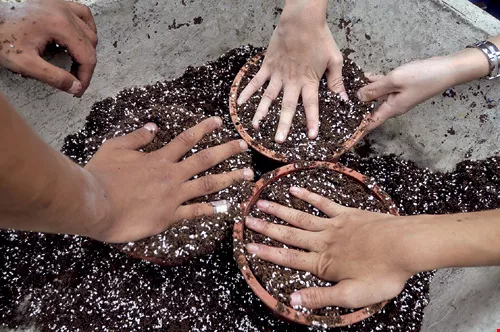
Elim Young's director Qiu Mingguo (second from left) leads a group of professional volunteers and counselors. For more than seven years, they have guided many teenagers through rebellious episodes in their troubled lives.
Yilan County's De An Family Care Association, established in 2008, is another institution that runs a diversified study program by combining farm work experience to help youth in trouble.
The association's executive director Li Jianqing cites the example of De An School, with just over an acre of land, located at Dongshan Township, Yilan County. The land was donated four years ago by a local benefactor, and the goal was to create an enjoyable learning environment which the students will never want to leave.
The school's curriculum is very diverse. Besides providing regular junior high school courses, other activities such as baking, pottery, carpentry and cycling form an important part of the program. The school also assists local social welfare groups to provide care for the needy. A highlight every summer is for a group of eight to 15 students supervised by five teachers to climb Mt. Xue and have their graduation ceremony on the peak.
School director You Meizhen says that the farm, which comprises a substantial portion of the school's land, is designed to provide opportunities for young people who are unable to adapt to mainstream education. They experience not only the true meaning of hardship in cultivating the land, but also the joy of harvest time.
"Getting them to work willingly on the farm is certainly not something that can be achieved overnight." Yu says that every year they listen to new students' complaints that farming is both boring and too hard. The teachers often just continue working quietly as an example to the students. And so the young people are eventually encouraged to become a part of the workforce. When they see the results of their labor becoming dishes for their lunch, and being purchased by consumers, they gradually gain interest and take responsibility for the farm work. These young teens who arrive at the farm with closed hearts not trusting anyone, like hedgehogs covered with sharp spines to protect themselves, gradually shed their spiny armor and open themselves to friendship.

For many lost youth, a little understanding and care is all they need.
In February 2010, the school set up a business in Luodong Township, Kachalu Cafe, designed to teach students service skills such as making drinks and coffee, and create a work ethic to prepare them for future employment.
Each cup of coffee represented one small piece of hope-the name "Kachalu" comes from an indigenous language of Colombia, and means "hope." But for a social welfare group, running a business is not that easy, involving a lot of time and manpower. In order to maintain its focus on its original training strengths, the association reluctantly closed the cafe early this year.
Li Jianqing, who has been counseling teenagers for nearly 20 years in Yilan, notes that at present Taiwan has about 5,000 teenagers who have dropped out of junior high school. And because the country in recent years has been moving towards an M-shaped society (a polarized society with extreme rich and extreme poor), the problems for disadvantaged kids, especially in rural areas, have become more pronounced.
In many disadvantaged families where parents have to work very hard just to maintain basic living standards, parents lack the time to spend with their kids, and in some cases their children are experiencing failure in the early stages of their lives. Not only will these factors influence their future development and limit their opportunities, but it will also be very difficult for them to escape from the cycle of poverty.
From Li's counseling experience, he finds that teenagers who are unable to adapt to society and who display deviant behavior, in general have experienced poor academic performance at school, have low self-worth, and lack self-confidence. The reasons may often be found in their upbringing where they were usually the targets of constant criticism, continually blamed and rarely praised. As a result, they gradually come to despise themselves and develop low self-esteem, in addition to developing a borderline personality.
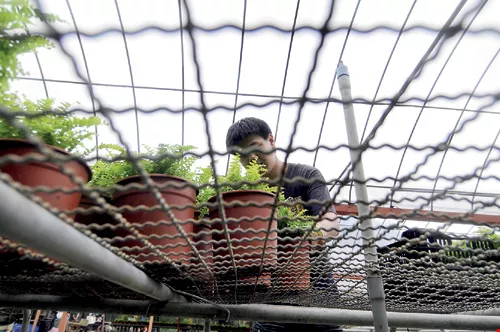
The young people may not be familiar with farming, but they do everything necessary by themselves: from repairing a greenhouse framework to mixing soil and sowing seeds. High-quality potted plants produced by the Elim Young farm have been sold to major flower markets in Taipei, as well as being available for individual purchase.
Counseling aims to provide young people with the freedom to view and choose from different perspectives, helping them to discover their strengths, and eventually to turn away from the path towards becoming what people tend to regard as "troublemakers."
Ah Hui, now 17 years old, graduated from De An School last year. He is in reality a tall, strong young man, but he feels small. After his parents divorced, he lived with his mother's family, but it didn't feel like home. He even worried about being criticized for eating too much at mealtimes, and instead of going "home" after school, he would hang around Internet cafes playing computer games.
His impulsive and aggressive personality is simply the result of this cumulative bitterness. Every time a teacher corrected his behavior at school, he would make offensive remarks to the teacher, until ultimately he dropped out.
After he was referred to De An School through an educational counselor, his character gradually softened, and now he is grateful. He takes the initiative to help his grandfather, aged over 70, do the farm work. He also finds that although he is unable to concentrate on study, he has one advantage: good health. He not only shares the work running the family farm, but he's also become an apprentice carpenter.
"They're a group of kids lacking love and care," says Yu Meizhen. For most kids, receiving care from parents is a natural part of life, yet for these troubled teens, it's a rare happiness. "So we have to encourage them to find their goals in life, to contribute more, and as a result they will be able to envisage a future for themselves."
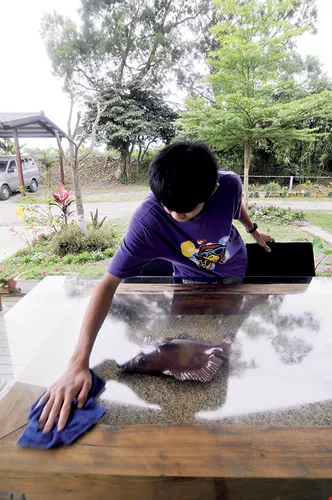
Organic farming, social services and physical activity are all part of De An School's diverse program. The school has developed a curriculum to suit all tastes in a fun learning environment.
Because of the lack of care and their frustration in the school system, these lonely rebellious teenagers have become isolated from family and school, but they should never be abandoned by society.
Examining the annual social welfare budget from the Ministry of the Interior, expenditure on youth counseling accounts for only 1-2% of annual funding (about NT$70 billion). And because of the limited resources, few social groups are able to devote attention to youth counseling.
For example, Elim Young, with nine full-time counselors and an annual intake of 25 to 30 students, needs about NT$8 million in funding per year. At present, 50% of this comes from government subsidies, while the remainder is provided by private organizations such as Yonglin Foundation, and minor donations.
According to data from the Directorate-General of Budget, Accounting and Statistics, there are about 1,620,000 teenagers aged 15 to 19 in Taiwan. Unemployment rates in this age group are around 11%, double the national average of 5%. According to the DGBAS' Human Resources Survey, since 2000 about 150,000 teenagers have entered the employment market annually, but approximately 20,000 have been unable to find a suitable job and have become unemployed. Of these 20,000, a small number go on to study at night school in a senior high school or senior vocational school, but most become "NEETs"-young people not in education, employment or training.
Ye Dahua, secretary-general of the Taiwan Alliance for the Advancement of Youth Rights and Welfare (TAAYRW), points out that youth unemployment is a major issue and a priority globally.
At the end of 2008, the National Youth Commission (NYC) launched the Youngsters' On Light Project. Students undertake courses such as career exploration, experiential education and employability competence training. Then work placements are arranged for students according to individual aptitudes and interests. A wage of NT$100 per hour is paid by the NYC. Nearly 900 people have participated in this program, and about 80% of the participants have entered the permanent workplace or returned to school as a result.
Since 2009, TAAYRW has cooperated with FamilyMart to launch a Disadvantaged Teens Training Program, providing career counseling, work placements, apprenticeship opportunities and the chance to do work for charity organizations. The program has helped 200 teenagers, who were neither studying nor working, to either find employment or return to school.
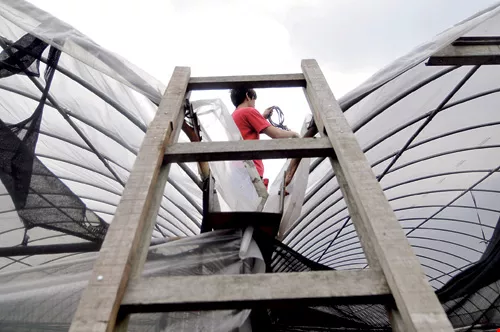
The young people may not be familiar with farming, but they do everything necessary by themselves: from repairing a greenhouse framework to mixing soil and sowing seeds. High-quality potted plants produced by the Elim Young farm have been sold to major flower markets in Taipei, as well as being available for individual purchase.
Ye stresses that for a long time, Taiwanese society has had a poor record in protecting the rights of children and adolescents. Society tends to regard the provision of support for disadvantaged children and adolescents as charity, rather than an essential duty of society. Children and adolescents must be regarded and protected as our most important social asset. If society cannot come to terms with these concepts, with all the social workers in the world to help them, the problem will never go away.
"Youth counseling is essential work with a high return on investment," says Qiu. Preventing these lost lambs from going astray and taking to crime is the best way to reduce future social costs. "These teenagers still have a long life ahead of them. If we spend the time looking after and counseling them, it will bear fruit for them and for us. It's a lifetime thing!"
The teenage years signal the most dramatic changes in any person's life. It is a critical period between childhood and the adult world. Because of concerns about who they are and where they're going and labels put on them by an unthinking society, many of today's teenagers are struggling to stay afloat in the great torrent of life. They need our support, and both Elim Young and De An School are planting the seeds of hope on their farms.
Note: Some of the images accompanying this article have been altered to protect the identity of minors.
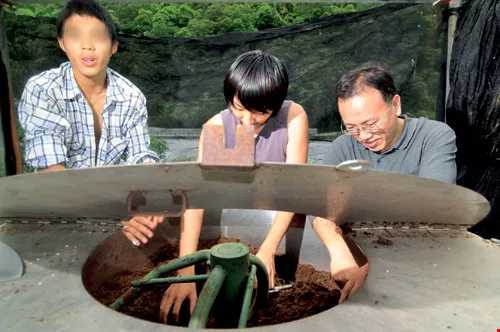
The young people may not be familiar with farming, but they do everything necessary by themselves: from repairing a greenhouse framework to mixing soil and sowing seeds. High-quality potted plants produced by the Elim Young farm have been sold to major flower markets in Taipei, as well as being available for individual purchase.
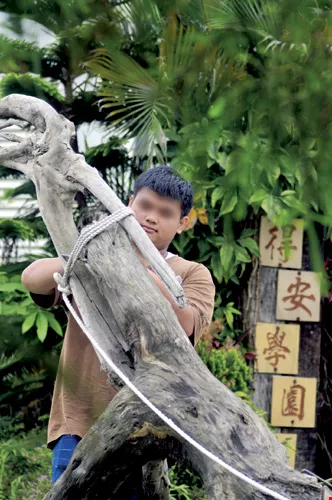
For many lost youth, a little understanding and care is all they need.
@List.JPG?w=522&h=410&mode=crop&format=webp&quality=80)

@List.jpg?w=522&h=410&mode=crop&format=webp&quality=80)


