Bantou Village Revitalizes Memories of a Bygone Era
Pamela Teng / photos courtesy of Ding-cai Garden / tr. by Scott Williams
March 2011


These last few years, families have been coming from all over Taiwan to visit Bantou, an old farming village in Xin-gang, Chiayi County. Young couples keen on photography have also been turning up to look for the "hide-and-seek girl" mentioned on so many blogs.
Like so many other agricultural communities, Bantou fell into decline with Taiwan's shift to an industrial economy. But by offering visitors glimpses of a long-lost childhood, the place has acquired a new luster.
Bantou Village's tour of the rural childhood of yore begins with a ride on a small train that runs on the road rather than on tracks. Pulled by a "locomotive" that is a converted car, the three-carriage train takes visitors on a whistle-stop tour of Bantou's streets that stirs long-forgotten memories.
What calls up these images of days gone by?
Bantou's streets, walls, parks, embankments, and even random corners offer glimpses that bring a light to the eyes and a smile to the lips.

It's all part of Bantou's "every family has a story" program, which has created images of animals and playing children on walls and corners all over town. Working water buffaloes, white herons, scampering sikas, and colorful candy trees decorate walls, hinting at what lies on the other side, be it a farmer's home or a candy factory.
Jointly crafted by Bantou residents, elementary-school students, and craftspeople, the ceramic images give a glimpse of local culture and awaken the inner child in visitors' hearts. These installations have sparked the community's rebirth.
Xingang Township is the original source of two traditional Taiwanese handicrafts: koji pottery and jiannian, forms of temple decoration that respectively use sculp-ted ceramics and cut tiles. Railways arrived there during the Japanese-era sugar boom. Ban-tou, at the intersection of the Jia-bei Line and the sugarcane-carrying Lunzi Line, soon became a hub. But when times changed and the railway lines fell into disuse, the sun set on Bantou's prosperity.

Bantou residents have given their once desolate-looking community flavor and character with a rustic barn, a "poet's walk" beside the paddies, and an old-fashioned bus.
Such declines are common in rural Taiwan. Bantou's distinctiveness comes from its residents' unwillingness to sit by and watch their community die. They put their limited resources to use rebuilding in an attempt to prevent their village from simply fading into memory.
They began this act of "self-preservation" with community redevelopment efforts that revitalized Bantou's aging facade.
A wooden plaque on the way into the village reads, "Believe that one day the trains will return." Weathered by the elements, the handwritten plaque isn't especially eye catching, but when you enter the village you realize its words express more than a goal; they also tell a story about belief.
The train has long been a vehicle for the memories and aspirations of the villagers. The first sugar train passed through -Ban-tou in 1911. When passenger service began in 1917, it bore Ban-tou into its heyday. People and money flowed endlessly along what was then known as the Wufenzi Line.
But time rolls faster than a locomotive. When Taiwan's economy began transitioning away from its farming roots, the sugar industry went into decline. Rail traffic decreased, jobs became scarce, and residents began leaving in search of a better life.
After the little train was finally shuttered in 1982, the villages along its route quickly withered. As Bantou slipped into decline, virtually everyone except the sick and the elderly left. The prosperity of the old days came to seem more legendary than real and no one wanted to hear about it anymore. At least, no one until the "Three Idiots and One Nutcase" entered the fray.

Bantou residents have given their once desolate-looking community flavor and character with a rustic barn, a "poet's walk" beside the paddies, and an old-fashioned bus.
The "Three Idiots and One Nutcase" are four individuals who have been rewriting the story of Bantou. Chen Ming-hui, the first of the "idiots," was the first leader of the Ban-tou Community Development Association and created Ding-cai Garden. Chen Zhong-zheng, the second "idiot," is the founder of Ban-tao-yao, a local crafts studio. Huang Shuis-hui, the third "idiot," is a local historian. Chen Jian-xun, the "one nutcase," is a tour bus operator.
Chen Minghui jokingly calls himself the "ringleader." He grew up in Ban-tou and, saddened by its decline, decided to become involved in community redevelopment. To that end, he began slowly rebuilding the village of his memories, while also providing comfort and care to the village's elderly. The fruit of this labor is his Ding-cai Garden.
"Everyone says community redevelopment is difficult," says Chen, "but I thought, 'How hard can it be?' I got it started and discovered that it wasn't hard at all once you got it rolling."
Dingcai Garden, which aims to recreate the living environment of Taiwan's farming communities in the 1940s and 50s, originally housed the community development association and elderly care center. Once it had acquired a more complete collection of period objects, community members got involved, building or renovating a school auditorium, a dry goods store, a peddler's stall, a bridal chamber, a pig-barn restaurant, and even a bus station. The new facilities drew growing numbers of visitors, who came to the village to enjoy a stroll down memory lane. They also made it a popular location for TV programs and commercials.
Once they had rebuilt the long-abandoned bus station and ticket counter, the villagers gave an old bus a makeover and began using it to provide passenger service. Once they had the bus running again, Chen Ming-hui had an even bolder thought: bring back the train!

Bantou has also put a tremendous amount of work into recreating the "ecology" and living experience of an agricultural village. Pictured here, children feed a water buffalo.
Chen's "gutsiness" made this seemingly impossible ambition real. Residents rooted around in the mud to find discarded track and ties to re-lay the Wu-fenzi Line. They even managed to rebuild the station using old beams as materials and old photos as blueprints. Along the way, they also received help from the Soil and Water Conservation Bureau of the Council of Agriculture and negotiated a lease for the land from Taiwan Sugar.
Chen's enthusiasm got residents involved and infected Chen Zhong-zheng and Huang Shui-shui as well.
Chen Zhong-zheng has made it his business to preserve and promote Xin-gang koji and jian-nian, running his Ban-tao-yao Crafts Studio as both a tourist factory and a handicrafts studio. Chen's goals are to introduce traditional handicrafts to a wider public and to use everyday experiences to bring Taiwanese closer to their traditions.
Chen Zhong-zheng and Chen Ming-hui put their heads together and came up with the idea of shaping Ban-tou into an arts community focused on koji and jian-nian. "I was always thinking about ways to take koji and jian-nian out of the temples," says Chen Zhong-zheng. "I wanted them to depict not just the usual subjects-loyalty, filiality, moral integrity, justice, birds, flowers, and mythic figures and beasts-but more personal and intimate scenes."
Their idea won support from the Council for Cultural Affairs, enabling Chen and Chen to buy materials and hire workers. The whole village threw itself into turning Ban-tou into the kind of community where every family had a story. They also worked on making it into an arts village that made handicrafts a more vibrant, contemporary part of everyday life.

Bantou residents have given their once desolate-looking community flavor and character with a rustic barn, a "poet's walk" beside the paddies, and an old-fashioned bus.
Huang Shuishui, a long-time student of history who also researches folk customs, worked with the Chens on ideas and implementation. He also established the Old Riverway Studio to allow visitors to make woodblock prints of images from old Ban-tou that Huang himself had carved.
Near the studio, Bantou Brother harks back to the good old days with its old-fashioned brown-sugar ices and dessert soups served up at equally old-fashioned prices.
Drawing on his experience with tour buses, Chen Jian-xun, a non-native Hakka resident of Bantou, spent two months converting a car into a shan-zhai replica of a train. Ban-tou residents now watch happily as "their train" tools around town, a symbol of their dreams made real.
Bantou has in effect been reborn. In recent months, the village's list of collective dreamers has grown to include Su Shili and Su Guo-zhang, the executive director and deputy executive director of the Ban-tou Community Development Association. Both men moonlight as volunteer tour guides, introducing visitors to Ban-tou's story about the power of belief.
Walking through Bantou you can't help but be moved, but you also worry on the community's behalf. The success of its "memory lane" tours depends on people having the same memories and experiences of youth. But today's kids are far removed from the decades the village recalls. If Ban-tou is to go on growing sustainably, it might benefit from expert assistance in working up development plans that wouldn't depend just on tourism and nostalgia, but would attract visitors interested in the village's slower, simpler way of life, or even in settling or retiring here.
Bantou's residents are keeping their noses to the grindstone. Having proven that nothing is more powerful than belief, their mantra has become: "Every community has its story, and what's gone can still be with us." In a sense, this belief is both the foundation and the guarantee of Bantou's future.
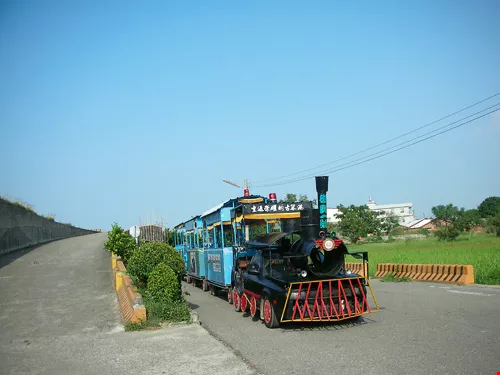
The reborn shanzhai ("knock-off") train may have only three cars, but it carries memories of childhood all around Bantou.
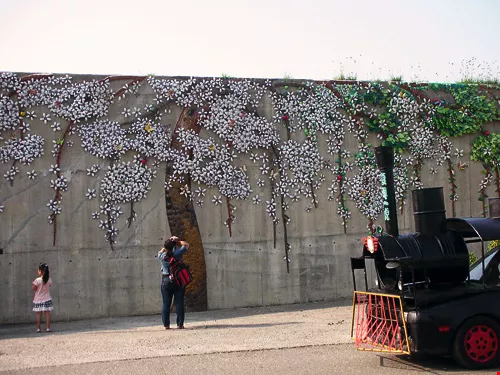
Polishing up Bantou's hard edges has helped revive the community. In the photo, a tall concrete wall has been spruced up with pottery flower blossoms crafted in the jiannian style. Passing visitors always stop for a better look or a few photos.


@List.jpg?w=522&h=410&mode=crop&format=webp&quality=80)


