Smartphone Apps Change Travelers’ Experience
Sam Ju / photos Chuang Kung-ju / tr. by David Smith
February 2013


The Tourism Bureau, a division of the Ministry of Transportation and Communications, successfully launched a popular new mobile app last year called Tour Taiwan, and since that time the bureau has been working hard to increase the app’s utility. Beginning perhaps as early as March, tourists arriving from overseas will be offered 10 days of free Internet access, which will encourage travelers equipped with mobile devices to share the sights of Taiwan with the world.
A Mr. Jiang, who loves traveling and especially enjoys visiting historic sites, still recalls the enormous Lonely Planet guidebooks that he lugged around several years ago on trips to the pyramids of Egypt and Angkor Wat in Cambodia. The sheer weight of the books remains fresh in memory even now.
This year, when Mr. Jiang invited a Canadian friend to visit Taiwan, he implored his buddy to dispense with a guidebook because after getting to Taiwan he’ll be able to immediately apply at the airport for free Internet access and then use his smartphone to download the Tour Taiwan app, which has all the information a traveler could want on tourist destinations, travel connections, accommodations, and restaurants.
-14.jpg?w=1080&mode=crop&format=webp&quality=80)
Family-run guesthouses are among the most charming tourism assets in Taiwan. A lot of visitors from Hong Kong, Macao, and Southeast Asia ask specifically for these accommodations. Shown here is Cheng Hiu-tung (right) of Hong Kong, having fun with the proprietor of a guesthouse in Nantou.
The Tour Taiwan app was planned by the Tourism Bureau, designed and developed by Chunghwa Telecom, and can be downloaded via either the App Store or Google Play in both Chinese and English versions. Since it was rolled out last June, it has been downloaded more than 300,000 times.
At this early stage, Tour Taiwan only offers information on 800-plus tourist destinations, most of which are big and well known.
Chao Chih-min, a section chief at the Tourism Bureau, says that Tour Taiwan will be integrated in February with a tourism database that they started working on two years ago. Once the two are combined, the app will offer information on over 6,000 sites of interest, including little-known locations throughout Taiwan. The database will be updated as local governments provide new information, which means the app will be a very reliable resource for independent travelers who come to Taiwan.
Regardless of where you may be in Taiwan, all you have to do is open the Tour Taiwan app and you’ll immediately acquire a GPS position fix. With this data in hand, you can easily find information on places near your current location.
A Ms. Nakamura, who traveled on her own in Taiwan late last year, logged onto Tour Taiwan after finishing up a visit to Chiang Kai-shek Memorial Hall and found that the Miniatures Museum of Taiwan was located nearby. She hadn’t noticed the museum in her guidebook, but the app explained that it was the first miniatures museum in Asia, and the second oldest in the world. Moreover, it houses the world’s biggest collection.
Ms. Nakamura exclaimed: “I was so happy that I didn’t miss such a nice place!” But she did feel that Tour Taiwan could be made a bit livelier in its presentation.
She said that a tech firm working on contract to the Japan Tourism Agency late last year launched the Hello Kitty Travel App, which features a separate Hello Kitty for each of over 50 different cities. The one for Tokyo holds a basket full of cherry blossoms, while the Hello Kitty for Kyoto is dressed in a kimono. And travelers can make mash-up photos in which they pose together with the Hello Kitty of the city they’re visiting, thus adding to the fun of traveling.
“When foreigners see Hello Kitty, they think of Japan.” And therein lies a key element of tourism marketing in Japan. Hello Kitty is the most eye-catching cultural symbol of Japan, while mobile apps are the soul of a smartphone. Put the two together, and a traveler gets unlimited utility in a very fun package.
The Tourism Bureau has followed up on Tour Taiwan with the launch of the Night Market app, another tool that packages culture to promote tourism.
In recent years the Tourism Bureau has been surveying the spending and travel habits of foreign visitors, and found that night markets are among Taiwan’s most popular tourist destinations.
Night Market is a virtual reality game much like Happy Farming (a big hit in Taiwan) or SimCity, and has been downloaded over 400,000 times to date. Chao explains that players have to read a bit of tourist information before they can get on with the game, which involves setting up street stalls to sell food.
Chao acknowledges that the use of these apps for marketing is still very much in its infancy, and most downloaders live right here in Taiwan. However, after the lunar new year, tourists arriving from overseas will be provided free mobile Internet access bundled together with a Tour Taiwan account.
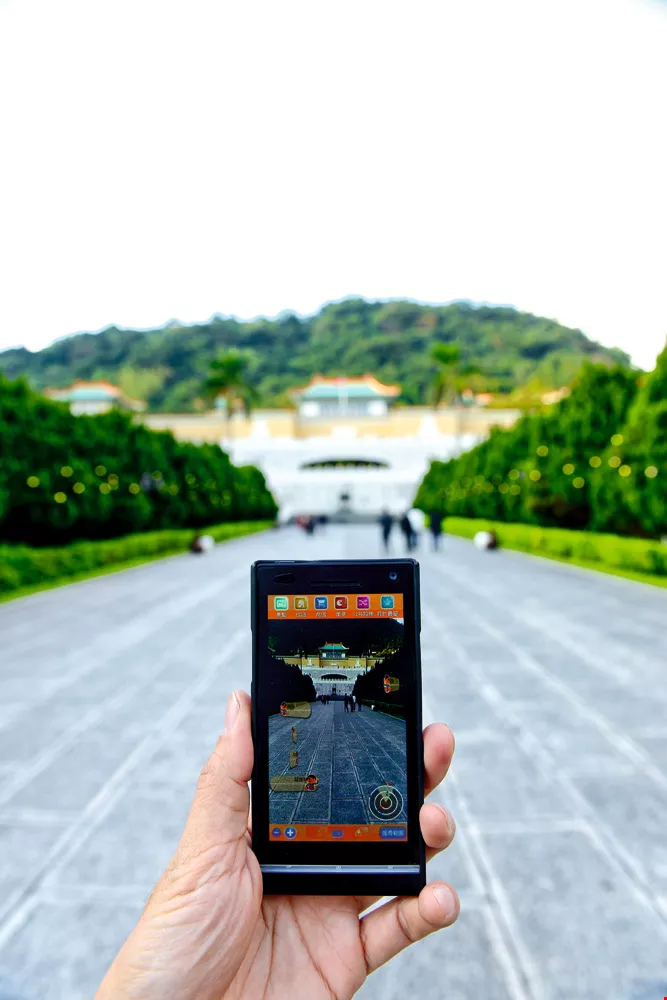
Mobile apps have emerged as an important tool for improving the traveling experience. Shown here is the Tourism Bureau’s Tour Taiwan app, being used by a traveler to find the way to the National Palace Museum.
The Tourism Bureau intends to take full advantage of mobile communications and cloud computing to market tourism in Taiwan. In the near future, foreign tourists will be able to use the iTaiwan network developed by the Research, Development, and Evaluation Commission, as well as the Taipei City Government’s Taipei Free network, to go online free of charge.
In addition, the Tourism Bureau also plans to incorporate Chunghwa Telecom’s WiFi hotspots into its system. The two sides are now discussing the details. The Tourism Bureau will fund the undertaking so that travelers can have a free WiFi connection for their smartphones.
The Tourism Bureau has estimated that the three systems together will have over 40,000 hotspots, thus offering excellent access all over Taiwan.
The Tourism Bureau is provisionally planning to provide travelers with 10 days of free access to iTaiwan and Taipei Free beginning from March at the earliest. When travelers arrive in Taiwan, they can use their passport to apply at the airport.
Soon, says Chao, a foreign traveler will, for example, be able to use the system to snap a photo of the famous Queen’s Head rock at Yeliu on the North Coast and upload it immediately to Facebook. In this manner, the online access will serve as a powerful marketing tool for tourism in Taiwan.
Also, making it possible for travelers to use their passports to apply for mobile Internet access will help the Tourism Bureau to better understand how tourists spend their money in Taiwan and where they go. By using cloud computing technology to gather statistics on each GPS position fix, the government can find out what tourist sites and hotels are the most popular with travelers of different nationalities. This information will enable the government to fine-tune its tourism policies.
Furthermore, the Institute for Information Industry will utilize data on hotel room reservations and restaurant spending to provide guidance to firms in the hospitality industry.
On the day an independent traveler arrives in Taiwan he can, for example, first have his luggage delivered from the airport to his hotel in Taipei, and after using his smartphone to plan his itinerary on the Tour Taiwan app, hop on a bullet train down to Tainan to sample the cuisine and visit famous sites such as the Confucius Temple and Fort Provintia, upload some photos to Facebook, then take an evening bullet train back to Taipei to check into the hotel. And before turning in for the evening, he could chat with friends using the Line app on his smartphone to tell them all about his trip.
And when the trip has come to an end and he’s boarding the plane to leave Taiwan, he’ll have discovered just how intelligent and simple a trip can be.
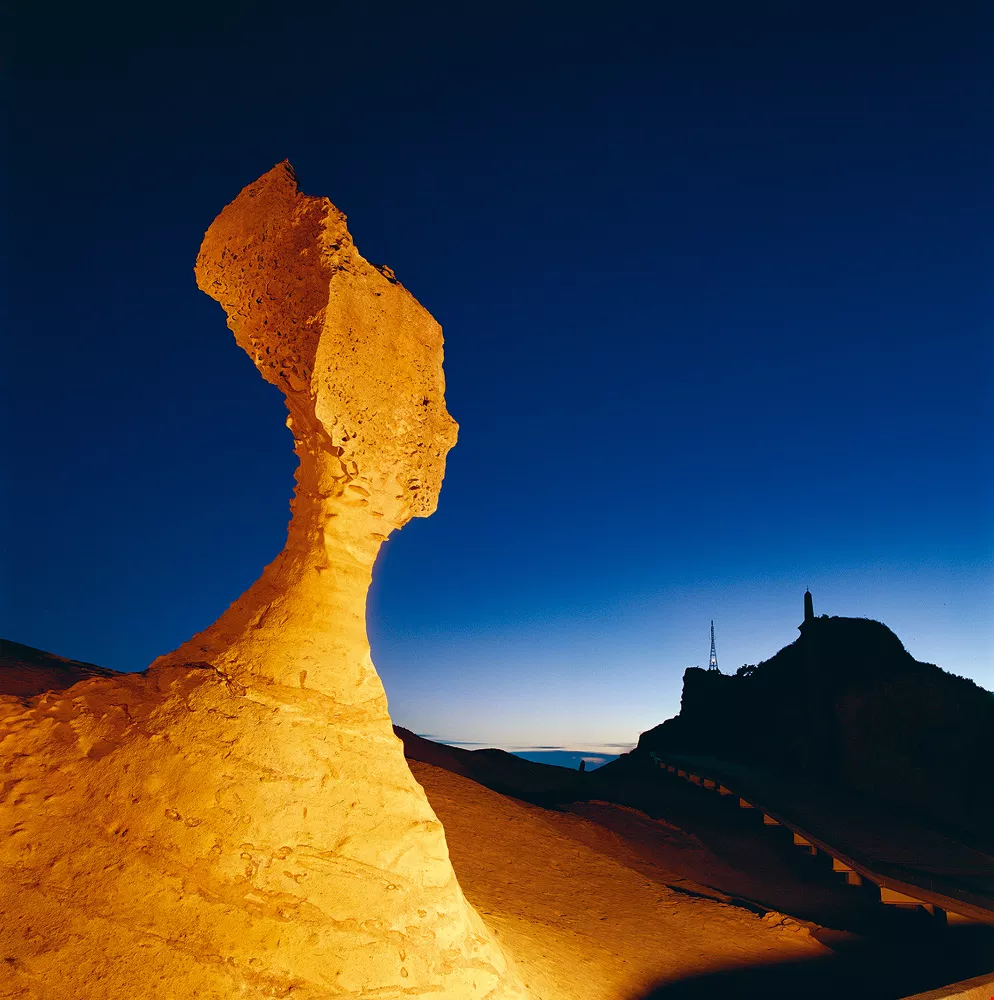
Queen’s Head rock at Yeliu on the North Coast is a must-see for foreign visitors to Taiwan.


@List.jpg?w=522&h=410&mode=crop&format=webp&quality=80)


