When the Living and the Dead Celebrate--Toucheng's Qianggu Festival
Tsai Wen-ting / photos Pu Hua-chi / tr. by Tsai Nanting
October 2006


Though the worlds of the living and the dead are usually separate, a "ghostly gate" is opened between the two realms during one month of each year. On the final night of that month, before the passageway closes, the qianggu festival, devoted to the salvation of lost souls, takes place in Toucheng. Here, at the northern tip of Ilan County, throngs of men and ghosts rub shoulders at the carnivalesque scene of the qianggu, an occasion that offers these vagabond souls a good meal before they return in contentment to their shadowy abode.
In this current leap year in the lunar calendar, there have been two seventh lunar months. These "ghost months" are considered especially inauspicious by ordinary folk. This year, a variety of folk customs relating to gods and ghosts are held with particular solemnity.
As the first of the two seventh months draws to a close, it so happens that the eve of the traditional "closing of the ghostly gate" falls between a Saturday and a Sunday. That night, leaders of 26 Toucheng neighborhoods (including two that have since been incorporated into Chiaohsi Township) gather together in a mounting mood of festiveness mingled with apprehension. Platforms have been erected in front of the various temples, and elderly devotees lead the young people in constructing the long, tapering poles (guzhan) that will be erected upon the main platform (gupeng). At the Shennung Temple in Paya Borough (formerly Patsailin), the pole that is being rushed to completion towers 30 meters, or about ten stories high.
"There are 13 poles set up on this platform, but only ours can really be called a 'wind god' pole," says Wei Tsung-tai, chairman of the Shennung Temple. In the past, Patsailin was populated by strong, rough-and-tumble farmers. When the practice of qianggu began, says Wei, "Other villages would bring their poles in horizontally, but the folks of Patsailin were different, carrying their poles in straight up to the meeting place in an especially awe-inspiring manner."
The villagers have poured time and money into these poles, whose completion involves cutting down the wood and bamboo, constructing the poles, and hauling them into the central meeting space on the day of the festival. While people are usually only willing to contribute money but not their labor to temple activities, the qianggu festival always succeeds in mobilizing the entire township.
"The biggest challenge is finding the right fir tree for the platform's main pillar. This one took over a dozen people searching for several days up in the mountains to find. After felling the tree, the group forged a path straight down from the mountain to bring it back down here," says one sexagenarian with pride. While the pillars supporting the main platform are not as high as the poles, they still rise to a height of 12 meters, or about four stories high. The platform must be able to support 13 poles and accommodate the swaying motion of numerous young men as they attempt to climb the poles. If the structure is not sound, disaster may ensue.
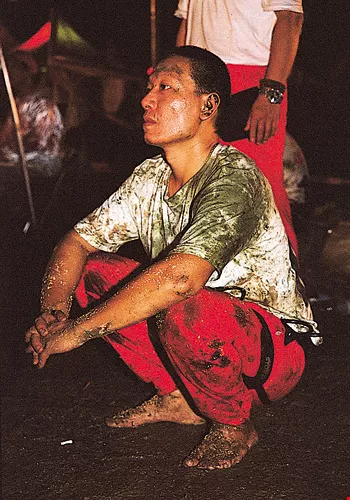
After the competition, competitors crouch panting, their bodies covered with tallow.
The sorrows of early settlers
When the first Han Chinese settlers began to arrive on Taiwan, many fell prey to natural and human disasters and disease, meeting their deaths far from home. Since these souls had no one among the living to sacrifice to them, they became ghosts. According to popular belief, the first day of the seventh lunar month is a time when ghosts are released by the bureaus of hell from their underworldly prisons. Temples dedicated to offerings to the ghosts, such as Paihsing Temple, Wanshan Temple, and Youying Temple, open up a gateway at dawn in a symbolic "opening of the ghostly gate." At dusk on that day, meat offerings, representations of clothing, and spirit money are offered as part of the ritual welcoming and purification of the ghosts.
The seventh lunar month is a time of release for the ghosts. All exorcistic activities such as the interrogation or expulsion of ghosts or the apotropaic opening of the temple doors are strictly forbidden. This is so that innocent ghosts are not inadvertently harmed. In Taiwan, it is traditional for temples to take turns putting on the pudu (universal salvation) offerings to the hungry ghosts, presenting daily offerings to these souls. The qianggu festival, held on the 30th day of the seventh month, is for those ghosts who are still lingering in the human world towards the end of the seventh month, and serves as a final announcement and salvific gesture to them. During the festival, humans stand in for the ghosts as they compete for the sacrificial offerings, and the dramatic events bring the entire pudu offerings of the seventh month to a rousing close.
At present the qianggu festival is held in only two places in Taiwan, Toucheng in the north and Hengchun in the south. The Toucheng celebrations are grander, and its pole-climbing competition more challenging. Qianggu festivals have been held at irregular intervals since the Qing Dynasty, but were stopped for 43 years after some climbers died in 1946. They were not held again until 1991, and since then also not on a regular basis.
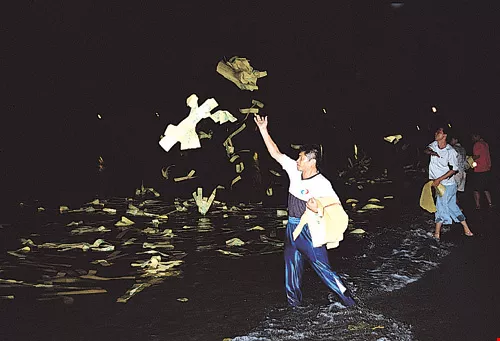
Paper representations of new clothes are tossed into the sea, in the hope that the naked water ghosts will be able to properly dress themselves and come ashore to enjoy the pudu feast.
Heaven and earth lanterns
On the 27th day of the seventh lunar month, the qianggu festival begins with the ritual of "raising the lanterns," which serves as an announcement to the three realms of heaven, earth, and humanity.
The "heaven" and "earth" lanterns are raised at dusk, at 6:00 p.m. The heavenly lantern is raised during the day and taken down at night, and announces to heaven the place and time of the pudu rites. The earthly lantern is raised at night and taken down during the day, summoning to the festival lost souls in the netherworld as well as those that roam the earth.
According to folk tradition, a lantern that is ten feet high is capable of attracting ghosts within ten li (a li is around half a kilometer or a third of a mile). The higher the lantern is, the further it illuminates and the more ghosts it can reach. But to avoid attracting too many hungry ghosts, and to fit the dimensions of the ritual space, most pudu rites feature lanterns ten to 20 feet high. Only at a grand pudu rite will the lanterns be over 50 feet high.
Li Yu-tang, head of the Shengyuan Shrine in Toucheng and a third-generation ritual master, is responsible for all of the religious rites at this year's qianggu festival. He arrives with 20 of his fellow adepts. Li recommends that the lanterns be set at about ten feet high. Drawing on the experience of their predecessors, he reasons that, although the festival is known throughout Taiwan, Toucheng is after all a small locality that does not need overly lofty lanterns. Setting the lanterns at a modest height will avoid the inauspicious situation of having hungry ghosts from neighboring villages and townships crossing over into Toucheng.
After the heaven and earth lanterns have been set up, at 7 p.m. Daoist priests burn incense, beat drums, set up the altar space and play sacred music. They burn sacrificial documents at the main altar to the Jade Emperor to announce the formal commencement of this year's rites.
During this month, given that the ghostly gate is opened, the main altar is arrayed with over 60 sacred Dipper lanterns, bushels filled with white rice, rulers representing safe passage through good times and bad, a balance, a demon-dispelling sword, a spirit mirror, and other exorcistic implements. These symbolic objects are used to safeguard those involved in the pudu rites. During the festival, the Dipper lanterns must be kept constantly burning. They must never be allowed to go out.
In the four days after the first incense is lit and the altar established, scriptures bespeaking compassion and salvation are continuously chanted from the main altar toward the four points of the compass, diffusing compassion to ghosts everywhere.
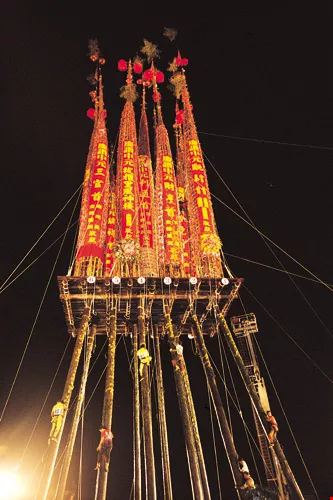
"The ghosts circle around vying for food offerings, outdoing one another in leaping onto the lofty platform." For over 200 years, the dramatic qianggu rites have mobilized the people of Toucheng, and are considered among the grandest folk customs in Taiwan.
Rescuing by land and sea
This spirit of compassion and salvation can be seen throughout the qianggu proceedings. Next to the main altar is a papier-mache dwelling place for ghosts, a bathing pavilion (with male and female facilities), and mountains of gold, silver, and clothing. This set of goods expresses human sincerity and a lack of condescension towards the ghosts.
On the night before the qianggu, traditional water lanterns are released. According to Lin Mao-hsien, lecturer in Taiwanese literature at Providence University, many early migrants traveling from China to Taiwan died of disease while still on the waters. Water lanterns are released to guide to shore souls who perished in darkness of the watery depths.
The wet Ilan region tends to be unpredictably rainy. At the point where Tetzukou Creek reaches the ocean, 50-odd water lanterns have been filled with spirit money. In the rain, the ritual master leads the people in casting paper printed with representations of clothes, combs, and shoes out to sea. Yellow spirit money flutters in the rain-streaked night, then rises and falls with the waves. One can imagine ragged, watery souls reaching out for the offerings, then arraying themselves properly to step onshore.
To prevent the turbulent waves from overturning the water lanterns, the organizing committee has acquired the voluntary services of a group of capable young swimmers. In the dark night of this ghostly month, these swimmers guide the lanterns one by one to sea. "Look, the first lantern has made it out to sea!" cry out the spectators with joy and relief as they peer out into the distance towards the barely visible lanterns.
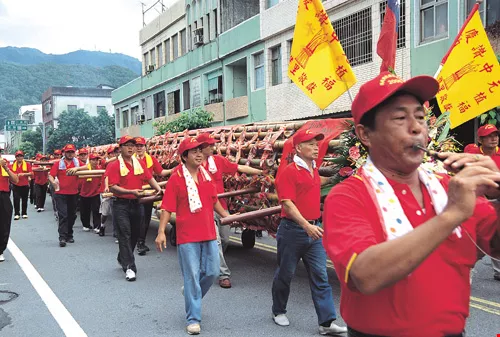
At dawn on the day of the qianggu, the guzhan climbing poles, bound with all manner of offerings, are brought into the ritual area amidst the resounding clamor of music and drums.
Climbing the pillars
Finally, the day of the qianggu has arrived. At dawn, fireworks erupt from the township's various temples. The poles have been affixed with cured meats, rice noodles, shrimp, crabs, squid, zongzi (sticky rice dumplings wrapped in leaves), and other sacrificial offerings. With the aid of a crane, the poles are set up on the main platform as spirited beiguan music plays. Over 100 people lend a hand as the poles are carried to the qianggu site on the edge of Wushih Harbor.
The qianggu poles, the only tall objects in this open space, tower over all else. This year's platform and poles, higher than in previous years, rise to a height of 42 meters, about the height of a 14-story building. Every security precaution has been made, from enlarging the safety net, to providing an extra security rope to prevent competitors from falling and injuring themselves during the climb up the platform and the poles.
The evening of the qianggu brings a slight break in the rain. Young and old from all over Ilan County have arrived. The crowds are thick, and children play delightedly. Meanwhile, an animated Taiwanese Opera performance is taking place on stage. This is a scene of joy for humans and ghosts alike.
At nine o'clock sharp, Lu Kuo-hua, Ilan County chief executive, Chen Hsiu-nuan, mayor of Toucheng Township, Huang Chen-tsan, chairman of the organizing committee, and others arrive on the scene and ascend the qianggu platform via a fire engine ladder. Five animal sacrifices are offered to make one last attempt to summon faraway ghosts. The rite involves taking the head of the sacrificial animal and turning it from the direction facing the main altar to the direction facing away from it. The ghosts will then realize that there is lots of food for everyone, heaped up on 100-plus tables. There is no need for them to jostle for their portion of the feast.
At ten o'clock, as everyone waits expectantly, a competition involving the climbing of the platform serves as a warm-up to the qianggu itself.
The fanpeng platform is smaller and, unlike the poles its pillars are not greased. It rises to a height of about ten stories. Ten competitors are signed up to climb it. Surprisingly, the winner, Huang Ching-lung, takes just 30 seconds to climb up to the platform, setting a new record in the process. The other competitors eventually make it as well. They are competing for the mochi that they then throw down to the crowds in the darkness below. The crowds are stirred to collect up these foodstuffs and "consume blessings," and excitement builds for the qianggu to come. Traditionally, riceballs were placed atop the platform, but hygienic concerns have led to their being replaced with the sticky, aromatic mochi.
At 11:15 p.m., with the arrival of the zi period (11 p.m.-1 a.m.), three strikes of a gong mark the beginning of the qianggu, the most exciting part of the entire festival. Twelve teams from all over Taiwan compete, climbing continuously up the poles, which are heavily greased with tallow. The wet weather makes the climb even more difficult, given that the poles have been smeared with 120 gallons of tallow, and each one is covered with spirit money and soaked in rain.
Moreover, this year's ropes are shorter and stiffer than those given out at last year's competition. None of the teams makes it up during the first round. One team even withdraws out of exhaustion. A climber falls off a pole onto the safety net, but fortunately is uninjured.
The climbers support themselves by attaching their ropes to the central pillar. Team members stand on each other's shoulders as they ascend. Fifty minutes after the start of the competition, every team has made numerous attempts but slipped off each time. Those in the crowd brave the rain and crane their necks to peer upward, crying out in excitement or disappointment.
Minute by minute, the end of the zi period approaches. When it ends, the ghostly gate will be closed. The organizers hold a quick meeting to discuss how to avoid a failed qianggu, an outcome that risks bringing down misfortune upon the community. They decide to lengthen the ropes and allow five climbers, instead of the originally allowed two, to help each other make the relayed climb up to the platform.
Half an hour later, the team from the Wanggong Temple of Erhcheng in Ilan County successfully climbs up the central pillar. They flip onto the platform and climb up their pole, which is attached full with sacrificial offerings, and are the first to successfully cut down the "favorable winds" flag at its top. Aside from symbolizing the ghosts' successful bid for food and salvation, the team wins some wonderful prizes: an automobile, a motor scooter, three taels of gold, and NT$100,000 in prize money.
By the end of the competition, eight of the 12 competing teams have successfully climbed their poles and claimed their prizes.
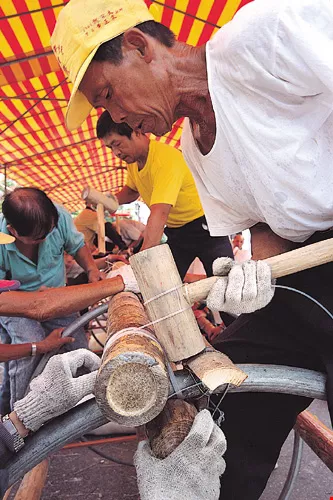
Taking on all the work themselves, the people of Toucheng work together to gather the materials for and construct the 13 guzhan poles.
Pioneer memories
The qianggu is at once carnivalesque and solemn, on the one hand showing compassion to the ghosts and on the other hand seeking after peace for each family. The guiding spirit of the festival is the quest for harmony between the human and the ghostly realms.
According to Lin Mao-hsien, pudu rites around Zhongyuan (the 15th day of the seventh lunar month) are especially popular in Taiwan, when compared with other Chinese communities. This phenomenon is linked with the history of Taiwan's settlement. During the passage from China to Taiwan, many unmarried wayfarers met a watery end on the high seas. After arriving in Taiwan, the settlers faced not only natural disasters and diseases, but also ethnic feuds over land and water, including feuds between Zhangzhou and Quanzhou immigrants, between Min and Cantonese peoples, and between Aborigines and Han Chinese. Many of those who died had no one to sacrifice to them. Because of these lost souls, the pudu rites at Zhongyuan were performed with special solemnity in Taiwan.
Li Chi-tse, an amateur cultural historian, feels that Taiwan's pudu rites are performed with special fervor to ritually calm the sense of uncertainty that accompanied the injuries and deaths of the early settlers. The qianggu is a kind of annual "group therapy" to expel people's innermost fears. These rites are a unique part of Taiwanese life, worthy of UNESCO world cultural heritage designation.
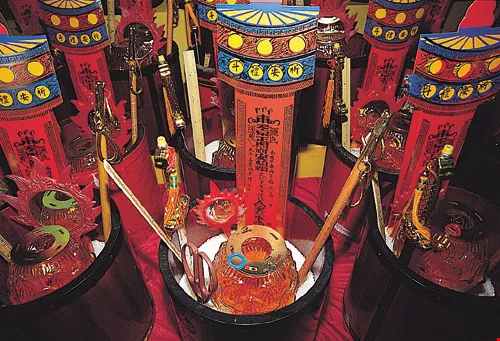
In order to ensure the successful completion of the rites, the main altar is specially outfitted with divine Dipper lanterns to protect all of those presiding over the sacrifices.
Peace between living and dead
In the over 200 years since Wu Sha opened up the Lanyang Plain to settlement, the qianggu at Toucheng has been performed only irregularly. In the current period of budget constraints, many have continued to call for the cancellation of the rites, which can cost tens of millions of NT dollars.
Huang Chen-tsan, who heads the Zhongyuan festival organizing committee, believes that the sharply rising cost of gold has been responsible for increased expenditures. Last year, only NT$770,000 was spent on the gold trophies. This year the same amount of gold would cost NT$1.1 million, or over NT$30,0000 more. In addition, each of the 13 qianggu poles costs NT$30,000. These increased expenses are a cause for worry among the organizers.
There is a local belief that the qianggu must be held for at least three years in a row, for to do otherwise would be to court disaster. This year marks the third year of the qianggu since the first in the current series was held in 2004. Fearing that the region may encounter a lack of peace, the Ilan County Government has decided to fully support the qianggu festival, and the festival organizing committee has decided to raise NT$300 each from the township's residents to add to its coffers. Those who have missed this year's qianggu may not be able to see the dramatic rites again next year.
Around 1825, Wu Zhufang, assistant sub-prefect of Ilan, then known as Kavalan, provided this vivid description of the offerings, water lanterns and qianggu in the poem "Zhongyuan at Lancheng": "Sacrificial goods are piled up at the banquet, / Smoke rises from the burning spirit money; / The city is filled with incense-bearing crowds, / And songs rise up to the moonlit skies. / Lanterns flicker upon the waters / And torchlights make their rounds in the streets. / The ghosts circle around vying for food offerings, / Outdoing one another in leaping onto the lofty platform."
More than 180 years have passed; the sacrificial offerings are still piled upon the banquet tables, the flickering lights of water lanterns continue to float upon the waters, and rope-wielding competitors still vie to be the first up on the platform....
Following traditions passed on for hundreds of years, the altar is dismantled and Zhong Kui dances his exorcistic dance. This marks the end of the festival. The carnival atmosphere subsides, and life returns to normal.
The ghosts return to their underworldly habitations, responding to the authority of the Grand General who commands the ghosts, and of Zhong Kui, who captures ghosts. The residents of Toucheng Township, recently caught up in the frenzy of activity, also gradually return to their daily lives. The living and the dead each return to their own proper spheres.
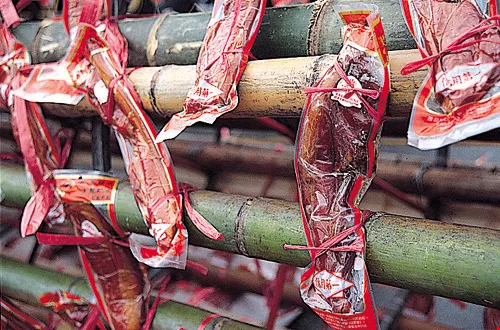
Guzhan poles, covered with tied-on sacrificial goods.
A Guide to the Qianggu Platform
Platform (gupeng):
the platform is divided into the lower portion, the pillars (guzhu); the middle portion, the platform (gupeng); the poles (guzhan); and the favorable wind (shunfeng) flags that top the poles.
Pillars:
Twelve pillars made of fir, each ten to 12 meters high, are distributed six on each side and set against each other at a slant two meters into the ground. They form a secure foundation for the platform above.
Origin of the pillars:
According to popular tradition, the 12 pillars came from the masts of Toucheng fishing boats. At the request of the pioneering hero Wu Sha, they were taken and used as pillars for the qianggu platform. During the periods of Japanese and Nationalist rule, when the qianggu festival was banned, the 12 original pillars were used for bridges, the harbor, and stages for Taiwanese Opera. Gradually they were all lost. The pillars used today were newly fashioned after the restoration of the rites.
Poles:
Thirteen poles are set upon the square platform, formed by lashing together fir and bamboo into a conical shape. Near the top, bamboo rings serve as handles for the climbers.
"Favorable wind" flags:
To the bamboo atop each pole are attached silver spirit money, a chicken to ward off evil, and at the very top a fine, woven "favorable wind" flag. According to tradition, once when a group of fishing boats at sea were caught in a typhoon, some were lost, but those bearing the "favorable wind" flag returned home safely. To the fishing community, the flags thus stand as a much-coveted symbol for good fortune and the safe return of the boats. Woven by renowned artisans, they are worth several tens of thousands of NT dollars each.
(Tsai Wen-ting/tr. by Tsai Nanting)
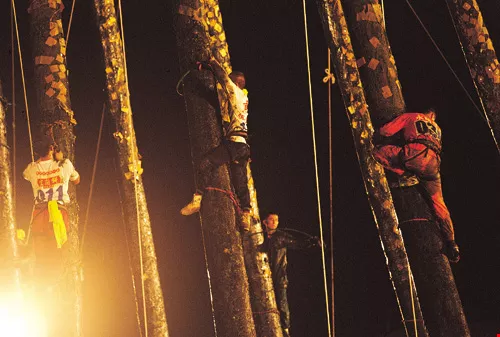
Qianggu climbers from all over Taiwan come with only a single rope as their equipment. They strive to climb up the poles, made slippery with tallow. The climbers match not only their strength and perseverance, but also their skill in this fierce competition.
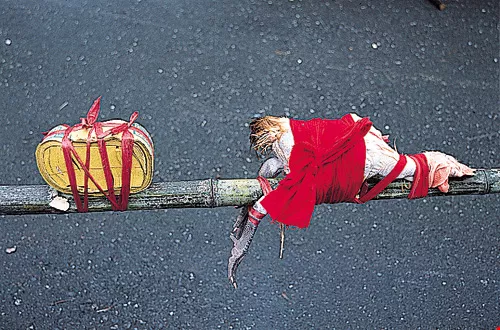
Bound to the top of each guzhan pole are golden spirit money and a whole chicken. They are so high up as to be barely visible to the crowds below.
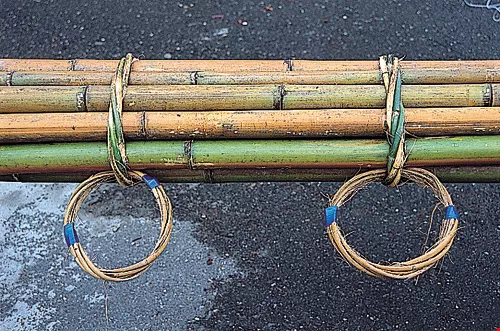
Bamboo hoops used by the qianggu climbers.
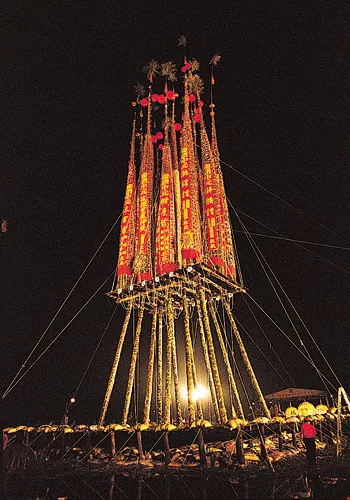
The gupeng consists of three parts, from bottom to top: the guzhu pillars, the gupeng platform, and the guzhan poles topped with the shunfeng ("favorable winds") flags.
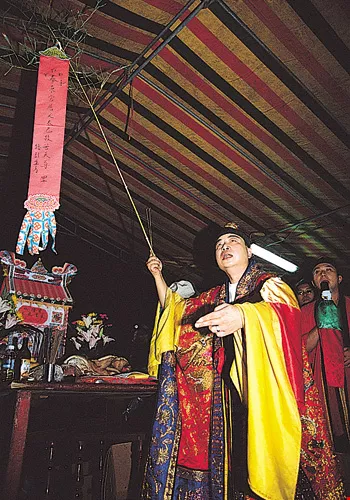
During the "ghost month," Daoists perform many rites to save the lost souls. The qianggu is a festival that combines the sentiments of sorrow and salvation.
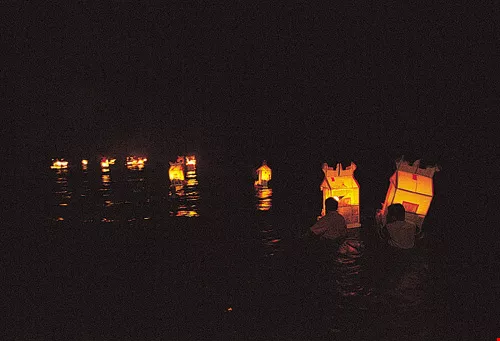
Numerous water lanterns light the way for the ghosts. Skillful young swimmers from Toucheng escort the lanterns to ensure their smooth passage out to sea.

@List.jpg?w=522&h=410&mode=crop&format=webp&quality=80)


