A New Consumer Age: Innovation in Taiwan’s Service Industries
Liu Yingfeng / photos Jimmy Lin / tr. by Jonathan Barnard
September 2014


Taiwan’s modern service industries took off in the 1980s, and by 2000 the sector was quite robust. In the years since, providers of services have been continually working to achieve economies of scale, develop brands, and sell experiences. Today the sector is at a pivotal moment when businesses are upgrading and refining the services they sell.
With the dawning of this new consumer age, service providers, whether retail stores, restaurants or websites, are sparing no effort to transform and reimagine themselves. Exquisite service is all in the details—in sales clerks that smile, in restaurants that bring congratulatory cards to the table, in moving stories that are depicted on packaging....
On a July afternoon, a brand new second-generation Pxmart is opening in Chiayi. Establishments of its type are changing the meaning of a neighborhood supermarket. The completely new space of more than 1500 square meters, which is full of fresh food shipped directly from producers, features a special counter for the produce of small-scale farmers. At the opening, both Pxmart chairman Lin Min-hsiung and president Hsu Chung-jen are in attendance, announcing that “Pxmart 2.0” has arrived.
Rewind to May. The Wowprime Group, in conjunction with Singapore’s Pu Tien Holdings, is launching its Sufood vegetarian restaurant chain in Singapore. Representing the first stage of Wowprime’s new overseas expansion drive, the event marks the first time a Taiwanese company has tried to build a vegetarian brand abroad.
Not to be outdone by leading retailers and restaurateurs, Leezen, a purveyor of organic goods that just opened its 100th store, is also actively streamlining supply chains, advising farmers on how to shift to organic crops, working with producers to develop brands together, and creating a safe and healthy consumer environment.
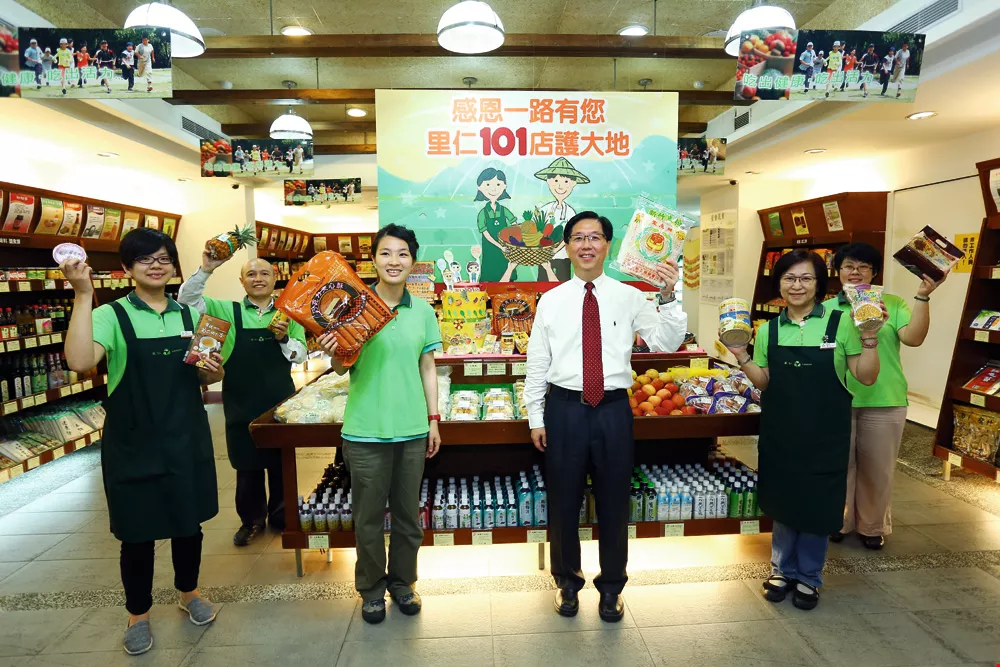
Leezen, an organic goods retailer, already has more than 100 retail locations. It is investing in R&D with other firms up and down the supply chain so that consumers can enjoy healthy food with peace of mind.
Accounting for nearly 70% of Taiwan’s GDP and six-tenths of its workforce, the service sector, a true pillar of Taiwan’s economy, has been getting stronger and stronger.
“Over the last five years, there has been a trend toward internationalization in Taiwan’s service industries,” says Alex Ju, vice director of commerce development and policy research at the Commerce Development Research Institute. Taiwan’s service industry used to be limited by the small national market. Immature in their development, and with insufficient capacity, service industry companies would have lacked the size to launch regional or international service industry brands whether or not they were interested.
But the abrupt rise of mainland China’s economy provided opportunities for Taiwanese companies to gain experience beyond our island’s shores and increase their scale. In recent years, quite a few Taiwanese firms have first tested their mettle by offering services on the mainland before setting their sights on America and Southeast Asia. The 85°C Bakery Café, for instance, successfully launched in the United States last year by opening branches in 11 locations. Starbucks better watch out!
Quite a few other firms are moving to internationalize as well. For instance, after establishing stores on the mainland and in Singapore, SunnyHills, the well-known pineapple cake brand, opened a flagship store on Omotesando Avenue in Tokyo—a move regarded by the outside world as a major step toward going international.
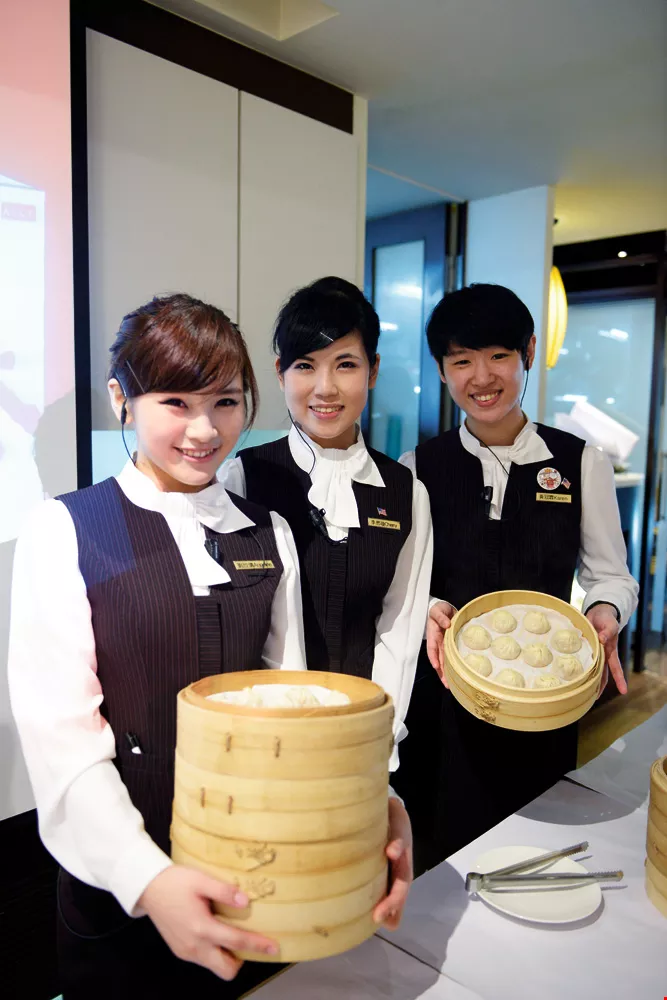
The internationally famous Din Tai Fung Dumpling House chain is searching for innovations to bolster its attentive service.
Ju points out that exporting services isn’t just about establishing brands; it’s also about exporting culture. In the new consumer age, he says, “The human touch is key for Taiwan’s service industry.” That touch, he explains, isn’t just about the cultivation of connections that has traditionally been so important to society and business in Taiwan. Rather, it is about carefully meeting the needs of clients and providing considerate service. This sensibility is rare in manufacturing but is an essential part of the service industry. When consumers purchase a service, they are not looking only for value. They are also acquiring a display of consideration, as well as a conceptual framework and cultural atmosphere that are part of experiencing the product.
In 2013 Shin Kong Mitsukoshi broke new ground by working with the Ping Fong Acting Troupe. The goal was to leverage a theater activity to attract consumers so that they would experience a new kind of shopping atmosphere in Taiwan.
After three months of planning, the department store and the Ping Fong Acting Troupe decided to put on Can Three Make It?, a show with mass-market appeal, on the store’s top floor. In three months, it sponsored a series of 100 performances, attracting 55,000 attendees and helping to bolster store revenues.
Zhou Baowen, an assistant manager at Shin Kong Mitsukoshi headquarters, worked with the troupe on producing the show. The aim wasn’t merely to provide foreign customers with a chance to experience Taiwan’s local cultural atmosphere. Shin Kong Mitsukoshi was also hoping to bring local young people back to department stores.
This year Shin Kong Mitsukoshi has followed up by working with the Performance Workshop and the Godot Theatre Company, which are putting on four different shows from July to October. The store hopes that the 70–80 performances will once again draw crowds up to the top floor.
Hogan Bakery, which has experienced a meteoric rise in recent years, takes a different tack by emphasizing a conception of local agriculture. It has expanded out of baked goods into the drinks industry by investing in retailer Fruit Hunter, which stresses sourcing produce from local farmers and telling consumers the stories behind its produce.
Polo Huang, Hogan’s president, explains that Hogan had always been sourcing produce from certain locales: spring onions from Yilan, plums from Xiaolin Village in Kaohsiung, and so forth. The company has also begun to send staff on field trips, going to Miaoli to learn about pickled radish. “After a succession of food safety scandals in Taiwan,” says Huang, “it’s important to have a firm grasp on the way that food is handled, all the way from the fields to the finished product.”
Last year, fed up with drinking tea that was full of additives, Huang decided to move into the beverage market. He set up Fruit Hunter and invited Ku Pi-ling, a senior figure in the media industry, to serve as its president. Fruit Hunter purchases large quantities of crops from local growers, including blue magpie tea from Pinglin, and plums from Xiaolin.
Ku explains that her previous work brought her into contact with quite a few farmers who were toiling diligently in the realm of ecofriendly farming. They truly hoped to grow healthy produce without toxic chemicals, but they found it hard to sell what they had produced. Consequently, she hopes through Fruit Hunter to create supply-chain links for small growers that will allow consumers to enjoy the flavor of truly pristine fruit juices and other drinks.
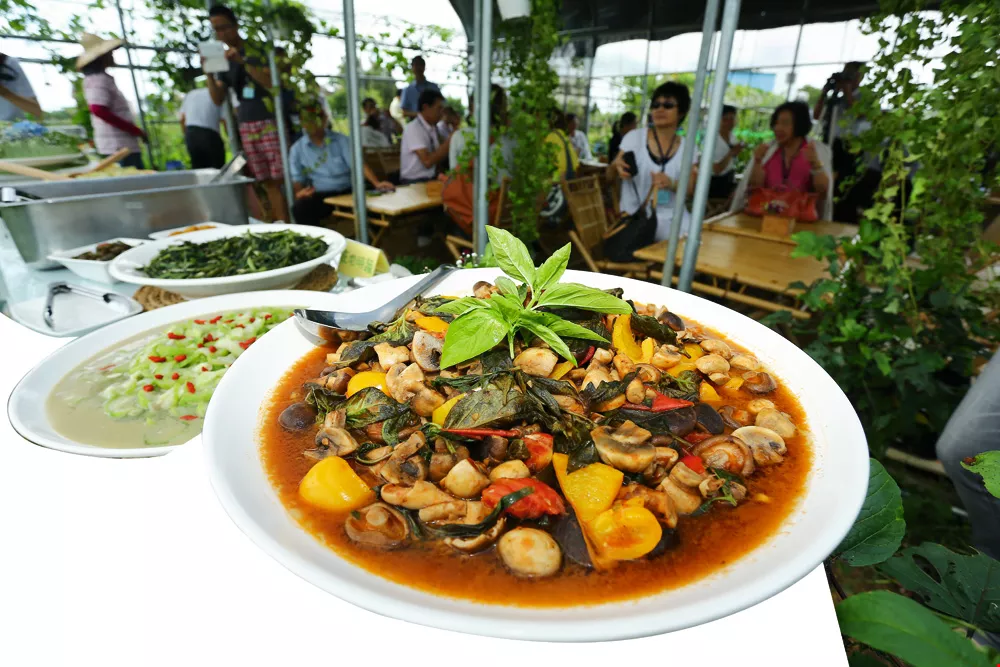
After a series of recent food safety scandals, consumers are concerned about both the taste and the provenance of what they put in their mouths. The photo shows Leezen’s Tse-Xin organic farm.
Confronting rapid change in consumer markets, businesses are doing everything they can to adapt, including working with companies in other fields. Some brands have pushed “the marketing of experiences” to attract customers. Others have improved their service by finding inspiration from their customers.
Not long ago Yang Chi-hua, president of the Din Tai Fung Dumpling House chain, held a launch party for his own book. With gratitude, he said that Din Tai Fung’s success stems entirely from the “attentiveness” of its staff. The company takes the unorthodox approach of using customer complaints as a launching pad for innovations.
A customer at Din Tai Fung’s Banqiao location once complained that the colored marks used to distinguish dumplings of different flavors were smudging in an ugly manner as the dumplings rubbed up against each other. The next day, at the regular morning staff meeting, Yang suggested using little chicken and crab molds to distinguish between flavors, as well as adding carrot juice to naturally color the dough used for some of the dumplings.
In 2013, when the molds began to be used to identify dumplings stuffed with chicken meat or crab eggs, customers were enthusiastic.
Leezen, a retailer of organic goods founded in 1997, also puts customers first by taking control of products at the source and thereby reducing the use of potentially unhealthy additives.
In 2004 Leezen began working with the major cereal processor Golden Crops to develop cereal products without chemical additives. In order to maintain quality, the Leezen management team asked that the plant not add emulsifiers, hydrogenated oils or other additives. The request didn’t go over well. Golden Crops said Leezen was “picky and lacking in professional understanding,” and the two companies almost stopped working with each other. But after two years of research, the products finally hit the market and completely sold out within two weeks, winning the favor of consumers and validating Leezen’s approach.
In 2004, looking for opportunities in a fiercely competitive market, the e-commerce website PayEasy established EasyFree, an exclusive e-shopping platform for corporate employees.
Joseph Chen, vice president of marketing and public affairs at PayEasy, explains that companies’ employee welfare committees traditionally fight on employees’ behalf to get better deals by buying in bulk. These are services that new Internet-based employee welfare networks like EasyFree can provide instead.
Consequently, PayEasy’s network, apart from providing workers with discounted group purchases, also uses its data to accurately gauge demand for products. Chen explains that Internet sellers have more data about customers than brick-and-mortar stores. What’s more, since the corporate employees served by its network are mostly white-collar workers, they can spend 20% more than mass-market consumers. PayEasy can thus offer more expensive products that are rarely offered elsewhere.
Using a business-to-business (B2B) service model, EasyFree has established a secure foothold in the Internet marketplace over the last decade. Today, it boasts more than 400 participating businesses and is topping NT$100 million in sales per year.

Meeting its competitors in the market head on, the 85°C Bakery Café is transforming and upgrading, opening spacious and comfortable second-generation shops.
Recently, a wave of upgraded “second-generation” stores have opened.
With the slogan “inexpensive and economical,” Pxmart, under the leadership of Hsu Chung-jen, established nine “second-generation” stores in Chiayi and Tainan in July.
The completely new stores are not only spacious, with wide aisles; they also emphasize fresh food, with the space given to fresh food dramatically increased to 50% of the total. The stores have a coffee shop, a pizza parlor, and a “direct from the farmer” section devoted to selling the produce of small farms. These are the most eye-catching features of these second-generation stores.
Pxmart’s general manager Tony Tsai explains that unlike conventional Pxmart stores, the second-generation stores allow small farmers themselves to set the prices that their produce is sold at. Pxmart is only responsible for packaging and brand marketing and takes a commission of 7.5% from the sales to cover its operating expenses.
Although the second-generation model is for now restricted to just those nine stores, there has been a lot of positive feedback since they opened, and many farmers have contacted Pxmart through the marketing groups of farmers’ associations and other channels. “In the future farmers will have brand stories that are unique to themselves,” says Tsai.
The service industry now provides 60% of Taiwan’s jobs. It’s already an important pillar of Taiwan’s economy. Alex Ju argues that as businesses pursue increases in scale and internationalization, if they want to break through traditional models of doing business and win out over the competition they will need to learn how to train personnel so as to be able to reliably replicate experiences for customers.
Over the past five years, the Commerce Development Research Institute has widely surveyed Taiwan’s service industry. It has discovered that quite a few retailers, chain eateries and Internet companies have developed technical innovations, making use of point-of-sale equipment, iPads and other electronic devices to manage inventory and sales with an eye toward raising the quality of service.
In 2010 the tea and juice chain Coco began to expand overseas to Europe and America. The company uses enterprise research planning software to successfully manage its back-end warehousing and has developed e-learning systems, all the while training overseas personnel and maintaining the consistent quality of its drinks.
Zoe International, established in 1999, has more than ten brands, including the Genteishoku and Azabu Sabo Japanese restaurant chains. Its restaurants use iPads and point-of-sale systems to transmit orders back to the kitchen, increasing the speed of table turnover by 20%.
But better technology is just one facet of any push toward expansion. “Rather than getting hung up on this sort of ‘hard power,’ fostering special qualities is the next big challenge for Taiwan’s service industries,” says Ju.
Service industries are based around people. Sellers of services must pay strict attention to detail and find ways to resonate with people emotionally if they are to stand out from the competition. At a time when the sector is in the midst of a dramatic transformation, Taiwan’s service providers will continue to advance only if they give consumers moving experiences and remain highly focused on their needs.
@List.JPG?w=522&h=410&mode=crop&format=webp&quality=80)


