

Whether making an offering to ancestors or praying to the gods, Taiwanese often find themselves holding sticks of incense, which are essential for many ceremonies. Incense represents a bridge between the world of men and the world of the gods. Those rising spirals of smoke hold countless prayers and hopes.
Sunny Pingtung, with clear skies 280 days a year, is Taiwan’s center of incense production. Although the industry used to be thriving here, its fortunes dimmed. Nevertheless, in July of 2012, 10 local businesses founded the Pingtung Incense Association with the aim of producing incense using traditional artisanal methods. Swimming against economic currents, these producers are hoping to burnish the image of craftsmanship in Taiwan.
Seven Star, the Pingtung Incense Association’s most active member, was established by the husband-and-wife team of Li Shijing and Kang Xiuhua in 1987. Aware of the nostalgia for traditional incense sticks, in 2009 they planted a garden full of herbs used in traditional Chinese medicine and opened a tourist factory and the Seven Star Sandalwood Incense Museum. These allow the public to gain a deeper understanding of traditional incense culture.
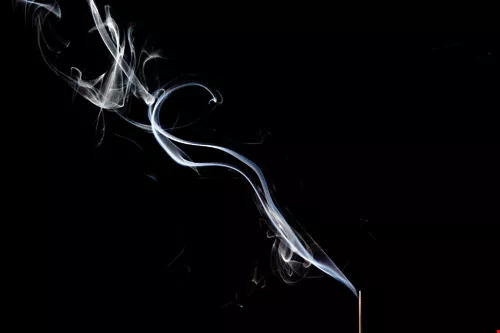
The history of the extraction of aromas in China goes back all the way to pre-Qin times, when people began to make incense and tie small sachets full of herbs to undergarments. For the Dragon Boat Festival in particular, revelers would often wear these herbal sachets.
Among other uses, incense was used as a soporific and to help relieve aches and pains.
The most important raw material used in natural incense is sandalwood. The sandalwood produced in the mountains of India is the highest quality, with a glossy and fine-grained appearance and a pure and rich scent. The sandalwood produced in Australia and Indonesia follow in quality. Sandalwood-based incense works as an insect repellant, disinfectant and tension dispeller. If you light a stick before going to bed, you’ll get a good night’s sleep.
Agarwood, with its strong and elegant aroma, is an extremely expensive component now used mostly for incense burnt during religious ceremonies. Buddhists believe that agarwood has a scent that can “open connections between the three worlds.” They often light agarwood incense when chanting or meditating.
There are numerous kinds of agarwood. The most expensive is ky nam agarwood from Vietnam, a kilogram of which can fetch more than NT$100,000. When Han Chinese pioneers were crossing the strait to Taiwan, they would often carry on their person images of gods carved in agarwood. If they felt ill, then they would pray to the gods, cut some agarwood shavings from those statues, mix them with water, and drink them. The mix may not have been effective, but it does demonstrate the high esteem in which people held agarwood back then.
In fact there is some basis to the Taiwanese folk belief that eating incense ashes (especially those that have been blessed by deities) cures illness. That’s because classically manufactured incense makes use of many ingredients used in Chinese herbal medicine. Apart from the essential agarwood and sandalwood, other ingredients frequently used in traditional incense include fine stalk vanilla, rhubarb, nardostachys root, clove, and Chinese cinnamon. Consequently, the ashes of traditionally manufactured incense sticks are full of the burnt ingredients from Chinese herbal medicine, and are by no means inedible.
But when it comes to incense ashes taken from temples, one should err on the side of caution.
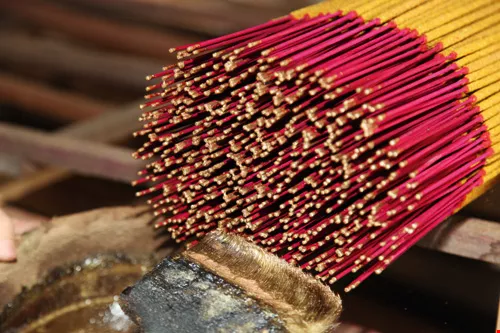
The incense making process: 1.Soaking in oil 2.Applying incense powder 3.“Spreading the fan” 4.Straightening up 5.Sun drying 6.Dyeing the handles 7.Applying gold paint to the ends
Thirty years ago, Li Shijing was running a successful dyeing and finishing business. After being injured in an accident at work, he returned home to Pingtung to recuperate. One of his uncles, who was getting on in years, was just then planning on closing his shop that sold incense and spirit money (the kind burnt as offerings). Li decided to take it over. He was hoping to have a new start in life but ended up collapsing from exhaustion. Without hesitation, Kang Xiuhua resigned from her job as a high-school teacher and returned home to help her husband with the business.
“Back then we often had sales of only NT$400 a day,” Kang Xiuhua recalls. Noting that profit margins are low with cheap incense, Kang explains that they decided instead to move toward incense made with ingredients from Chinese herbal medicines. What’s more, they picked a younger crowd as target customers, and then aggressively pushed to open the market using strategies such as digitized warehouse controls, open shelving, and transparent pricing and delivery services.
After several years of hard work and gradually growing sales, they were battered by a wave of low-cost imports from mainland China that really put the squeeze on Taiwan’s incense industry. Media reports described how much of the incense on the market, due to its chemical components and low-quality artificial fragrances, produced toluene, formaldehyde, acetone and other carcinogens when burned. These health concerns led to a sudden downturn in the incense industry, with sales plummeting by 70–80%. Li and Kang were close to calling it quits.
In July of 2012, 10 local firms that were interested in promoting traditional methods of producing incense banded together to form the Pingtung Incense Association. Members exchange techniques in producing traditional handmade incense, hoping to raise the level of the industry by investing it with cultural meaning.
Traditional incense manufacturers aim to produce incense with “sufficient scent, a round cylindrical shape, and a beautiful handle.”
The creation of incense starts with the sticks, which are created from three-millimeter-wide strips of bamboo. These are soaked in oil, and dipped in incense powder before being left to dry in the sun. It takes real skill to be able dip a bunch of bamboo sticks into the incense powder without having them stick together.
In the 15 steps of incense manufacture, two key steps are spreading the incense sticks like a fan in your hand, and shaking off the excess powder. Only by spreading the sticks in this way can one apply the incense powder evenly to all of them without having them stick together. After applying the powder, you’ve got to shake them vigorously to remove the excess incense powder.
The traditional manufacture of incense sticks involves apprentices learning from masters. After entering the profession, one spends all one’s days battling with the incense ingredients and dust. You’ve got to get up at 4 a.m. to go to work. Before the sun comes up, you’ve got to ready the incense so it can be exposed to the sun. Old masters develop a sixth sense that is far superior to a weather report: When the wind shifts, they can quickly tell that rain is coming and that they need to bring the incense indoors. If rain were to fall before the incense were in, then all of their hard work up to that point would have been for naught.
Apart from reviving the traditional techniques, association members have obtained SGS certification and registered a certification mark so that consumers can feel confident that their incense is of high quality and free of toxic chemical additives. Incense artisan and retailer Wang Shunfang notes, “Our family has made incense for generations. My father lived to 90, and his older brother lived to 100. Their longevity is the best demonstration of the healthiness of their incense!”
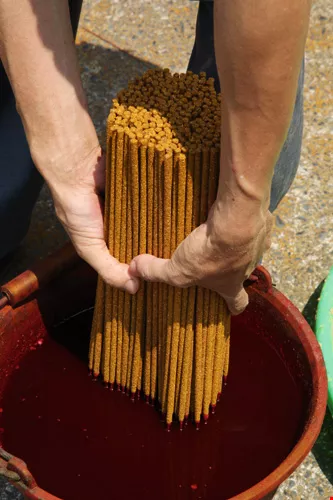
The incense making process: 1.Soaking in oil 2.Applying incense powder 3.“Spreading the fan” 4.Straightening up 5.Sun drying 6.Dyeing the handles 7.Applying gold paint to the ends
The association members, each with their own specialties, have pooled their talents to establish a brand—“Taiwan Prayers”—which acts as a platform for sales of religious products and services of all kinds. With customers such as Taipei’s Cihui Mazu Temple, Kaohsiung’s Guangong Temple, and Pingtung’s Donglong Temple, the brand has attained a yearly gross of NT$35 million.
Taiwan has numerous temples. Every year the countless religious ceremonies held at these temples create a huge market for related products. Taiwan Prayers handles everything from design to sales, providing custom-tailored services and integrated sales channels. Express delivery service is available throughout Taiwan. They can even do event planning for temple activities.
In recent years more attention has been given to religious art. First, there was the popularity of performances by Nezha troupes set to techno music, and then there was the film Din Tao: Leader of the Parade. Taiwan Prayers has kept pace with this trend of melding traditional culture with modern elements by designing an electroluminescent deity palanquin for the Donglong Temple and a lion dance LED light box for the Tianhou Temple in Tainan.
Via the Pingtung Incense Association and Taiwan Prayers, traditional manufacturers are working together to show their love for traditional culture by breathing new life into traditional local industries. Revenues have increased by 11% in just the six months that Taiwan Prayers has been established, and it has already increased its staff by 12%.
Amid the fragrant aroma of incense, poets recite poetry while Buddhist monks perform their ceremonies. Even larger numbers of common folk pray to the Taoist deities. Everywhere the fragrant smoke spirals upward. To experience a state of serenity, modern people need only to spark up an artisanal incense stick.
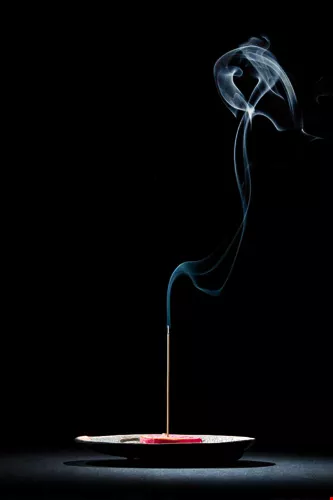
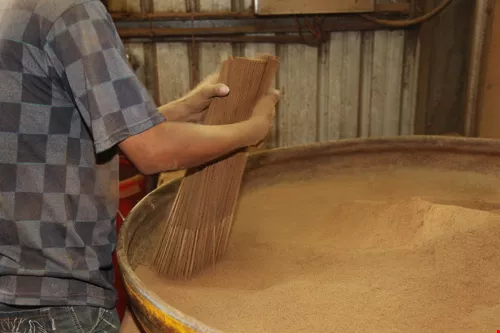
The incense making process: 1.Soaking in oil 2.Applying incense powder 3.“Spreading the fan” 4.Straightening up 5.Sun drying 6.Dyeing the handles 7.Applying gold paint to the ends
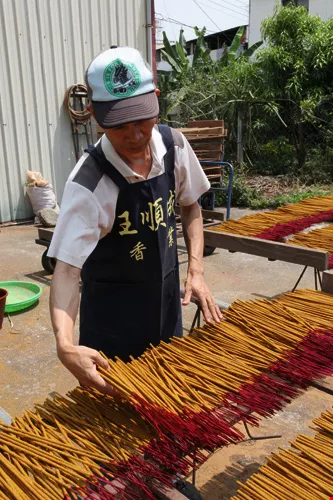
The incense making process: 1.Soaking in oil 2.Applying incense powder 3.“Spreading the fan” 4.Straightening up 5.Sun drying 6.Dyeing the handles 7.Applying gold paint to the ends
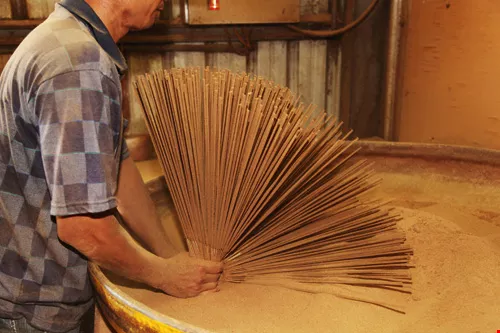
The incense making process: 1.Soaking in oil 2.Applying incense powder 3.“Spreading the fan” 4.Straightening up 5.Sun drying 6.Dyeing the handles 7.Applying gold paint to the ends
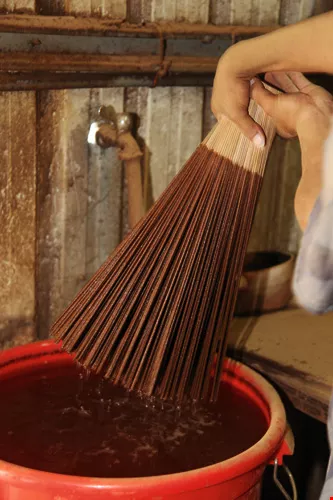
The incense making process: 1.Soaking in oil 2.Applying incense powder 3.“Spreading the fan” 4.Straightening up 5.Sun drying 6.Dyeing the handles 7.Applying gold paint to the ends
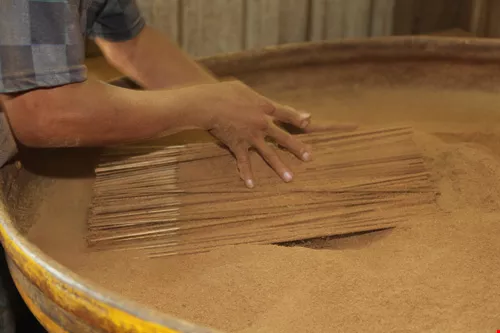
The incense making process: 1.Soaking in oil 2.Applying incense powder 3.“Spreading the fan” 4.Straightening up 5.Sun drying 6.Dyeing the handles 7.Applying gold paint to the ends

_DSC2938@List.jpg?w=522&h=410&mode=crop&format=webp&quality=80)

@List.jpg?w=522&h=410&mode=crop&format=webp&quality=80)


