

Every lunar New Year's, tradition-conscious Chinese spruce up their living quarters and embellish their surroundings with gay and festive decorations. The two large pictures customarily posted on either side of the front door are especially conspicuous.
The origin of this custom goes back a long way, to ancient superstitions. Early people painted a picture of a tiger, rooster, or other animal over their doorways to ward off the diseases, ghosts, and spirits which they feared might otherwise enter in.
But subjects of door pictures are chiefly gods and heroes.
Door gods come in many varieties. The first to be mentioned, in documents from the Han dynasty (206 B.C.-- 220 A.D.), are Shen T'u and Yu Lei, two brothers. They were said to have inspected all the ghosts one day under a peach tree on Tushuo Mountain, tied up with reeds any who had recklessly caused people trouble, and fed them to tigers. The ancients believed peachwood could ward off evil, so they painted pictures of the brothers on peachwood boards and hung the boards up over their doors for protection. Peachwood was later replaced by paper, resulting, it is said, in the door god posters of today.
According to the History of the Former Han, however, the earliest door god was rather Cheng Ch'ing, a brave hero whose portrait, with short smock, long trousers, and long sword, was painted on the gates of the palace. Ching K'o, the would-be assassin of the tyrannical Ch'in Shih Huang, was also represented as a door god. Both figures can still be seen on murals and stone portraits preserved from the Han dynasty.
The door gods Ch'in Ch'iung and Yuchih Chingte were T'ang dynasty (618-- 907) generals whom the emperor T'ai Tsung, fallen ill and frightened by ghostly howls and wails, ordered to stand guard outside his sickroom. They are popularly called White Face and Black Face or, in Kiangsi province, the White General and the Red.
The scholar Chung K'uei, also from the T'ang dynasty, was another subject of New Year's pictures, these painted inside the palace but the function of which, to ward off evil, was similar to that of the door gods.
After this, door gods become ever more colorful and diverse. During the Northern Sung dynasty (960--1127), street vendors in Pienliang, the capital, sold at year's end wooden boards painted with pictures of various door gods, some shown in tiger-shaped headgear, fearsome to behold. The door god paintings of the rich and noble sparkled with gold foil.
Later, the loyal generals Kuan Yu, of the Three Kingdoms Period (220--265), and Yueh Fei, of the Northern and Southern Sung dynasties (960--1279), along with Wen T'ien-hsiang, the last prime minister of the Sung, were also portrayed as door gods, in honor of their loyalty and righteousness. Wei Cheng, a T'ang dynasty official who appears in the novel Journey to the West, is featured on pictures for the inside of doors, like Chung K'uei.
Also the subject of New Year's paintings are figures dressed in courtly attire, called Celestial Officials. They may be shown accompanied by a hat, deer, spear, set of chimes, vase, or saddle, which, by a series of puns, stand for public office, prosperity, good luck, felicity, peace, and security, respectively. There is also a Door Boy who is used specially for bridal suites and newlyweds' homes. He may be pictured riding a Chinese unicorn or a lion to symbolize future offspring or career success.
Door gods, intended at first, like New Year's firecrackers, to ward off evil spirits, together with their accompanying and later developing door boys and celestial officials reflect two major characteristics of Chinese folk belief: the wish to ward off evil and the desire to call forth good fortune.
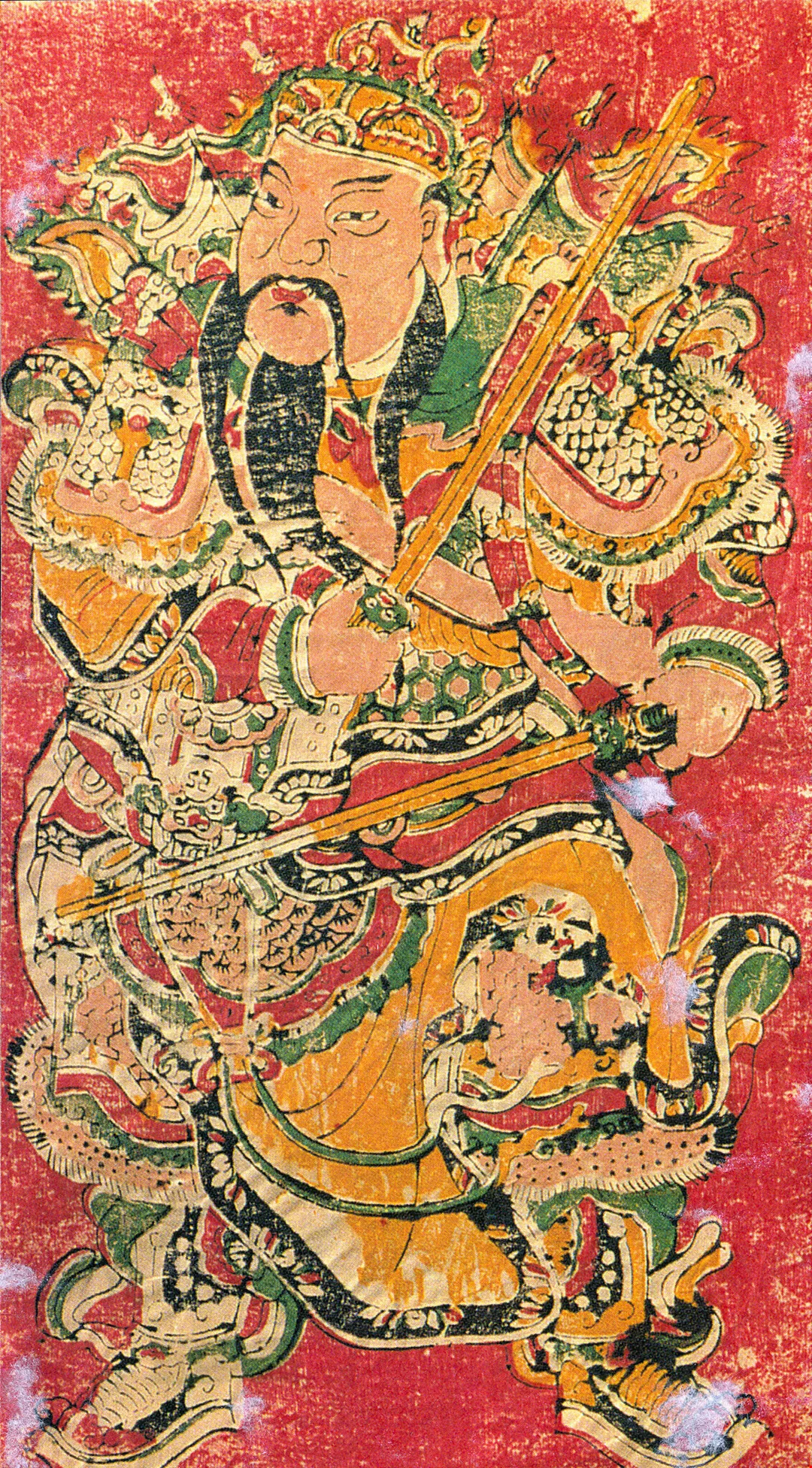
Door Gods.


@List.jpg?w=522&h=410&mode=crop&format=webp&quality=80)


