Serving Up the Past—The Taiwan Bowl and Dish Museum
Tsai Wen-ting / photos Chuang Kung-ju / tr. by Phil Newell
October 2014


Whether you are rich or poor, high-born or low, there is nothing more satisfying and heartwarming than having the whole family gathered around the dinner table.
Though often taken for granted, bowls, dishes, and other ceramic tableware are integral to meals. To the antiquarian, they are essential pieces of the puzzle in reconstituting how people have lived over time. Indeed, imagining them on a table, you can almost inhale the fragrances of culinary cultures gone by....
The Taiwan Bowl and Dish Museum, located in Yuanshan Township, Yilan County, is housed in a structure that was once a luggage factory. The exterior is so nondescript that a lot of people just drive by without realizing what it is.
When you enter the Bowl and Dish Museum, you are greeted by an enormous oval “fish platter,” 4.2 meters long and 3.0 meters high. This serving dish, 100 times larger than the ones you will find on ordinary dining tables, completely fills visitors’ line of sight, serving to block out the present day and tumbling them into a world of memory.
When you examine the fish platter closely, the swimming orange and red lines of the decorative fish painted on the bottom, vibrant and evocative, are redolent with the vitality of folk traditions and a sense of joyous celebration. When the platter was first made, museum founder Chien Yang-tung really wanted it to have authentic old colors and patterns, so he specially invited Yilan’s renowned temple painter Huang Rongtong to handle the artwork.
At first, the museum hoped to make a real ceramic fish platter. But it turned out that there was not a single kiln in Taiwan large enough to accommodate the design, so the museum turned instead to an old master carpenter, an expert in traditional craftsmanship. After several discussions, the carpenter adopted techniques used by shipwrights to create this delightful super-sized “vessel.”
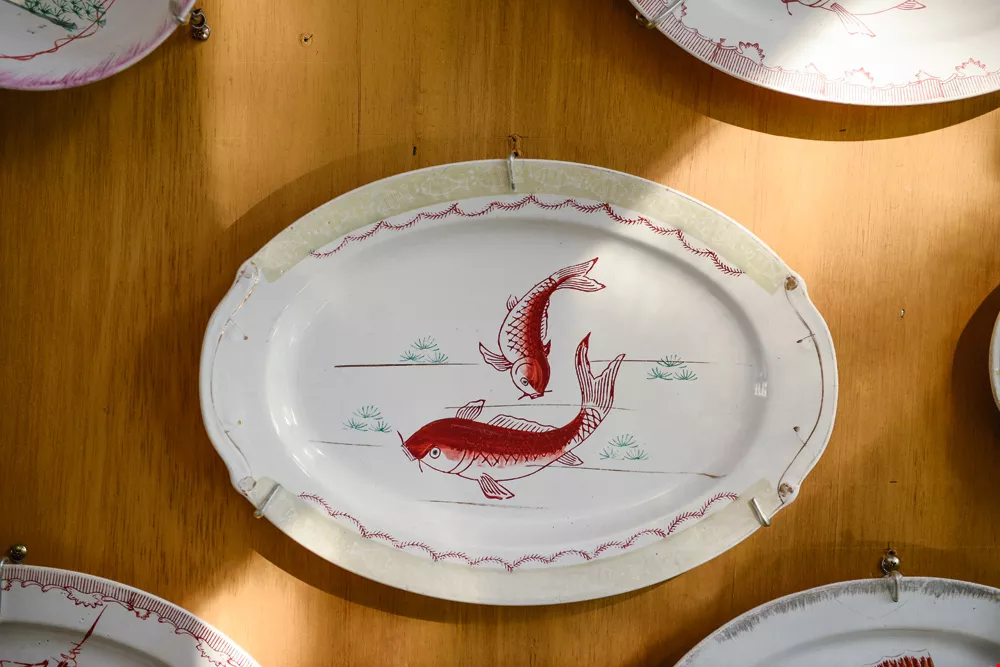
Life was hard in pre-modern times. For many, fish and shrimp were luxuries they could rarely afford. But they didn’t cease to hope for better times, and these hopes were reflected in the many ceramic items decorated with paintings of fish or shrimp.
The Taiwan Bowl and Dish Museum occupies about 1600 square meters, and is divided into four areas: display, cultural/creative, cross-cultural, and hands-on. The display area, as the name suggests, is for the museum’s main collection. It starts with a brief history of the development of ceramic tableware over the years, both in Taiwan and around the world.
In the earliest days of human settlement, people in all corners of the world figured out that they could shape containers from handfuls of clay, thereby bringing ceramics into everyday life.
Humans understood how to combine clay and heat to fire pottery more than 30,000 years ago. Items with decorative patterns dating back over 13,000 years have been unearthed at the Xianrendong site in Jiangxi Province in mainland China. Here in Taiwan, the ground beneath our feet is a storehouse of ceramic vessels from as early as the Neolithic era, some 6000 years ago.
Ceramics can be roughly divided into three major categories: earthenware, stoneware, and porcelain. Looking back at the development of ceramic tableware in Taiwan, the thing that stands out is the unadorned, natural-looking stoneware of ancient times. There is a simple reason why our forebears adopted this type: Taiwan simply doesn’t produce much of the type of raw material (known as white clay or kaolin clay) that is required for light-colored porcelain, so the ceramics made in Taiwan were stoneware, somewhere between crude earthenware on one hand and porcelain on the other.
The clay used in early ceramic ware in Taiwan was in some cases mineral-rich clay from mountain areas (as in Beitou or Miaoli), which, owing to its greater mineral content, is more resistant to higher temperatures. But even more early ceramics were made using mud from the fields (as in Yingge and Nantou). There is more organic matter in field mud, so pieces emerge from the kiln with a dark brown color. These are the kinds of bowls and plates that even today are used so commonly by streetside vendors to serve rice noodle soup, braised pork on rice, and other fare for the common man, as a result of which, even in a quiet museum, for Taiwanese they evoke the sounds and smells of a cheap and tasty night-market snack.
In order to manufacture tableware that would be shinier, cleaner-looking, and more durable, our forebears got their creativity cranked up and decided to add various stone and other mineral ingredients to their ceramics. For example, in the Yuchi region, people added light-colored powdered stone, whereas in Beitou they added a washed white clay. By combining a variety of raw materials, they could raise the firing temperatures in their kilns and get semi-vitreous stoneware.
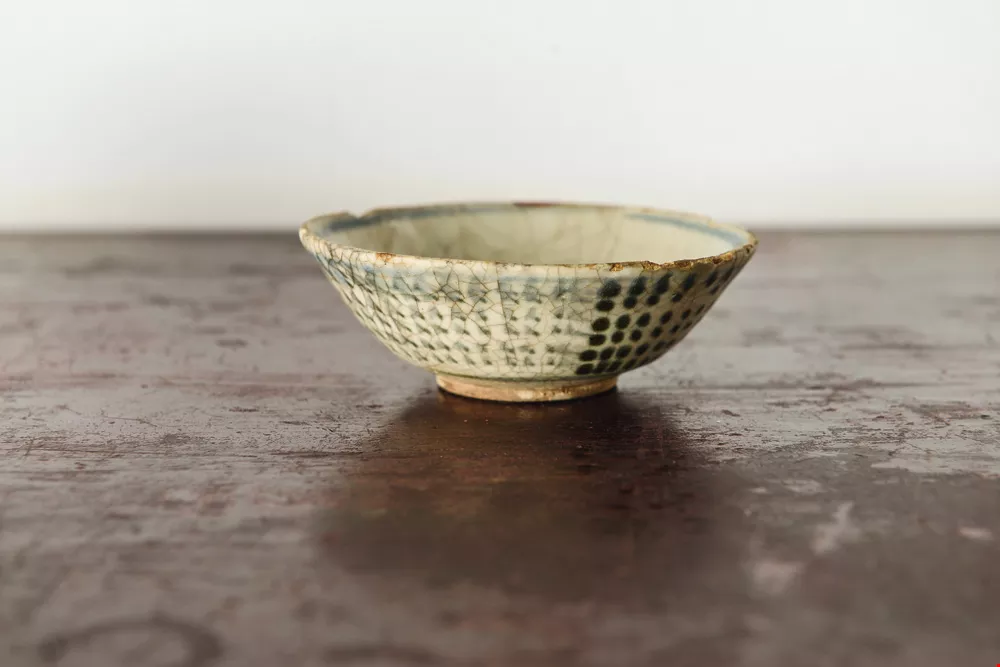
A blue and white porcelain bowl with decorative pattern, from the Ming Dynasty (1368–1644).
After this basic introduction to ceramics, you turn a corner and hit the museum’s main exhibition area. A row of small glass cases set next to the windows exhibit, in serial order, ceramics that have graced the tables of Taiwan in the major periods of our history: the imperial era (the Ming and Qing dynasties), the era of Japanese rule (1895–1945), and the Republic of China era (1945 to the present).
During the age of the great sailing ships more than four centuries ago, the Chinese imperial government banned Chinese people from living near the coast or engaging in maritime commerce, and Taiwan became a major entrepôt for world trade headed to or from Japan and Southeast Asia. Thus some exquisite Japanese porcelain from that era remains. Later, after Han Chinese began migrating to Taiwan, while they made some ceramics locally—such as roof tiles, which were too space-consuming to haul over from the mainland—that was not the case for tableware. Stackable dishes and bowls, more easily shipped, still mainly came from the Chinese coast.
In the whole display area, the piece that Chien Yang-tung treasures most is a blue-and-white painted porcelain bowl from the Ming Dynasty. When he first acquired this piece, he knew only that it was quite old. It was only when excavation began at the Kiwulan archeological site in Yilan County that—amongst the many pottery shards of the indigenous Kavalan people—a similar porcelain bowl was discovered (albeit not a complete and intact specimen). This find was very exciting for Chien, for it suggests that even at that early time there was trade between Taiwan’s indigenous peoples and mainland China, and this porcelain bowl was probably there to witness it.
During the era of Japanese rule, while trade continued between Taiwan and mainland China, naturally Japan—and especially Gifu Prefecture—became a major source of imported ceramics. In addition, the Japanese colonial government adopted a systematic policy of promoting the ceramics industry here in Taiwan, and major kilns were set up in four locations: Nantou, Yingge, Beitou, and Miaoli.
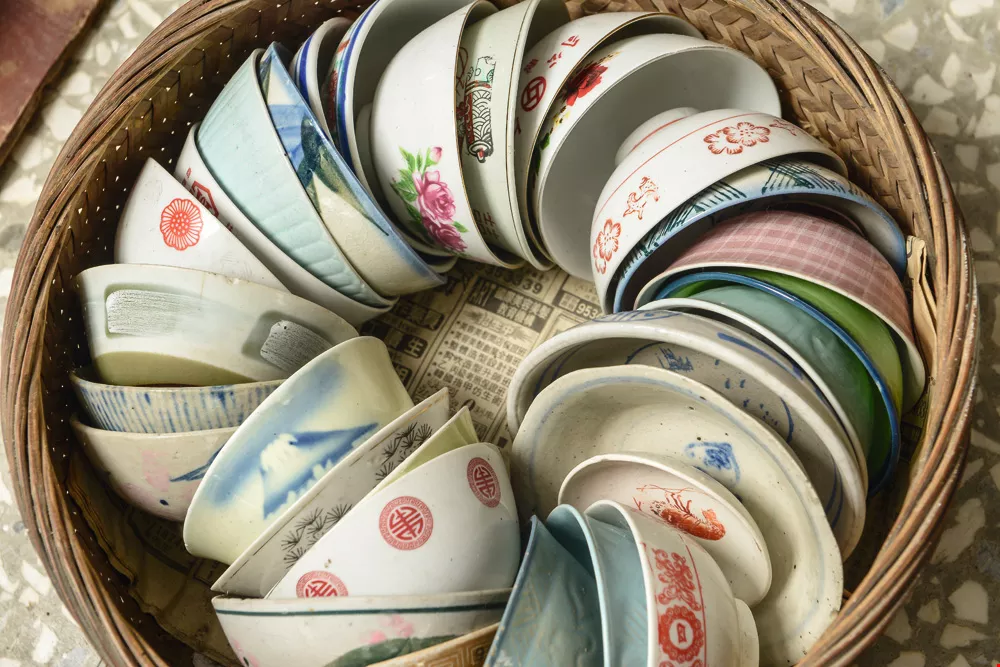
Each and every dish and bowl tells a story of how people lived in days gone by. Inhale deeply: Did you pick up on that fleeting fragrance of culinary cultures past?
The Beitou ceramics industry has an especially interesting story. According to the book Traditional Ceramic Tableware of Taiwan, by Chen Jinchuan and Zhuang Xiuwen, the first kilns there were set up by the Beitou Pottery Company, founded by a Japanese man named Kametaro Matsumoto. He invited master potters from Kyoto to join his business, becoming the forerunner of the entire Beitou ceramics boom. Miaoli, meanwhile, was the first place to utilize natural gas for firing ceramics. Besides the factories opened through joint Taiwanese–Japanese investment, there also began to appear some companies founded independently by Taiwanese, including the Fuxing Kiln, where the fires are still burning even today.
In contrast to those ceramics makers who were deeply influenced by Japanese techniques, the Jianshan Kiln in Yingge forged a different path. Jianshan received no guidance or instruction from the Japanese colonial government, and had no Japanese investors. Instead—or perhaps we should say consequently—its strength was in adapting traditions of Han Chinese people. World War II, which brought world trade to a standstill, actually was a boost for Taiwan’s ceramics industry, which enjoyed a resurgence. It was common in those days to see retailers fighting for space in front of kilns to get their share of bowls and dishes fresh from the oven.
After WWII, the ROC government began importing large amounts of kaolin clay, and put an emphasis on research and learning. This period proved to be a great leap forward for Taiwan’s ceramics industry. Statistics in the book A History of Yingge Ceramics indicate that there were 90 ceramics makers in Taiwan in 1945, but that figure rose to 180 in 1962, more than 1000 in 1987, and more than 2000 in 1993! Yingge, where 75% of the companies primarily focused on tableware, became a veritable kingdom of ceramics, due in large part to three major advantages: a railroad station, locally sourced clay, and coal mines.
An especially noteworthy year was 1963, when Ta Tung Chinaware was founded. This company, which would become enormously famous, was instrumental in bringing Taiwan tableware unreservedly into the glistening-clean white porcelain age. In those days it became virtually obligatory for a newly married couple to get a complete set of Ta Tung china for their nuptials. And the company more or less had a monopoly of the banquet tableware business. They were also the first company to export ceramics from Taiwan.
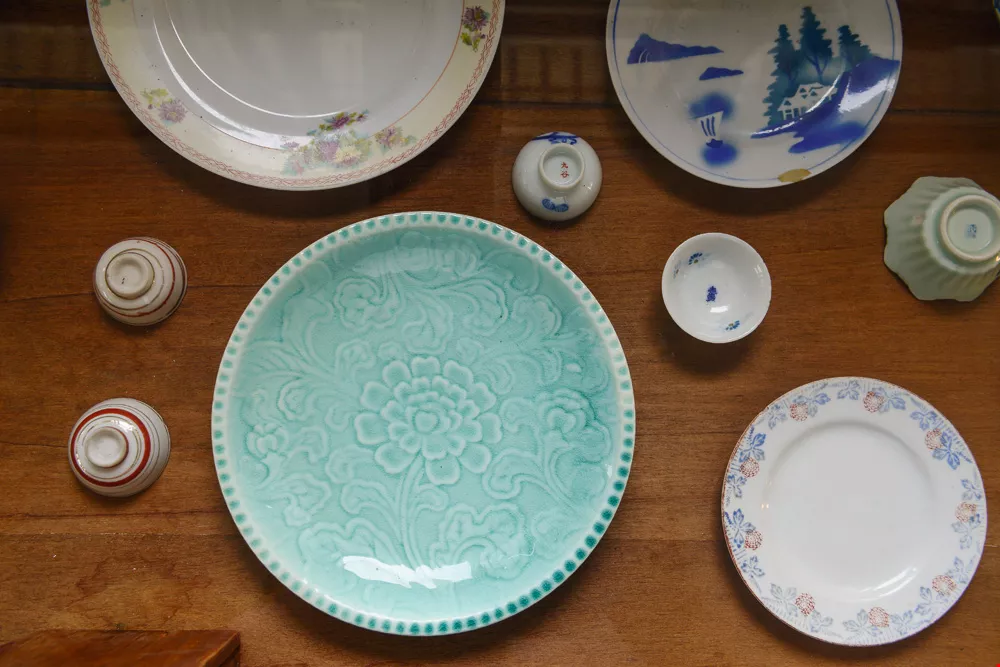
Fine food makes for healthy bodies, fine china makes for happy hearts.
The end of Japanese rule meant the end not only of a political era, but of a stylistic one as well. After 1945 ceramics designers looked instead to the tradition of Chinese ink-wash painting. For example, during the Japanese era, floral patterns included only the blossoms, but after the war the motif was broadened to include the entire flower—stem, leaves, and all. Especially popular were plum blossoms, orchids, bamboo, chrysanthemums, peonies, and roses. Other new elements included influences from Chinese landscape painting, and poetry written in elegant calligraphy.
Coming back to the Bowl and Dish Museum, looking at the thousands of items on the display walls, you see that like snowflakes, no two are exactly alike. The craftsmen who hand-decorated them would paint two or three bamboo leaves here, one or two little flowers there, varying the motifs and brushstrokes as the mood struck them.
Then there are the countless items with auspicious meaning, like “fish platters” and “shrimp platters.” These were not necessarily designed to serve fish or shrimp, but merely had pictures of fish or shrimp painted on the bottom. “In a time when life was difficult, it was no easy thing to get real fish or shrimp in your dish,” says Chien. “The hopes and dreams of our ancestors were vividly expressed in the brushstrokes on their ceramic ware.”
Picking up a lard pot heavily marked by time, Chien explains that early ceramic tableware in Taiwan was very special in one particular way—almost all of it had “crackling” in the glaze. “Crackling” means that there is a large spider-web-like network of cracks in the glazed surface. This happened in Taiwan in the old days because early technology was inadequate, resulting in a thermal expansion mismatch between the clay and the transparent glaze. Once removed from the kiln and exposed to cool air, the surface would fracture into countless lines and cracks. “I suppose you would have to call these ‘rejects’ today, but they have a magic of their own. In particular, ceramic containers that were routinely placed in baskets for steaming food seem to have a hint of the aromas of the ingredients still ensconced in the surface fractures!” Chien, who can wax eloquently about every item he owns, sniffs at the used containers and asserts without reserve that he can detect the warm smell of lard.
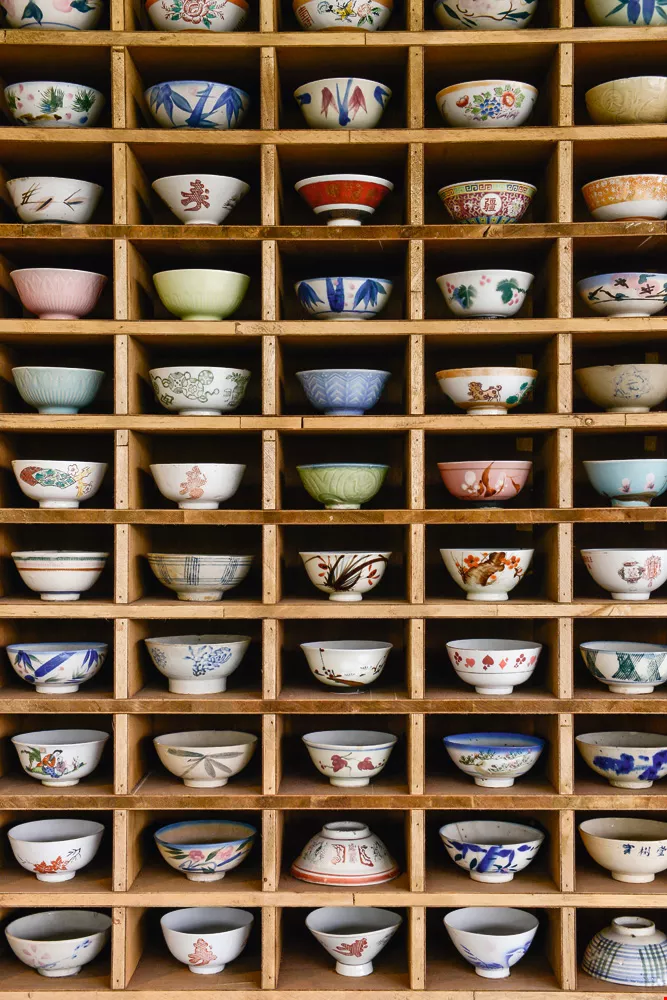
The entire museum is laid out with the hope of being very visitor-friendly, so that people who come in to browse can feel relaxed and comfortable. For example, rather than using ropes to keep visitors away from the items on the display walls, the museum has strategically placed a few items here and there to create a buffer that feels completely natural. It’s markedly different from the feeling you get in big museums, where visitors are treated like a threat to the exhibits!
A particular problem for all museums in Taiwan is earthquakes. They are doubly worrisome for a ceramics museum, and triply so for one in eastern Taiwan, the part of our island where earthquakes are most common. While they don’t have to worry about fire, the Bowl and Dish Museum takes extreme precautions against tectonic shifts to keep all display items safe and sound. Chien Yang-tung has been particularly attentive to this problem. The items on the display walls are all fixed in place with hot-melt adhesive. Ceramic ware in display cases or on wooden frames is held in place with a German-made putty fixative produced especially for this purpose.
The biggest problem is posed by plates hung on the display walls. If they are fixed too firmly, they will actually be more vulnerable to damage. Chien, who seems to be an endless fount of clever ideas, got the idea of copying the suspension system used in cars, and devised a fixture made with springs and flexible plastic tubing. It was not long before his invention was severely tested: Early in the morning on the day after the opening of the Bowl and Dish Museum, Yilan was struck by a temblor measuring 6.0 on the Richter scale. Yang immediately rolled out of bed and drove to the museum. “Fortunately, everything came through without a scratch!”
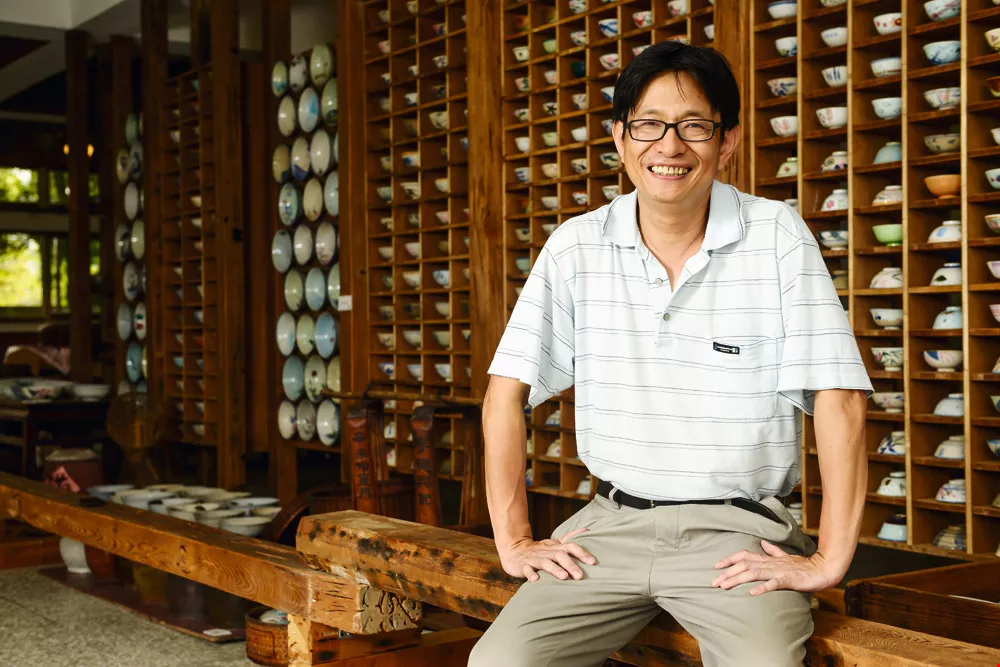
Taiwan Bowl and Dish Museum founder Chien Yang-tung created the museum single-handedly, to share his beloved collection with visitors. He hopes that everyone will come to find the same warmth and beauty in these ceramics as he has.
When your cup finally runneth over from the pleasure provided by the more than 6000 items displayed on the first floor (which are in fact only a fraction of the museum’s more than 20,000 holdings), you can head up to the second floor to the cultural/creative exhibition area. In addition to a small library of specialist books, probably the most interesting items up here are the “Yilan Bowls,” created by the museum itself. These aren’t just knock-offs—a lot of thought went into making them.
Last year, for the celebrations marking the 200th anniversary of the founding of Yilan City, the museum, with funding from the Ministry of Culture, created a new collector’s item: Yilan Bowls. They come in two sizes, small and large. Chien notes that Yilan is famous throughout Taiwan for its unique local foods, but it’s rather a disappointment when they arrive at the table in a plastic or styrofoam bowl. He is hoping his creations will catch on as a new symbol of Yilan.
The small bowls are hand painted in light blue around the rim, and imprinted with the Chinese words for “safe and sound” [ping’an] and “smooth progress” [shunxing]. The large bowls, imprinted with the same characters in vermilion, are decorated with a hand-painted bamboo motif in light blue. The Chinese words connect the bowls directly with Yilan’s earliest days. When the original walled town was built 200 years ago, a fengshui expert chose the names for the four gates, names which included the characters ping, an, shun, and xing. The museum took one character from each gate name, then recombined them into the two words inscribed on the bowls.
To give Yilan bowls even more unique local character, black mud from the bottom of Yilan’s Lake Dahu was kneaded into the pre-fired mixture. The only problem is that Yilan clay, which in the old days was only used to make bricks, is not very suitable for ceramic tableware. At first they tried a formula of 30% Yilan black mud, but the bowls broke when fired. They had to keep reducing the percentage, only succeeding in getting finished products when they lowered the figure to around 5%. “The black spots on the bowls are from the Yilan black mud,” says Chien, who, examining an Yilan Bowl, laughs: “I had to run to the kiln more than 30 times just to finally get this little guy!”
After that the museum created Taiwanese Opera commemorative dishes, imprinted with images of performers working in the historically earliest style of Taiwanese Opera, known as the Loe-de-sao form. These were followed by “four seasons bowls” featuring water plants unique to the Yilan area. When visitors to the museum get a little tired, they can exchange their entrance tickets for a bowl of cold-brewed tea or a scoop of guava ice cream produced by homemakers in the community. There is a special flavor to a refreshing treat when it is consumed from an antique-style bowl—hard to describe, but you know it when you taste it!
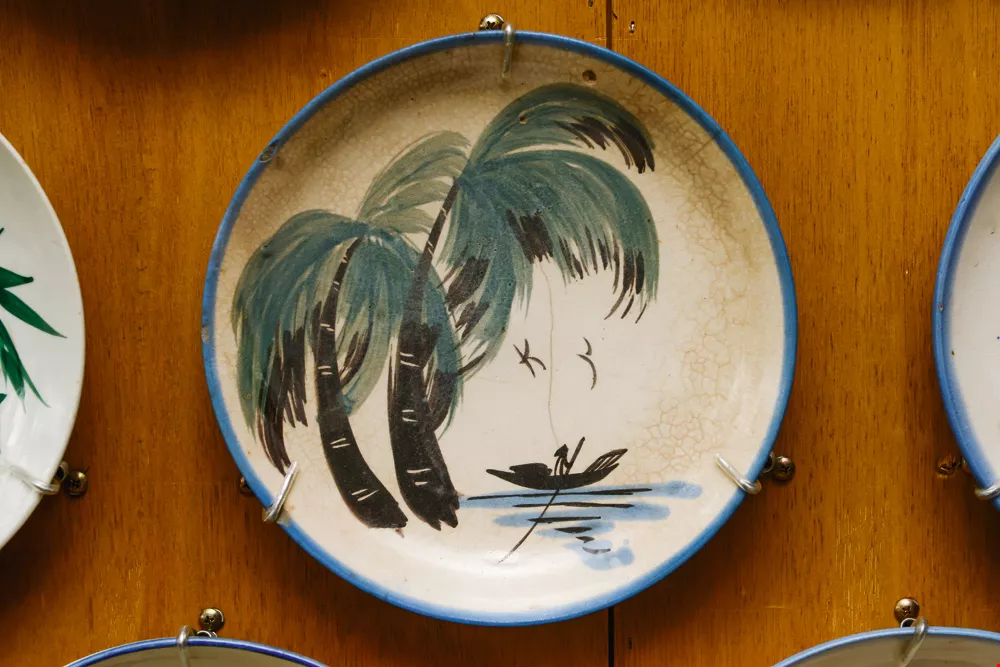
Of all the images, this one with palm trees most evokes Taiwan’s exotic character as a subtropical island.
Over the last two-plus years, the Taiwan Bowl and Dish Museum has held a number of events that have drawn very enthusiastic crowds. As Chien says, “We want the museum to be vital and alive, and the only way to do that is to link it with the living community around us, in the spirit of an eco-museum.” One of the first activities the museum organized after opening was to send a “tableware authentication team” to the nearby Yonghe Community. They invited the homemakers and elderly ladies in the community to search out old bowls, dishes, and other ceramic ware from their homes, and then everyone got together to share their “kitchen stories.” Chien assessed the womens’ ceramic ware for its age and authenticity, and everyone got a chance to marvel at the beauty (and monetary value!) of these antiques. These women have rapidly become an important source of assistance for the museum, even preparing meals for museum events.
One such event is the totally unique “Lyrical Banquet: Twelve Courses of Traditional Taiwanese Cuisine, with Libretto.” We need a little background to understand the inspiration behind this concept.
Yilan is the home of Taiwanese Opera, and Yuanshan’s Jietoufen neighborhood is where it all began. One piece nearly a century old, written early in the era of Japanese rule, tells the story of a woman hosting a 12-course meal for the man she loves. It’s an evocative, vivid song, as the lyrics describe everything from the setting of the table to the appetizers to the wine, and also suggest the implied or symbolic meanings behind each dish. We still have this libretto thanks to old compendiums of Taiwanese Opera, which, like books of sheet music for contemporary pop songs, record the words for various operatic works.
The museum event combined Yuanshan Taiwanese Opera with the museum’s own ceramic tableware, and the organizers invited ladies of Jietoufen to be the chefs, preparing a menu shaped by reference to the one in the song. The inaugural event, held on November 1 of 2013, brought the culinary culture of a century past back to life.
On that evening, the museum was transformed into an enormous restaurant with a decidedly historic feel. Musicians played their classical stringed instruments, and the diners entered to the sounds of bells and drums. (It was standard for Chinese walled towns to have a drum tower and a bell tower.) Members of the Jietoufen Taiwanese Opera Studies Group then began to sing the lyrics of the “Twelve Course Song.” “Bring out the round table / A wine glass and ivory chopsticks for all / A table covered with cold appetizers and roast pig / To play host to our noble guests....” The homemakers of the community pulled out all the stops, and—adhering to the original Taiwanese Opera lyrics—served duck with salted Chinese cabbage, fried shrimp, chicken, roast pig, and more. Against a background of classical Chinese music, the attendees ate and drank at dining tables that doubled as time machines.
The banquet drew rave reviews, and has become the most important annual event at the Bowl and Dish Museum. For November of 2014, the museum will work jointly with the Yilan County Cultural Affairs Bureau, and this fête will be considered one element in the county’s “Art in Village” events.
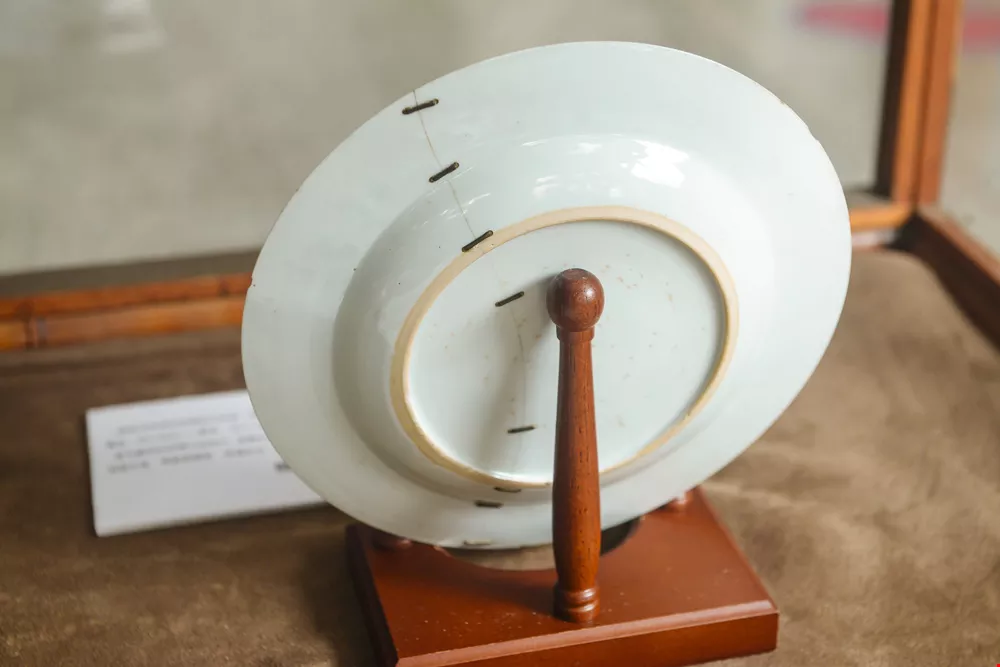
Have you ever seen a piece of tableware “stapled”? You can see how much people in days gone by treasured their few material possessions.
Have you ever seen a “stapled” piece of ceramic ware? Items that have been broken can be repaired with staples holding the pieces together. The fact that anyone would go to such lengths for a bowl or dish tells us a lot about how much people in times past valued their few material possessions, whose abundance and low cost we take for granted today.
How about a “stamped” plate or dish? A “stamped” piece of tableware is one that has been marked with a symbol or family name for identification purposes. To the cognoscenti, this is also very revealing of rural life in days gone by. For big events like weddings, everyone in the neighborhood would pitch in not only by helping with the setting up and cooking, but also by lending their finest tableware. The only problem, when the party was over, was figuring out which dishes belonged to which household—hence the ID marks.
When you visit the Taiwan Bowl and Dish Museum in Yilan County, you will find a lot more than just thousands of examples of ceramic tableware. You will find yourself back in a slower, more leisurely time, a time when most people lived off the land and communities were close-knit. So come on along: How hard can a journey through time be when you can do it all in one place!


@List.jpg?w=522&h=410&mode=crop&format=webp&quality=80)
