Fishing Village Culture at the Keelung Squid Festival
Esther Tseng / photos by Keelung City Dept. of Economic Affairs / tr. by Phil Newell
August 2025
The Sea Prince Cultural Festival held by Xie’an temple in Waimushan includes an “inspection tour” by the deities Wangye and Mazu.
In the 21st year of the Keelung Squid Festival, local fishing villages are extending nighttime activities related to neritic squid, while by day they are promoting a series of experiential activities including fishing village “academies,” DIY squid processing, and cloth-dyeing using pigments from yam plants (Dioscorea). There are also the unique at-sea “inspection tours” (religious processions) by icons of the deity Wangye. Come to Keelung and enjoy Taiwan’s maritime culture!
Before headng out for some nighttime squid fishing, we first visit the fishing village of Badouzi to attend a village “academy” and experience local lifestyles.
Passing a certain spot, we smell a strong fishy aroma. It turns out that some Badouzi people still engage in the traditional practice—used before the advent of freezers—of first blanching their catch of ayu sweetfish, horse mackerel, and neritic squid, and setting them out to dry on bamboo trays. Alternatively they would lay the blanched catch out in the sun to dry or deliver it to Kanzaiding Fish Market. Walking by, we are exposed to waves of salty-fragrant aromas.
Dyeing and DIY squid processing
As fishing villages have faced population outflow and the aging of their residents, a rural regeneration program involving seven Keelung communities has empowered teams of mothers and youths from communities such as Badouzi and Changtan to periodically organize fishing village experiential and learning activities.
During the day there are classes on various types of seafood including mackerel and neritic squid, and even dissection of the creatures to learn about their anatomy, after which they are cooked and eaten or used for overnight DIY processing activities (gutting, cleaning, and drying). The whole marine creature is used without waste.
Tsai Fu-ning, director general of the Keelung City Department of Economic Affairs, recommends that visitors try Dioscorea dyeing. In the past, handmade fishing nets were steeped in reddish-brown juices pressed from Dioscorea plants, dyeing the plant fibers of the nets while also strengthening them and making them more resilient and durable.
Local cultural teams have preserved memories of this past practice and now organize cloth-dyeing activities for visitors. After the cloth is dyed, people put on traditional straw sandals and walk down to the beach to rinse it out.
Lan Li-lin, founder and head of the Keelung City Badouzi Tourism Industry Association, says that visitors or school field-trip groups can choose between various activities, such as squid dissection with DIY processing activities, the plant dyeing and intertidal zone straw sandal experience, or trying their hand at fishing with an old-fashioned cast net. These are all popular summertime maritime cultural activities. Now there are also English-language guides available, which has attracted many foreign exchange students.

In dissection class, visitors can learn about the anatomy of neritic squid; after the lesson is over, the squid are cooked and eaten.

The “Sea Fishing Academy” offers a class in DIY overnight processing (gutting, cleaning, and drying) of squid or ocean fish.
Maritime cultural assets
Each year on the 11th day of the sixth month by the lunar calendar (which in 2025 fell on July 9), the three Wangye deities of Sheling Temple on Heping Island are taken on a tour of inspection of their domain on land and at sea. A week later, on the 18th day of the lunar month, a similar event is held for the Wangye and Mazu deities at Xie’an Temple in Waimushan.
Officially registered as folk cultural heritage by the Keelung City Government, the at-sea portion of the Sheling Temple event starts out from Zhengbin Fishing Port on Heping Island. After visiting other fishing harbors and their temples, the deities make three turns around the Port of Keelung and then return to Sheling Temple where they are greeted by local people, and where a market is held.
Because Keelung is a major international harbor, says Tsai Fu-ning, it is only during Sheling Temple’s at-sea Wangye procession that one can see this kind of activity by fishing boats in the commercial port area.
The Waimushan event, known in English as the Sea Prince Cultural Festival, is also held on the open ocean. A procession of fishing boats sets off from Waimushan Fishing Port at 7 a.m., and heads east to the sister port of Shen’ao, where it turns three circles in greeting to representatives of the Xie’an Temple’s sister temple, Chengtian Temple, as boats from Shen’ao set off fireworks and firecrackers in welcome. This kind of interaction between boats, temples, and fisherfolk, is a special feature of the Sea Prince Cultural Festival.
The procession then heads west to pass by other fishing harbors along the coast, and returns to Waimushan around noon, when residents head to Xie’an Temple to join in the celebrations and consume a meal that symbolizes the festival’s purpose of praying for fishing crews’ safety throughout the year, and includes local delicacies like agar jelly, and rice noodle soup with neritic squid. In the afternoon tourists can visit nearby sights and return for an evening banquet with shrimp, crabs, and scallops. After eating and drinking your fill, you can see real fishing boats enjoying the deities’ blessings of fair wind and weather, their holds brimming with abundant catches.
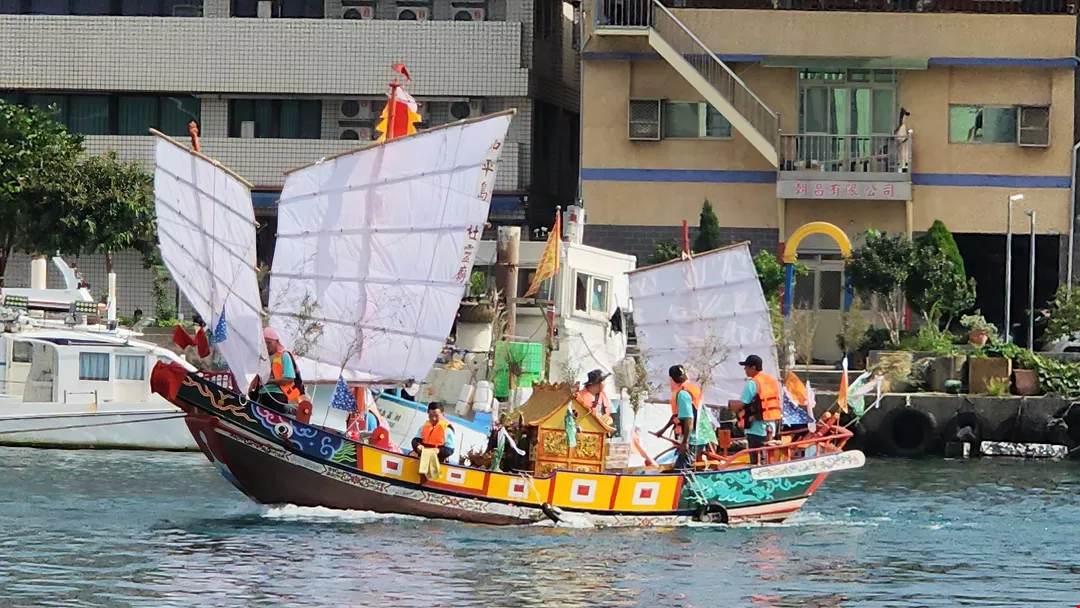
This at-sea Wangye event, the Heping Island King’s Sea Tour, held by Sheling Temple, is listed as folk cultural heritage by the Keelung City Government.
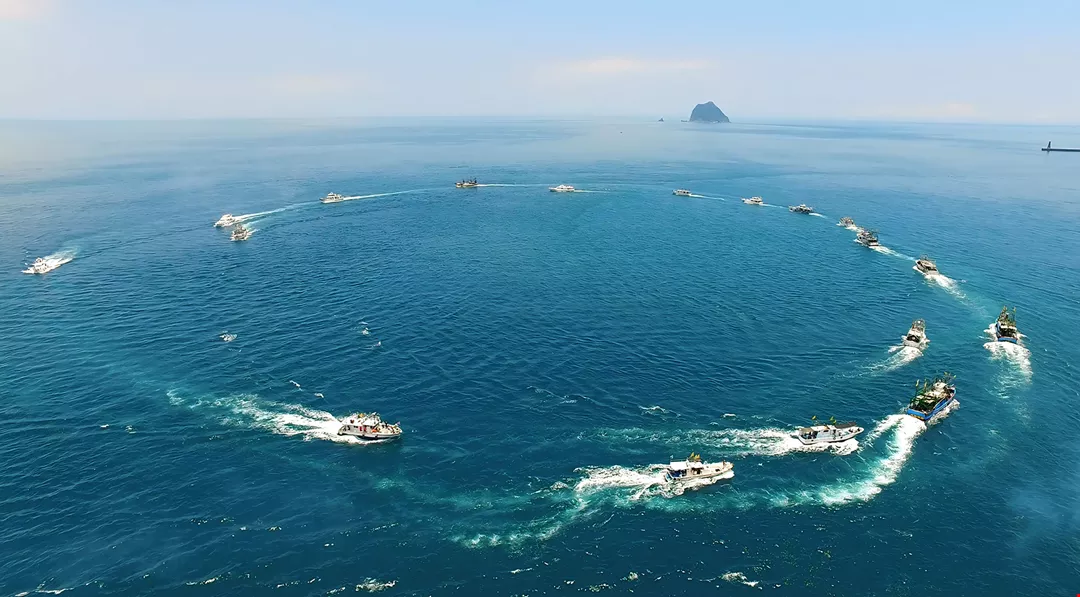
When the Wangye procession from Waimushan reaches Shen’ao fishing harbor, the boats make three circuits by way of greeting locals.

