

Picture this: In 41 years' time, when the world's oil reserves run out, the cars that now choke our city streets will have no fuel to run on. Twenty-two years later, production of natural gas will dry up, so frying up a meal on a gas ring will also become a thing of the past. As for coal, at current rates of consumption the world has enough deposits to last for 114 years. But as oil and gas are depleted, the speed at which coal is used up seems sure to increase. Can anyone guarantee that in two centuries' time, our grandchildren will not have to live in a primitive age without cars or electricity?
The search for alternative sources of energy has become an important issue worldwide. In Taiwan, the debate four years ago over whether to continue building a fourth nuclear power plant produced a popular consensus that the island should be made a nuclear-free zone. Thus we urgently need to find clean, safe, sustainable energy sources. The "renewable energies" that environmental groups have been strongly promoting in recent years may provide a good solution.
Taiwan produces little of its own energy, currently importing 97.97% of its traditional fuels. Of these, petroleum accounts for 55%, coal for one-third, natural gas for 5% and nuclear fuels for 8%.
With recent instability and uncertainty in the Middle East, oil prices have rocketed to their highest level since World War II. Clearly, over the next decade global competition for access to oil resources will grow increasingly intense. As an isolated island, Taiwan cannot link its power transmission grid to those of neighboring countries and buy electricity from them, but must stand on its own two feet. This makes the formulation of its energy policy all the more difficult.
Taiwan's electricity is generated not only from traditional fossil fuels (oil, coal and gas) and hydropower, but also by nuclear plants that supply some 20% of the island's power. In view of the thorny issues associated with nuclear power, such as the possibility of radioactive pollution and the difficulty of nuclear waste disposal, this proportion is unlikely to rise substantially in the future, and in fact is likely to decline. If the long-term aim of a nuclear-free Taiwan is to be achieved, development of the next generation of energy sources cannot be delayed.
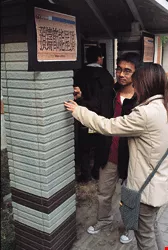
A well-designed building that shades out the summer sun and is insulated to stay warm in winter can save greatly on the energy used for air-conditioning.
Sustainable, inexhaustible
"The next generation of energy sources have to be inexhaustible, unlike traditional energy sources that are quickly depleted," says Chan Shih-hung, president of Yuan Ze University and of the New Energy Association of Taiwan. Chan points out that traditional energy sources are mainly extracted from underground, which not only takes a great deal of effort, but also cannot continue forever. Looking to the future, the main focus of development for the next generation of energy sources will be "renewable energies." These include the abundant forces of nature such as sunlight, wind, water and geothermal energy, along with "biomass energy" (e.g. methane produced by anaerobic digestion of pig-farm effluent or slurries).
"As long as the sun and the earth continue to exist, these renewable energies will be inexhaustible-they are sustainable sources of energy. And since they are products of nature, human error during their conversion into forms of energy that can be conveniently used by mankind will not lead to pollution or devastation, as oil well explosions or oil spills can. In other words, renewable energy is very environment-friendly," says Shih Hsin-min, a professor of chemical engineering at National Taiwan University and founding chairman of the Taiwan Environmental Protection Union.
In fact, not only in Taiwan but worldwide, energy policymakers are turning their gaze to renewable energy. For example, European countries have already set targets for renewables to account for at least 10% of their total energy production by 2010. Denmark has set this target as high as 29%, while Germany's target is 14%.
Taiwan started formulating its renewable energy policies somewhat later than the advanced countries. Five years ago, on the basis of the UN Framework Convention on Climate Change and the Kyoto Protocol, the government began directing efforts toward improving energy technologies and raising the efficiency of energy use, and-on condition that it should not impact economic development-toward reducing emissions of carbon dioxide and other greenhouse gases. The energy experts charged with the planning decided that Taiwan should work to develop renewable energies.
The development of renewable energies is also one of the pillars of the "Challenge 2008" six-year national development plan, announced by the Executive Yuan in 2002. The plan projects public investments of over NT$1 billion per year in renewables, with the stated aim that by 2020 the installed capacity of electricity generating equipment powered by renewable energy should reach 6.5 gigawatts, and account for 12% of Taiwan's total generating capacity, or twice the current level of 6% (including existing conventional hydroelectric capacity).
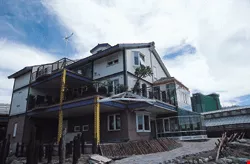
"Green architecture" embraces many concepts, including biodiversity, creating plant-rich surroundings, water conservation and reducing energy use. It incorporates renewable energy features into the design of buildings to make them into a self-sufficient organic whole.
Balanced development
The policies are in place, but what of their implementation?
"Taiwan really does have favorable conditions for developing renewable energy," says He Tsung-hsun, executive director of the NoNuke Taiwan Union: the island enjoys lengthy periods of strong sunshine, which can be used for solar thermal energy or for photovoltaic generation of electricity; its coasts and offshore islands are swept by powerful sea winds, suitable for generating electricity from wind power; surrounded by sea, it is well placed to experiment with tidal and wave power; the lush vegetation that results from its location straddling tropical and subtropical climate zones provides abundant "biomass"; and heat from its many hot springs and geothermal sites can also be converted into usable energy.
Wu Huang, deputy secretary-general of the Energy Commission of the Ministry of Economic Affairs (MOEA), explains further: "Precisely because the range of renewable energies is so diverse, each country has to direct its limited resources toward the development of selected areas in which it has an advantage. Thus Germany is developing wind power and Japan hydroelectric power. In Taiwan we hope to achieve a balanced development of hydro, wind, geothermal, biomass and photovoltaic energy sources."
However, Wu says that although Taiwan's geographical situation is favorable, closer examination reveals that the conditions are not entirely ideal for any one form of renewable energy, making it very difficult to choose one area for all-out development. Thus one can only adopt a multi-pronged approach, and attempt to develop a number of different renewables. After a comprehensive cost analysis and assessment, the Energy Commission has set long-term development targets for each type of renewable energy: photovoltaic 1 gigawatt (GW); wind power 1.5 GW; biomass 1.35 GW; hydropower 2.5 GW; heat recovery 1.6 GW; and geothermal energy 150 megawatts.
In terms of future development potential, solar power, including both solar heat and photovoltaic energy, is seen as the most promising. Lai Wei-chieh, general secretary of the Green Citizens' Action Alliance, describes the sun as a gigantic nuclear fusion reactor, so powerful that the sunshine that hits the earth in 45 minutes contains as much energy as the whole of mankind uses in a year. Thanks to the efforts of the worldwide energy industry over many years, solar energy technology has advanced greatly and costs are gradually falling.
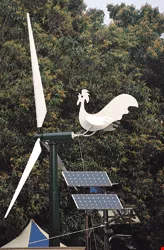
A combination of photovoltaic panels and a wind turbine provide for an uninterrupted flow of energy come rain or shine.
New energy for the home
Wu Huang of the Energy Commission also sees rosy prospects for photovoltaic energy. Solar panels convert sunlight into electric current thanks to the photovoltaic effect that occurs when photons strike the silicon wafers from which the panels are made. This use of silicon presents an opportunity for joint development with the semiconductor industry, in which Taiwan is already a world player. The cost of photovoltaic generation is currently around NT$15-20 per kilowatt-hour (kWh), far above that of traditional power generation at NT$2.09 per kWh. But if in the future this cost can be reduced to NT$2.2, photovoltaic generation will become economically viable, and will also generate business for local industries.
Yuan Ze University president Chan Shih-hung describes his ideal of home life in the new energy era: on the roof of every building there will be a set of photovoltaic panels and a wind turbine, which together will supply every household's electricity needs, while their gas or electric water heaters will be replaced by a solar hot water system.
This is an alluring vision, but as yet solar energy equipment is still too expensive, and despite government encouragement and subsidies, it is proving very difficult to bring it into widespread use.
For example, says Wu Huang, a solar hot water system, though simple enough in structure, costs NT$40-80,000, has to be installed on the roof, and covers a substantial area. The flat roof space of apartment buildings in Taiwan is regarded as shared between all residents, or as the de facto property of the top-floor household. A family living on a lower floor that wishes to install its own system will find it very difficult to get the other residents to agree. At present, 300,000 households in Taiwan use solar hot water systems, a penetration level of 4%. This falls a long way short of the target of 1.5 million households, but is a good start nevertheless.
By contrast, at present only around 40-50 larger sets of photovoltaic panels are installed in Taiwan to generate electricity from the sun's rays. On public land and buildings, to date the MOEA has completed demonstration systems in only a few locations including the Presidential Palace and the Yushan meteorological observatory. There is also little sign of enthusiasm for installations on ordinary residential buildings.
"People who are willing to put a photovoltaic system on their own rooftop are mostly those with a passionate level of environmental consciousness, who won't even install air conditioning in their homes," says Wu Huang. He observes that only people completely committed to their environmental ideals regardless of cost would be prepared to fit a photovoltaic system that has a useful life of only 20 years, an installed cost of NT$700,000-900,000, and only produces 1500 kWh of electricity a year.
Thar she blows
As for the oldest form of renewable energy-wind power-it is technologically the most mature and also the most economic. Since promotion began in 2000, demonstration wind farms have been completed in ten locations in Taiwan, including Mailiao in Yunlin County, Chungtun on Penghu, and the Tien Long paper mill at Chupei in Hsinchu County. But they are all very small in scale, and together only account for 0.25% of Taiwan's total generating capacity.
"Taiwan is an island, and for more than half of every year the monsoon winds blow from the northeast, giving us abundant wind power resources," says Lai Wei-chieh of the Green Citizens' Action Alliance. He notes that the greatest obstacle to generating electricity from the wind has always been the variability of wind speeds. A windmill needs a wind speed of at least five meters per second to drive it effectively, yet it is vulnerable to damage from typhoons and storms. Secondly, in fact Taiwan is not short of electricity, except during brief periods of peak demand in the heat of summer, when air-conditioning systems are running at full blast in houses and offices throughout the land. Once autumn arrives electricity is in plentiful supply, so that sadly the winter northeasterlies come too late to be of any assistance.
Wind turbines can now be fitted with electronic governors that control the speed of the rotor, so that the blades turn slowly and at an even speed, which greatly boosts the efficiency of electricity generation. With wind power technology continuing to improve by leaps and bounds, the cost of generation at many large wind farms in favorable locations around the world has already fallen below that at coal-fired power stations. Wind power looks set to be the most important form of renewable energy over the next decade.
High-efficiency clean batteries
Another rising star in the renewable energy field is the "fuel cell." Yuan Ze University is home to the YZU Fuel Cell Center. As YZU principal Chan Shih-hung explains, a fuel cell's main fuel is hydrogen, which is abundant in the natural world. When fed into the cell, it combines with oxygen to form water, and in the process chemical energy is converted into electrical energy. A fuel cell's operation does not involve combustion and produces no pollution, and the efficiency of energy conversion is several times higher than in conventional cells. "Hydrogen energy" has been a hot field of research internationally for more than a decade.
Furthermore, hydrogen can be recovered: for example, if the electricity generated by a rooftop solar panel is used to extract hydrogen from water, the hydrogen can be stored and used to power a fuel cell. This can solve the problem of what to do with excess electricity generated by a home system.
Products powered by fuel cells, such as robots and small submarines, have already been developed in various advanced countries around the world. In Japan, fuel-cell-powered electric cars have been successfully developed; manufacturers expect to build 50,000 units in 2010, and 5 million by 2020. By that time, filling stations will offer hydrogen in addition to traditional fuels.
Here in Taiwan, as long as 12 years ago the government launched a fuel cell research and development program, which it has funded to the level of some NT$100 million each year. Taiwanese manufacturers are now producing fuel cells for teaching purposes priced below NT$10,000 each. However, at the present stage of technical development, they are still far from ready full commercialization.
Of all the renewable energies, "Taiwan's capacity for electricity generation using methane from biomass ranks first in Southeast Asia," says Wu Huang of the Energy Commission. Taiwan has an installed capacity of 23 megawatts for generating electricity from methane derived from such sources as anaerobic digestion of pig-farm effluent and waste slurries, and from refuse landfills. This is halfway to the government's target, showing that with determination one can achieve results.
New concepts, new systems
Renewable energy sources are everywhere, and this makes them especially suited to small-scale power generation in local, distributed installations. But this differs greatly from the present structure of large-scale concentrated electricity generation conducted mainly by the Taiwan Power Company (TaiPower), so that the changes in attitudes and in the regulatory system that are required are highly complex and no less formidable than the technical and economic barriers.
At a recent forum on renewables, Wu Huang of the Energy Commission observed, based on his own experience of promoting various projects, that the administrative and legal barriers one was most likely to encounter were firstly the difficulty of obtaining land-such as where to apply to obtain use of a piece of unused land with no registered owner-along with such issues as whether the height of a generating facility would interfere with military flight paths or radar, the difficulty of obtaining a change in the designated use of farmland, and so on. Fortunately there has been progress in this area over the last two years, and demonstration projects have been completed in a number of locations. But if renewable energy really is to be widely promoted, Wu believes that regulations will need to be further relaxed.
Shih Hsin-min of the Taiwan Environmental Protection Union suggests that in future farmers' and fishermen's associations can be invited to join in renewable energy promotion. For instance, oyster farmers could manage wind turbines sited offshore to take advantage of sea winds. In other words, energy production could be combined with farming and fishing, thus making full use of the human, land and natural resources of the countryside. He believes this is a direction worth working toward.
Secondly, says Shih, compared with traditional energy sources, the cost of power generation from renewables is still too high, and the small scale of the various demonstration projects in Taiwan makes them even less economically viable. Thus what private individuals and enterprises wishing to try their hand at renewables most need is government incentives in the form of subsidies and energy purchasing schemes.
The MOEA's present incentive programs are only set to continue until the end of 2004. In the case of wind power and photovoltaic systems they provide for subsidies up to half the cost of the equipment, while for solar hot water systems they offer subsidies of 15-20%. In response to intense public pressure, in November 2003 TaiPower announced rules for purchasing electricity generated from renewables, and set the price at NT$2 per kWh. But this price will be reduced if the total installed capacity of eligible generating equipment exceeds 300 MW; and once TaiPower is privatized and no longer burdened with mission of promoting government policies, it may scrap the scheme altogether.
Green taxes
Compared with Germany, where the authorities are vigorously promoting renewable energy and are willing to buy electricity from private producers at high prices, there is clearly still room for improvement in Taiwan's approach. Uncertainty as to purchase price and quantity will also discourage private enterprises that are interested in generating electricity from renewables, and make it difficult for them to borrow the funds they need from banks.
However, to look at the issue from another perspective, "Although traditional energy sources appear cheap, in fact their external cost to society, such as pollution, the disastrous effects of greenhouse warming, and the potential risks of nuclear waste, are commonly left out of the equation." So says Wang Tu-fa, a standing director at TaiPower and an adjunct professor in the economics department at National Taipei University (NTPU). He states that many European countries are currently pursuing "green" tax reforms, introducing taxes such as carbon taxes, energy taxes and pollution taxes, in the hope that they can persuade the public to correctly recognize the true cost of using various different types of energy.
Assistant Professor Lee Chien-ming of NTPU's Institute of Natural Resource Management says that in fact internationally there are many mechanisms and technologies related to the new resource economy that Taiwan should urgently adopt.
One example is the "clean development mechanism" (CDM). Lee explains that this is one of the three "flexible mechanisms" of the Kyoto Protocol that were put forward by advanced countries in 1997 with the aim of reducing total global greenhouse gas emissions. The CDM program encourages countries that possess effective technology for reducing greenhouse gas emissions to assist other countries (generally developing countries) in developing clean industries, through such means as funding and technology transfers. The reduced emissions that result are credited to the donor country and count toward its own greenhouse gas reduction targets, or may be traded. Thus both donor and recipient benefit.
Last year, after staff from the Formosa Plastics Group on an overseas inspection tour learned of this mechanism, the company decided to assist Vietnam in developing clean technologies such as cogeneration (combined heat and power) and tree planting, and then sell the resulting greenhouse gas reduction credits (valued at US$10 per tonne) to countries that need them, thus developing a new line of business.
In fact Taiwan itself also has an urgent need to introduce cutting-edge renewable energy technologies. "Through CDM, we can find advanced countries that are willing to help us with funds and technology," says Lee Chien-ming. Although the mechanism is still controversial internationally, Lee believes this is no reason not to assess and review the policy's effectiveness, and introduce it when the time is right.
Act now or regret it later
Some of the legal changes needed to develop renewable energies now look set to be introduced. In April, the Renewable Energy Bill that had long been stalled in the legislature at last made it onto the debating agenda. But in the event the debate did not take place, much to the frustration of environmental groups.
He Tsung-hsun of the NoNuke Taiwan Union is always busy lecturing on campuses islandwide in the hope of promoting renewable energy by educating the next generation. He says that based on the current situation in Taiwan, it will indeed be difficult to do away with nuclear power in the short term. Nonetheless, a non-nuclear Taiwan is the long-term national goal, and policies should take account of this as early as possible by implementing all kinds of supporting measures. In particular, he urges, the development of renewable energies has an important role to play, for "if we don't act today, we will regret it tomorrow."
Renewable energy sources are all around us, and humankind should make the best use of them to replace polluting and high-risk energy sources. The next time you watch the sunrise, hear the waves crashing on the shore or enjoy the sight and sound of the wind whipping up the water, apart from admiring their beauty, don't forget to thank nature for providing humanity with a natural power station.

@List.jpg?w=522&h=410&mode=crop&format=webp&quality=80)


@List.jpg?w=522&h=410&mode=crop&format=webp&quality=80)
@List.jpg?w=522&h=410&mode=crop&format=webp&quality=80)
