Taiwan's Shumei Farmers Live Out Their Back-to-the-Land Dreams
Kuo Li-chuan / photos Jimmy Lin / tr. by Jonathan Barnard
November 2007


According to the Council of Agri-culture, Taiwanese farmers used 36,529 metric tons of pesticides in 2005. That's 1.6 kilograms for every man, woman and child in Taiwan-a shocking statistic that bears witness to an excessive dependence on fertilizers and pesticides.
The growing demand for organic produce has led growers to plant crops in confined and unnatural environments. With consumers fearing pesticides, yet farmers unable otherwise to keep bugs under control, they cover crops with plastic. Unable to spray, growers build greenhouses.
Is the filtered sunlight healthy for crops? Are the tea-seed meal and other resources that organic farmers use instead of chemicals to rid crops of pests really so benign, given that they kill bugs? One media report after another describes marketers cheating consumers by mislabeling conventional produce as "organic" or notes that pesticide residues have been found on certified organic food. No wonder consumers are beginning to have doubts about the safety of organic food.
Meanwhile, the Korean idea of shintoburi ("body-soil unity"), which emphasizes that food grown in local soil is best), the Japanese custom of eating seasonal foods, and The Yellow Emperor's Classic of Internal Medicine (with its dictum that "the best medicine offers treatment before illness") stress the close connection between food and health. In modern medical terms, all are versions of preventive medicine.
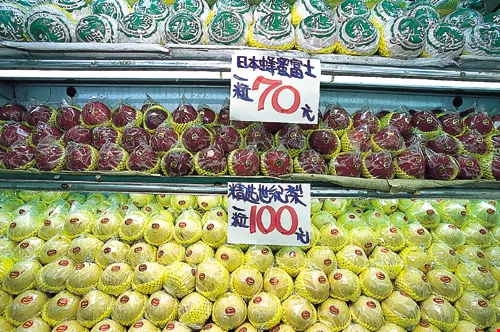
Japanese apples, Korean pears, American grapes, New Zealand kiwifruit... globalization has brought consumers more choice, but the world pays a high price.
Let the soil heal itself
In the 1950s, the Japanese religious figure Mokichi Okada (1882-1955) promoted a style of farming that eschewed fertilizers and pesticides. Shumei-or natural farming-asks farmers to plant and harvest by themselves and to take "recovering soil purity" as top priority. Natural farming jibes with the principles of preventive medicine and the objectives of the environmental and conservation movements, and it has been gradually attracting a following in nations around the world. Promoted in Taiwan for more than a decade, natural farming has a growing number of adherents here.
Mokichi Okada believed that the land provided all the nutrients that crops needed and that soil pollution and weakness could be attributed to man and his chemicals. Consequently, a natural farmer's top priority is to protect and bolster the purity of the soil to help it heal itself. Natural farmers shun organic fertilizers (apart from compost made from leaves and non-woody plants) and use seeds culled from previous crops.
Shumei has been practiced in Japan for more than 40 years. Currently, more than 1,200 farmers are practicing it on more than 80 farms there. Collectively, they have more than 500 hectares under cultivation. And they have established the Shumei Natural Agriculture Network, which works with farmers throughout Japan and has established promotional offices in various places, including the United States, Britain, Germany, the Philippines and Taiwan.
Located in Tanshui in Taiwan County, the Tatun River Shumei Educational Farm has been using these methods longest in Taiwan. Chen Hui-wen, the farm's owner, explains that natural farming differs from organic farming in that it relies entirely on natural forces to promote plant growth. Sometimes, in order to heal the soil, its practitioners eschew plowing, or they cut weeds but leave the roots in the soil.
Weeds might seem to be unbeneficial or even detrimental (when viewed as thieves of the soil's nutrients). But they can in fact help the soil, both by holding it in place and by creating fertilizer. Natural farmers often cut weeds at ground level but leave the roots. In an effort to lighten their load, the root systems of these formerly robust plants then release great amounts of nutrients into the soil, making them available to the planted crops. What's more, during photosynthesis such plants will fix certain elements from the air; thus they enrich the soil with trace elements. It is a mutually beneficial natural cycle.
"The compost made from cut weeds serves as a mulch that retains moisture and temperature and keeps the soil from hardening, and as the underground roots rot they loosen and aerate the soil," Chen says. "You need only poke at the soil gently once or twice to provide a crack for planting seeds."
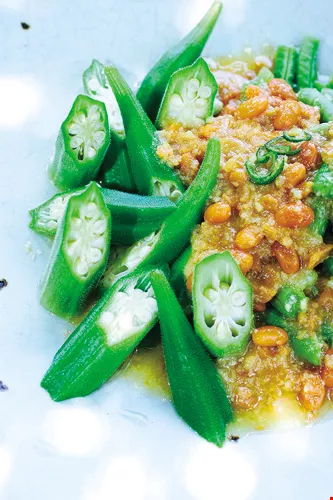
Large okra pods and sweet pumpkins grown by natural farming methods offer subtle and refreshing flavors.
Natural selection
The sun-bronzed Lin Yi-lung, who established the Hsiayun Natural Living Farm in Taitung last year, is collecting seeds in what looks like a vegetable garden overrun with weeds.
Unlike the manipulative precision of plant hybridization, a field in which Taiwan excels, natural farming relies on nature's power, giving plants the job of natural selection. Lin argues that one shouldn't think of plants as lacking wisdom. In fact, they are quite intelligent and carry memories of the environment in their genes. After propagating for a number of generations, they produce special characteristics that better suit them to the local ecology and climate. These naturally evolved plants are very hardy and have strong resistance to pests and disease.
For a newcomer to natural farming such as Lin, it will take at least eight years of gathering successive generations of seeds from the F1 (hybridized) plants grown in the first season before the genes can strengthen and learn to "survive independently in nature."
So-called "F1" seeds are created by crossbreeding two different species of plants. These F1 seeds, touted as "improved varieties" by their marketers, have some advantages, but the seedlings rely heavily on fertilizers and pesticides. And the generations of seeds that follow are often of uneven quality and pose great challenges to natural farmers.
"Watching bugs eat one's crop is a unpleasant experience that farmers new to shumei frequently have to bear. Often, the plants are entirely devoured, so that collecting seeds is impossible," explains Lin. "Even if there are healthy plants with seeds, the next year it's often the case of 'a tiger siring a dog,' and growth isn't as one had anticipated."
Chen, who had abundant experience with her family's vegetable garden before she became a professional farmer, once used seeds that had proved quite stable through four years only to lose the next year's crop after she had sowed when conditions were wetter than usual. But she has also experienced smashing successes, such as okra that she "trained" for over ten years in the wild to grow seedpods that are 25 centimeters long yet very tender when cooked, and daikon radishes so huge that old local conventional farmers can't help but mutter their praise.
Chien Ya-ling has a degree in horticulture from National Taiwan University. Last year she joined the Bulaubulau Farm in Ilan's Hanhsi, where she is responsible for agricultural planning. "Plants are like people, with particular environments that suit them. When they move, they've got to adjust. So the same plant grown in different nations, or even just in different counties or towns, will grow differently, due to differences in soil, climate and water quality." For instance, seeds that Chen Hui-wen collects in Taipei County might not do so well if Lin Yi-lung were to try to plant them in Taitung.

Local agriculture
"Apart from not damaging the soil, natural farming is also the form of agriculture that best treasures the world's natural resources. Japanese advocates of natural agriculture also favor "community supported agriculture." When produce is grown and consumed locally it doesn't consume energy by being shipped. And from the standpoint of health, food that is locally grown and in season is best suited to meeting the body's needs.
A researcher at the Kumamoto Prefectural Agricultural Research Center in Japan once made a comparative study of the nutritional value of in-season field-grown tomatoes versus out-of-season greenhouse tomatoes. He discovered that the in-season tomatoes had 86 times the iron of the greenhouse tomatoes. Apart from offering convenience, low cost and high nutritional value, consuming of locally grown produce also prevents energy being wasted to transport and chill it. It's no wonder that during the recent era of oil shortages environmentalists have been promoting "local farming" and calculating "food miles." These efforts achieve the same results as boycotts of foreign food.
Chen Hui-wen cites the Council of Agriculture's "new agriculture movement" to demonstrate the growing number of people with back-to-the-land dreams. For these new farmers, natural farming is unquestionably the simplest, healthiest and most environmentally friendly form of agriculture, and it is particularly well suited to Taiwan, an island nation with limited land.
The COA has been promoting a "farmland bank," giving those who wish to enter farming a chance to rent or buy land with unpolluted soil and water. It has also designated some outstanding farms as "demonstration farms," where interested people can go to practice farming and gradually gain the stamina necessary to become true farmers. The aim is to foster a stream of people to go into farming and develop agriculture that is natural, clean, local and high in quality. It would bring about a win-win situation for the people and the land.
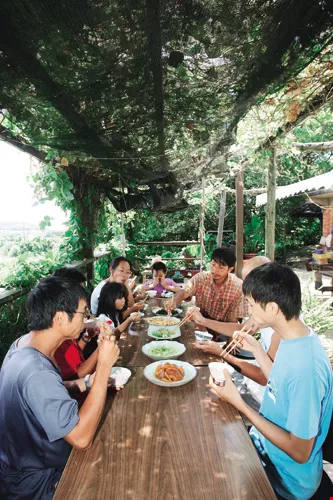
Tatun River Natural Educational Farm offers tours and demonstrations to people who are interested in natural farming. Afterwards, they share a simple meal, enjoying the fruit of their labor. In this photo, Li Hsu-ying and his wife Chen Hui-wen are seated at the far end of the table.
Religious ideal: To establish heaven on earth. Aiming to reduce poverty, sickness and conflict, the religion promotes several "arts": "life art" (purifying one's spirit), "agricultural art" (natural farming), and "aesthetic art" (the church has founded several museums, including the Miho Museum, which was designed by I.M. Pei).
Principles of natural farming The land supports a teeming variety of life forms, and people should learn from nature rather than interfering with it. Farmers can only help things grow, but those living things themselves play the leading roles.
Priciple 1: Don't use fertilizers Don't pamper crops. Apart from using compost from leaves and other non-woody plant matter found on site, apply no fertilizer (including organic compost-because kitchen scraps have traces of pesticides, chemical fertilizers and modified genes; and they also attract bugs).
Principle 2: Allow seeds to self sow Don't plant commercially grown seeds, which are cultivated using fertilizers and pesticides. And allow seeds naturally to fall the ground after the fruit or seedpods mature. Successive generations of these volunteers will provide each farmer with unique seeds, thus increasing biodiversity.
Principle 3: Don't move crops Like a husband and a wife, plants and the land hold "memories" of each other. Hence, it's best to keep successive generations of plants on the same plot of land. This idea differs starkly from the crop rotation used in organic farming.
Principle 4: Mental outlook of the grower The soil and plants have their own "minds," and the attitude of growers and consumers can affect the way plants grow. Consequently, one should proceed with a sense of gratitude and blessing.
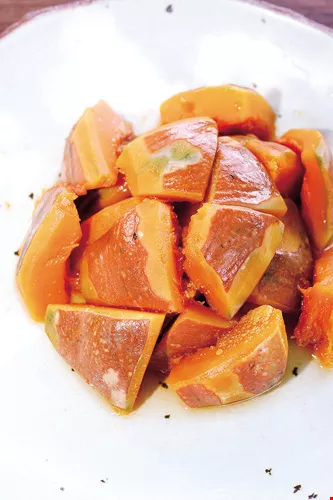
Large okra pods and sweet pumpkins grown by natural farming methods offer subtle and refreshing flavors.
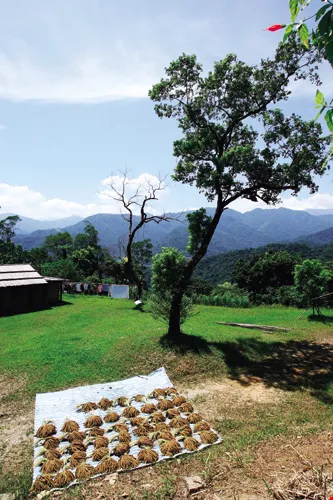
Natural farming, which takes recovering soil purity as top priority, jibes both with the principles of preventive medicine, and with the values of the environmental and conservation movements. By creating a win-win situation for the people and the land, it has been receiving growing attention and is gaining adherents in various nations around the world.
@List.JPG?w=522&h=410&mode=crop&format=webp&quality=80)


