Warming the God of Wealth--Taitung's Blasting Handan Festival
Kate Yang / photos Chuang Kung-ju / tr. by Scott Gregory
April 2005


Usually, the arrival of the Lantern Festival on the fifteenth of the first lunar month means the end of the Lunar New Year holiday season, and the festive sound of firecrackers fades away. But in Taitung, it marks the beginning of one of the biggest events of the local year-the "Blasting of Handan."
Every year, in addition to the public event put on by the county government, businesses also invite the god Handan to come and be blasted with firecrackers, to bring them good luck in the new year.
In order to drum up more tourism, the Taitung County festival notched up the amount of firecrackers this year. The private festivals were more concentrated as well, so tourists could see more of them.
There are many explanations of the origin of Taitung's "Blasting Handan" festival. In Taoism, Handan was originally a Shang Dynasty military officer named Zhao Gongming or Zhao Xuandan. He became known as the "Martial God of Wealth" due to his financial resources.
Handan is said to hate the cold, so people throw firecrackers at him to warm him up, believing that the more firecrackers you throw, the better your financial fortune in the new year. Everywhere his palanquin goes, the excitement follows, and firecrackers are set off by the boxload.
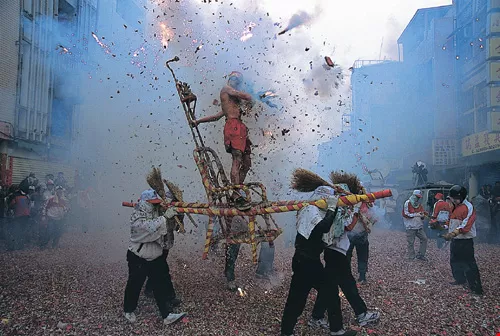
Experienced Handans say it's lonely up there, as you can't see or hear what's going on, and only your faith in the god Handan will get you through
Handan the brave and wise
On his head he wears a red scarf and a gold headband with characters reading "Handan." He has protective eyewear on, and symbols of the Taoist Heavenly Masters hang from his body. He has earplugs in his ears, and his nose and mouth are covered with a wet yellow cloth. Shirtless, he wears only a pair of red shorts. He holds a banyan tree branch in his right hand. Standing majestically in his rattan palanquin, he is Handan incarnate.
His palanquin carried by four men, he looks like a mighty god. He won't be worried about the pain when they throw the firecrackers at him. His biggest concern will be trying to breathe with the thick smoke enveloping him. The wet towel over his nose and mouth is to filter the air and keep him from choking.
Multiple Handans incarnate take turns on the palanquin, enduring by sheer willpower. The longer they can hold out, the more brave and strong they are said to be and the more applause they get when they come down from the palanquin<.
One experienced Handan recalls the feeling of being blasted with firecrackers as a lonely one, as he couldn't see or hear what was going on around him, only persevering through faith in Handan. Another jokes, "Holding out for three minutes hurts, and holding out for ten does too, so you might as well harden yourself and keep it up for a while for appearances."
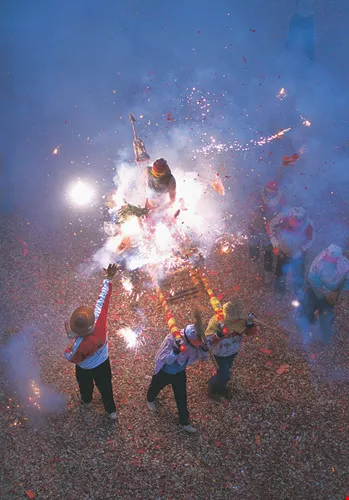
Experienced Handans say it's lonely up there, as you can't see or hear what's going on, and only your faith in the god Handan will get you through
Pain brings redemption
Most of these Handans were recruited by Taitung's Hsuanwu Temple, which also provided the firecrackers. A system of management has developed to keep the festival alive.
Temple head Li Chien-chih says that in the past the firecrackers were brought by members of the business community who were invited to attend. Those setting them off, however, were inexperienced, and the firecrackers were of all different sizes. The explosions often got out of control, and there were many accidents. Also, many businesses, thinking the more firecrackers the more prosperous they'd be, would set off NT$5-600,000 worth at a time by the sides of their shops. The huge detonations were like bombs going off. Due to these factors, the entire event is now managed by Hsuanwu Temple, including employing experienced hands to set off the fireworks.
With experience comes knowledge of how to factor in the wind and safely throw the firecrackers. Also important, now that tourism brings crowds to Taitung for the Handan festival, is the aesthetics of the explosions. Throwers learn to throw them to explode just so in the air, making an impressive sight.
In the past, most of the Handans who took to the palanquins were heavily tattooed in gangster style, giving Handan the nickname "the hoodlum god." Such characters gritting their teeth and bearing the pain gave off a strong image of penance.
After becoming a tourist attraction, the Blasting Handan festival is still a Taitung tradition, but it is different from religious events such as the Mazu Festival and the Ship-Burning Festival in that it does not stress divine protection-participants get by on pure willpower and bravery. Stepping up onto the palanquin means stepping out of social norms. Whether a participant wishes to pray to Handan or just train his own endurance is up to him. There are no age limits, either-Li says the temple has Handans from age 15 to age 50.
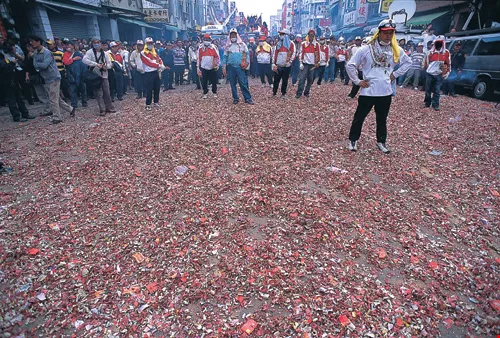
The ground is covered in the remains of firecrackers, but it's not over yet. Those setting them off are merely waiting for the next Handan to take his turn.
More fire, more luck
A 30-year-old jewelry shop called Chinyeh on Taitung's Kuangming Road has participated in the festival for the last five or six years, inviting Handan to their storefront to be blasted with firecrackers. This year, they purchased NT$600,000 worth of firecrackers in the hopes of improving business. They plan to commence firing two days before the Lantern Festival at three in the afternoon.
Around noon, shops on Kuangming Road begin setting out offerings of flowers, fruit, and candles on tables out front. Employees of Chinyeh are all smiles as they look forward to the afternoon festivities. As the start draws near, the police close off the street to traffic, and pedestrians, tourists from all over, swarm in. Look up and you'll notice that the rooftops are covered with spectators too. Some have even climbed big trees nearby to get a good view.
When the sound of gongs announces the arrival of the Hsuanwu Temple's Handan procession, the excitement begins. The businesses finish up their worshiping, and the incarnate Handans down bottles of an alcoholic herbal energy drink in attempts to ready themselves. They also spray their bodies with an antiseptic provided by the temple. They take to the palanquins, which are then lifted by four strong men. A man in front with a glowstick directs them to proceed in a circle. Just seconds later, the scene erupts in explosions on all sides, and choking smoke fills the air. Amidst the noise and smoke, the incarnate Handans are lost, with only their banyan branches visible, swinging through the haze.
Banyan leaves are traditionally said to ward off evil, but here the branch is used by the Handans to block firecrackers, protect their eyes, and wave the smoke from their faces so they can breathe. And if a speechless Handan can take no more, he merely needs to wave a few circles over his head and his time is up. The next takes his turn, and so it continues until there are no more firecrackers.
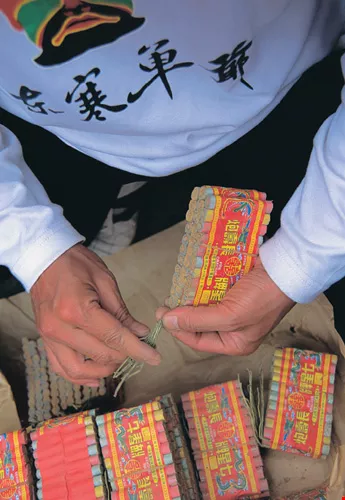
In the past, when businesses ran the festival, it was largely unregulated. Now the Hsuanwu Temple makes sure things go smoothly.
Glory and tears
Businesses usually give a red envelope of cash to the Handans when they come down from the palanquin as a token of gratitude, and Chinyeh hands out specially made gold medals every year.
A close look at the shirtless Handans after the ordeal reveals that not only are they shaking, but their chests are covered with welts and long, bloody scrapes. It's not a pretty sight. Occasionally, a fearless teenager steps up to be a Handan. When the parents hear about it and rush to the scene, only to see their baby enveloped in smoke and explosions, it's hard for them to take. Fathers are seen with heads lowered, trying to wipe away tears without being seen, while mothers just lose control. Such parents are the saddest part of the spectacle.
Due to the heavy volume of firecrackers this year, and the fact that most of the Handans are first-timers in their teens to mid-twenties, they can only take so much. "One from last year could beat three from this year," a Chinyeh employee says. This year the Handans invited by Chinyeh just turn a few circles and come down. The goldsmith can't keep up to make enough medals for them all. The shop staff keep crying out, "That's it?"
When it's all over, the shop has given out 11 medals. The last participant, "Hsiao Hua," is the star attraction. He's taken part in the festival several times before and performed like a hero. Because no one will take turns after him, he has to endure the explosions till the end of the ceremony.
With a fierce look in his eye, he takes to the palanquin. No matter how rough it gets, he never drops his banyan branch. During the explosions, he receives wild applause befitting a hero.
As soon as Hsiao Hua comes down, he is mobbed by workers from Hsuanwu Temple. They spray him down with antiseptic to keep his cuts from becoming infected. A spectator gives a thumbs-up sign, saying, "Now that's how it's done!"
Hsiao Hua collects his medal, and his girlfriend, who looks like nothing has even happened, lights him a cigarette to help him relax. She says the first time Hsiao Hua took part in the festival she cried her eyes out, but after so many years, she's used to it.
When asked why he didn't signal with the banyan branch to stop, he smiles and says, "I gotta look cool! It looks better that way!" Then he says more seriously, if you can't take it you shouldn't bother going up in the first place, and once you are up there, you've got to show some "spirit." It's tough talk from a guy who wants to give face to the "brothers" he came with.
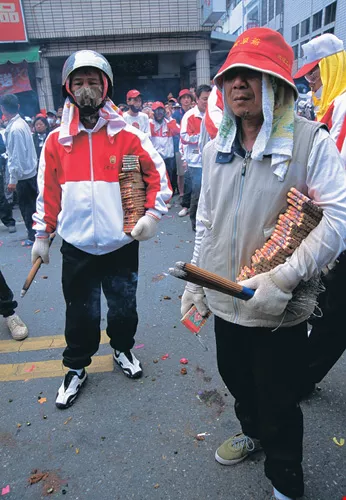
In the past, when businesses ran the festival, it was largely unregulated. Now the Hsuanwu Temple makes sure things go smoothly.
Naruwan's challenge
In contrast with Handan festivals of the past, which were scattered throughout the city, this year's event takes place in ten to 20 sites organized into a circuit. Businesses along the way request a visit from Handan in hopes for a prosperous year.
This year, the most special participant is the Naruwan Hotel, which has invited Handan for the first time. The Naruwan, which opened around five years ago, is Taitung City's only five-star hotel. Its aboriginal decor and easy South Pacific style have made it a hit with tourists.
The Naruwan's invitation was different from the others in that it issued a challenge through the Hsuanwu Temple, seeking anyone who thought they could withstand NT$300,000 worth of firecrackers. On the same day, it enlisted 50 or 60 people to set the firecrackers off. The Naruwan hoped to use the Blasting Handan festival to put Taitung on the tourist map.
The official Blasting Handan festival takes place on the night of the Lantern Festival, in Nanjing Square. In the midst of the flash and bang and smoke is a spectacle full of local culture. The big event this year is Taitung mayor Lai Kun-cheng's turn as Handan. It's the first time a public official has stepped into the fray. Those manning the firecrackers are merciful, and the scene is played up for entertainment with continuous detonations that don't actually hit him. When Lai comes down, he gasps for air and says it was like being on the moon. He jokes that he was screaming "No more!" the entire time, but nobody heard it. He then suggests that all future mayors of Taitung take a turn at being blasted.
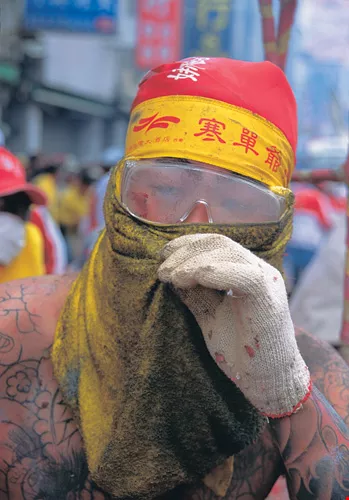
The thing the Handans fear the most is the suffocating smoke. A wet cloth over the nose and mouth allows them to breathe.
Crackdown
Though the festival is a tradition, it has changed greatly. Wang Cheng-fu, a researcher of local history, says that in the early days participants were all mobsters who usually preyed on the people. Though everybody liked to watch, they didn't think of the event as respectable. The businesses sponsoring it were not upstanding firms but shady bars and teahouses.
In 1983, the government tried to stamp out what they saw as a threat to public order, and the police chief banned the event. Those who ignored the ban were prosecuted under anti-hooliganism laws, and the festival ground to a halt.
Then in 1985 came a nationwide crackdown on gangsters, forcing the Handans even further underground. It wasn't until 1989 with negotiation by some representatives of the county government and promises of gangsters not to cause trouble that the event made a comeback.
Now Taitung's Blasting Handan Festival ranks in fame with the sky lanterns in Taipei County's Pinghsi and Yanshui's fireworks in the south. Bringing Lantern Festival excitement to a peak, this festival of blood and courage has become an important New Year season event for all Taiwan, and a source of pride for Taitung.
Tradition has it that Handan was a military official of the Shang Dynasty by the name of Zhao Gongming. He is represented as having a black face and thick hair, and wearing battle gear. In one hand he carries a whip, and in the other gold. A black tiger crouches at his feet. In Fengshen Yanyi, a book describing Chinese gods, it is said he was a brave general and also a savvy businessman, so he is called the "Martial God of Wealth." This is in contrast with the "Literary Gods of Wealth," Bi Gan and Lord Tao Zhu.
In the early days of Taitung's Lantern Festival, Handan was just another god in the procession. There were no temples involved and everything was managed by the mobsters. Later he came to stand out and a statue was built for him.
Nowadays, he is part of the Lunar New Year celebrations, and those looking to expand their fortunes offer fruit and other items to Handan on the day of Lantern Festival. Taitung's Blasting Handan ceremony is the best known celebration of this god of wealth.
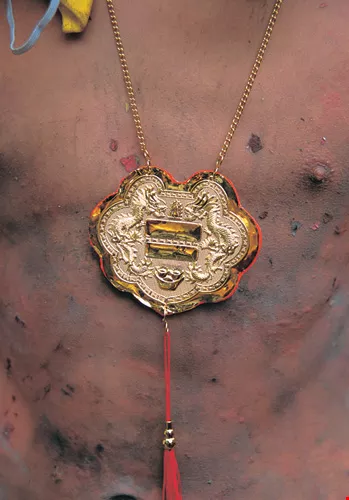
Etiquette had it that a business should give a Handan a red envelope containing the same amount as it spent on firecrackers, but now they give as they like-and some give gold medals.
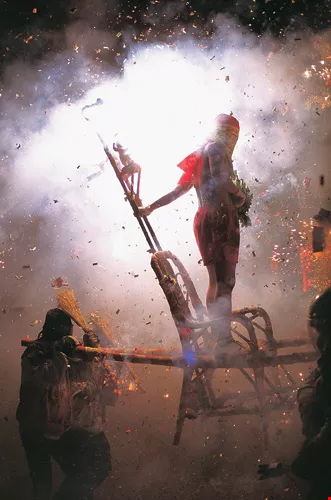
The 22-centimeter Handan statue tied to the palanquin is a point for the incarnate Handans to focus on during the blasting to take their minds off the pain.
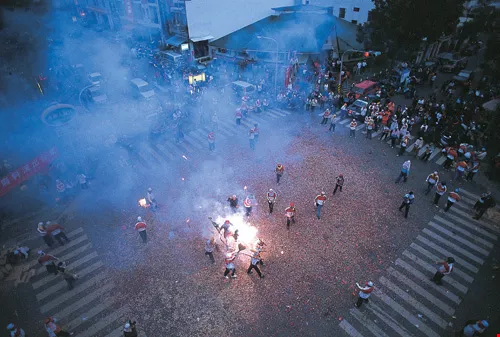
Nowadays it's a real festival, costing NT$100,000-500,000 to put on. The locals say the more firecrackers are lit at the festival, the more prosperous the new year will be.
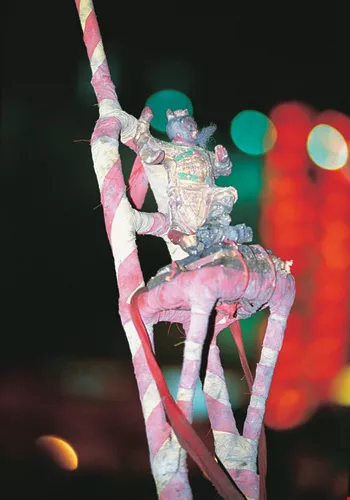
The 22-centimeter Handan statue tied to the palanquin is a point for the incarnate Handans to focus on during the blasting to take their minds off the pain.

@List.jpg?w=522&h=410&mode=crop&format=webp&quality=80)


