A Hakka Community Transformed-Kungkuan Rural Township
Chang Chiung-fang / photos Hsueh Chi-kuang / tr. by Phil Newell
July 2002


In recent years, as well as working to develop the economy, many caring people in Taiwan have come to attach importance to community regeneration, and in the process of exercising "good-neighborly concern," have brought a more individual and cultured aspect to previously drab communities. If we look more closely at the success stories among efforts toward community regeneration, we see that they all involve felicitous combinations of the three factors of "individual contributions," "unique characteristics," and "effective strategies," through which some communities have been able to create an attractive sense of warmth.
To give readers inside and outside Taiwan an insight into the current situation and the strategies being adopted in community regeneration in the ROC, Sinorama is collaborating with the Council of Cultural Affairs to produce a series of reports introducing distinctive communities in northern Taiwan, which we hope readers will find informative and enjoyable.
In late spring and early sum-mer the mountains in northern Taiwan are covered in a sea of snow-white tung tree blossoms. This "May snow" has become a new symbol for the Hakka people of northern Taiwan, who in the past largely resided in the mountains.
At the end of April, the opening ceremony was held in Peiho Village in Kungkuan Rural Township for a series of "Tung Blossom Events" sponsored by the Hakka Affairs Commission and the Miaoli and Hsinchu county governments. The ceremony, based on the Hakka "nine offerings" tradition, was directed to the deities of the mountains, earth, and heavens, in a spirit of respect for nature and gratitude for nature's bounty.
With an area of 71 square kilometers and a population of about 34,000, Kungkuan is an old-fashioned rural Hakka community. These days, with both traditional industry and agriculture declining, it is facing a transition. What can Kungkuan, which was formerly a center of ceramics production in Taiwan, do to reverse its fortunes? Can agriculture be revived? Community activists will play an important role in answering these questions.
The tung blossoms show their beauty / The mountains put on their best face / The earth dons its snow-white overcoat / Journey, and listen to the whispers that float and tumble in the breeze / Bathe in the fragrance of a primeval forest / Witness the fortuitous encounter of Hakka people and tung blossoms.
This poem introduces a brochure for the Tung Blossom Events. These Hakka activities, which included theater, concerts and banquets, were held in April and May, allowing people who were traveling to admire the "May snow" to also get an understanding of community development in Hakka villages in the last few years. Of these Hakka communities, Kungkuan Rural Township in Miaoli County is one of the best-known, thanks to its being the location for the early film Origins and the more recent Public Television program Cold Night. It is one of the most important Hakka bastions alongside Peipu in Hsinchu County and Meinung and Liukuei in Kaohsiung County.
Kungkuan is located in the southeast quarter of Miaoli County, between the Pachiaotung Mountains and the Houlung River. To the north it borders Touwu Rural Township, to the south it connects with Tahu Rural Township, to the east it faces Tungluo across the river, and to the west its neighbor is Shihtan Rural Township. Early on Kungkuan was known as Ailiaohsia or Ailiaochiao (meaning "below the gap" or "at the foot of the gap"). The local government administration was set up here under Japanese rule, from whence comes the name Kungkuan, which means (roughly) "city hall."
There are 19 villages within the rural township, all basically agricultural communities. The best-known local products include salted preserved greens like phot tshoi and meigancai, dried persimmons, jujube, fermented bean-curd, and silk goods.
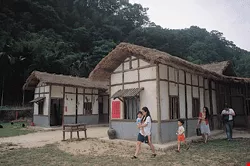
Local settings used for filming Cold Night for Public Television have become tourist attractions. From the house and its surroundings you can get a feel for the lifestyle and hardships faced by early Hakka immigrants to Taiwan.
If you take the Miaoli exit off of the freeway in the direction of Kungkuan, the first structure to capture your attention when you hit the streets of Kungkuan is sure to be the "Little Big Egg." This is a domed stadium, a smaller version of the more famous "Big Egg" in Taoyuan County. The Little Big Egg, which from the outside suggests a Napoleonic hat, was completed less than a year ago. Construction ran to more than NT$1 billion, and because the facility is completely enclosed, costs for air conditioning and lighting are astonishing. Yet the structure is rarely used, and locals joke that it is just there to help raise mosquitoes. Chan Yun-hsi, deputy director of the Miaoli New Homeland Association, describes this as "poor folk pretending to wealth," and says the whole scheme has turned out to be a disaster.
In fact, scenic Kungkuan is by no means a poor and backward place. It once had Taiwan's only oil well, and its ceramics industry became famous throughout Taiwan by building on the local coal resources and high-quality clay. Kungkuan is the setting for the famous Cold Night Trilogy, written by the Hakka author Li Chiao about 19th-century Hakka pioneers. But in recent years traditional industry has left Kungkuan, and the town has gone into decline. Consequently, under the impetus of the recent wave of interest in community regeneration, many people in Kungkuan are throwing themselves into community work, hoping to give Kungkuan a new lease on life.
Miaoli New Homeland Association executive director Hsu Chin-jung, a retired middle school teacher, ran for Miaoli County chief executive as the nominee of the Democratic Progressive Party four years ago. Though he lost the election, he has not lost his enthusiasm for serving the people of his district. He says that he had to come up the hard way himself, and has a deep attachment to the soil; today, with no worries in life, he wants to give something back to his hometown. Thus he has consistently been on the front lines of historical preservation and environmental protection. "The sun is setting and the journey is long, so inevitably there is a sense of urgency," he says.
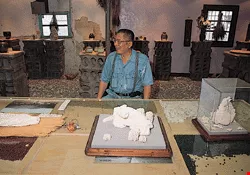
Lin Chung-hsin, director of the Kungkuan Kiln Ceramics Garden, is determined to "play with clay until the end of his days." He is hoping to transform Kungkuan's cermamics manufacturing tradition into something that will be of greater cultural and recreational interest to tourists.
However, if you are looking for the cutting edge of environmental protection in Kungkuan, you have to go to the "environmental model community" of Takeng.
Thanks to its beautiful natural setting and the cooperative efforts of the local residents, Takeng has year after year been named by the Environmental Protection Administration as one of the "ten environmental model communities" in Taiwan. Among those most influential in this effort have been Yang Tung-jung and his son, who have sequentially served as village mayor for more than two decades.
The most valuable asset of Takeng is the forest walking trail, which still retains its primitive appearance. Along the trail makino bamboo, acacia, keyaki, camphor, and other trees grow in abundance. This is an ideal place for local residents to stroll, do sports, or just relax.
In order to maintain its natural environmental inheritance, the Takeng Community Development Association has brought together 10 or 20 volunteers who each day patrol the community to keep it clean.
In this type of environment, it's no surprise that the local residents live happily and live long. Yang Tung-jung says that Takeng, with 300 or so households and 1600-plus residents, is nicknamed "Longevity-ville" because it boasts the longest life expectancy of any village in Kungkuan Rural Township. Yang laughs as he says, "Every year at Lunar New Year when we give out 'red envelopes' [containing cash gifts] to everyone over 80, we end up giving out 50 or 60 at a time!"
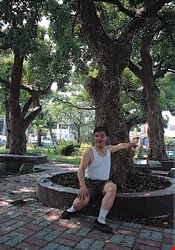
Old Peng's efforts to save old trees have become legendary around Kungkuan.
The biggest problem facing Kungkuan today is the departure of its industries for greener pastures.
The clay in Miaoli, which is of good quality and resistant to high temperatures, once brought considerable economic benefits. Ceramics was originally one of the most important industries in Kungkuan, and at the peak there were more than 400 factories in operation in the rural township, with all of the ceramics (basically household goods) being exported. But as manpower came into short supply and wages rose, the ceramics industry began to wither.
The Kungkuan Kiln, founded in 1936, testifies to the history of ceramics in Kungkuan. The third-generation heir, Jet Lin, has decided to create new opportunities. "After more than 30 years of doing this, today I am down to five or six employees, and can't carry on. But I am determined to play with clay to my last breath." Lin has brought ceramics-making together with tours of traditional houses in his neighborhood. Visitors not only get to admire the historic sites and the works of modern Miaoli ceramics artists which are on display in his family home (a grade three historic site), but also to get their hands dirty and engage in a little pottery DIY.
Jet Lin says: "Kungkuan is a ceramics township, and now we are going to have some fun with it to keep the tradition alive."
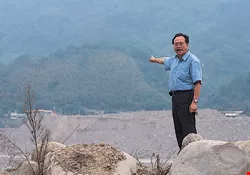
Hsu Chin-jung, executive director of the Miaoli New Homeland Association, has been trying hard to do something about the excessive scooping of gravel off the bed of the Houlung River.
The decline of agriculture is also striking a blow to Kungkuan Rural Township. But the people of Kungkuan do not quit easily. Although their rice fields are disappearing, the only jujube grove in all of Taiwan still stands as gloriously as ever, while the sight of glistening green yam leaves rustling in the wind has become a new visual symbol for Kungkuan.
In addition, a group of go-getters is helping Kungkuan experience a new wave of recreational farms.
"The beautiful fields that we are creating are suitable for families, residence, or business," says Lai Yuan-sheng, founder and now chairman of the Kungkuan Tourist Industry and Culture Association. Lai emphasizes that it is critical to understand the importance of creative added value. "Who says farmers can only plant rice paddies? Who says that rural life has to be hard and exhausting?"
Lai takes his own Joyful Land Spice Farm as a case in point. He explains that about a decade ago an effort began to encourage organic farming in Miaoli. But because organic crops are vulnerable to insects, losses have piled up over the last ten years. So he turned to planting spices, which originally were supposed to protect the crops against insects. Two years ago he followed up by opening a spice restaurant, which caught the recent natural foods and natural spice trends and became an instant hit.
Lai has great expectations and a vision for the future of "cultur-ization of commerce, commercialization of culture." At the current juncture Lai is bringing together 11 different businesses, including firms selling ceramics and leicha (traditional Hakka ground tea), growers of strawberries, water lilies, and sunflowers, a coffee shop, and his own spice farm to engage in collective marketing. He plans to decorate the irrigation ditches that wind around the village in blue (lavender), yellow (sunflowers), pink (water lilies), and green (strawberry plants), to embellish the watercourses in the fields in vibrant colors.
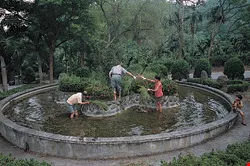
The Takeng neighborhood, named as one of the ten environmental model communities in Taiwan, is Kungkuan's "pure land." Volunteers from the community go out on rounds each night to keep the enironment pristine.
Besides working to inject new life into old businesses, people in Kungkuan Rural Township are also dedicating themselves to preserving traditional culture. The most moving of their stories involve efforts to save a local temple and protect old trees.
Although ultimately the effort to protect the nearly 100-year-old Wukukung Temple failed, it drew local citizens' attention to historical sites. The effort was led by Peng Yu-ming, whose grandfather once served as the caretaker at the Wukukung Temple, and who is now the head of the Miaoli Formosa Wilderness Association.
Peng had special feelings for the temple, but also its surroundings. In the summer of 1990, an old banyan tree next to the temple, which was already 80 years old, fell ill. Its leaves fell off, leaving only a dying trunk. Peng began a wholly volunteer movement to preserve old trees. He disinfected the area, changed the soil, put on an IV drip, and installed automatic temperature and moisture monitors. Eventually the old withered branches again sprouted supple new buds.
Sadly, the whole affair ended tragically when someone threw acid on the old tree. But Peng did not give up hope. The movement to protect old trees spread like wildfire, and there have subsequently been efforts to rescue an old bishopwood tree in front of the Kungkuan Primary School, a tree at the Hsihu Primary School, a grove at the Kungkuan Agricultural Improvement Station, and an old camphor tree in Kung-kuan's Yuhsin Park, as well as to transplant an old banyan tree from Chungyi Village. Peng has given his all in every case.
Old Peng, who came to realize the true meaning of life after recovering from a serious illness, says that fame and fortune are fleeting, and that life only has real meaning if you do something for your descendants and leave a little something for your hometown.
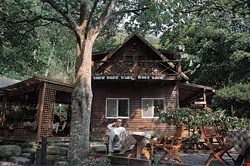
The Tung Blossom House, located in the woods near Futeh Village, is famous far and wide. What a pleasure it is to enjoy a fine coffee and take in the scenery from beneath the tung oil tree.
The Stone Wall Foundation, founded by Chang Chiu-tai, principal at the Kuokuang Primary School, specializes in sponsoring educational and cultural activities. Chang says that music can improve the general cultural level, and cites as examples the recently staged concerts by Hakka singer Chen Yung-tao and the Woodpeckers, which attracted hundreds of local residents. In the orderly and attentive atmosphere of the concert, uninterrupted by shouting or blustering, Chang Chiu-tai could see the future and hope of Kungkuan Rural Township.
Have you ever been to Kungkuan? Have you ever drunk coffee beneath the tung tree at the Tung Blossom House? Have you ever had dinner at the Joyful Land Spice Farm, in an ambience reminiscent of a Provencal restaurant? Have you ever visited the genuine places that provided the settings for Cold Night? Have you discovered what makes Kungkuan so special? In fact, there is much more happening than just superficial change. With the sowing of seeds and their cultivation by community activists, some things have already begun to grow out of the soil. Let us look forward to the day when they bloom, grow, and flourish.

If community work is successful, and children can grow up in a superior environment passed along from generation to generation, Taiwan will certainly find a path for itself.

@List.jpg?w=522&h=410&mode=crop&format=webp&quality=80)


@List.jpg?w=522&h=410&mode=crop&format=webp&quality=80)
@List.jpg?w=522&h=410&mode=crop&format=webp&quality=80)
