Tanshui: An Inspiration to Poets, Artists, and Romantics
Lin I-hsien / photos Diago Chiu / tr. by Phil Newell
January 2001


In paintings, a white cloud layer swirls over Mt. Kuanyin; waves on the river drift like a breeze; a red sun dances on golden water; a yellow moon sings from a deep purple sky. . . . The Tanshui of illustrations is a place of unblemished beauty, a myth that remains unshakeable.
In the 300-plus years since its founding, this port town-formerly called Huwei, now Tanshui Township-has seen days of prosperity and has also been through a baptism of fire. What makes it special among the 309 urban and rural townships of Taiwan? How do the people of Tanshui live today? How do they recall the past? And how do they see the future?
"You want to know how Tanshui has changed? I would say that the biggest change is that the old streets are gone." So declares Tu Hsiu-yuan, proprietor of the Hui Yuan Pharmacy, and also director of the Huwei Cultural and Historical Workshop. His pharmacy is located on what is now called Chungcheng Road, one of the oldest streets, which Tanshui natives still call Huwei Street.
Tu, who has lived his whole life in the old neighborhood, has watched from his doorstep as old shops have refurbished themselves in modern style, and modern shops have adopted the look of the old. For the convenience of cars, the streets have been widened repeatedly. In 1988, the last train on the old Tanshui Line of the railroad chugged into history, taking that old slower pace of life with it. In 1997 the Tanshui Line of the mass rapid transit system opened, bringing floods of visitors to the town. Yet, while these tourists bring a human touch to the streets on weekends and holidays, on ordinary weekdays the silence is accompanied only by leftover garbage, empty shops, and those Huwei people who refuse to leave their old homes.
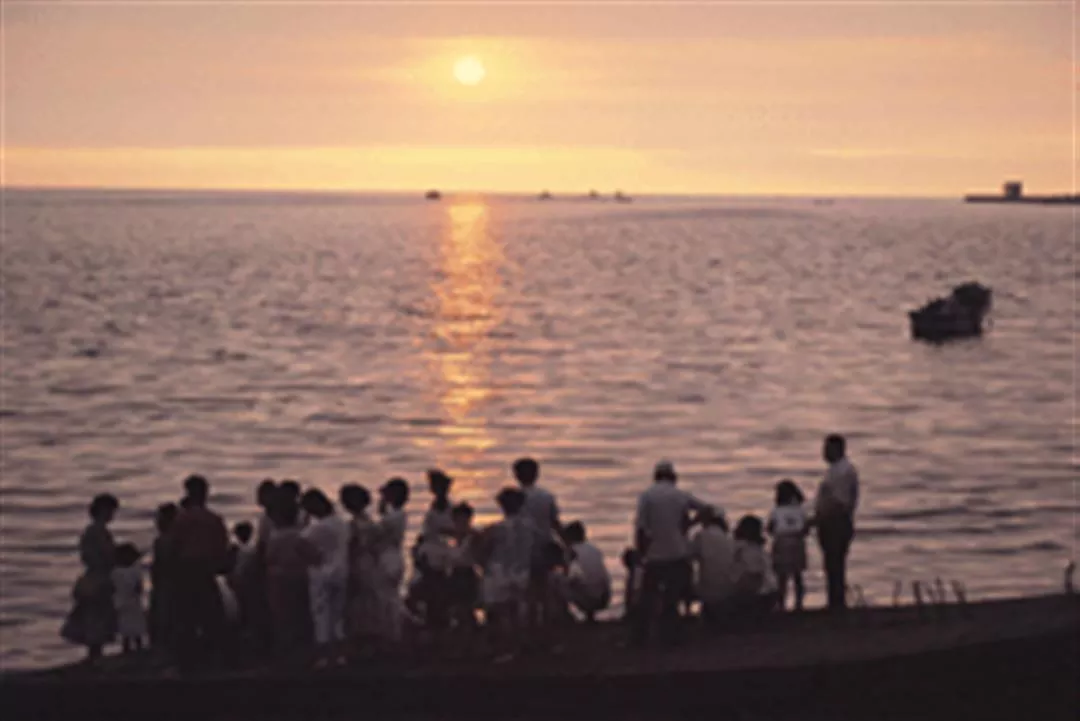
As the lazy sun displays an extraordinary beauty, a fishing boat drifts toward shore over the golden water.
The golden age of Huwei
There are different explanations as to the origins of the word Huwei, the original name for Tanshui. Some say it was a transliteration of the place name used by the indigenous people. But others say it comes from a long-gone fishing practice, using a shi hu ("stone pool"). Early fishermen used stones to carve a long, narrow catchment (the so-called "pool") in the sand, waiting for the tide to carry in fish which they could then easily scoop up. Since the place now known as Tanshui was at the tail end (wei) of this stone pool, it came to be called Huwei.
Tanshui occupied an important place in the transport network connecting Taiwan to Southeast Asia. Even before the arrival of Westerners in Taiwan, Han Chinese often crossed over from China to Tanshui, which is relatively close to the mainland. Here they engaged in barter trade with the Pingpu (meaning "plains") aborigines, with deer skins and sulphur being the most coveted products. As Western powers turned their eyes to Asia, Tanshui became strategically important. In the 17th century, first the Spanish, and then the Dutch, built forts here as symbols of their claims to territorial control. In the mid-17th century, China took control of Taiwan, and closed Tanshui to international trade. Later, as a result of the Sino-French war of 1884, Tanshui was again opened up to Western access.
During Tanshui's golden age, large and small boats were constantly coming and going in the harbor, and it was not unusual to see enormous steamships. In the latter part of the Qing dynasty, Tanshui was the largest port in Taiwan, and was the "customs headquarters," also charged with overseeing port activities at Keelung, Tainan, and Kaohsiung. However, during the Japanese occupation, as a result of silting, and because the Japanese invested a huge effort in developing the port at Keelung, Tanshui faded in importance, never again to see the likes of its glory days.
Tanshui is a place of many historic sites, a place that invites reflection on things past. In the "foreign district," a missionary named George Mackay established the first hospital for Western medicine in Taiwan; it was here that in 1878 the first case of paragonimiasis in the world was diagnosed. The old church next to the hospital is a mecca for Tanshui painters. The schools, homes, and consulates in the foreign district-some long gone, some still standing-testify to the fact that this was a place of intensive interaction between Chinese and Western cultures.
If you go up Sanmin Street, you will discover the head of an old and disused water pipe. This could be a relic left behind by one of the major Japanese infrastructure projects, the first tap water station. Or you could walk instead next to the MRT station and see another first for Taiwan: the first seaplane landing area, also built in the Japanese occupation era. Or you could visit the venerable Tamkang Secondary School. As you watch the children laughing and arguing and playing, you can think back to the time when the Japanese government did not allow Taiwanese and Japanese to attend school together. Under those circumstances, Tamkang Middle School became a cradle for the training of Taiwanese elites.
Gradually you will discover that Tanshui is a bookish place. This little town has everything from nursery schools to graduate schools. During the reign of the Guangxu emperor of the Qing dynasty (which began in 1875), and prior to the beginning of the Japanese occupation in 1895, Tanshui produced two successful candidates in the highest level military exam, one in the highest level civil exam, and countless successes in lower-level imperial exams. Even in modern times, the town has not passed up chances to embrace knowledge: When the idea of founding Tam-kang University in Tanshui was going to be abandoned because of a lack of land and money, local residents offered cheap land, donated money, and lobbied so that the university could set its roots in town.
These historic sites are near the river, but don't spend all your time there. Don't forget the Tatun Mountains, which shelter the town. In the old days, Tanshui folk who cultivated farms on the slopes had to walk for an hour to get to their crops. These days you can take a local mini-bus. In the mountains you will see the occasional terraced field grown over with weeds. This land, which has gone from grass to grain and back to grass again, is where many an old Tanshui native played when they were children.
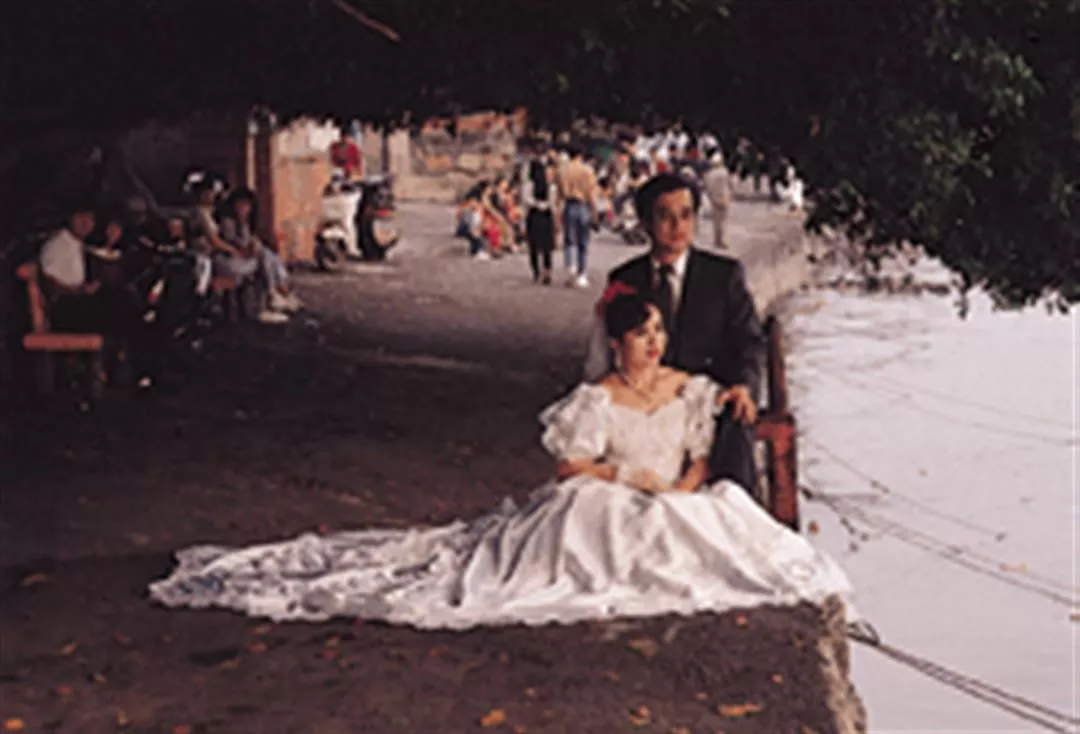
(facing page) These lovers may be gazing at Tanshui with their eyes, but their hearts have eyes only for one another. Tranquil and romantic Tanshui is a great place for wedding photos.
The Tanshui mystique
The mountains are also filled with old stories. The often-renovated Hsing Chung Tang shop is more than a century old. Owner Li Yung-kun is a descendant of the eminent Li family of Tanshui, which produced three juren (a successful candidate in provincial-level exams, held every three years). The house testifies to this past: It has a swallow-tailed roof and a flagpole, features that only the home of a juren was entitled to have. Li Mingbin (whose name by birth is Li Minghui), a scholar from Beijing University currently working at Chinese Culture University on an exchange program, is a descendant of the juren Li Yingzhen, who was wounded resisting the Japanese occupation and fled to the mainland, where he settled down. Like his elders, Li Mingbin bridges the gap across the Taiwan Strait, as he is capable of conversing fluently in either Beijing dialect or the southern Fujian dialect used in Taiwan.
Of course, stories don't have to be old to be interesting. Today's Tanshui residents are living their own stories. The crotchety but modest guy who delivers the newspapers, the seafood restaurant owner who has made his fortune from scratch, the old man at the roadside food stall, the hostess in the tea house greeting and sending off guests. . . . Some are active in the early morning, some late at night. Though the founders of many of these shops have passed away, the second generation has taken the baton. In the old bamboo tea shop, the now elderly hostess still plays her role amidst the ambience of wine and tea, offering a feminine presence to help put at ease her customers who come looking for a little relaxation, evoking the bewitching atmosphere of Tanshui at night.
Businessmen from outside, smelling profits, have set up gaudy storefronts and neon signs, hoping to trade on Tanshui's mystique to sell coffee, seafood, antiques, and snack foods. Students, who have enough money to keep several streets of shops going, carelessly wheel their motorcycles through the narrow streets, their minds elsewhere, thinking of youthful fun or romance. Happy couples and jilted lovers line the river, displaying their joy or sadness in their postures: two people's shadows are melted together by the darkened river behind, while others stand alone on the riverbank like statues.
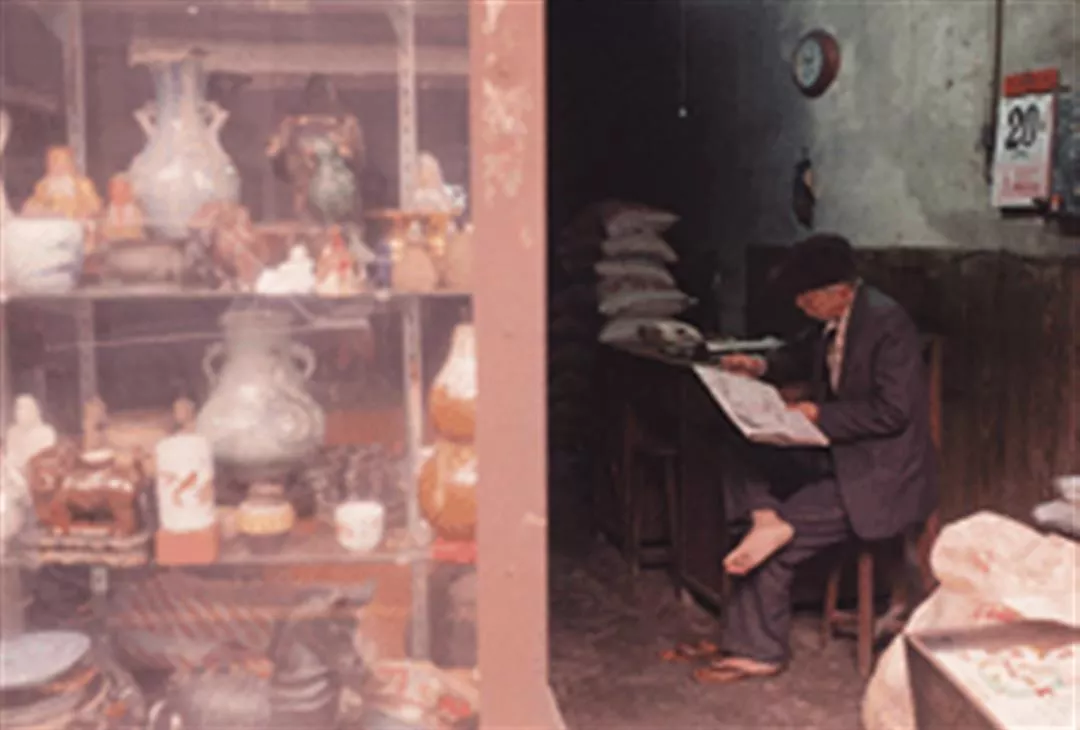
An old Tanshui resident sits with legs crossed reading the paper, as the passage of time, marked on the calendar on the wall, adds a gloss to the antiques.
The weeping river
Have you heard of the weeping junks? During the Sino-French war, Taiwan governor Liu Mingchuan, attempting to obstruct a French landing, scuttled several of these boats. It is said that, late at night, the sunken junks make moaning sounds. But I think that it may be the river itself that is moaning.
In 1998, the government produced a plan for a riverside expressway to Tanshui. The road, which was expected to have three levels, would have cut through rare mangroves and created a barrier between the river and the town of Tanshui. If the plan had been implemented, people who wanted to go to Tanshui and gaze out over the river would have had to find some very high vantage point in town to do so! Fortunately, thanks to efforts by cultural and environmental activists from Tanshui, the plan was first postponed, and then was ultimately killed after an environmental impact assessment released in September refused to approve the scheme. But a question remains: Is something like this bound to come sooner or later?
"For the purposes of development, the Tanshui coast has been constantly exploited. But what will be result of this incessant struggle against nature?" says an agitated Tu Hsiu-yuan. And Hsieh Teh-hsi of the Tamsui Culture Foundation adds: "High-rises are going up one after another in Tanshui New Town [a huge government-planned development], but many of the apartments remain empty. Everybody here knows that when the northeast winds blow in during the winter, that is the coldest place around. No wonder those apartments are not selling!" Tu says, with disbelief and exasperation in his voice: "Do you know that they are going to build a huge bridge between Tanshui and Pali? It's such a beautiful and historic location, but they are just going to stick up a bridge there, and they are even talking about having a rotating restaurant on top!"
Lovers of Tanshui, while keeping close watch over her, are fearful that the giant beast of development may eventually come and bulldoze Tanshui away one piece of land at a time. They fear that their children, like they themselves, will have to search through photographs and memories to find Tanshui's traditional simplicity and the joys of being close to nature. When the old buildings are gone, and people lose contact with the great outdoors, will Tanshui even be worthy of its reputation anymore?
Scattered wooden fishing boats bob in the river. I haven't met any of the fishermen who these days go out and catch only small fry. They might relate how in the old days they could just put a hand in the river and come up with a big catch. The lonely fishing boats are waiting for the Tanshui-Pali ferry to pass by and say hello. Those lanterns moving through the river are actually the ferry, while those stars flashing in the distance are beams of light that come from the lighthouse every five seconds.
It is only now that I realize that, even in the drabbest weather, Tanshui is still beautiful.
Taiwan's Townships
When you look at a map, what do the 309 townships of Taiwan mean to you? Do you draw a complete blank on all of them? Or do some of the names evoke beautiful memories? What do these townships have to offer visitors? What interesting or famous characters have they given birth to? In this age of the global village, how much do you know about the village next door? Sinorama wants to take you on a journey through Taiwan's 309 townships large and small: As they follow their individual rhythms, what is it that enables them to create their own music, and what can we hear in the songs they sing?
Tanshui Facts and Figures
Tanshui Township (also spelled Tamsui) is part of Taipei County. It abuts Sanchih Rural Township to the northeast, the Kuantu area of Taipei City to the southeast, and the Taiwan Strait to the northwest; to the southwest it faces Pali Rural Township over the Tanshui River. It covers an area of just over 70 square kilometers, and has a population of 115,000. It is the largest paddy-rice producing area in Taipei County. In days gone by, because the Kuroshio current passes close by, the waters offshore were rich fishing grounds. However, in recent years, pollution from the Tanshui River and exhaustion of fish stocks have caused the catch to dwindle. Among the more famous tourist sites are Fort San Domingo, Yin Shan Temple, the Lixuetang school (known in English as Oxford College, founded in 1882 to train missionaries), Huwei cannon emplacement, the mangrove conservation area, Shalun beach recreation area, the historic buildings of the Mackay Hospital and Tamkang Middle School, "Antiques Street" (Chungcheng Road), and the ferry pier. Public transportation includes inter-city bus service, the Tanshui Line of the Taipei mass rapid transit system, and local buses. For more detailed information visit http://www.tamsui.gov.tw/.


@List.jpg?w=522&h=410&mode=crop&format=webp&quality=80)


@List.jpg?w=522&h=410&mode=crop&format=webp&quality=80)
